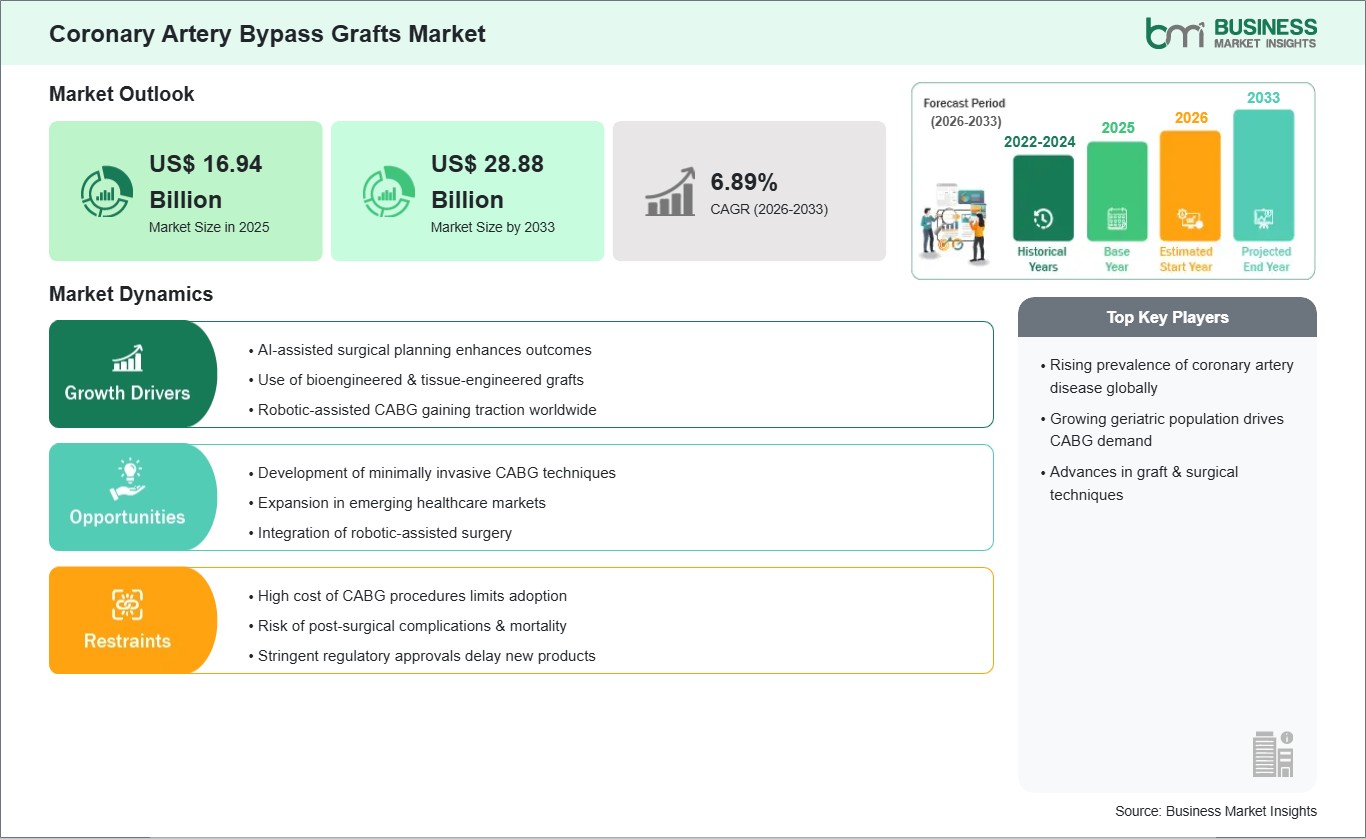
The Coronary Artery Bypass Grafts market size is expected to reach US$ 28.88 billion by 2033 from US$ 16.94 billion in 2025. The market is estimated to record a CAGR of 6.89% from 2026 to 2033.
Coronary artery bypass grafts help restore blood flow to the heart. The main types are on-pump, off-pump, and less invasive (MIDCAB) methods. For people with complicated heart disease affecting several blood vessels, these surgeries are the best choice, leading to better long-term survival and a lower chance of needing another procedure than less invasive treatments done through the skin. Market growth is driven by the increasing global prevalence of coronary artery disease, an aging population, and a higher incidence of lifestyle-related comorbidities such as diabetes. The adoption of robotic-assisted surgical systems and AI-guided intraoperative imaging is also improving procedural precision and reducing patient recovery times.
However, several challenges may limit market growth. The high costs of advanced robotic systems and specialized ICU care are still major barriers in emerging economies. Minimally invasive procedures like PCI with drug-eluting stents also continue to compete with traditional open-heart surgery. The industry also faces a technical talent gap in cardiothoracic surgery and increasingly stringent reimbursement policies that favor value-based, episode-of-care payment models.
Despite these challenges, the market offers significant opportunities, driven by the need for improved long-term cardiac outcomes and the growing adoption of hybrid revascularization strategies that combine surgical and interventional techniques. The expansion of Ambulatory Surgical Centers (ASCs) for elective cardiac procedures and the development of bio-engineered, "off-the-shelf" synthetic grafts to eliminate donor-site morbidity are expected to create significant opportunities for market growth.

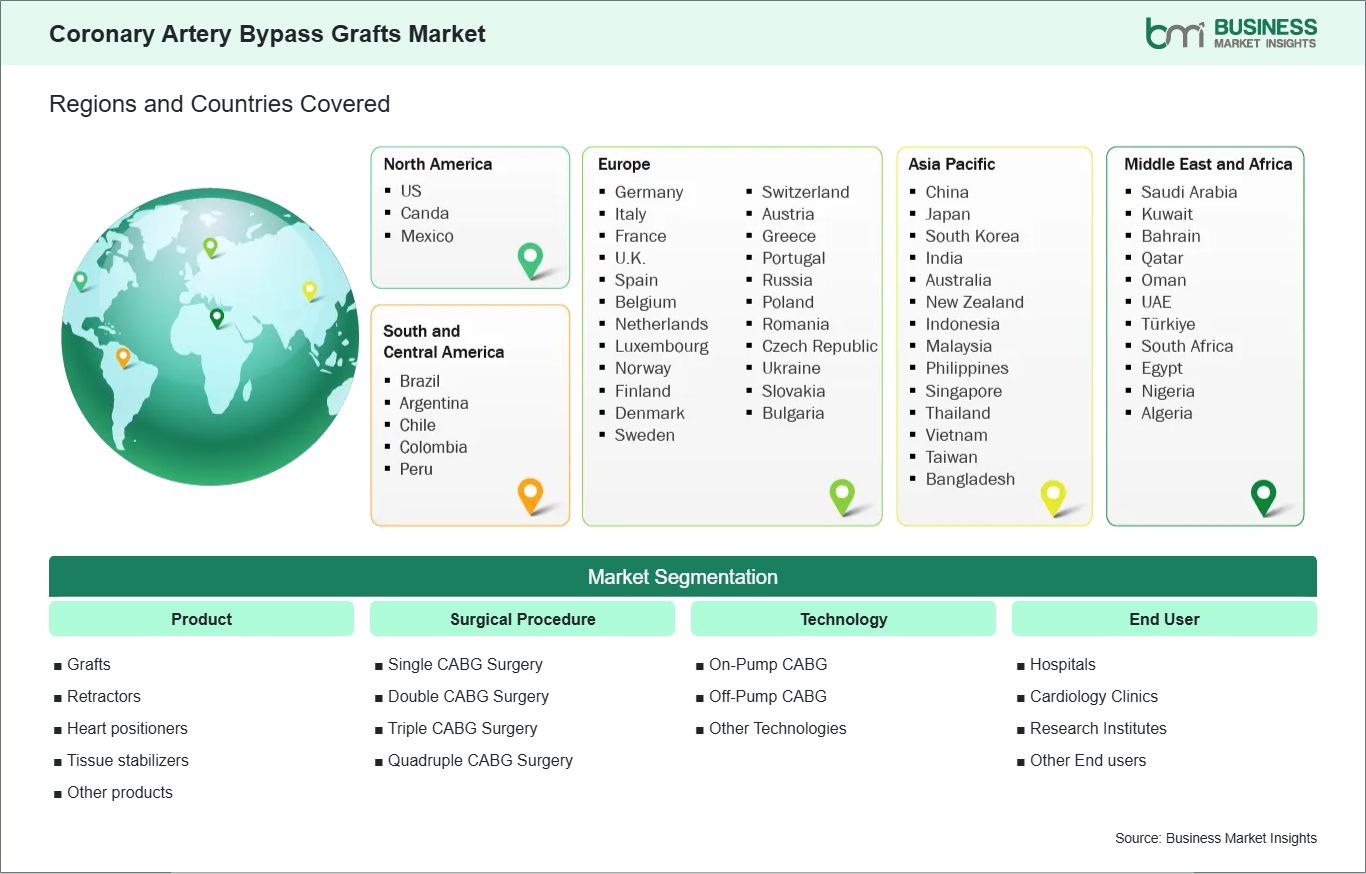
Key segments that contributed to the derivation of the Coronary Artery Bypass Grafts market analysis are product, surgical procedure, technology, and end user.
As the global geriatric population continues to grow, with the World Health Organization estimating that one in six people will be over the age of 60 by 2030, the prevalence of complex cardiovascular conditions has risen sharply. Aging significantly increases the risk of multivessel coronary blockages and progressive atherosclerosis, creating a larger patient pool requiring advanced cardiac interventions. Although interventional cardiology offers less invasive options such as percutaneous coronary intervention (PCI), coronary artery bypass grafting (CABG) remains the gold-standard treatment for individuals with diabetes, left-main disease, or severe diffuse coronary artery involvement. CABG provides superior long-term survival, better protection against restenosis, and a lower likelihood of repeat revascularization compared to PCI.
Demand for CABG is further strengthened by rapid improvements in healthcare infrastructure across emerging economies. In the Asia-Pacific region in particular, expanded health insurance coverage, government investment in tertiary cardiac care, and the development of specialized heart centers have greatly increased access to high-quality surgical treatment. These advancements are enabling broader segments of the population to receive timely and effective bypass surgery, driving sustained market growth and improving patient outcomes.
Robotic Precision and Bio-Engineered Grafts
Technological advancements are reshaping the landscape of coronary artery bypass grafting (CABG), particularly through the adoption of AI-guided robotic systems and high-resolution 3D intraoperative imaging. These innovations enable surgeons to perform bypass procedures using tiny “keyhole” incisions rather than a full sternotomy, significantly minimizing surgical trauma. The reduction in pain, blood loss, and postoperative complications translates into shorter hospital stays and quicker rehabilitation, making minimally invasive CABG an increasingly attractive option compared to traditional open-heart surgery.
Another rapidly evolving frontier is the development of next-generation tissue-engineered and synthetic grafts. Research is progressing toward acellular, “off-the-shelf” small-diameter conduits designed to replicate the function of native vessels without the need to harvest veins or arteries from the patient’s own limbs. This approach not only reduces operative time but also lowers the risk of wound infections and long-term morbidity at the donor site. Manufacturers that focus on biocompatible materials, enhanced graft durability, and streamlined surgical workflows are poised to benefit.
Additionally, companies integrating Remote Patient Monitoring (RPM) systems for post-CABG care are gaining a competitive edge, as healthcare providers increasingly value personalized, data-driven, and outcome-focused recovery pathways.

The Coronary Artery Bypass Grafts market demonstrates steady growth, with size and share analysis revealing evolving trends and competitive positioning among key players. The report further examines subsegments categorized within product, surgical procedure, technology, and end user, offering insights into their contribution to overall market performance.
For instance, the Grafts subsegment holds a significant market share, as grafts are the primary conduits used to bypass occluded arteries. Saphenous Vein Grafts remain highly utilized due to their ease of harvesting and length; however, there is a notable clinical shift toward internal thoracic artery grafts. This trend is driven by their superior long-term patency rates and better patient outcomes, which are becoming a key metric for quality-based reimbursement in Hospitals. To support these surgeries, advanced tissue stabilizers and heart positioners are essential, particularly as the industry moves toward more complex multi-vessel revascularization.
| Report Attribute | Details |
|---|---|
| Market size in 2025 | US$ 16.94 Billion |
| Market Size by 2033 | US$ 28.88 Billion |
| Global CAGR (2026 - 2033) | 6.89% |
| Historical Data | 2022-2024 |
| Forecast period | 2026-2033 |
| Segments Covered | By Product
|
|
Regions and Countries Covered
| |
| North America | US, Canada, Mexico |
| Europe | Belgium, Austria, Finland, Denmark, Greece, Poland, Romania, Russia, Ukraine, Czech Republic, Slovakia, Bulgaria, Italy, Luxembourg, Germany, Switzerland, France, Netherlands, Norway, Portugal, Spain, Sweden, United Kingdom |
| Asia-Pacific | Australia, China, India, Japan, South Korea, Indonesia, Malaysia, Philippines, Singapore, Thailand, Vietnam, Bangladesh, New Zealand, Taiwan |
| South and Central America | Brazil, Argentina, Peru, Chile, Colombia |
| Middle East and Africa | Bahrain, Kuwait, Oman, Qatar, Saudi Arabia, United Arab Emirates, Turkiye, South Africa, Egypt, Algeria, Nigeria |
| Market leaders and key company profiles |
|
The Coronary Artery Bypass Grafts Market Size and Forecast (2022–2033) report provides a detailed analysis of the market covering below areas:
The geographical scope of the Coronary Artery Bypass Grafts market report is divided into five regions: North America, Asia Pacific, Europe, Middle East & Africa, and South & Central America.
The Asia-Pacific Coronary Artery Bypass Grafts Market is segmented into China, Japan, South Korea, India, Australia, New Zealand, Indonesia, Malaysia, the Philippines, Singapore, Thailand, Vietnam, Taiwan, Bangladesh, and the Rest of Asia. The market is primarily driven by the region's vast population base and the increasing prevalence of cardiovascular diseases, such as coronary artery disease. China and India are the primary growth engines, where a growing middle class and improved access to specialized hospitals are making cardiac surgeries more accessible. Japan also contributes significantly due to its large geriatric population with a higher risk of heart-related complications.
Growth is further bolstered by the rising popularity of minimally invasive and robotic-assisted CABG procedures, which offer faster recovery times and shorter hospital stays. Additionally, the growth of medical tourism in countries like Thailand and India, where high-quality cardiac surgeries are available at a lower cost, and the adoption of advanced synthetic and bioengineered grafts solidify Asia Pacific as a critical global hub for innovation in the CABG market.

The Coronary Artery Bypass Grafts market is evaluated by gathering qualitative and quantitative data post primary and secondary research, which includes important corporate publications, association data, and databases. A few of the key developments in the Coronary Artery Bypass Grafts market are:
The Coronary Artery Bypass Grafts Market is valued at US$ 16.94 Billion in 2025, it is projected to reach US$ 28.88 Billion by 2033.
As per our report Coronary Artery Bypass Grafts Market, the market size is valued at US$ 16.94 Billion in 2025, projecting it to reach US$ 28.88 Billion by 2033. This translates to a CAGR of approximately 6.89% during the forecast period.
The Coronary Artery Bypass Grafts Market report typically cover these key segments-
The historic period, base year, and forecast period can vary slightly depending on the specific market research report. However, for the Coronary Artery Bypass Grafts Market report:
The Coronary Artery Bypass Grafts Market is populated by several key players, each contributing to its growth and innovation. Some of the major players include:
The Coronary Artery Bypass Grafts Market report is valuable for diverse stakeholders, including:
Essentially, anyone involved in or considering involvement in the Coronary Artery Bypass Grafts Market value chain can benefit from the information contained in a comprehensive market report.
Please tell us your area of interest
(Market Segments/ Regions and Countries/ Companies)