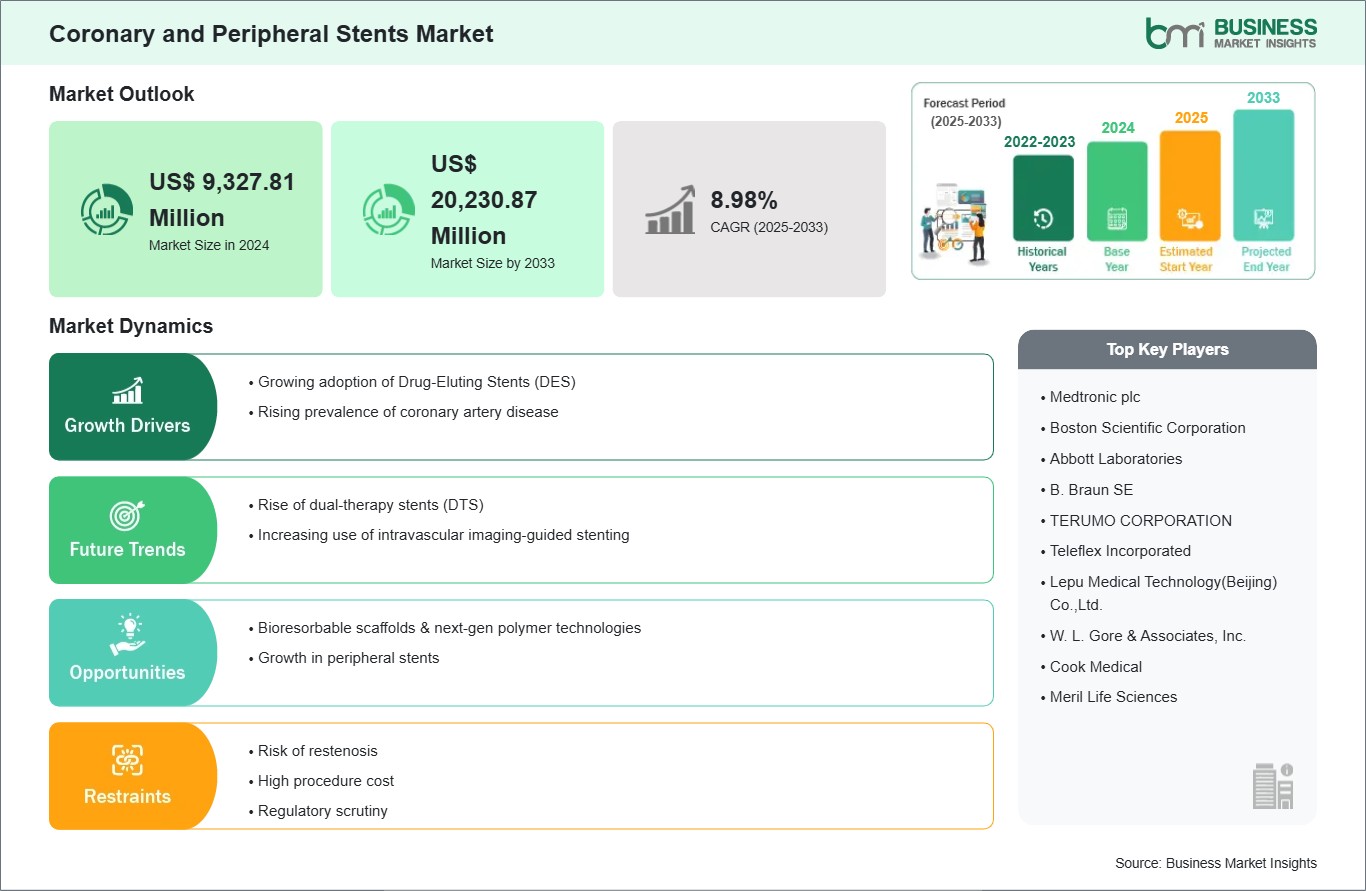
The Coronary and Peripheral Stents Market size is expected to reach US$ 20,230.87 Million by 2033 from US$ 9,327.81 Million in 2024. The market is estimated to record a CAGR of 8.98% from 2025 to 2033.
Executive Summary and Global Market Analysis:
The market for coronary and peripheral stents is heavily influenced by the increasing prevalence of cardiovascular disease, particularly as the population ages, lifestyles become increasingly sedentary, and risk factors such as diabetes and obesity continue to trend upwards. Additionally, numerous technological advances, including ultrathin designs, bioresorbable scaffolds, and dual-therapy stents, will continue to increase procedural success rates and patient long-term outcomes. Increased preference of minimally invasive intervention, along with intravascular imaging to help optimize stent placement, are also contributing to the growth.
Moreover, peripheral stents are gaining traction due to the rising incidence of peripheral artery disease, particularly in diabetic and elderly patients. Favorable reimbursement policies, ongoing clinical trials, and the introduction of dedicated stents for complex anatomies, such as bifurcations and below-the-knee lesions, are creating new growth opportunities. However, pricing pressures and regulatory challenges may limit the market expansion.
Coronary and Peripheral Stents Market Segmentation Analysis:
Key segments that contribute to the derivation of the coronary and peripheral stents market analysis are product type, material type, application, and end user.
- By product type, the coronary and peripheral stents market is segmented into bare-metal stents, drug-eluting stents, bioresorbable vascular scaffolds and others. The drug-eluting stents segment dominated the market in 2024.
- By material type, the coronary and peripheral stents market is segmented into metal, polymer and hybrid. The metal segment dominated the market in 2024.
- By application, the coronary and peripheral stents market is segmented into coronary artery disease and peripheral artery disease. The coronary artery disease segment held a larger share of the market in 2024.
- By end user, the market is segmented into hospitals, ambulatory surgical centers, cardiac catheterization labs, and specialty clinics. The hospitals segment held the largest share of the market in 2024.
Coronary and Peripheral Stents Market Drivers and Opportunities:
Growing Adoption of Drug-Eluting Stents (DES)
The growing preference for drug-eluting stents is a significant driver in the coronary and peripheral stents market. These stents possess a coating of drugs that is delivered slowly over time to prevent frequent narrowing of the artery. This has improved long-term clinical outcomes than bare-metal stents. Advancements in stent platforms, polymer coatings, and antiproliferative drugs have further enhanced safety and efficacy, making DES the preferred choice for a wide range of patient profiles. Guideline endorsements, positive long-term clinical data, and broader availability in emerging healthcare markets have further accelerated their use. The increased use of DES illustrates a shift toward technologies that reduces adverse events, increase patient satisfaction minimizes the need for repeat procedures, making DES a central element in modern interventional cardiology.
Rising Prevalence of Coronary Artery Disease
The increasing prevalence of coronary artery disease (CAD) and peripheral artery disease (PAD) is a key factor fueling growth in the stents market. These conditions occur when coronary arteries become clogged with plaque, reducing blood flow and increasing the risk of serious heart and vascular events. As populations age and lifestyles change, these diseases are becoming more common, increasing the need for effective treatments. For instance, according to the Centers for Diseases Control and Preventions (CDC), CAD is the most common type of heart disease and a leading cause of death for both men and women in the U.S. In 2022, CAD was responsible for 371,506 deaths in the U.S.
Stents are a key part of minimally invasive procedures that restore blood flow and relieve symptoms. Many patients have both coronary and peripheral issues, which increases demand for stents that work in different areas of the body. Rising awareness, earlier diagnosis, and improved access to advanced interventional procedures in both developed and developing countries has increased utilization of stent globally. These factors are expected to keep demand for stents rising in the years ahead.
Coronary and Peripheral Stents Market Size and Share Analysis
By product type, the coronary and peripheral stents market is segmented into bare-metal stents, drug-eluting stents, bioresorbable vascular scaffolds, and others. The drug-eluting stents segment dominated the market in 2024. Drug-Eluting Stents are dominant due to their ability to slowly release medication, which effectively prevents the re-narrowing of the artery (restenosis). This leads to better long-term patient outcomes compared to bare-metal stents.
By material type, the coronary and peripheral stents market is segmented into metal, polymer, and hybrid. The metal segment dominated the market in 2024. Metal stents are dominant because they offer superior mechanical strength, durability, and a low rate of fracture. Materials like cobalt-chromium allow for thinner struts, improving flexibility and biocompatibility.
By application, the coronary and peripheral stents market is segmented into coronary artery disease and peripheral artery disease. The Coronary Artery Disease segment held the largest share of the market in 2024. Coronary artery disease is the leading application as it is a major cause of death worldwide. The high prevalence of the disease, coupled with the effectiveness of stents as a primary treatment, drives its high demand.
By end user, the market is segmented into hospitals, ambulatory surgical centers, cardiac catheterization labs, and specialty clinics. The hospitals segment held the largest share of the market in 2024. Hospitals dominate as end users because stent implantation is a complex surgical procedure performed by specialized interventional cardiologists in a hospital setting. Hospitals are equipped with the necessary infrastructure for these procedures and post-operative care.
Coronary and Peripheral Stents Market Report Highlights
Coronary and Peripheral Stents Market Report Coverage and Deliverables
The "Coronary and Peripheral Stents Market Size and Forecast (2022–2033)" report provides a detailed analysis of the market covering below areas:
- Coronary and Peripheral Stents market size and forecast at global, regional, and country levels for all the key market segments covered under the scope
- Coronary and Peripheral Stents market trends, as well as market dynamics such as drivers, restraints, and key opportunities
- Coronary and Peripheral Stents market analysis covering key market trends, global and regional framework, major players, regulations, and recent market developments
- Industry landscape and competition analysis covering market concentration, heat map analysis, prominent players, and recent developments for the coronary and peripheral stents market
- Detailed company profiles, including SWOT analysis
Coronary and Peripheral Stents Market Country and Regional Insights
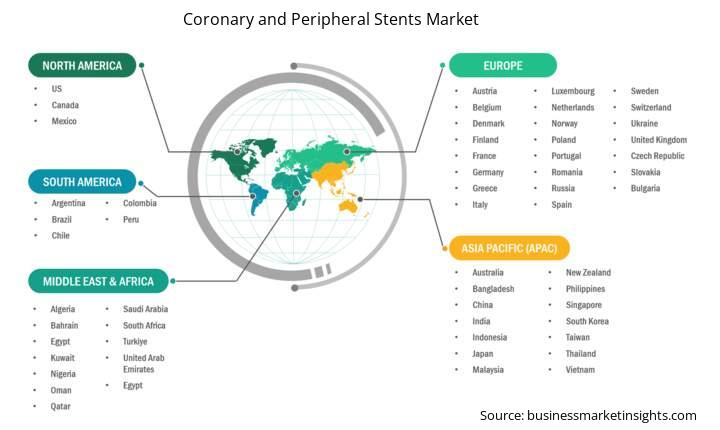
The geographical scope of the coronary and peripheral stents market report is divided into five regions: North America, Asia Pacific, Europe, Middle East & Africa, and South & Central America. The coronary and peripheral stents market in Asia Pacific is expected to grow significantly during the forecast period. The Asia Pacific coronary and peripheral stents market is segmented into China, Japan, South Korea, India, Australia, New Zealand, Indonesia, Malaysia, the Philippines, Singapore, Thailand, Vietnam, Taiwan, Bangladesh and the Rest of Asia.
North America leads the coronary and peripheral stents market. This region has an influence on the market due to its top-notch healthcare system high number of procedures, and wide use of new stent tech. Strong payment systems, quick access to new products, and large number of heart care centers support its domination. Europe stands as the second-biggest market. This region has robust regulatory frameworks, extensive physician expertise, and a growing preference for minimally invasive procedures across both public and private healthcare systems. The Asia Pacific region is the fastest growing region within the global market. The market in Asia Pacific is propelled by the rising number of heart patients, expanding health budgets, and more use of advanced stents in growing economies. Rapid urbanization, and emergence of new global and local medical devices manufacturers boost the market growth. This makes Asia Pacific a key area to grow the market in the future.
Coronary and Peripheral Stents Market Research Report Guidance
- The report includes qualitative and quantitative data in the coronary and peripheral stents market across product type, material type, application, end user, and geography.
- The report starts with the key takeaways (chapter 2), highlighting the key trends and outlook of the coronary and peripheral stents market.
- Chapter 3 includes the research methodology of the study.
- Chapter 4 further includes ecosystem analysis.
- Chapter 5 highlights the major industry dynamics in the coronary and peripheral stents market, including factors that are driving the market, prevailing deterrents, potential opportunities as well as future trends. Impact analysis of these drivers and restraints is also covered in this section.
- Chapter 6 discusses the coronary and peripheral stents market scenario, in terms of historical market revenues, and forecast till the year 2033.
- Chapters 7 to 11 cover coronary and peripheral stents market segments by product type, material type, application, end user, and geography across North America, Europe, Asia Pacific, Middle East and Africa, and South and Central America. They cover the market volume revenue forecast and factors driving the market.
- Chapter 12 describes the competitive analysis along with the heat map analysis for the key players operating in the market.
- Chapter 13 describes the industry landscape analysis. It provides detailed descriptions of business activities such as market initiatives, new developments, mergers, and joint ventures globally, along with a competitive landscape.
- Chapter 14 provides detailed profiles of the major companies operating in the coronary and peripheral stents market. Companies have been profiled on the basis of their key facts, business descriptions, products and services, financial overview, SWOT analysis, and key developments.
- Chapter 15, i.e., the appendix is inclusive of a brief overview of the company, list of abbreviations, and disclaimer.
Coronary and Peripheral Stents Market News and Key Development:
The coronary and peripheral stents market is evaluated by gathering qualitative and quantitative data post primary and secondary research, which includes important corporate publications, association data, and databases. A few of the key developments in the coronary and peripheral stents market are:
- In October 2023, Medinol, an interventional cardiovascular medical devices manufacturer, announced United States Food and Drug Administration (FDA) approval for the EluNIR-PERL™ drug-eluting stent (DES) for the treatment of coronary artery disease.
- In May 2024, Abbott, a global medical technology company, announced that they have launched its XIENCE Sierra Everolimus Eluting Coronary Stent System in India in.
Key Sources Referred:
- The World Bank World Development Indicators
- World Health Organization (WHO)
- Center for Disease Control and Prevention (CDC)
- Medicines and Healthcare Products Regulatory Agency (MHRA)
- European Society of Cardiology
- American College of Cardiology
- American Heart Association
- Asian Pacific Society of Interventional Cardiology
- Company website
- Company annual reports
- Company investor presentations
Coronary and Peripheral Stents Market Strategic Insights
Coronary and Peripheral StentsMarket Report Highlights
| Report Attribute | Details |
| Market size in 2024 | US$ 9,327.81 Million |
| Market Size by 2033 | US$ 20,230.87 Million |
| Global CAGR (2025 - 2033) | 8.98% |
| Historical Data | 2022-2023 |
| Forecast period | 2025-2033 |
| Segments Covered |
By Product Type
|
|
Regions and Countries Covered
|
|
| North America | US, Canada, Mexico |
| Europe | Belgium, Austria, Finland, Denmark, Greece, Poland, Romania, Russia, Ukraine, Czech Republic, Slovakia, Bulgaria, Italy, Luxembourg, Germany, Switzerland, France, Netherlands, Norway, Portugal, Spain, Sweden, United Kingdom |
| Asia-Pacific | Australia, China, India, Japan, South Korea, Indonesia, Malaysia, Philippines, Singapore, Thailand, Vietnam, Bangladesh, New Zealand, Taiwan |
| South and Central America | Brazil, Argentina, Peru, Chile, Colombia |
| Middle East and Africa | Bahrain, Kuwait, Oman, Qatar, Saudi Arabia, United Arab Emirates, Turkiye, South Africa, Egypt, Algeria, Nigeria |
| Market leaders and key company profiles |
|
Coronary and Peripheral Stents Market Country and Regional Insights