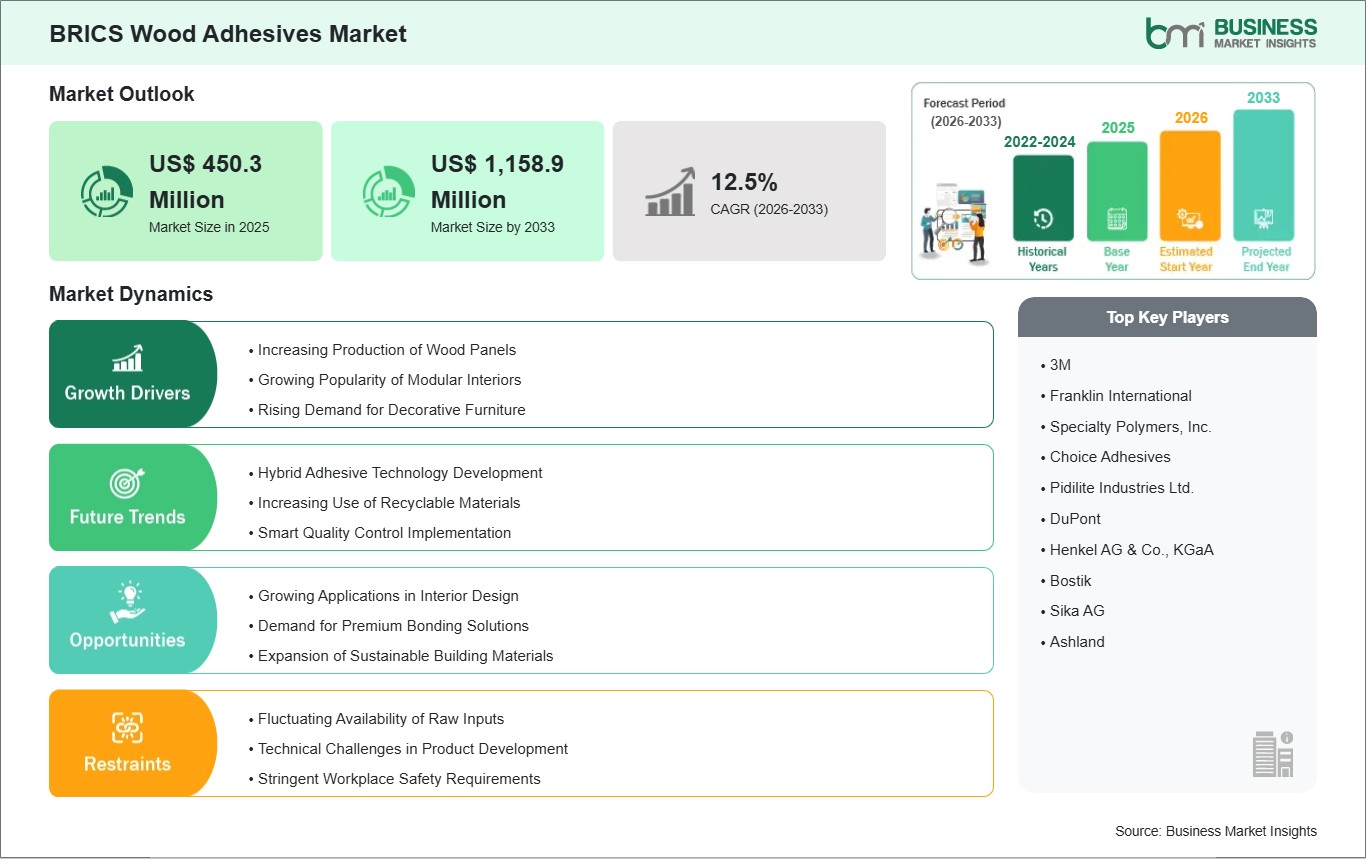
The BRICS wood adhesives market size is expected to reach US$ 5,327.0 million by 2033 from US$ 2,731.2 million in 2025. The market is estimated to register a CAGR of 8.7% from 2026 to 2033.
The BRICS wood adhesives market is undergoing a significant transformation driven by industrial modernization, expanding furniture manufacturing capabilities, and increasing adoption of engineered wood products across residential, commercial, and industrial applications. Market participants are focusing on product innovation to enhance bonding performance, moisture resistance, durability, and environmental compliance, aligning with evolving customer specifications and sustainability requirements. The growing preference for lightweight and cost-efficient wood composites has accelerated demand for advanced adhesive technologies, including polyurethane, polyvinyl acetate, epoxy, and bio-based formulations. Manufacturers are strategically investing in production efficiency, raw material optimization, and supply chain localization to mitigate volatility associated with petrochemical feedstocks and international trade dynamics. Additionally, the increasing penetration of automated woodworking equipment is encouraging the development of adhesives compatible with high-speed manufacturing processes and precision assembly lines. Regulatory emphasis on low-emission and formaldehyde-free products is further influencing product development strategies, prompting suppliers to expand eco-friendly portfolios. The market also benefits from rising renovation activities, urban infrastructure projects, and the expansion of organized furniture retail channels across BRICS economies. Competitive intensity remains elevated as domestic producers and multinational companies strengthen distribution networks, pursue strategic partnerships, and introduce application-specific solutions for cabinetry, flooring, laminates, and structural wood components. As end-user industries prioritize product quality, operational efficiency, and environmental stewardship, the BRICS wood adhesives market continues to evolve toward technologically advanced and value-added adhesive systems capable of supporting long-term industrial growth and manufacturing competitiveness.

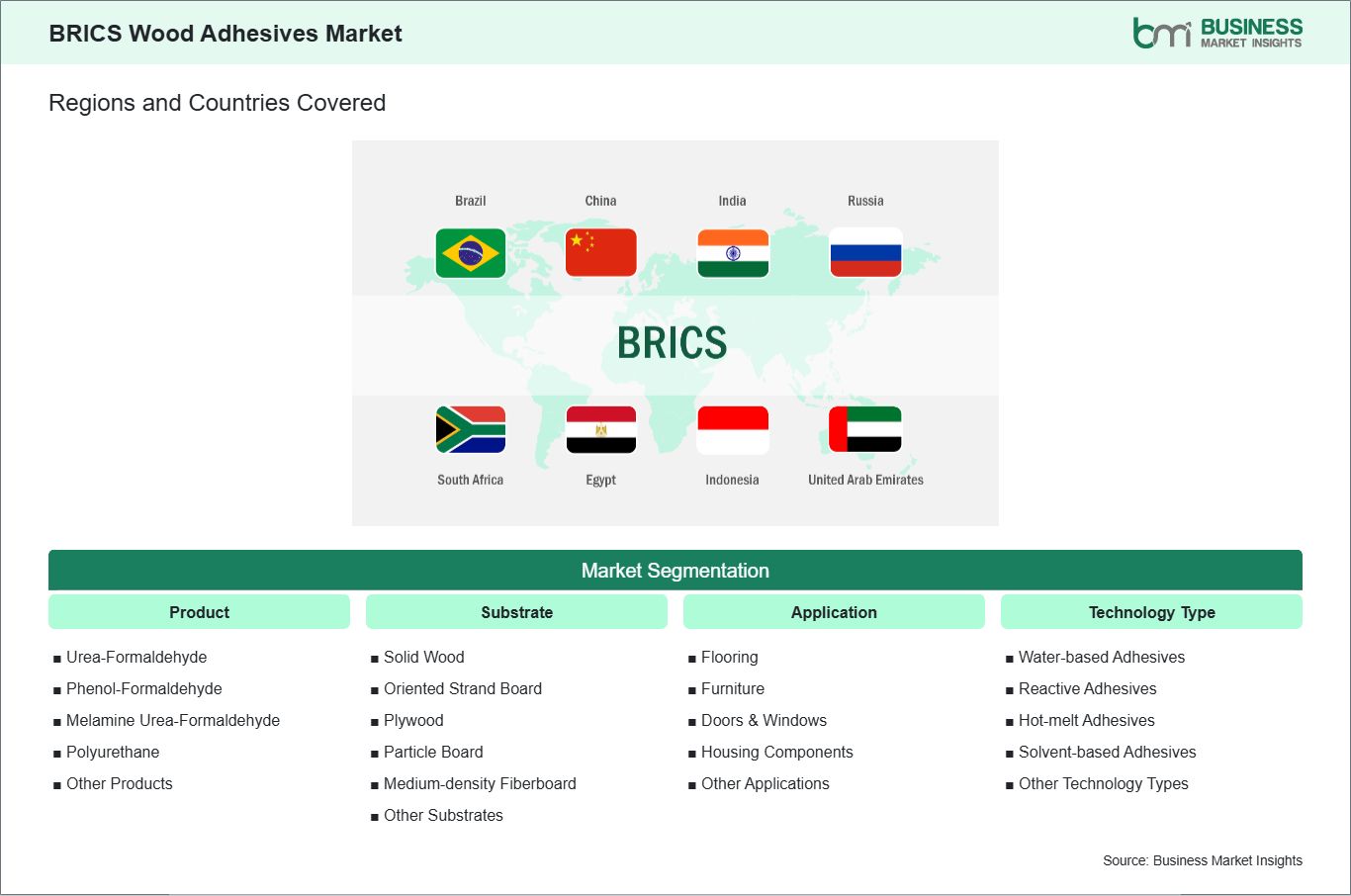
Key segments that contributed to the derivation of the BRICS wood adhesives market analysis are product, substrate, application, and technology type.
The BRICS wood adhesives market is supported by the growing production of wood panels used in furniture, construction, and industrial applications. Manufacturers across the region are expanding their processing capabilities to meet rising demand for engineered wood products. This trend is increasing the need for reliable adhesive solutions that improve bonding performance and production efficiency.
The presence of raw materials for wood, coupled with investments being made for processing wood, is making the manufacture of plywood, MDF, particle boards, and other panel products possible. With manufacturers working towards ensuring quality, there is a steady increase in the need for adhesives, which provide good bonding strength and perform consistently. Adhesives are increasingly becoming an important element in manufacturing processes.
Furthermore, the transition to new manufacturing methods is encouraging the use of innovative adhesives. Manufacturers are looking for solutions that can help them reduce production time and minimize wastage. With increased wood panel production in BRICS nations, adhesive manufacturers will find themselves in high demand from existing as well as new manufacturers.
The growing popularity of modern interior design is creating new opportunities for the wood adhesives market in BRICS countries. Rising consumer interest in attractive and functional living spaces is increasing the use of wood-based furniture, decorative panels, cabinets, and flooring products. These applications rely heavily on adhesives to ensure durability, appearance, and long-term performance.
The manufacturers have adopted diverse designs in response to their consumers' needs. It has created a need for a variety of adhesive products that can cater to such varied requirements. The manufacturers of adhesive products have been instrumental in helping other manufacturers create efficient interiors with the help of such products.
There is also an increase in commercial construction using these products. It has been observed that offices, hotels, commercial places, and other institutions use wooden interiors due to their aesthetic and practical applications. With increasing demands of stylish interior products in the BRICS economies, there will be a steady rise in the application of wood adhesives in these areas.

The wood adhesives market in BRICS is experiencing steady growth, with market size and share analysis reflecting evolving treatment preferences and competitive dynamics among key players. The report evaluates important subsegments categorized within product, substrate, application, and technology, highlighting their respective contributions to market performance.
By product, the urea-formaldehyde (UF) segment dominated the market in 2025 driven by its low cost, strong bonding performance, and widespread use in engineered wood products such as particleboard and MDF.
Based on substrate, the particle board (PB) segment dominated the market in 2025, driven by its high consumption in furniture and interior applications, creating substantial demand for wood adhesives.
On the basis of application, the furniture segment dominated the market in 2025, driven by rising residential and commercial furnishing demand, supported by urbanization and expanding middle-class populations across BRICS countries.
In terms of technology, the water-based adhesives segment dominated the market in 2025, driven by increasing preference for low-VOC, environmentally compliant adhesive solutions and their broad compatibility with wood-processing applications.
| Report Attribute | Details |
|---|---|
| Market size in 2025 | US$ 2,731.2 Million |
| Market Size by 2033 | US$ 5,327.0 Million |
| CAGR (2026 - 2033) | 8.7% |
| Historical Data | 2022-2024 |
| Forecast period | 2026-2033 |
| Segments Covered | By Product
|
|
Regions and Countries Covered
| |
| BRICS | Russia, Brazil, South Africa, India, the UAE, China |
| Market leaders and key company profiles |
|
The "BRICS Wood Adhesives Market Size and Forecast (2022–2033)" report provides a detailed analysis of the market covering below areas:
The geographical scope of the BRICS wood adhesives market report is divided into Russia, Brazil, South Africa, India, the UAE, China. China held the largest share in 2025.
Country-level dynamics within the BRICS wood adhesives market reveal distinct growth patterns shaped by industrial specialization, resource availability, and manufacturing priorities. China maintains a dominant position as a global woodworking and furniture production hub, benefiting from extensive downstream manufacturing ecosystems and continuous technological advancements in adhesive applications. India is witnessing increasing demand driven by organized furniture production, expanding real estate development, and the gradual shift from traditional carpentry methods toward factory-based manufacturing. Brazil leverages its abundant forestry resources and well-established wood processing industry, creating favorable conditions for adhesive consumption across plywood, veneer, and engineered wood segments. Russia's market is supported by its substantial timber reserves and growing focus on value-added wood processing activities, encouraging investments in domestic adhesive production and industrial integration. South Africa serves as a strategic gateway to regional markets, with demand supported by construction-related woodworking applications and developing furniture manufacturing capabilities. Across BRICS nations, localization strategies are becoming increasingly important as governments encourage domestic manufacturing, reduce import dependency, and strengthen industrial self-sufficiency. Trade policies, infrastructure development programs, and industrial investment incentives continue to influence procurement patterns and supplier positioning. Furthermore, varying environmental regulations and product certification requirements are prompting manufacturers to tailor formulations according to country-specific standards and customer expectations. These diverse national characteristics create a multifaceted competitive environment where success depends on regional adaptation, technical expertise, efficient distribution networks, and the ability to address evolving industry requirements through customized adhesive solutions and localized market strategies.

The BRICS wood adhesives market is evaluated by gathering qualitative and quantitative data post primary and secondary research, which includes important corporate publications, association data, and databases. A few of the key developments in the BRICS wood adhesives market are:
The BRICS Wood Adhesives Market is valued at US$ 2,731.2 Million in 2025, it is projected to reach US$ 5,327.0 Million by 2033.
As per our report BRICS Wood Adhesives Market, the market size is valued at US$ 2,731.2 Million in 2025, projecting it to reach US$ 5,327.0 Million by 2033. This translates to a CAGR of approximately 8.7% during the forecast period.
The BRICS Wood Adhesives Market report typically cover these key segments-
The historic period, base year, and forecast period can vary slightly depending on the specific market research report. However, for the BRICS Wood Adhesives Market report:
The BRICS Wood Adhesives Market is populated by several key players, each contributing to its growth and innovation. Some of the major players include:
The BRICS Wood Adhesives Market report is valuable for diverse stakeholders, including:
Essentially, anyone involved in or considering involvement in the BRICS Wood Adhesives Market value chain can benefit from the information contained in a comprehensive market report.
Please tell us your area of interest
(Market Segments/ Regions and Countries/ Companies)