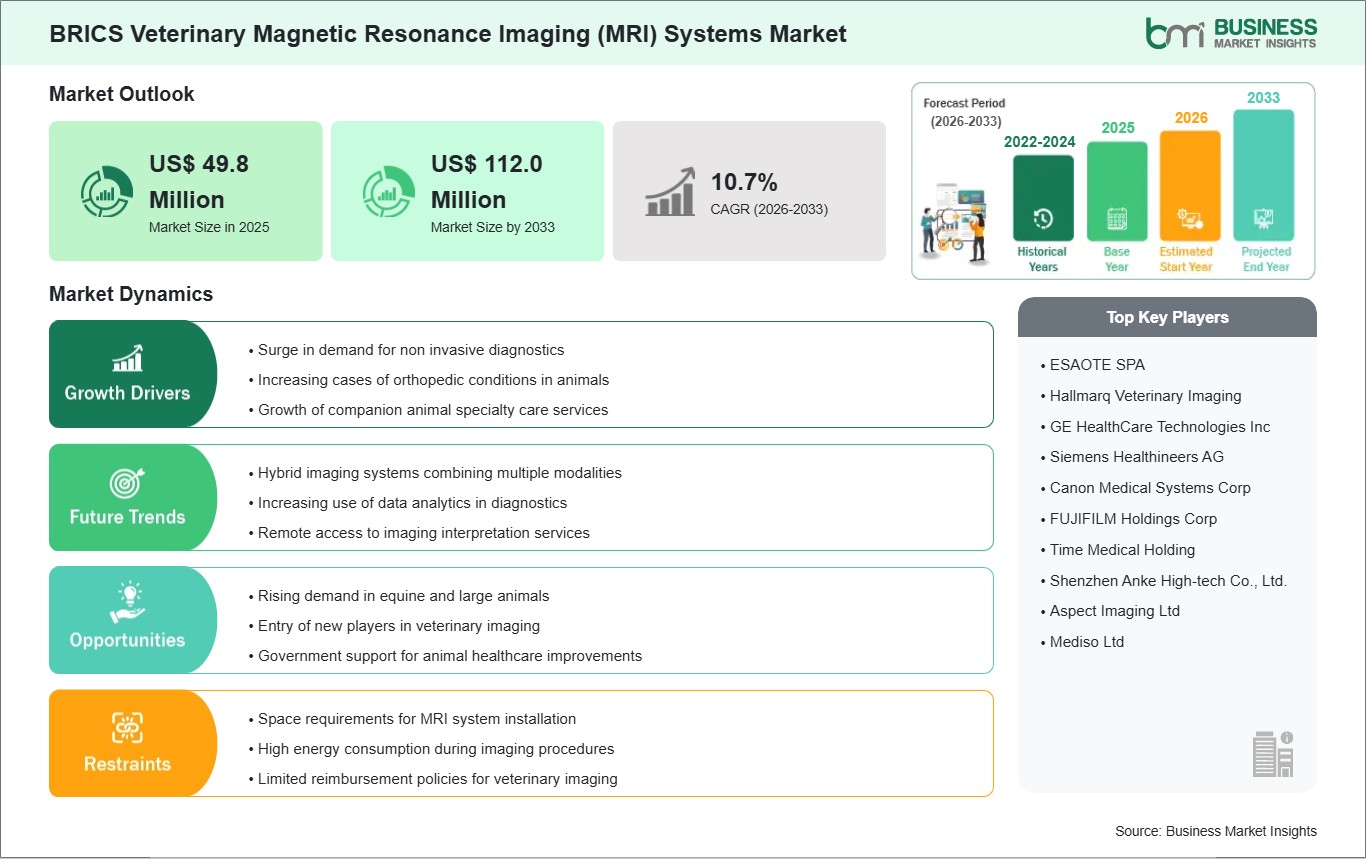
The BRICS veterinary magnetic resonance imaging (MRI) systems market size is expected to reach US$ 112.0 million by 2033 from US$ 49.8 million in 2025. The market is estimated to register a CAGR of 10.7% from 2026 to 2033.
The BRICS Veterinary Magnetic Resonance Imaging (MRI) systems market shows continuous growth because veterinary healthcare facilities upgrade their systems and veterinary facilities start using new imaging methods for treating both pets and farm animals. The developing economies now consider MRI to be an essential imaging technique that veterinary hospitals and specialty clinics use to diagnose complicated neurological, musculoskeletal and soft tissue disorders that affect animals. The market currently exists at a developmental stage, which stands between its established state and its complete westernization, because people now understand animal health better, and veterinarians advance their practice standards. The pet ownership growth in BRICS countries drives market expansion because urban pet owners now spend more on diagnostic tests. Urban areas in China, India and Brazil show a clear trend toward developing systematic healthcare systems for companion animals, which now include insurance coverage for specific parts of their care. The expansion of veterinary education, together with referral networks, now supports the use of MRI as the primary imaging method for difficult cases, which leads to greater investments in permanent and advanced MRI equipment at first-tier veterinary hospitals. The entry of international veterinary imaging companies and technology providers into BRICS markets acts as a vital growth factor because they introduce cost-efficient, low-field MRI solutions designed specifically for veterinary use. The new technologies develop solutions to traditional challenges, which include expensive installation requirements, existing facility restrictions and the unavailability of qualified veterinary radiologists. The veterinary hospitals and diagnostic imaging centers work together to establish better MRI service access in urban areas. The market still experiences major obstacles that prevent its growth. Industries in price-sensitive markets face difficulties because they must meet high capital expenditure needs, which particularly affect countries like India and South Africa and certain regions in Brazil. The limited reimbursement systems for veterinary diagnostics, together with the uneven advancement of veterinary facilities, create obstacles to achieving widespread adoption. The BRICS countries face two main challenges that prevent them from using MRI-based veterinary diagnostics: their shortage of veterinary radiology experts and their difficulty in developing operational capacity. The BRICS veterinary MRI systems market represents an industry transition from specialized high-priced medical tests to general clinical practices that use technological advancements and increased spending on pet health services, and the ongoing development of new veterinary facilities in developing markets.

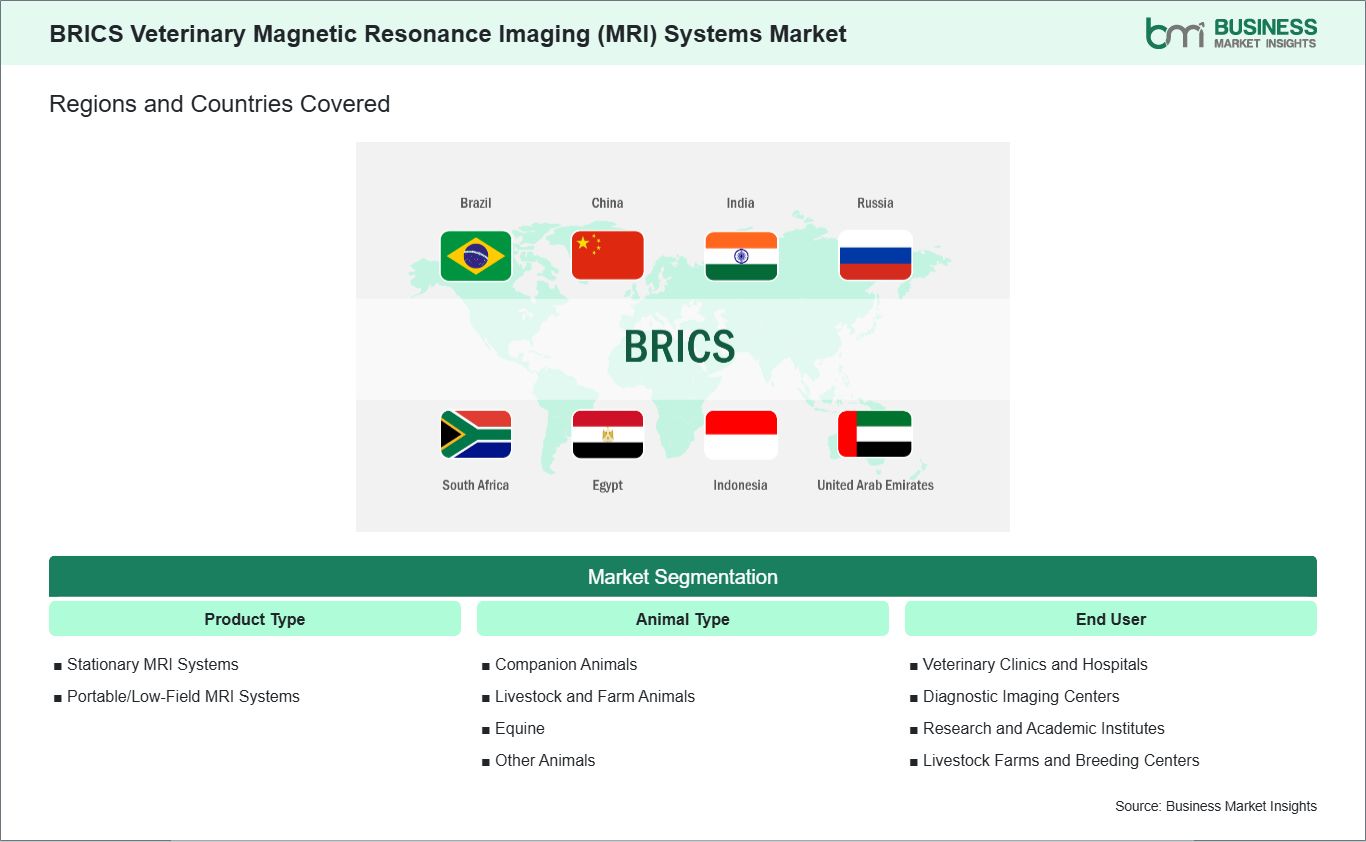
Key segments that contributed to the derivation of the BRICS veterinary magnetic resonance imaging (MRI) systems market analysis are product type, animal type, and end user.
The BRICS veterinary MRI systems market is gaining traction because companion animal ownership is increasing in Brazil, Russia, India, China, and South Africa. The rising pet adoption rates in São Paulo, Shanghai, Moscow, and Mumbai are increasing the need for advanced MRI diagnostic solutions, which can test pets for both neurological and orthopedic conditions. The growing public understanding of animal health issues is driving veterinary hospitals to implement more imaging systems for their medical services.
Pet owners in China and India are increasingly selecting premium diagnostic imaging services because middle-class income levels have risen, and they can now obtain pet insurance. The two major veterinary referral hospitals in Beijing and Delhi are expanding their MRI system acquisitions to support their diagnosis of complex cases, which include spinal injuries and brain disorders in companion animals. The rising chronic disease rate in pets is driving this trend forward.
The BRICS countries face equipment adoption challenges because their infrastructure systems are incomplete, and they experience high equipment expenses. The veterinary centers in urban areas are adopting modern imaging technology, but the basic diagnostic equipment will continue to be used in rural and semi-urban areas. Government programs in Brazil and China, which support veterinary healthcare modernization initiatives, are helping to make MRI technologies more accessible to medical facilities.
Telemedicine integration is emerging as a key opportunity in the BRICS veterinary MRI systems market, enabling remote diagnosis and consultation for complex imaging cases. Veterinary clinics in Brazil and South Africa are increasingly collaborating with centralized diagnostic hubs to interpret MRI scans, improving access to specialist radiology expertise in underserved regions.
In Russia and China, digital veterinary networks are expanding, allowing MRI data sharing between hospitals and academic institutions. This is particularly beneficial for large animal and livestock diagnostics, where expert availability is limited. Cloud-based imaging platforms are enhancing workflow efficiency and reducing turnaround time for diagnosis.
Despite growing digital adoption, challenges such as inconsistent internet infrastructure in rural India and regulatory fragmentation across BRICS countries limit full-scale telemedicine deployment. However, ongoing investments in AI-assisted imaging and cross-border veterinary collaborations are expected to strengthen remote MRI diagnostics and expand market reach across emerging veterinary care ecosystems.

The BRICS veterinary magnetic resonance imaging (MRI) systems market is experiencing steady growth, with market size and share analysis reflecting evolving treatment preferences and competitive dynamics among key players. The report evaluates important subsegments categorized within product type, animal type, and end user, highlighting their respective contributions to market performance.
By product type, the stationary MRI systems subsegment dominated the market in 2025, driven by higher image quality, greater throughput, and widespread adoption in hospitals for comprehensive diagnostic imaging.
Based on animal type, the companion animals subsegment dominated the market in 2025, driven by increasing pet ownership and rising demand for advanced diagnostic imaging in routine veterinary care.
In terms of end user, the veterinary clinics and hospitals subsegment dominated the market in 2025, driven by the widespread adoption of x-ray systems for comprehensive diagnostic and treatment services.
| Report Attribute | Details |
|---|---|
| Market size in 2025 | US$ 49.8 Million |
| Market Size by 2033 | US$ 112.0 Million |
| CAGR (2026 - 2033) | 10.7% |
| Historical Data | 2022-2024 |
| Forecast period | 2026-2033 |
| Segments Covered | By Product Type
|
|
Regions and Countries Covered
| |
| BRICS | Russia, Brazil, South Africa, India, the UAE, China |
| Market leaders and key company profiles |
|
The "BRICS Veterinary Magnetic Resonance Imaging (MRI) Systems Market Size and Forecast (2022–2033)" report provides a detailed analysis of the market covering below areas:
The geographical scope of the BRICS Veterinary Magnetic Resonance Imaging (MRI) Systems Market report is divided into Russia, Brazil, South Africa, India, the UAE, and China. China held the largest share in 2025.
The BRICS veterinary Magnetic Resonance Imaging (MRI) systems market experiences regional market performance variations, which occur because of different levels of technological adoption, veterinary spending abilities and the extent of specialized animal healthcare delivery. Russia operates its veterinary MRI system through selective adoption, which permits usage only in advanced referral centers located in Moscow and St. Petersburg, whereas companion animal practitioners need advanced imaging technology to achieve their diagnostic goals. Brazil experiences gradual growth, which pet humanization trends and private veterinary clinic development in São Paulo and Rio de Janeiro support, but income inequality and high imaging system costs prevent smaller clinics from adopting advanced technology. South Africa maintains a niche market that limits MRI use to veterinary hospitals and equine care facilities. The market shows advanced clinical expertise, yet it suffers from growth limitations because of its small installed base, its need to import products, and its demand exists only in urban areas such as Johannesburg and Cape Town. The Indian market is experiencing rapid growth because of urban development, rising pet ownership and the growth of veterinary hospital networks. The medical field requires mid-field MRI systems, which provide affordable yet effective diagnostic solutions, but face obstacles because of insufficient infrastructure, untrained radiologists and budget restrictions. The United Arab Emirates operates as an exclusive market that serves small customer groups who seek advanced veterinary care at its Dubai and Abu Dhabi hospitals, because expatriates who own pets and have high purchasing power and advanced veterinary technology drive market demand. China operates as the primary market, which shows the highest development across all BRICS regions, because its large companion animal population, veterinary hospital upgrades, domestic production capabilities and AI-based imaging systems enable rapid expansion of veterinary MRI services in China.

The BRICS Veterinary Magnetic Resonance Imaging (MRI) Systems Market is evaluated by gathering qualitative and quantitative data post primary and secondary research, which includes important corporate publications, association data, and databases. A few of the key developments in the BRICS veterinary magnetic resonance imaging (MRI) systems market are:
The BRICS Veterinary Magnetic Resonance Imaging (MRI) Systems Market is valued at US$ 49.8 Million in 2025, it is projected to reach US$ 112.0 Million by 2033.
As per our report BRICS Veterinary Magnetic Resonance Imaging (MRI) Systems Market, the market size is valued at US$ 49.8 Million in 2025, projecting it to reach US$ 112.0 Million by 2033. This translates to a CAGR of approximately 10.7% during the forecast period.
The BRICS Veterinary Magnetic Resonance Imaging (MRI) Systems Market report typically cover these key segments-
The historic period, base year, and forecast period can vary slightly depending on the specific market research report. However, for the BRICS Veterinary Magnetic Resonance Imaging (MRI) Systems Market report:
The BRICS Veterinary Magnetic Resonance Imaging (MRI) Systems Market is populated by several key players, each contributing to its growth and innovation. Some of the major players include:
The BRICS Veterinary Magnetic Resonance Imaging (MRI) Systems Market report is valuable for diverse stakeholders, including:
Essentially, anyone involved in or considering involvement in the BRICS Veterinary Magnetic Resonance Imaging (MRI) Systems Market value chain can benefit from the information contained in a comprehensive market report.
Please tell us your area of interest
(Market Segments/ Regions and Countries/ Companies)