Market Summary
Executive Summary and Market Analysis
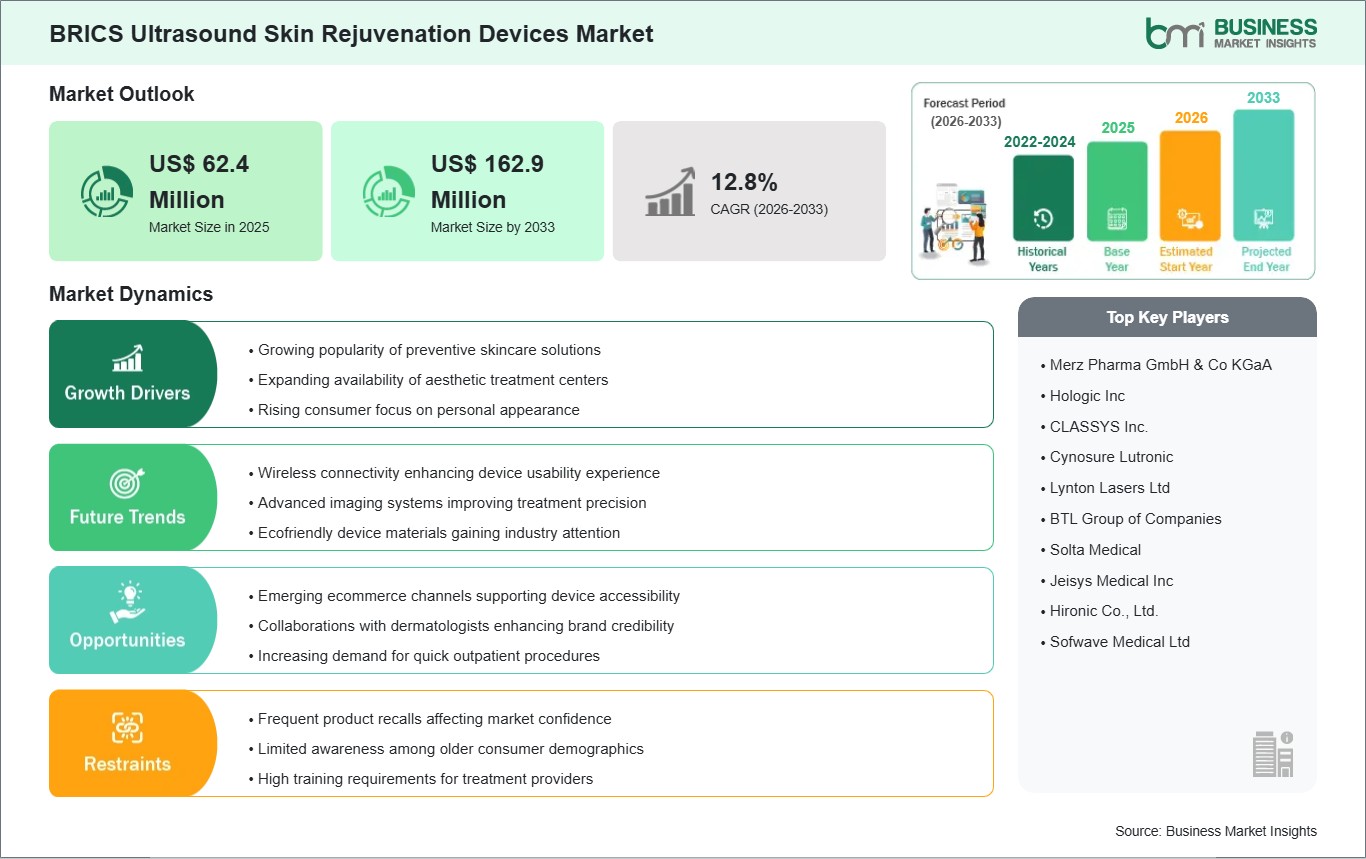
The BRICS ultrasound skin rejuvenation devices market is experiencing a structurally evolving demand landscape driven by rapid expansion of medical aesthetics infrastructure, increasing consumer inclination toward non-invasive dermatological procedures, and growing penetration of advanced energy-based skin treatment technologies. Across member economies, increasing disposable incomes in urban cities and growing attention on appearance enhancement are contributing to increasing uptake of ultrasonic devices used for collagen regeneration, skin firming, and facial sculpting applications. Notable changes can be noted in terms of shifting from invasive methods such as surgery to the use of devices in non-invasive out-patient procedures especially in densely populated metropolitan areas where ease of use and convenience are essential considerations in the decision-making process. In terms of suppliers, global and regional manufacturers are making significant efforts to localize their distribution channels, develop partnerships with dermatology practices, medspas, and cosmetic surgeries. Innovation within product offerings revolves around the development of multi-frequency ultrasound, precise targeting mechanisms, and artificial intelligence to assist with calibration processes during treatments. Increasing demand for portable and medium-tier aesthetic devices further widens the target market base to include medium-tier wellness centers. China and India, on the other hand, continue to experience fast commercialization cycles with support from massive health care modernization efforts. Meanwhile, Brazil and South Africa experience high levels of concentration in the demand for their aesthetic services from the private sector. The Russian market remains characterized by consumer demands based on the consumption pattern of urban elites. Furthermore, there have been investments in training programs for practitioners that help in standardizing procedures and enhancing technology acceptance. Competition has intensified among companies as well due to price-based competition.
Segment Analysis
BRICS Ultrasound Skin Rejuvenation Devices Market Segmentation
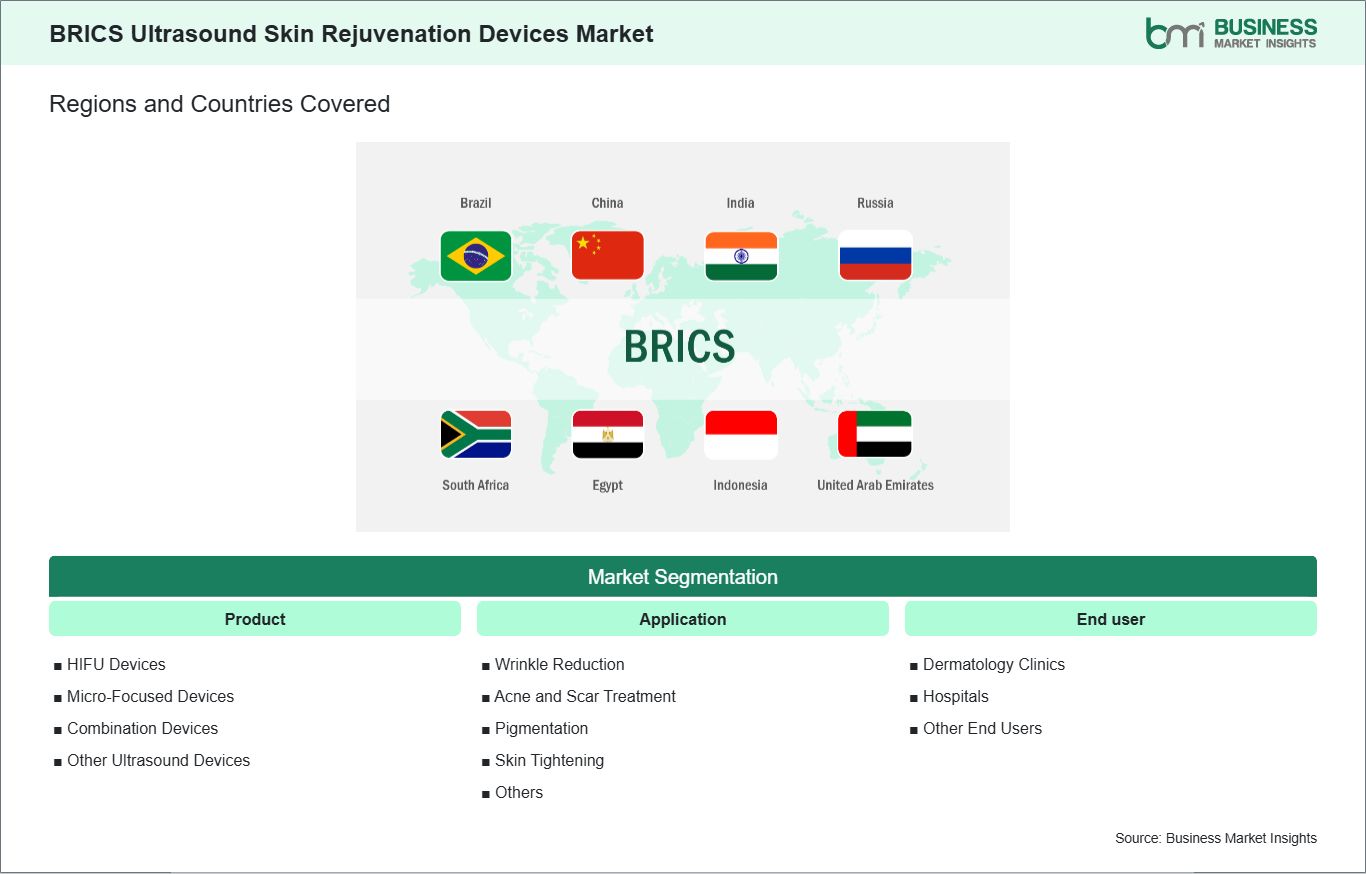
Key segments that contributed to the derivation of the BRICS ultrasound skin rejuvenation devices market analysis are product, application, and end user.
- By product, the ultrasound skin rejuvenation devices market is segmented HIFU devices, micro-focused devices, combination devices, other ultrasound devices. The HIFU devices segment dominated the market in 2025.
- Based on application, the ultrasound skin rejuvenation devices market is categorized into wrinkle reduction, acne and scar treatment, pigmentation, skin tightening, others application. The wrinkle reduction segment dominated the market in 2025.
- In terms of end user, the ultrasound skin rejuvenation devices market is categorized into dermatology clinics, hospitals, other end users. The dermatology clinics segment dominated the market in 2025.
Market Forces
BRICS Ultrasound Skin Rejuvenation Devices Market Drivers and Opportunities
Increasing preference for minimally invasive procedures
The BRICS ultrasound skin rejuvenation devices market is experiencing strong growth driven by a widespread shift toward minimally invasive aesthetic procedures that offer visible results without surgery or extended recovery time. In today’s cities, residents living in large urban metropolises prefer to opt for fast, safe, and efficient solutions. Hence, skin tightening using ultrasound technology becomes more relevant than ever before. High Intensity Focused Ultrasound (HIFU) machines become popular because they help produce new collagen and tighten the skin without destroying the epidermis layer. Thanks to growing online popularity and social media promotion of alternative non-invasive treatments to facelift surgeries, many consumers are becoming interested in skin-tightening treatments using ultrasound technology.
There has been a huge interest especially among professionals and middle class individuals looking for anti-aging services that suit their lifestyle and schedule. There have been numerous incidences of individuals undertaking “lunch-time procedures” whereby individuals can undergo ultrasound lifting of the skin, with reduced downtime after the procedure, and get back to their routines almost immediately. This has been encouraged by increasing private practices and aesthetic chain clinics that have invested in small-sized portable ultrasound machines that increase efficiency within the facilities. Another notable trend involves the increasing number of males seeking contouring and skin-tightening procedures.
Another major factor that has contributed to growth is the increasing incorporation of ultrasound technology along with other non-invasive technologies such as radio frequency and lasers. Clinics are now providing patients with package deals that incorporate more than one technology to achieve better results. This has increased the usage of devices by physicians and repeat visits by customers, thus further contributing to market demand. With the availability of certified CE and FDA approved devices, more physicians have started using the devices in their clinics, whether it be for high-end or mid-end aesthetic centers.
Growing medical tourism for cosmetic treatments
Medical tourism is emerging as a significant growth driver for the ultrasound skin rejuvenation devices market, supported by increasing cross-border patient flows seeking cost-effective and high-quality aesthetic procedures. More foreign patients are visiting sites renowned for dermatology facilities and cost-effective cosmetic procedures. The use of ultrasound technology in skin-rejuvenation treatments becomes especially appealing due to its noninvasiveness, reliable results, and quick recuperation time, thereby making it suitable for short-stay medical tourism purposes.
The growth in cosmetic clinics that offer special skincare services and aesthetic clinics has continued to make the medical tourism landscape robust. The use of skin ultrasound therapy in these clinics is now common with more clinics offering a combination of ultrasound skin therapy with general anti-aging solutions. Telemedicine has played a big role in ensuring better pre- and post-treatment consultations. Partnerships between cosmetic equipment manufacturers and private hospitals have resulted in improved access to modern ultrasound technologies by patients.
Another critical consideration includes the increasing recognition of specific market locations as international centers for non-surgical cosmetic treatments. Competitively priced services, professional dermatology experts, and the high volume of treatments available are motivating patients from countries where prices are relatively high to opt for cheaper alternatives. Increasing promotion by medical tourism companies of skin rejuvenation via ultrasounds is also contributing significantly towards the popularity of this non-invasive cosmetic procedure. As a result, there are increasing investments being made in the most sophisticated ultrasound machines by dermatology clinics to satisfy their foreign clientele. As the demand for beauty treatments increases worldwide, medical tourism will play a vital role in promoting ultrasound skin rejuvenation technology.
Size and Share Analysis
BRICS Ultrasound Skin Rejuvenation Devices Market Size and Share Analysis
The BRICS ultrasound skin rejuvenation devices market demonstrates steady growth, with size and share analysis highlighting evolving trends and competitive dynamics among key players. The report examines subsegments categorized within product, application, and end user, offering insights into their contribution to overall market performance.
By product, the HIFU devices segment dominated the market in 2025, driven by superior non-invasive lifting outcomes with deeper tissue penetration compared to alternative ultrasound-based technologies in BRICS markets.
Based on application, the wrinkle reduction segment dominated the market in 2025, driven by high consumer preference for quick-visible aesthetic improvements targeting early signs of aging in urban populations across BRICS countries.
In terms of end user, the dermatology clinics segment dominated the market in 2025, driven by availability of trained specialists and higher uptake of clinic-based procedural treatments over at-home aesthetic devices.
Report Coverage
BRICS Ultrasound Skin Rejuvenation Devices Market Report Coverage and Deliverables
The "BRICS Ultrasound Skin Rejuvenation Devices Market Size and Forecast (2022-2033)" report provides a detailed analysis of the market covering below areas:
- Market size and forecast at global, regional, and country levels for all the key market segments covered under the scope
- Market trends, as well as drivers, restraints, and opportunities
- Market analysis covering key trends, global and regional framework, major players, regulations, and recent developments
- Market concentration, heat map analysis, prominent players, and recent developments for the Market
- Detailed company profiles, including SWOT analysis
Geographic Insights
BRICS Ultrasound Skin Rejuvenation Devices Market Geographic Insights
The geographical scope of the BRICS ultrasound skin rejuvenation devices market report is divided into Russia, Brazil, South Africa, India, the UAE, China. China held the largest share in 2025.
Country-level dynamics within the BRICS ultrasound skin rejuvenation devices market reflect highly differentiated adoption patterns shaped by healthcare maturity, aesthetic culture, and economic stratification. In China, rapid urbanization and the strong influence of digital beauty ecosystems are driving large-scale adoption of ultrasound-based aesthetic technologies, particularly among younger demographics seeking preventive anti-aging solutions. The market is further supported by dense networks of cosmetic dermatology clinics and aggressive innovation cycles from domestic device manufacturers. India presents a cost-sensitive but fast-expanding landscape, where growing awareness of non-invasive cosmetic procedures is gradually shifting consumer preference away from surgical interventions. Tier-1 cities such as Mumbai, Delhi, and Bengaluru are emerging as key adoption hubs, supported by expanding medspa chains and dermatology franchises. Demand is also being influenced by increasing medical tourism inflows, where international patients seek affordable aesthetic treatments with advanced device technologies. Brazil demonstrates strong cultural alignment with aesthetic enhancement procedures, making it one of the most mature cosmetic markets within BRICS. High consumer acceptance of body and facial contouring treatments supports steady demand for ultrasound rejuvenation devices, particularly in private dermatology clinics and specialized cosmetic centers. Russia’s market is more concentrated in premium urban segments, where high-income consumers prioritize advanced anti-aging technologies and premium skincare solutions. Meanwhile, South Africa exhibits emerging demand driven by private healthcare expansion and rising interest in non-surgical beauty treatments among urban professionals. Across all BRICS nations, increasing investments in aesthetic training, rising social media influence on beauty standards, and gradual technological diffusion are collectively strengthening long-term market penetration of ultrasound-based skin rejuvenation systems.
Industry Activity
Recent Developments
The BRICS ultrasound skin rejuvenation devices market is evaluated by gathering qualitative and quantitative data post primary and secondary research, which includes important corporate publications, association data, and databases. A few of the key developments in the BRICS ultrasound skin rejuvenation devices market are:
- In January 2024, Kokilaben Dhirubhai Ambani Hospital (India) announced that it had introduced High-Intensity Focused Ultrasound (HIFU) technology for non-invasive therapeutic and aesthetic applications, expanding clinical access to ultrasound-based skin and tissue treatment technology in India’s dermatology and medical aesthetics segment.
- In September 2024, Merz Aesthetics announced the European and international rollout of Ultherapy PRIME, the next-generation micro-focused ultrasound (MFU-V) skin lifting platform, expanding availability across global markets including BRICS countries such as Brazil, India, China, and South Africa through its regional distributor network.
Trust & Transparency
Research Methodology
The market analysis combines proprietary research with secondary data from government agencies, company disclosures, regulatory filings, industry databases and expert interviews. Market estimates are validated through data triangulation, cross-market benchmarking and analyst
review.
View Full Research Methodology
Key Sources Referred:
American Society for Laser Medicine and Surgery (ASLMS)European Academy of Dermatology and Venereology (EADV)Bharat Society of Laser Medicine & Surgery (BSLMS)S. Food and Drug Administration (FDA)European Medicines Agency (EMA)International Electrotechnical Commission (IEC)International Organization for Standardization (ISO)Beauty Device Association (BDA)Indian Laser Association (ILA)Association of Industrial Laser Users (AILU)