Market Summary
Executive Summary and Market Analysis
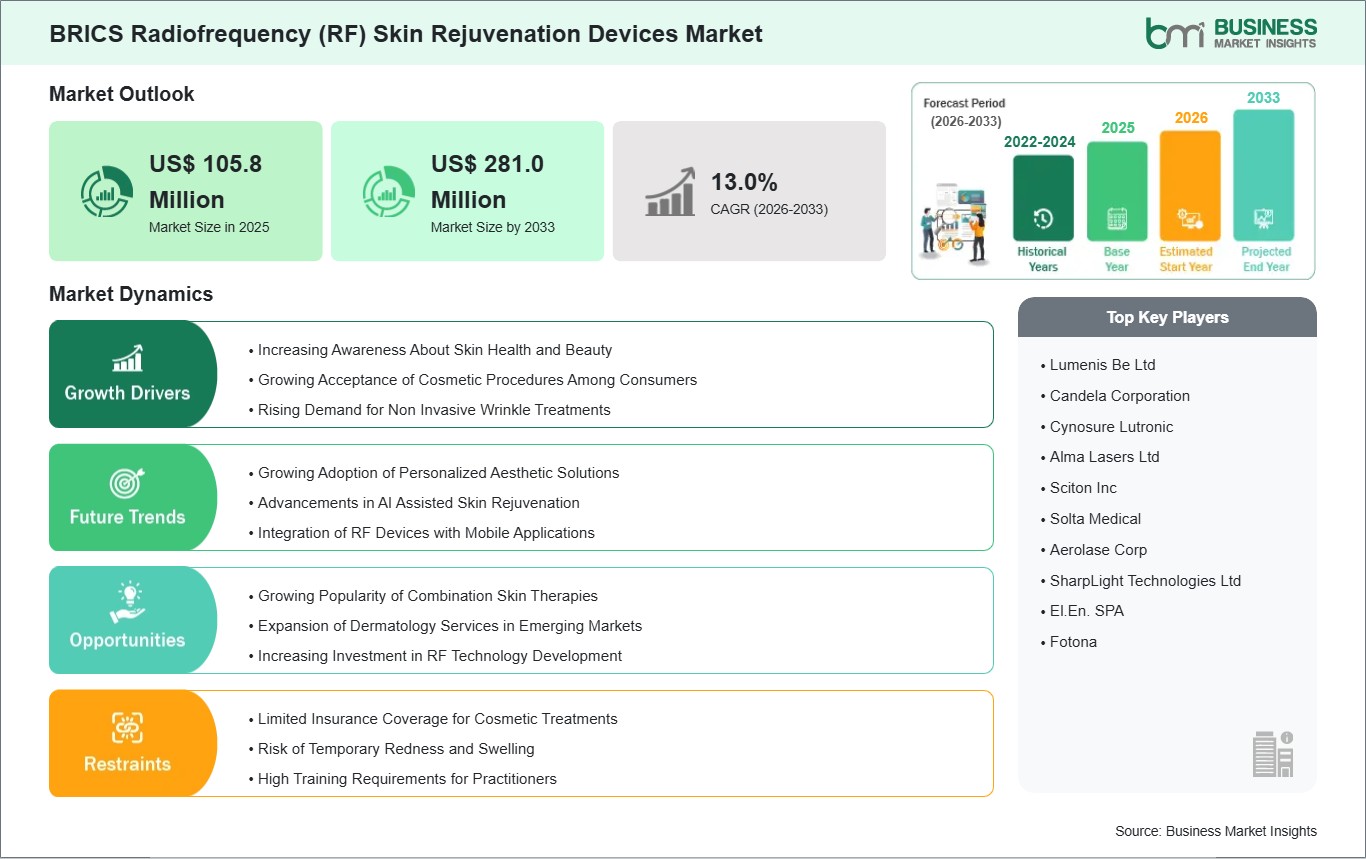
The BRICS nations of Brazil, Russia, India, China, and South Africa represent a dynamic emerging market for radiofrequency (RF) skin tightening devices on account of the rising preference for non-surgical methods of aesthetics and increased knowledge about advanced dermatological solutions. In all these countries, RF-based technology is becoming increasingly popular among dermatologists and other cosmetic physicians, who value the technology's capability of triggering collagen production, skin tightening, and noticeable results against aging without resorting to invasive measures. The growth of the market is also driven by the rapid expansion of the urban middle class in these countries, whose members are increasingly concerned about enhancing their appearances and maintaining optimal skincare. This is helped by the availability of aesthetic facilities in major cities, increased access to dermatologists, and the influence of global standards of beauty through social media channels. Furthermore, advancements in the diffusion of technology in these developing nations have facilitated faster uptake of sophisticated RF-based equipment, such as fractional and microneedling RF technologies that are especially favored for their low recovery times and wide range of applications against skin tightening and acne-related scars. Nonetheless, the market faces restrictions due to the high cost of purchasing and operating RF machines. The requirement for trained personnel to operate the technology further impedes its growth, especially in semi-urban areas where new health care facilities are being established within BRICS countries. In spite of this, the future still looks bright owing to the rising interest of consumers in undergoing aesthetic treatments and the establishment of private dermatology and medspa clinics in the region.
Segment Analysis
BRICS Radiofrequency (RF) Skin Rejuvenation Devices Market Segmentation
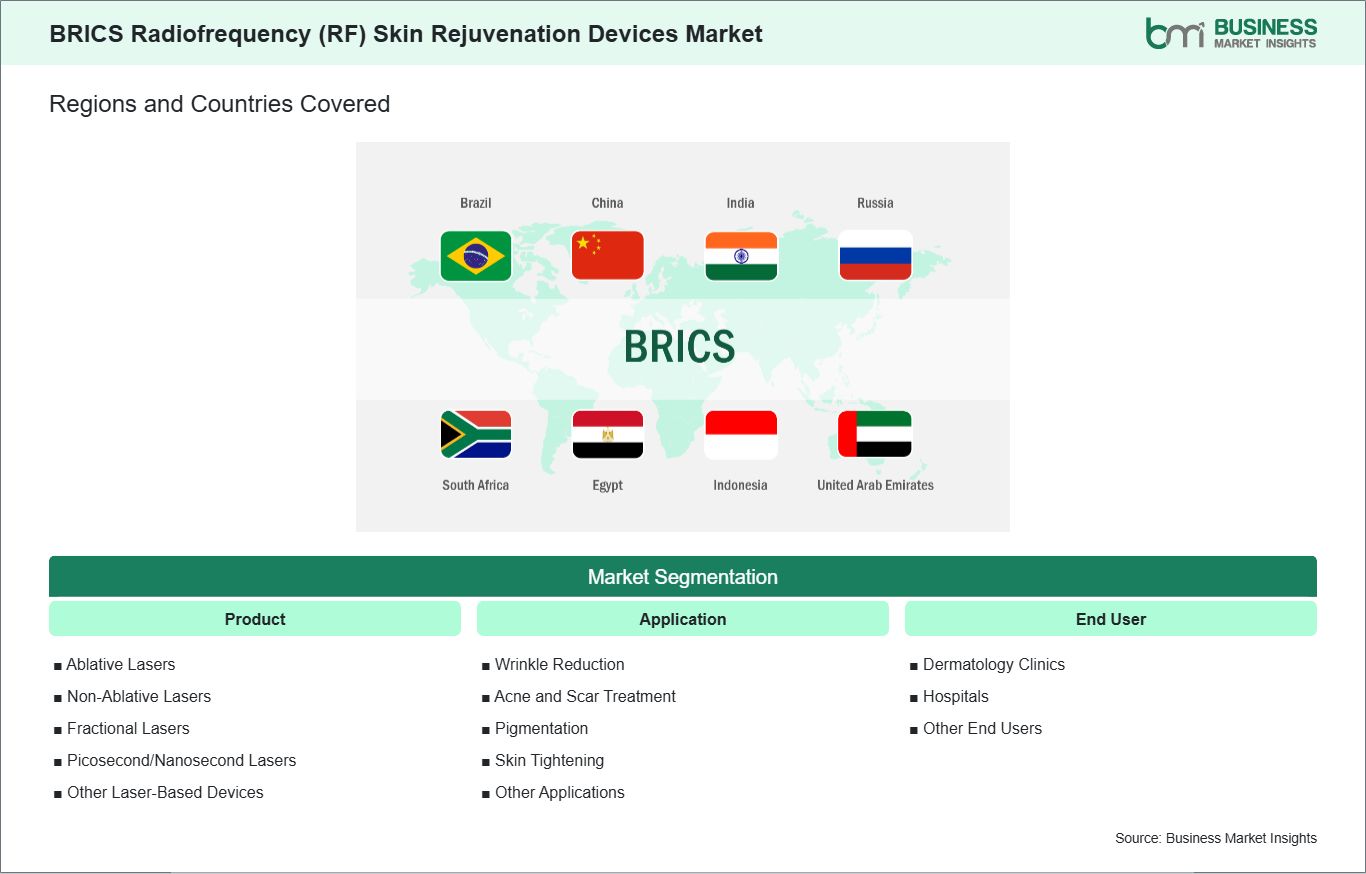
Key segments that contributed to the derivation of the BRICS radiofrequency (RF) skin rejuvenation devices market analysis are product, application and end user.
- By product, the radiofrequency (RF) skin rejuvenation devices market is segmented into ablative lasers, non-ablative lasers, fractional lasers, picosecond/nanosecond lasers, and other laser-based devices. The non-ablative lasers segment dominated the market in 2025.
- Based on application, the radiofrequency (RF) skin rejuvenation devices market is categorized into wrinkle reduction, acne and scar treatment, pigmentation, skin tightening, and other applications. The wrinkle reduction segment dominated the market in 2025.
- In terms of end user, the radiofrequency (RF) skin rejuvenation devices market is categorized into dermatology clinics, hospitals, and other end users. The dermatology clinics segment dominated the market in 2025.
Market Forces
BRICS Radiofrequency (RF) Skin Rejuvenation Devices Market Drivers and Opportunities
Increasing Awareness About Skin Health and Beauty
Skin rejuvenation devices based on BRICS RF skin rejuvenation in the country continue to witness robust growth owing to an increased inclination towards preventive skin care among consumers. The rise in disposable income levels, coupled with the availability of better dermatological services in cities in countries like India, China, and Brazil, is driving the acceptance of RF skin rejuvenation technology among these consumers.
In India and China, the rising popularity of health campaigns run by healthcare providers and influencers on social media is changing consumers' perception about skin care and the need to start early with RF skin tightening and rejuvenation procedures.
In Brazil and South Africa, there is a marked increase in the number of consumers interested in aesthetic skin care procedures due to the emergence of private clinics that offer these treatments using minimally invasive techniques. The focus of consumers to remain young even into their late years using minimally invasive RF technologies, is driving the market growth in both metropolitan and semi-urban areas.
Growing Popularity of Combination Skin Therapies
The BRICS RF skin rejuvenation devices market is increasingly shaped by the adoption of combination skin therapies that integrate radiofrequency with complementary aesthetic technologies. Clinics across major cities in China, India, and Brazil are prioritizing multifunctional platforms to address multiple skin concerns in a single treatment session.
In India and China, dermatology centers are combining RF microneedling with laser and ultrasound-based procedures to enhance treatment outcomes, reduce recovery time, and improve patient satisfaction among urban clients seeking efficient cosmetic solutions.
Similarly, in South Africa and Russia, aesthetic practitioners are adopting layered treatment approaches that combine RF tightening with injectables and resurfacing procedures to deliver more comprehensive anti-aging results. This trend reflects a broader shift toward personalized treatment planning, where practitioners tailor multi-modality protocols based on individual skin type and aging concerns. Growing competition among aesthetic clinics in urban BRICS markets is further accelerating investment in advanced combination devices that improve efficiency and patient throughput. This is especially evident in high-demand metropolitan healthcare sectors overall growth.
Size and Share Analysis
BRICS Radiofrequency (RF) Skin Rejuvenation Devices Market Size and Share Analysis
The BRICS radiofrequency (RF) skin rejuvenation devices market is experiencing steady growth, with market size and share analysis reflecting evolving treatment preferences and competitive dynamics among key players. The report evaluates important subsegments categorized within product, application and end user, highlighting their respective contributions to market performance.
By product, the non-ablative lasers subsegment dominated the market in 2025, driven by increasing consumer preference for minimally invasive skin rejuvenation procedures with reduced downtime and improved safety profiles.
Based on application, the wrinkle reduction subsegment dominated the market in 2025, driven by the rising demand for anti-aging treatments and growing awareness regarding aesthetic skin enhancement procedures.
In terms of end user, the dermatology clinics subsegment dominated the market in 2025, driven by the increasing availability of advanced aesthetic treatment solutions and the growing number of patients seeking specialized skincare services.
Report Coverage
BRICS Radiofrequency (RF) Skin Rejuvenation Devices Market Report Coverage and Deliverables
The "BRICS Radiofrequency (RF) Skin Rejuvenation Devices Market Size and Forecast (2022–2033)" report provides a detailed analysis of the market covering below areas:
- Market size and forecast at regional and country levels for all market segments covered under the scope
- Market trends, as well as drivers, restraints, and opportunities
- Market analysis covering key trends, regional framework, major players, regulations, and recent developments
- Market concentration, heat map analysis, prominent players, and recent developments for the Market
- Detailed company profiles, including SWOT analysis
Geographic Insights
BRICS Radiofrequency (RF) Skin Rejuvenation Devices Market Geographic Insights
The geographical scope of the BRICS Radiofrequency (RF) Skin Rejuvenation Devices Market report is divided into Russia, Brazil, South Africa, India, China, Egypt, Indonesia, Saudi Arabia, and the UAE. China held the largest share in 2025.
The BRICS RF skin rejuvenation devices market is marked by sporadic yet growing demand throughout regions. Asia Pacific is noted for its highest growth dynamics overall, whereas China takes the lead as the dominating country owing to rapid uptake of aesthetic procedures, increasing disposable income levels, and robust production and medical facility development alongside the fast-growing cosmetic demand in metropolitan areas. Growth drivers in India and Indonesia include increasing medspa penetration, growing aesthetic consciousness, and rising disposable incomes among the middle-class population. Russia has an established base of dermatological clinics, but experiences a relatively slow adoption rate due to innovation barriers. Brazil in Latin America is considered one of the main hubs where non-invasive aesthetic procedures are highly accepted and where a beauty-conscious community fuels constant adoption of RF skin rejuvenation technology. South Africa is a major growth driver in terms of demand in Africa in conjunction with the BRICS group, although the penetration rates are still rather low because of price sensitivity and inadequate facilities. In the Middle East region, Saudi Arabia and the UAE become the best niche markets, owing to medical tourism, luxury aesthetic facilities, and governmental investment into the health sector, whereas Egypt and Indonesia represent secondary. In general, China’s advantages in size, technological advancements, and clinic density make it the core of the growth story, whereas other BRICS countries and their BRICS allies provide sporadic yet growing demand for dermatology clinics, medical spas, and cosmetic surgery facilities.
Industry Activity
Recent Developments
The BRICS Radiofrequency (RF) Skin Rejuvenation Devices Market is evaluated by gathering qualitative and quantitative data post primary and secondary research, which includes important corporate publications, association data, and databases. A few of the key developments in the BRICS radiofrequency (RF) skin rejuvenation devices market are:
- In July 2025, InMode India, announced that it officially launched IgniteRF, a next-generation radiofrequency (RF) platform designed for minimally invasive skin tightening, body contouring, and tissue rejuvenation, marking a major expansion of its RF-based aesthetic technology portfolio in the Indian market.
- In September 2024, BTL Industries, announced that it launched Clear RF as part of its Exion multiplatform system, introducing an advanced RF microablation-based treatment designed to improve skin tone, texture, and discoloration through controlled energy delivery and precision skin remodeling technology.
Trust & Transparency
Research Methodology
The market analysis combines proprietary research with secondary data from government agencies, company disclosures, regulatory filings, industry databases and expert interviews. Market estimates are validated through data triangulation, cross-market benchmarking and analyst
review.
View Full Research Methodology
Key Sources Referred:
Medicines and Healthcare products Regulatory Agency (MHRA – UK)American Society for Laser Medicine and SurgeryEuropean Academy of Dermatology and VenereologyWorld Health Organization (WHO)International Society for Dermatologic SurgeryAmerican Society of Plastic SurgeonsNational Medical Products Administration (NMPA)International Society of Aesthetic Plastic SurgeryCompany WebsitesCompany Annual ReportsCompany Investor Presentations