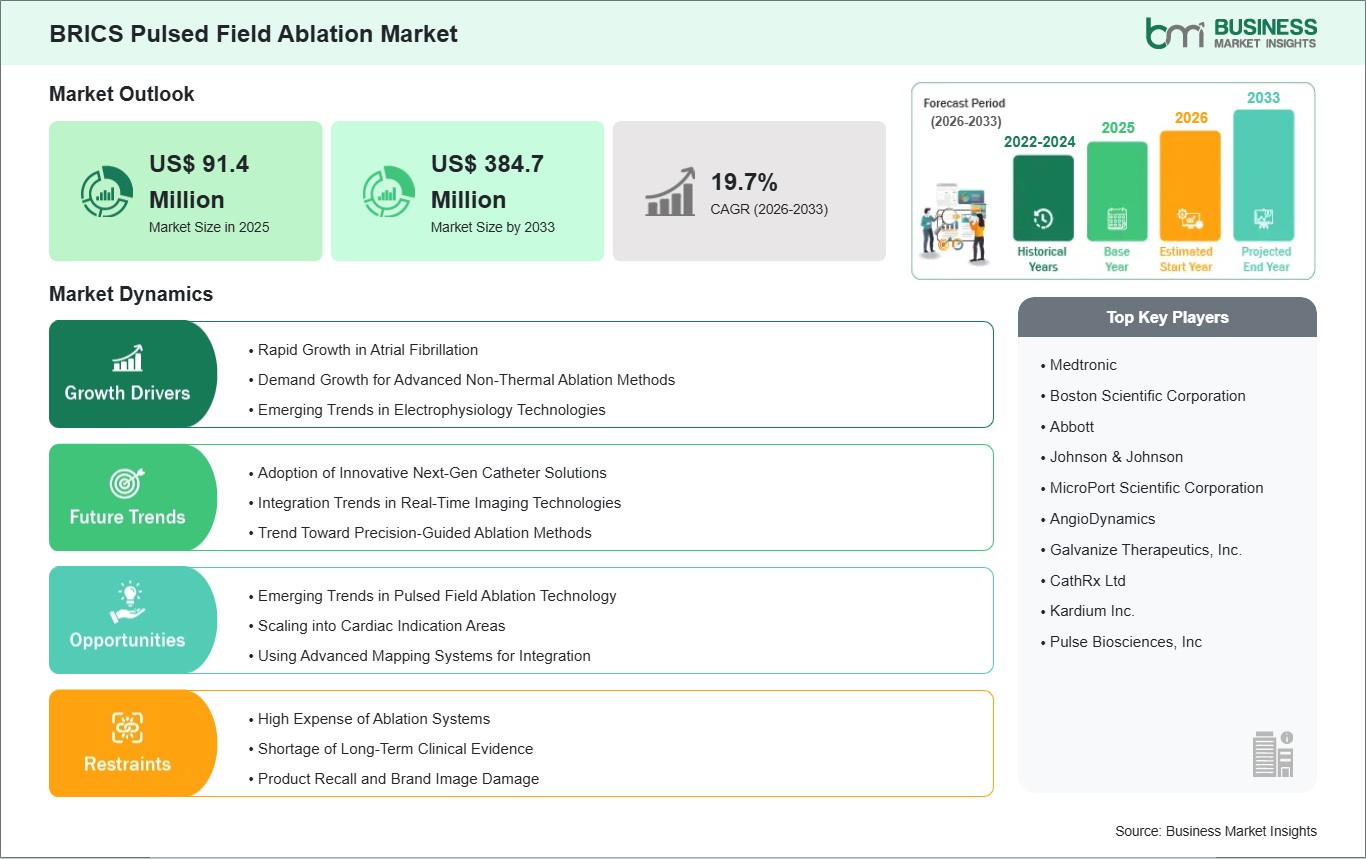
The BRICS pulsed field ablation market size is expected to reach US$ 384.7 million by 2033 from US$ 91.4 million in 2025. The market is estimated to register a CAGR of 19.7% from 2026 to 2033.
The BRICS pulsed field ablation (PFA) market is developing into a potentially lucrative market subset in the domain of cardiac electrophysiology, marked by selective uptake in sophisticated health facilities in the participating nations. The main factor behind the growth of this market segment is the growing number of patients diagnosed with various cardiovascular diseases, such as atrial fibrillation and other kinds of arrhythmia. PFA technology is popular because of the minimal invasion and non-thermal process involved in performing the procedure that enables the precise removal of abnormal tissue within the heart without causing damage to adjacent healthy tissues.
Growth within the BRICS market is further enhanced by improved investments in healthcare infrastructure, such as the building up of specialty electrophysiology labs, along with clinician training programs. Clinics located in more advanced urban centers are increasingly adopting PFA techniques in an effort to provide better patient results, reduce recovery periods, and ensure that they stay on the cutting edge of cardiac treatment technologies. Partnerships with international suppliers of cardiac medical technology are further helping to foster knowledge and implementation of the technology as well. The adoption of the technology within the BRICS markets also suffers from some constraints. The cost of the procedure, as well as specialized equipment, means that only top clinics can afford it, while there are not enough qualified specialists available.

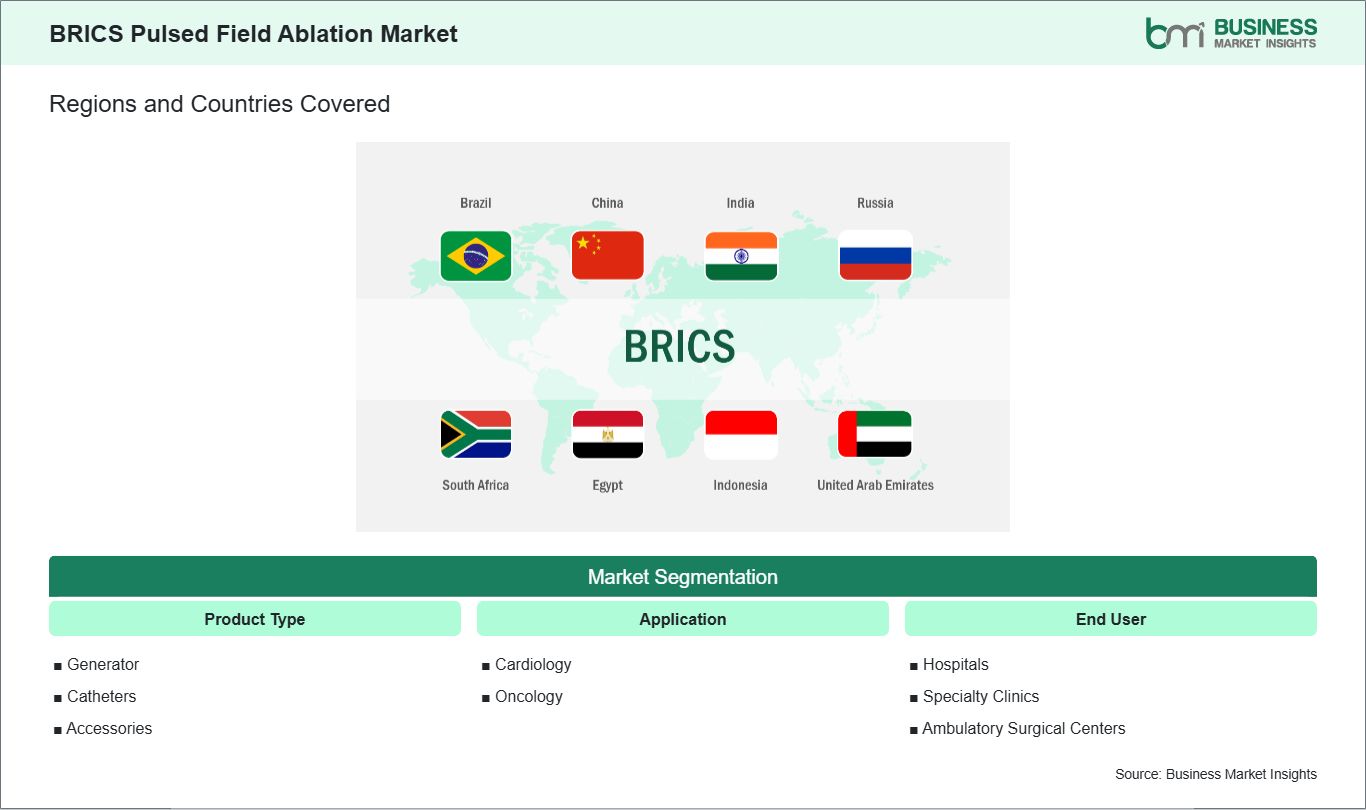
Key segments that contributed to the derivation of the BRICS pulsed field ablation market analysis are product type, application, and end user.
Atrial fibrillation (AF) is increasingly placing pressure on healthcare systems across the BRICS nations, driven by demographic changes, urbanization, and lifestyle shifts. Rapid population growth in countries such as Brazil, India, and South Africa, combined with aging populations in Russia and China, has contributed to a higher number of patients presenting with arrhythmias. Sedentary lifestyles, dietary transitions, and rising prevalence of cardiovascular risk factors have amplified the clinical burden. Hospitals and cardiac centers are responding by expanding screening programs, strengthening diagnostic capabilities, and prioritizing early intervention to prevent complications such as stroke, heart failure, and other long-term cardiac disorders.
Healthcare providers are also investing in specialized cardiology and electrophysiology services to meet increasing patient volumes. Clinicians are focusing on minimally invasive procedures that provide precision and reproducible outcomes while reducing procedural risk and recovery time. By optimizing care pathways and improving workflow efficiency, hospitals can manage larger patient populations without compromising quality of care.
The rising incidence of AF presents a strategic opportunity for advanced therapies. Pulsed field ablation (PFA) offers a tissue-selective approach that minimizes collateral damage and procedural complications while enhancing procedural efficiency. Its adoption enables hospitals to deliver safer, faster, and more effective arrhythmia treatment, strengthening cardiac care capabilities and supporting scalable, high-quality interventions across the diverse BRICS healthcare landscape.
Pulsed field ablation (PFA) is driving innovation in arrhythmia management across BRICS nations, providing a precise, safe, and efficient alternative to conventional thermal ablation. PFA uses high-voltage electrical pulses to selectively target cardiac tissue while sparing surrounding structures, reducing procedural complications and supporting quicker recovery. Recent advancements in catheter design, energy delivery, and integration with mapping and visualization systems have enhanced procedural accuracy, consistency, and clinician confidence, enabling complex interventions to be performed safely across diverse healthcare environments.
Healthcare institutions in BRICS countries are supporting PFA adoption through investments in infrastructure, clinician training, and standardized procedural protocols. Training initiatives and workflow integration help reduce the learning curve, ensuring consistent procedural quality while improving operational efficiency. Hospitals are leveraging these advancements to manage rising AF patient volumes effectively and safely, strengthening cardiac care capabilities and optimizing resource use.
Continued innovation in PFA is expected to accelerate modernization of arrhythmia care across the BRICS region. Enhancements in mapping integration, device usability, and procedural workflow support allow hospitals to deliver more predictable outcomes and higher procedural efficiency. Adoption of PFA aligns clinical effectiveness with operational priorities, improves patient safety, and positions healthcare providers to address the increasing prevalence of atrial fibrillation with advanced, scalable, and reliable therapies across BRICS markets.

The BRICS pulsed field ablation market demonstrates steady growth, with size and share analysis highlighting evolving trends and competitive dynamics among key players. The report evaluates important subsegments categorized within product type, application, and end user, highlighting their respective contributions to overall market performance.
By product type, the catheters subsegment dominated the market in 2025. Catheter devices offer improved procedural efficiency, reduced risk of complications, and real-time control for electrophysiologists, making them a crucial component for effective PFA therapy and a key revenue driver for manufacturers.
In terms of application, the cardiology subsegment dominated the market in 2025. The leadership of cardiology applications is attributed to the rising prevalence of atrial fibrillation and other cardiac arrhythmias, growing preference for non-thermal and tissue-selective ablation techniques, and increasing awareness among healthcare providers about the clinical benefits of PFA.
Based on end user, the hospitals subsegment dominated the market in 2025. Hospitals maintain a stronghold due to their established cardiology and electrophysiology departments, access to advanced PFA systems, trained physicians and clinical staff, and the capability to perform specialized cardiac procedures with comprehensive patient monitoring and post-procedure care.
| Report Attribute | Details |
|---|---|
| Market size in 2025 | US$ 91.4 Million |
| Market Size by 2033 | US$ 384.7 Million |
| CAGR (2026 - 2033) | 19.7% |
| Historical Data | 2022-2024 |
| Forecast period | 2026-2033 |
| Segments Covered | By Product Type
|
|
Regions and Countries Covered
| |
| BRICS | Russia, Brazil, South Africa, India, China, Egypt, Indonesia, Saudi Arabia, United Arab Emirates |
| Market leaders and key company profiles |
|
The "BRICS Pulsed Field Ablation Market Size and Forecast (2022–2033)" report provides a detailed analysis of the market covering below areas:
The geographical scope of the BRICS pulsed field ablation market report is divided into: Russia, Brazil, South Africa, India, China, Egypt, Indonesia, Saudi Arabia, and the UAE. China held the largest share in 2025.
China is dominant in the pulsed field ablation market with large amounts of people available as patients, a lot of high-tech medical facilities available, and a strong desire to incorporate new technologies used to treat heart disease. One factor leading to growth in PFA is the increasing prevalence of atrial fibrillation and other irregular heart rhythms, resulting in heavy demand for minimally invasive and effective procedures that can treat patients safely. Due to the PFA's unique non-thermal, tissue-selective mechanism of action, physicians have the ability to precisely target cardiac tissues while minimizing collateral damage. Thus, PFA potentially creates a safer environment for patients during the procedure, as well as increases the speed of recovery post-procedure; therefore, PFA is well-suited to a high-volume patient setting.
Development of the PFA market in China will be supported by significant investments in new electrophysiology laboratories and imaging systems. In addition, hospitals are establishing structured educational programs to improve the skill sets of their interventional cardiologists in the safe and effective performance of PFA procedures. This training is delivered through partnerships with equipment manufacturers, thus ensuring appropriate operational integration, knowledge transfer, and clinical best practices are followed. However, the high costs associated with the purchase of PFA systems and consumable supplies limit widespread availability; there is also an ongoing need to expand the pool of electrophysiologists trained to perform PFA procedures to address the growing patient demand. Although there are improvements being made with regard to the regulatory processes that medtech companies are required to navigate to be able to bring new technologies to market, these processes can still slow the rate at which new technologies are being adopted in clinical practice.

The BRICS pulsed field ablation market is evaluated by gathering qualitative and quantitative data post primary and secondary research, which includes important corporate publications, association data, and databases. A few of the key developments in the BRICS pulsed field ablation market are:
The BRICS Pulsed Field Ablation Market is valued at US$ 91.4 Million in 2025, it is projected to reach US$ 384.7 Million by 2033.
As per our report BRICS Pulsed Field Ablation Market, the market size is valued at US$ 91.4 Million in 2025, projecting it to reach US$ 384.7 Million by 2033. This translates to a CAGR of approximately 19.7% during the forecast period.
The BRICS Pulsed Field Ablation Market report typically cover these key segments-
The historic period, base year, and forecast period can vary slightly depending on the specific market research report. However, for the BRICS Pulsed Field Ablation Market report:
The BRICS Pulsed Field Ablation Market is populated by several key players, each contributing to its growth and innovation. Some of the major players include:
The BRICS Pulsed Field Ablation Market report is valuable for diverse stakeholders, including:
Essentially, anyone involved in or considering involvement in the BRICS Pulsed Field Ablation Market value chain can benefit from the information contained in a comprehensive market report.
Please tell us your area of interest
(Market Segments/ Regions and Countries/ Companies)