Market Summary
Executive Summary and Market Analysis
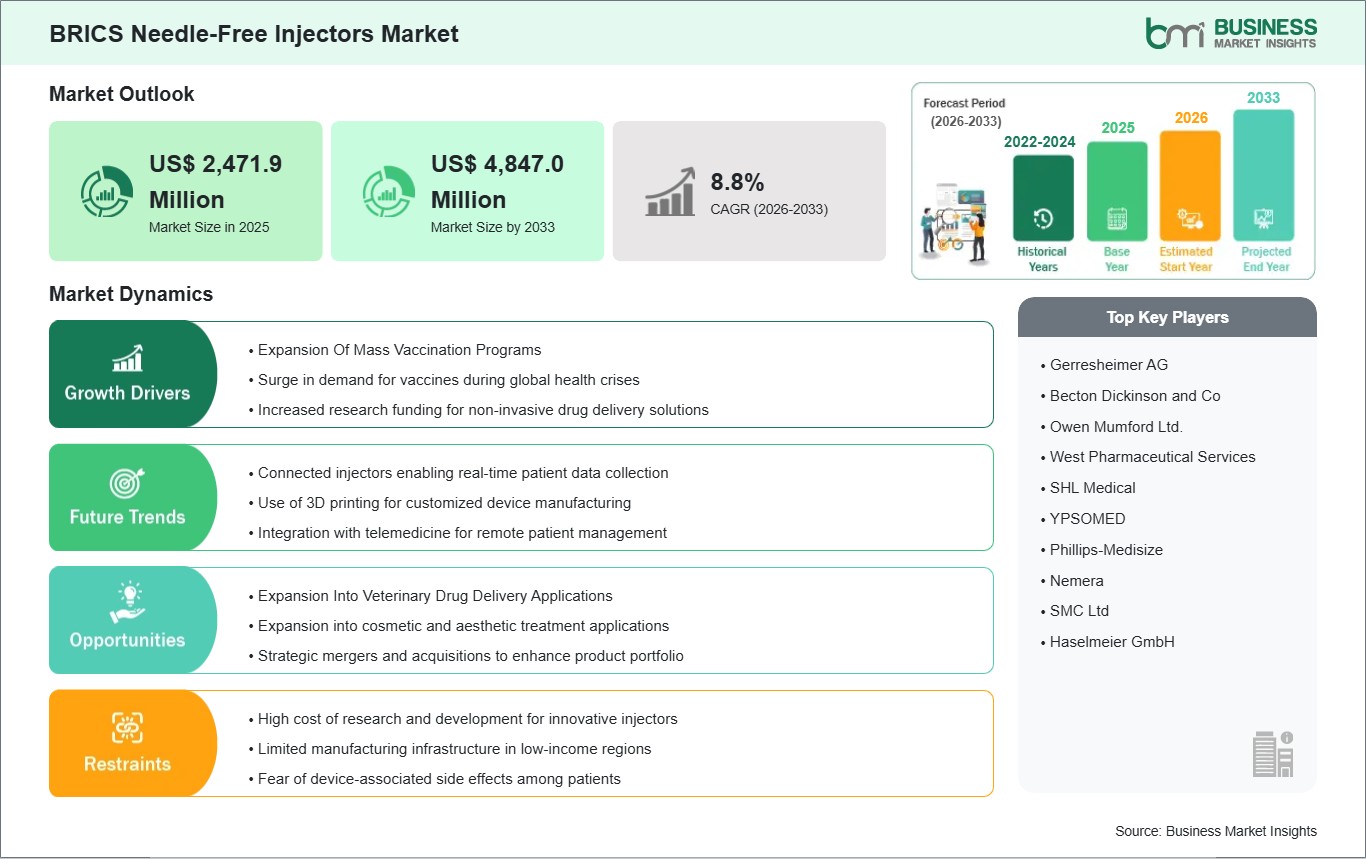
Across Brazil, Russia, India, China, and South Africa, the market is characterized by a mix of multinational manufacturers entering via partnerships and local device producers leveraging cost-effective production capabilities. Adoption is fueled by public health initiatives, vaccination campaigns, and outpatient care expansion, where needle-free injectors reduce risks of needle-stick injuries, improve compliance, and enhance efficiency in high-volume administration settings. Regulatory environments vary across the BRICS nations, with Brazil and China implementing stringent device approval procedures, while India and South Africa show a more flexible framework for pilot studies and early adoption programs. Market dynamics emphasize factors such as product reliability, adaptability to different drug formulations, and integration with hospital workflow systems. Buyers evaluate devices based on total cost of ownership, considering training, maintenance, consumables management, and risk mitigation. Competitive differentiation is shaped by technological innovation, including disposable systems, high-precision dosing, and ergonomically designed devices aimed at healthcare professionals and patient self-administration. Strategic collaborations between pharmaceutical companies and device manufacturers are becoming more common to ensure compatibility with biologics and vaccines. The market reflects a transition from initial awareness and pilot deployments toward structured adoption, supported by policy-driven healthcare initiatives and growing emphasis on patient safety, operational efficiency, and cost-effective delivery solutions.
Segment Analysis
BRICS Needle-Free Injectors Market Segmentation
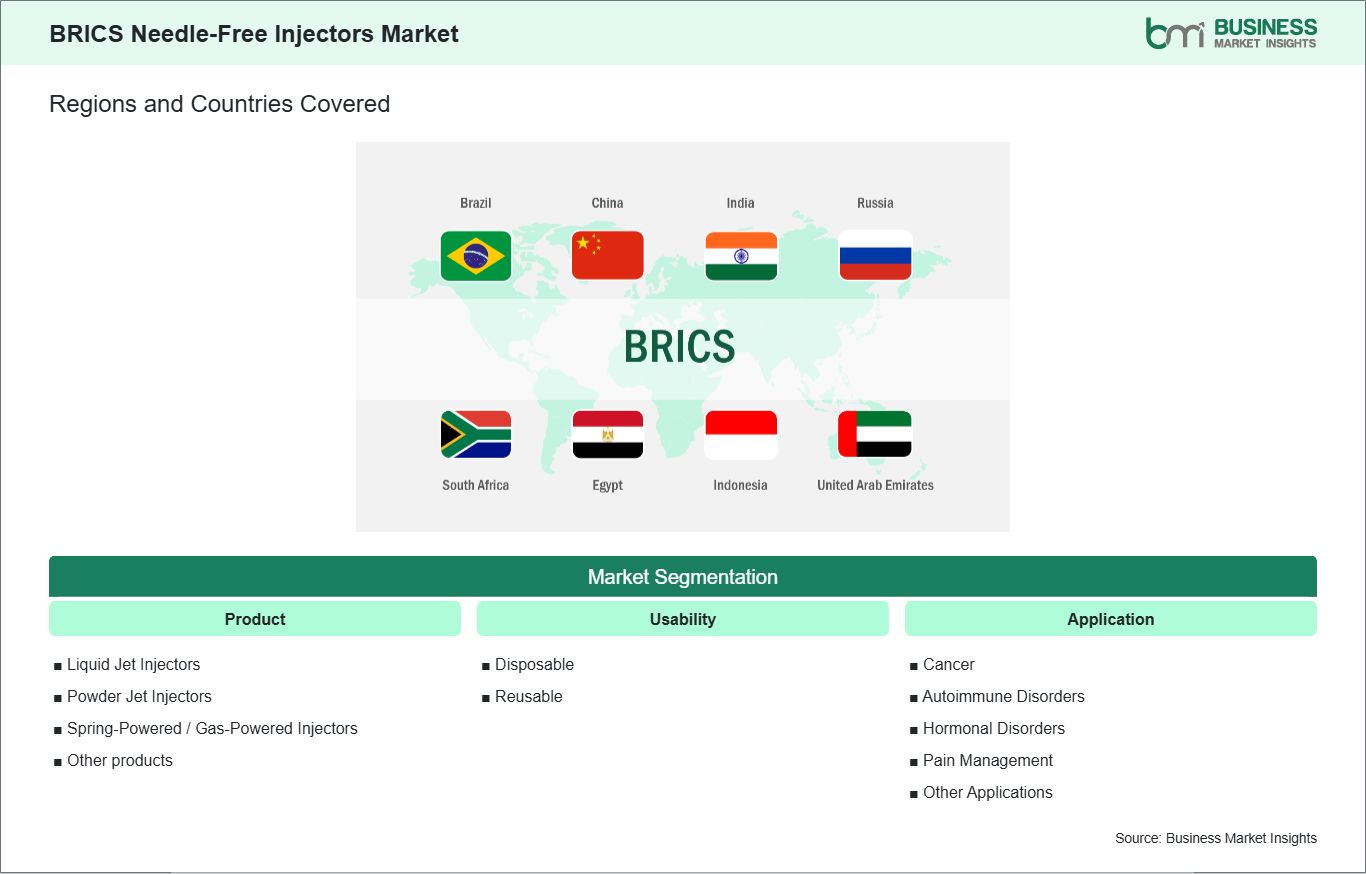
Key segments that contributed to the derivation of the BRICS needle-free injectors market analysis are product, usability, and application.
- By product, the needle-free injectors market is segmented into liquid jet injectors, powder jet injectors, spring-powered / gas-powered injectors, and other products. The liquid jet injectors segment dominated the market in 2025.
- Based on usability, the needle-free injectors market is categorized into disposable and reusable. The disposable segment dominated the market in 2025.
- In terms of application, the market is classified into cancer, autoimmune disorders, hormonal disorders, pain management, and other applications. The autoimmune disorders segment dominated the market in 2025.
Market Forces
BRICS Needle-Free Injectors Market Drivers and Opportunities
Expansion Of Mass Vaccination Programs
The region has seen a strong focus on public health initiatives, with mass vaccination programs becoming a central pillar of national healthcare strategies. Countries such as Brazil, India, and South Africa are implementing large-scale immunization drives to prevent infectious diseases. Needle-free injectors play a key role in these programs by enabling faster, safer, and more efficient vaccine administration, particularly in densely populated or resource-limited areas where large numbers of doses must be delivered in a short time. Needle-free injectors overcome common barriers in vaccination campaigns, such as needle phobia, fear of pain, and the risk of needle-stick injuries for healthcare workers. By providing a painless delivery option, these devices improve patient compliance, especially among children and populations with limited exposure to healthcare facilities. In regions with diverse geographies and remote communities, the portability and ease of use of needle-free systems are critical for ensuring wide coverage and timely immunization. Governments and health organizations are prioritizing efficiency and safety in vaccine distribution. Needle-free injectors reduce the risk of cross-contamination and minimize waste compared to traditional syringes, making them well-suited for large-scale campaigns. As these countries expand vaccination programs to combat endemic and emerging diseases, needle-free injectors are viewed as an essential tool for modern public health initiatives, supporting the goal of higher vaccination coverage and improved population health outcomes.
Expansion Into Veterinary Drug Delivery Applications
Livestock and companion animal populations require regular medication, including vaccines and biologics, and traditional injections can pose challenges such as stress for animals, risk of injury to handlers, and time-intensive administration. Needle-free injectors address these issues by offering a faster, less stressful, and safer method of drug delivery, enhancing animal welfare and operational efficiency. Countries such as India, Brazil, and Russia are investing in modern veterinary practices to support livestock productivity and public health. Needle-free systems are useful in large-scale livestock operations, where high-volume dosing is needed, and in urban settings where companion animals are receiving preventive care. The adoption of needle-free injectors improves compliance with vaccination schedules, reduces handling risks, and allows veterinarians to administer medications across diverse animal populations. Veterinary applications serve as a strategic avenue for market growth by demonstrating the versatility of needle-free technology beyond human healthcare. Manufacturers are collaborating with veterinary institutions to develop specialized devices for different species and dosage requirements, creating opportunities for innovation and market differentiation. As awareness of animal health and welfare continues to rise, needle-free injectors are expected to gain wider acceptance in both livestock and companion animal care, contributing to the expansion of the BRICS needle-free injector market.
Size and Share Analysis
BRICS Needle-Free Injectors Market Size and Share Analysis
The BRICS Needle-free Injectors Market demonstrates steady growth, with size and share analysis highlighting evolving trends and competitive dynamics among key players. The report examines subsegments categorized within product, usability, and application, offering insights into their contribution to overall market performance.
By product, the liquid jet injectors subsegment dominated the market in 2025, driven by their ability to deliver large volumes of medication quickly and accurately, making them suitable for mass vaccination campaigns and chronic therapy.
Based on usability, the disposable subsegment dominated the market in 2025, driven by the need for enhanced hygiene, infection control, and convenience in high-volume clinical and community healthcare settings.
In terms of application, the autoimmune disorders subsegment dominated the market in 2025, driven by the requirement for frequent, long-term injections where patient comfort, adherence, and safety are critical for disease management.
Report Coverage
BRICS Needle-Free Injectors Market Report Coverage and Deliverables
The "BRICS Needle-free Injectors Market Size and Forecast (2022–2033)" report provides a detailed analysis of the market covering below areas:
- BRICS Needle-free Injectors Market size and forecast at regional and country levels for all market segments covered under the scope
- BRICS Needle-free Injectors Market trends, as well as drivers, restraints, and opportunities
- BRICS Needle-free Injectors Market analysis covering key trends, regional framework, major players, regulations, and recent developments
- Industry landscape and competition analysis covering market concentration, heat map analysis, prominent players, and recent developments for the BRICS Needle-free Injectors Market
- Detailed company profiles, including SWOT analysis
Geographic Insights
BRICS Needle-Free Injectors Market Geographic Insights
The geographical scope of the BRICS Needle-free Injectors Market report is divided into Russia, Brazil, South Africa, India, the UAE, and China. China held the largest share in 2025.
In China, demand is concentrated in public hospitals and vaccination campaigns, with procurement influenced by federal and state-level health programs. Russia emphasizes advanced clinical applications in hospitals and research centers, where precision and regulatory compliance are critical for adoption. India is highly price-sensitive, with selective uptake in urban private hospitals, large immunization drives, and pilot projects promoted by distributors and NGOs. Brazil represents a technology-driven landscape with growing interest in biologics, home-based therapy, and digital integration, supported by large-scale government initiatives and domestic manufacturing capacity. South Africa reflects high adoption in urban private healthcare systems and NGO-supported rural outreach programs. Across the BRICS nations, pilot studies, clinician advocacy, and distributor-led training are pivotal in shaping adoption patterns. Local regulatory compliance, reimbursement structures, and supply chain efficiency influence both market entry. These country insights demonstrate that the BRICS needle-free injectors market is heterogeneous, requiring region-specific strategies, localized partnerships, and nuanced commercialization approaches to navigate varying clinical, economic, and regulatory environments.
Industry Activity
Recent Developments
The BRICS Needle-free Injectors Market is evaluated by gathering qualitative and quantitative data post primary and secondary research, which includes important corporate publications, association data, and databases. A few of the key developments in the BRICS needle-free injectors market are:
- In December 2025, Intas Pharmaceuticals signed an agreement with IntegriMedical to deploy needle‑free injection systems for in‑vitro fertilisation (IVF) and gynaecology therapies across India, targeting a national rollout by early The partnership aims to enhance patient comfort in fertility care settings and scale product use across specialist clinics — an extension of needle‑free technology into new therapeutic domains within a BRICS member state.
- In May 2024, the Serum Institute of India (SII) announced a strategic investment to acquire a 20 % stake in IntegriMedical to support the development, commercialization, and scaling of the Needle‑Free Injection System technology. This partnership underscores a BRICS‑region collaboration aimed at accelerating access to needle‑free delivery platforms across India and potentially into other emerging markets. The investment is intended to reduce needle‑stick injuries and improve patient comfort while paving the way for broader rollout collaborations.
Trust & Transparency
Research Methodology
The market analysis combines proprietary research with secondary data from government agencies, company disclosures, regulatory filings, industry databases and expert interviews. Market estimates are validated through data triangulation, cross-market benchmarking and analyst
review.
View Full Research Methodology
Key Sources Referred:
World Health Organization (WHO)Organisation for Economic Cooperation and Development (OECD)The World Bank GroupWorldometerThe LancetInternational Bar AssociationInternational Trade Administration