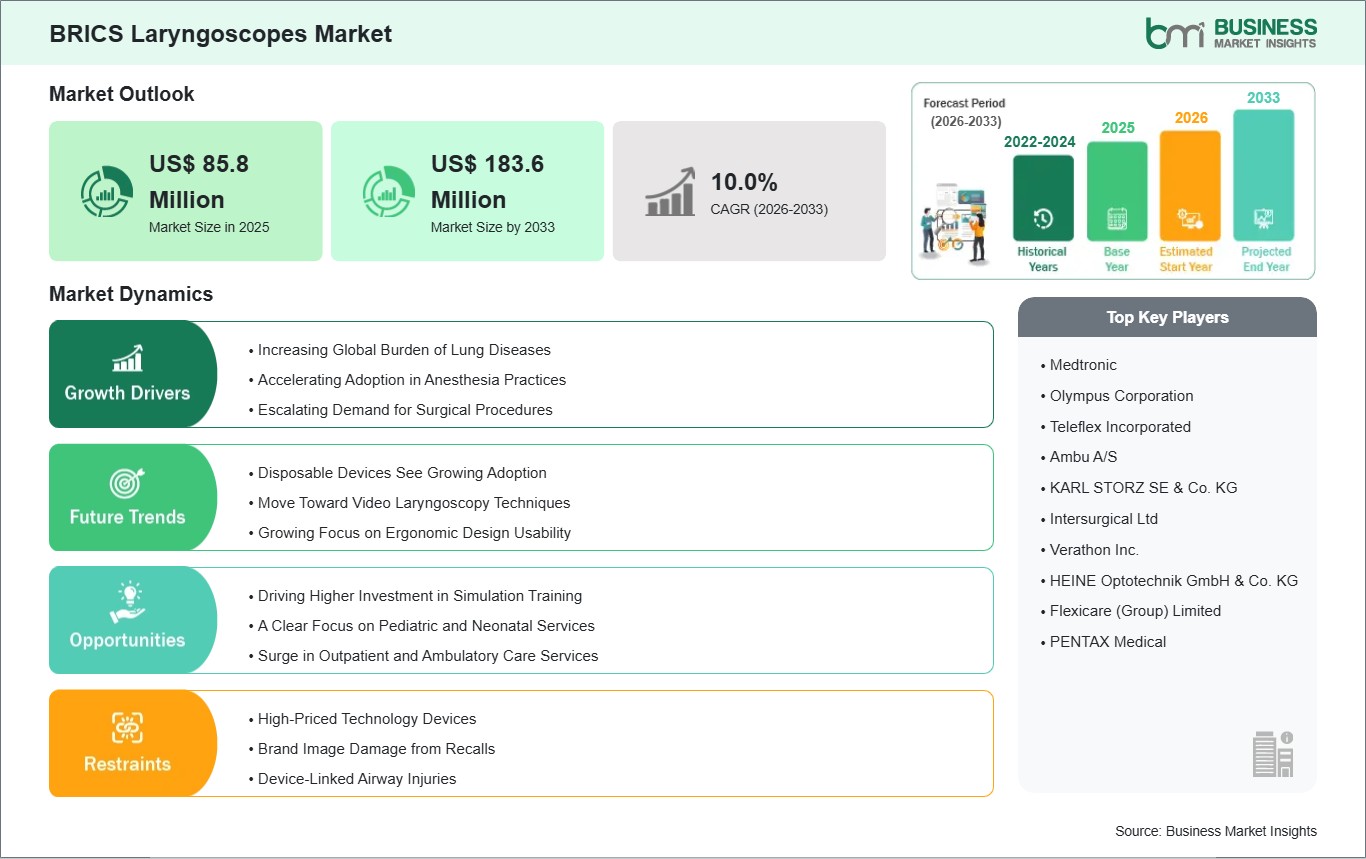
The BRICS laryngoscopes market size is expected to reach US$ 183.6 million by 2033 from US$ 85.8 million in 2025. The market is estimated to record a CAGR of 10.0% from 2026 to 2033.
The BRICS market of laryngoscopes is influenced by the fast development and modernization of the healthcare sector in Brazil, Russia, India, China, and South Africa, owing to growing requirements of advanced surgical procedures and emergency care measures. The use of laryngoscopes is an important procedure involved in anesthesia, intensive care units, and emergency medicine, which is associated with the growing number of surgeries and critical care cases. The market is characterized by a steady trend towards a shift from direct laryngoscopes to video-assisted devices due to the necessity to ensure better visualization, increased procedure efficiency, and patient safety.
Investment in the development of the healthcare infrastructure in terms of developing more hospital facilities, improving the operations theater, and increasing emergency service centers has been going on. The increasing incidence of diseases that require surgery and respiratory diseases has contributed significantly to an increasing demand for airway management tools. Moreover, the trend of adopting minimally invasive surgical procedures in BRICS has increased the use of laryngoscopy tools in both government and privately owned healthcare facilities.
However, the vast differences in the development of healthcare infrastructure among the member countries lead to uneven adoption of the advanced laryngoscopes, which means that some countries still continue to use basic devices. Being cost-sensitive in nature, public health infrastructures restrict their use owing to their high cost. Besides, using imported medical tools creates certain problems regarding procurement and cost issues.

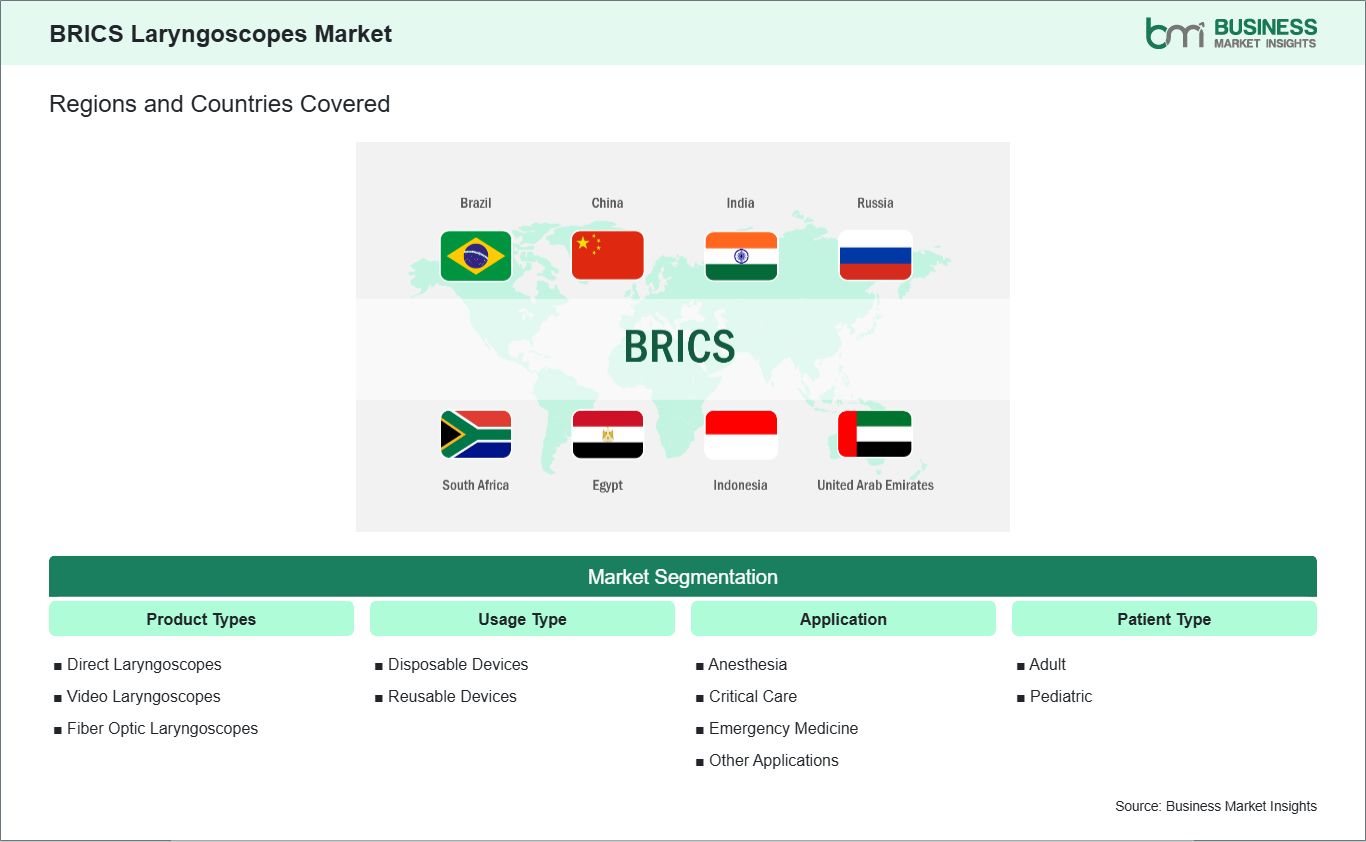
Key segments that contributed to the derivation of the BRICS laryngoscopes market analysis are product type, usage type, application, patient type, and end user.
The BRICS countries are experiencing a steadily rising burden of lung and respiratory diseases, driven by rapid urbanization, industrial growth, and environmental stress. Megacities like Shanghai, Mumbai, São Paulo, Moscow, and Johannesburg frequently face air quality challenges linked to vehicular emissions, coal-based energy use, and industrial pollutants. These environmental conditions contribute to higher incidence of chronic respiratory conditions like asthma, COPD, and occupational lung diseases, increasing the need for airway management interventions in hospitals.
In addition to environmental factors, lifestyle and demographic changes are making matters worse for the respiratory system health of patients in the BRICS region. The high rates of smoking in China, Russia, and South Africa keep playing a major role in contributing to chronic damage to the lungs, while in India and Brazil, the problem is being compounded further due to the issue of increased air pollution inside people's homes due to biomass fuel usage in remote or peri-urban areas.
Infections make things difficult for patients and health workers dealing with airway management in BRICS countries. The seasonal flu epidemic, along with the prevalence of tuberculosis in India and South Africa, is putting strain on the work done in emergency rooms as well as ICU. While in some areas of BRICS there have been improvements in terms of access to healthcare facilities, the variability in the early diagnosis and treatment of diseases keeps resulting in advanced cases of respiratory problems that also require laryngoscope intubations.
Healthcare systems across BRICS are increasingly prioritizing simulation-based training to address disparities in clinical skills and improve patient safety in high-risk procedures like airway management. Medical universities and teaching hospitals in China, Brazil, and India are expanding simulation centers where clinicians practice intubation techniques using high-fidelity mannequins and digital feedback systems. This is particularly important in large healthcare systems where training consistency across regions can vary significantly.
Simulation training in BRICS emerging healthcare facilities is being employed as a means of mitigating shortages and discrepancies in access to clinical experience. In rural areas of India or distant provinces of Brazil and China, healthcare professionals may have little exposure to complicated airway situations. Through simulations, healthcare providers can have numerous opportunities to encounter problematic situations regarding airways, making it more likely that they will perform without procedural mistakes during the use of laryngoscopes in actual emergency situations.
Moreover, modernization initiatives in national healthcare systems, as well as collaboration between different facilities, provide an opportunity for inclusion of novel airway devices into training programs. Training programs at hospitals and educational institutions are gradually converging with actual equipment in clinics; consequently, trainees receive not only theoretical knowledge but also practice with both conventional and video-assisted laryngoscopes. Gradually, such convergence of training and practices enhances the demand for modern airway devices.

The BRICS Laryngoscopes market demonstrates steady growth, with size and share analysis highlighting evolving trends and competitive dynamics among key players. The report evaluates important subsegments categorized within product type, usage type, application, patient type, and end user, highlighting their respective contributions to overall market performance.
By product type, the video laryngoscopes subsegment dominated the laryngoscopes market in 2025. This is driven by the increasing demand for enhanced airway visualization, improved first-pass intubation success rates, and reduced complications in difficult airway management, making them a key revenue driver for manufacturers and supporting strong adoption in clinical practice.
In terms of usage type, the disposable devices subsegment led the market in 2025. The dominance of disposable devices is attributed to the growing emphasis on infection control, prevention of cross-contamination, and the operational convenience of eliminating reprocessing and sterilization requirements in high-volume healthcare settings.
Based on application, the anesthesia subsegment held the largest share in 2025. Hospitals and surgical centers widely rely on laryngoscopes during anesthesia procedures for airway management and intubation, supported by the rising number of surgeries and the increasing use of advanced airway management techniques.
In terms of patient type, the adult subsegment dominated the market in 2025. This is driven by the higher prevalence of surgical procedures, critical care admissions, and chronic respiratory conditions among adults, resulting in greater demand for airway management devices in this population group.
By end user, the hospitals subsegment held the largest share in 2025. Hospitals maintain leadership due to their advanced infrastructure, availability of skilled healthcare professionals, high patient inflow, and strong capability to perform complex surgical and emergency procedures requiring laryngoscopy.
| Report Attribute | Details |
|---|---|
| Market size in 2025 | US$ 85.8 Million |
| Market Size by 2033 | US$ 183.6 Million |
| CAGR (2026 - 2033) | 10.0% |
| Historical Data | 2022-2024 |
| Forecast period | 2026-2033 |
| Segments Covered | By Product Types
|
|
Regions and Countries Covered
| |
| BRICS | Russia, Brazil, South Africa, India, China, Egypt, Indonesia, Saudi Arabia, United Arab Emirates |
| Market leaders and key company profiles |
|
The "BRICS Laryngoscopes Market Size and Forecast (2022-2033)" report provides a detailed analysis of the market covering below areas:
The geographical scope of the BRICS Laryngoscopes market report is divided into: Russia, Brazil, South Africa, India, China, Egypt, Indonesia, Saudi Arabia, and the UAE. China held the largest share in 2025.
China is benefited with its comprehensive healthcare facilities, large patient pool, and continual upgrades to modernize its healthcare facilities. There is evidence that the healthcare facilities in China, especially the urban areas and tier one cities, have adopted advanced airway management techniques, such as the use of video laryngoscopy technology. It is because China focuses on increasing the accuracy of treatment and minimizing any possible complications while performing the intubation procedure. Another factor that encourages the use of laryngoscope devices includes the heavy investment made in the construction of hospitals and their critical care units.
The unique aspect of the Chinese market is its reliance on domestically made medical equipment. Local manufacturing helps China to develop innovative and affordable laryngoscopes, which can be easily adopted by various hospitals. Moreover, the importance that China gives to clinical training and anesthesia ensures the consistent use of laryngoscopes in medical institutions. The market remains structurally diverse despite having such a technologically sophisticated health care system in place. The highest-tier health facilities adopt the latest technologies first, with respect to next-generation video-assisted devices. In contrast, smaller and rural hospitals have to resort to using laryngoscope equipment owing to their inability to afford otherwise. Consequently, a diversified picture emerges in terms of technological diffusion in the sector.

The BRICS Laryngoscopes market is evaluated by gathering qualitative and quantitative data post primary and secondary research, which includes important corporate publications, association data, and databases. A few of the key developments in the BRICS Laryngoscopes market are:
The BRICS Laryngoscopes Market is valued at US$ 85.8 Million in 2025, it is projected to reach US$ 183.6 Million by 2033.
As per our report BRICS Laryngoscopes Market, the market size is valued at US$ 85.8 Million in 2025, projecting it to reach US$ 183.6 Million by 2033. This translates to a CAGR of approximately 10.0% during the forecast period.
The BRICS Laryngoscopes Market report typically cover these key segments-
The historic period, base year, and forecast period can vary slightly depending on the specific market research report. However, for the BRICS Laryngoscopes Market report:
The BRICS Laryngoscopes Market is populated by several key players, each contributing to its growth and innovation. Some of the major players include:
The BRICS Laryngoscopes Market report is valuable for diverse stakeholders, including:
Essentially, anyone involved in or considering involvement in the BRICS Laryngoscopes Market value chain can benefit from the information contained in a comprehensive market report.
Please tell us your area of interest
(Market Segments/ Regions and Countries/ Companies)