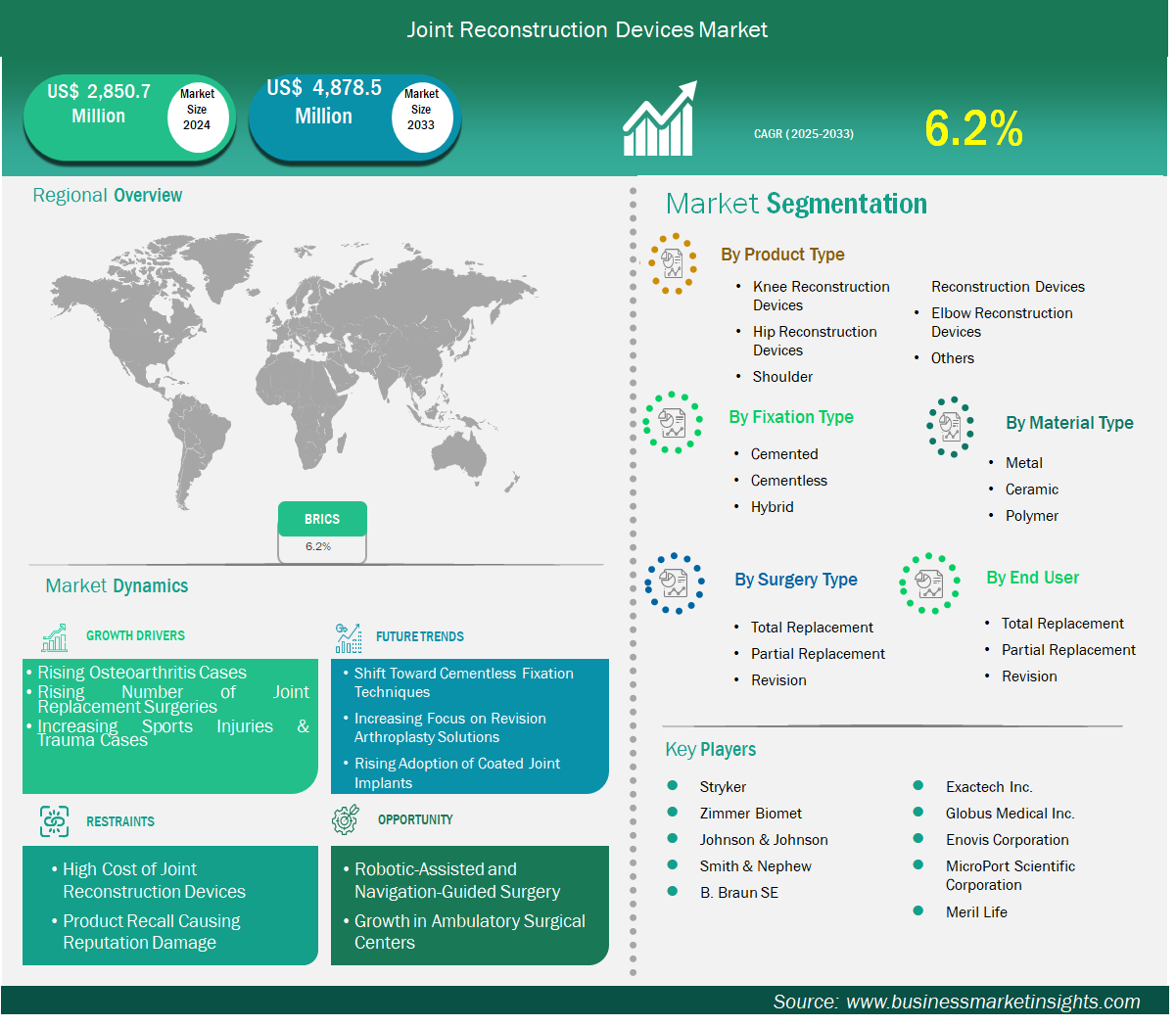
BRICS joint reconstruction devices market size is expected to reach US$ 4,878.5 million by 2033 from US$ 2,850.7 million in 2024. The market is estimated to record a CAGR of 6.2% from 2025 to 2033.
Executive Summary and BRICS Joint Reconstruction Devices Market Analysis:
The joint reconstruction devices market across BRICS nations is diverse, reflecting varying levels of healthcare development and infrastructure. China and India are the most dynamic among them, with rapidly expanding markets driven by aging populations, high prevalence of osteoarthritis, and growing access to orthopedic care. Both countries are witnessing strong product demand, increased adoption of minimally invasive techniques, and domestic manufacturing that enhances affordability and access. Brazil presents a stable market with a strong private healthcare sector and growing use of modern joint reconstruction technologies, particularly in urban centers. Russia’s market is facing ongoing challenges due to supply disruptions and limited access to Western products. However, demand for trauma and reconstructive care remains high, with a shift toward local production and regional alternatives
Key segments that contributed to the derivation of the joint reconstruction devices market analysis are product type, fixation type, material type, surgery type, and end user
By product type, the joint reconstruction devices market is segmented into knee reconstruction devices, hip reconstruction devices, shoulder reconstruction devices, elbow reconstruction devices, others. The knee reconstruction devices segment dominated the market in 2024.
By fixation type, the joint reconstruction devices market is segmented into cemented, cementless, and hybrid. The cemented segment dominated the market in 2024.
By material type, the market is segmented into metal, ceramic and polymer. The metal segment held the largest share of the market in 2024.
By surgery type, the market is segmented into total replacement, partial replacement, and revision. The total replacement segment held the largest share of the market in 2024.
By end user, the market is segmented into hospitals, ambulatory surgical centers, and orthopedic clinics. The hospitals segment held the largest share of the market in 2024.
BRICS Joint Reconstruction Devices Market Outlook
BRICS nations including Brazil, Russia, India, China and South Africa contributed towards the growth of joint reconstruction devices market as a result of aging population, growing incidence of joint problems and increasing demands for orthopedic treatments. China and India are volume leaders because of their large populations and growing access to healthcare, and Brazil and Russia, because of improving surgical infrastructure and insurance coverage. South Africa, on a smaller scale, exhibits the urban side of growth, where there has been an investment in private healthcare. In BRICS, the expanding of middle class, government-sponsored health programs, and the increase in medical tourism, especially in India and Brazil are providing fillip to the joint reconstruction surgery. Besides, growing local manufacturing facilities and persisting public investment in contract manufacturers are improving affordability and access and making BRICS an important force in the worldwide joint reconstruction devices sector.
BRICS Joint Reconstruction Devices Market Country Insights
Based on region, the BRICS Joint Reconstruction devices Market is further segmented into the Russian Federation, Brazil, South Africa, India, and China. The China held the largest share in 2024.
China dominates the joint replacement devices market in the BRICS economic grouping. The country has a high elderly population, rising osteoarthritis prevalence, and a developing healthcare infrastructure. There has been an intense increase in joint replacement surgeries for knees and hips in the country with the expansion of insurance coverage and increase in the number of specialized orthopedic centers. Urbanization and health consciousness have gone about as key factors for patients to get early surgical interventions. Also, the local manufacturing capacity is improving with the implants turning out to be cheaper and more readily available. Major reforms are under way in the healthcare system, including volume-based procurement and upgrade of public hospitals, which are significantly bringing down the cost of implants while improving access to orthopedic care across urban and half-urban areas, leading to an enhanced demand scenario across domains.
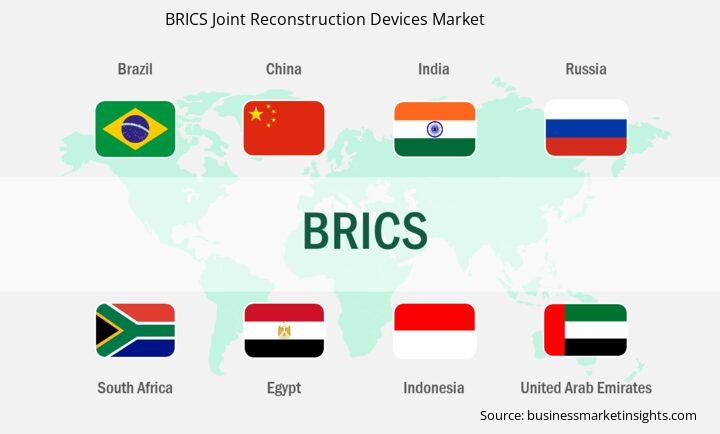
Russian Federation, Brazil, South Africa, India, China, Egypt, Indonesia, United Arab Emirates
Market leaders and key company profiles
Stryker
Zimmer Biomet
Johnson & Johnson
Smith & Nephew
B. Braun SE
Exactech Inc.
Globus Medical Inc.
Enovis Corporation
MicroPort Scientific Corporation
Meril Life
Get more information on this report
BRICS Joint Reconstruction Devices Market Company Profiles
Stryker, Zimmer Biomet, Johnson & Johnson, Smith & Nephew, B. Braun SE, Exactech Inc., Globus Medical Inc., Enovis Corporation, MicroPort Scientific Corporation, and Meril Life are among the key players operating in the market. These players adopt strategies such as expansion, product innovation, and mergers and acquisitions to stay competitive in the market and offer innovative products to their consumers.
BRICS Joint Reconstruction Devices Market Research Methodology:
The following methodology has been followed for the collection and analysis of data presented in this report:
Secondary Research
The research process begins with comprehensive secondary research, utilizing both internal and external sources to gather qualitative and quantitative data for each market. Commonly referenced secondary research sources include, but are not limited to:
Company websites, annual reports, financial statements, broker analyses, and investor presentations
Industry trade journals and other relevant publications
Government documents, statistical databases, and market reports
News articles, press releases, and webcasts specific to companies operating in the market
Note: All financial data included in the Company Profiles section has been standardized to US$. For companies reporting in other currencies, figures have been converted to US$ using the relevant exchange rates for the corresponding year.
Primary Research
Business Market Insights conducts a significant number of primary interviews each year with industry stakeholders and experts to validate and analyze the data and gain valuable insights. These research interviews are designed to:
Refine findings from secondary research
Enhance the expertise and market understanding of the analysis team
Gain insights into market size, trends, growth patterns, competitive dynamics, and future prospects
Primary research is conducted via email interactions and telephone interviews with industry experts across various markets, categories, segments, and sub-segments in different regions. Participants typically include:
Industry stakeholders: Vice Presidents, business development managers, market intelligence managers, and national sales managers
External experts: Valuation specialists, research analysts, and key opinion leaders with industry-specific expertise
BRICS Joint Reconstruction Devices Market Country and Regional Insights
The List of Companies - BRICS Joint Reconstruction Devices Market
Stryker Zimmer Biomet Johnson & Johnson Smith & Nephew B. Braun SE Exactech Inc. Globus Medical Inc. Enovis Corporation MicroPort Scientific Corporation Meril Life
Krishna is a Market Research Analyst with over 4 years of experience across Life Sciences and Materials & Chemicals industries. He holds a Bachelor's degree in Pharmacy (B.Pharm.) and a Master's degree in Pharmaceutical Medicinal Chemistry (M.Pharm.). His expertise spans market intelligence, competitive benchmarking, market sizing and forecasting, primary and secondary research, and strategic consulting.
Krishna has successfully contributed to numerous syndicated and custom research engagements, delivering industry reports, market assessments, competitive analyses, and business proposals for clients across diverse sectors. With ..
Show More
Frequently Asked Questions
How big is the BRICS Joint Reconstruction Devices Market?
The BRICS Joint Reconstruction Devices Market is valued at US$ 2,850.7 Million in 2024, it is projected to reach US$ 4,878.5 Million by 2033.
What is the CAGR for BRICS Joint Reconstruction Devices Market by (2025 - 2033)?
As per our report BRICS Joint Reconstruction Devices Market, the market size is valued at US$ 2,850.7 Million in 2024, projecting it to reach US$ 4,878.5 Million by 2033. This translates to a CAGR of approximately 6.2% during the forecast period.
What segments are covered in this report?
The BRICS Joint Reconstruction Devices Market report typically cover these key segments-
Product Type (Knee Reconstruction Devices, Hip Reconstruction Devices, Shoulder Reconstruction Devices, Elbow Reconstruction Devices, Others)
Fixation Type (Cemented, Cementless, Hybrid)
Material Type (Metal, Ceramic, Polymer)
Surgery Type (Total Replacement, Partial Replacement, Revision)
What is the historic period, base year, and forecast period taken for BRICS Joint Reconstruction Devices Market?
The historic period, base year, and forecast period can vary slightly depending on the specific market research report. However, for the BRICS Joint Reconstruction Devices Market report:
Historic Period : 2022-2023
Base Year : 2024
Forecast Period : 2025-2033
Who are the major players in BRICS Joint Reconstruction Devices Market?
The BRICS Joint Reconstruction Devices Market is populated by several key players, each contributing to its growth and innovation. Some of the major players include:
Stryker
Zimmer Biomet
Johnson & Johnson
Smith & Nephew
B. Braun SE
Exactech Inc.
Globus Medical Inc.
Enovis Corporation
MicroPort Scientific Corporation
Meril Life
Who should buy this report?
The BRICS Joint Reconstruction Devices Market report is valuable for diverse stakeholders, including:
Investors: Provides insights for investment decisions pertaining to market growth, companies, or industry insights. Helps assess market attractiveness and potential returns.
Industry Players: Offers competitive intelligence, market sizing, and trend analysis to inform strategic planning, product development, and sales strategies.
Suppliers and Manufacturers: Helps understand market demand for components, materials, and services related to concerned industry.
Researchers and Consultants: Provides data and analysis for academic research, consulting projects, and market studies.
Financial Institutions: Helps assess risks and opportunities associated with financing or investing in the concerned market.
Essentially, anyone involved in or considering involvement in the BRICS Joint Reconstruction Devices Market value chain can benefit from the information contained in a comprehensive market report.





 Get Free Sample For BRICS Joint Reconstruction Devices Market