Market Summary
Executive Summary and Market Analysis
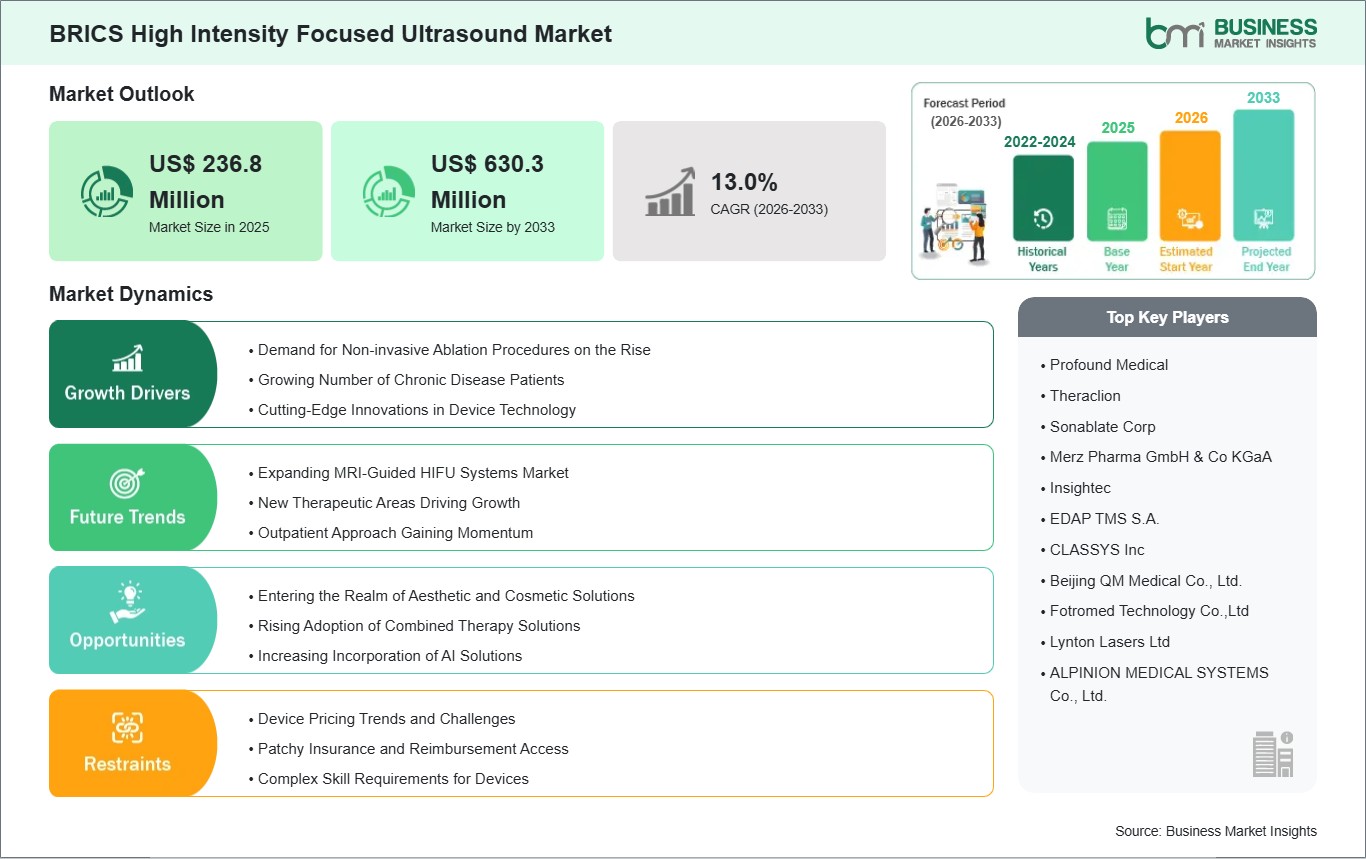
The BRICS region is witnessing growing interest in High Intensity Focused Ultrasound (HIFU) technologies, driven by the increasing demand for non-invasive therapeutic procedures and rising investment in advanced healthcare infrastructure. Hospitals and specialty clinics are exploring HIFU for applications such as prostate treatments, uterine fibroids, and certain localized tumors, owing to its precision, minimal recovery time, and reduced surgical complications. Rising patient awareness of non-invasive alternatives and the desire for faster, safer procedures further support adoption. Moreover, the growth of private healthcare sectors and medical tourism in BRICS countries is encouraging providers to invest in state-of-the-art technologies like HIFU to enhance clinical services. Despite these drivers, the market faces challenges, including inconsistent regulatory frameworks, variations in reimbursement mechanisms, and uneven access to trained clinicians capable of delivering HIFU treatments. Infrastructure disparities between urban and rural healthcare facilities also hinder widespread deployment in certain countries. The BRICS region presents a promising landscape for HIFU adoption, as healthcare modernization, innovation initiatives, and patient preference for minimally invasive procedures collectively drive gradual integration of this technology across major healthcare hubs.
Segment Analysis
BRICS High Intensity Focused Ultrasound Market Segmentation
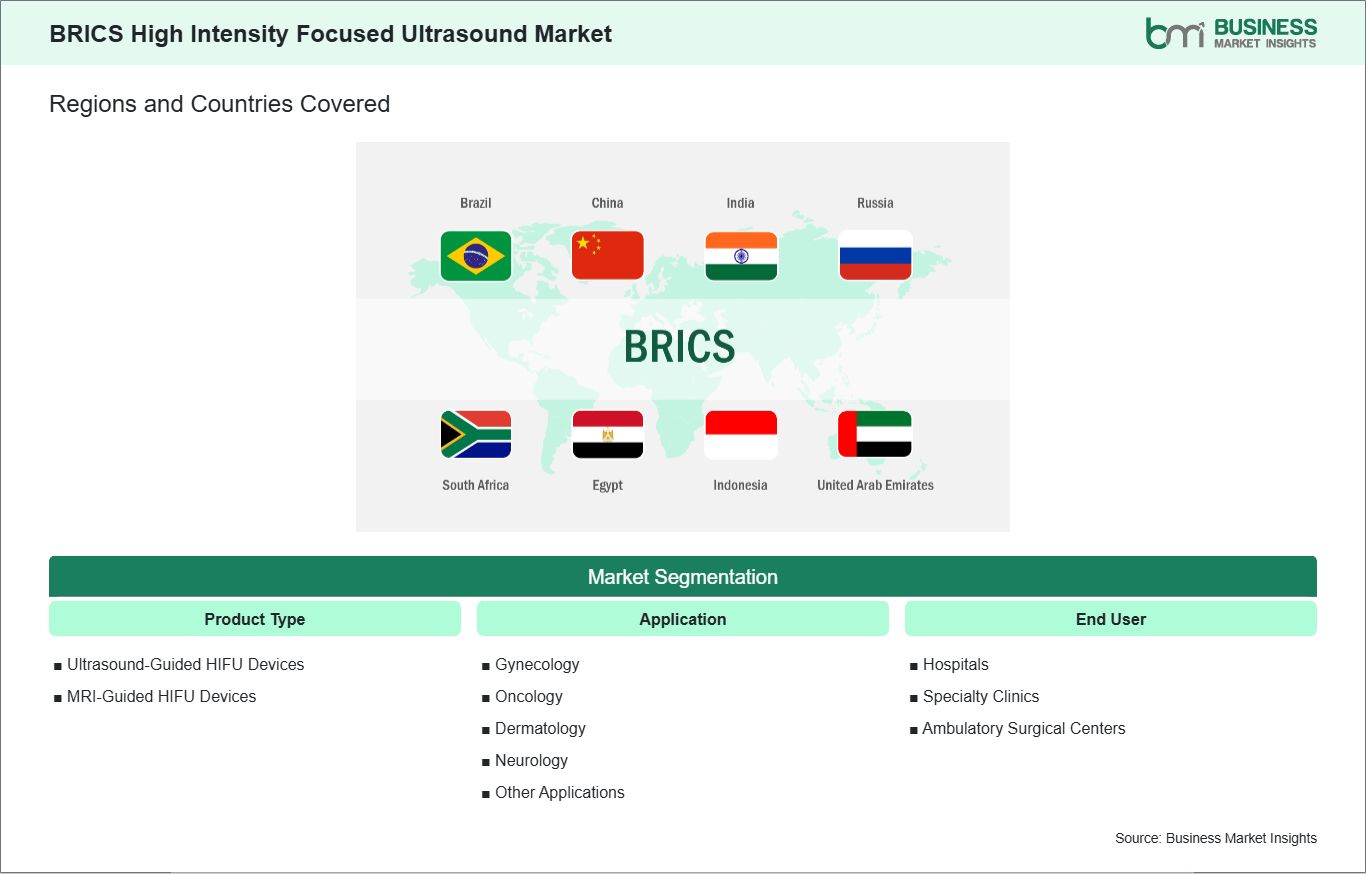
Key segments that contributed to the derivation of the BRICS high intensity focused ultrasound market analysis are product type, application, and end user.
- By product type, the high intensity focused ultrasound market is segmented into ultrasound-guided HIFU devices, MRI-guided HIFU devices. The ultrasound-guided HIFU devices segment dominated the market in 2025.
- Based on application, the high intensity focused ultrasound market is classified into gynecology, oncology, dermatology, neurology, other applications. The gynecology segment dominated the market in 2025.
- In terms of end user, the high intensity focused ultrasound market is categorized into hospitals, specialty clinics, and ambulatory surgical centers. The hospitals segment dominated the market in 2025.
Market Forces
BRICS High Intensity Focused Ultrasound Market Drivers and Opportunities
Demand for Non‑invasive Ablation Procedures on the Rise
Across the BRICS grouping, healthcare systems are increasingly looking toward non‑invasive ablation procedures like High Intensity Focused Ultrasound as alternatives to traditional surgery. In many major hospitals and specialty centers, clinicians are incorporating HIFU to treat conditions such as uterine fibroids and select tumors because it allows precise targeting of diseased tissue without invasive incisions. This trend reflects a broader emphasis on reducing procedural risks and improving patient comfort within advanced care pathways.
Healthcare providers within the BRICS markets are also focusing on training multidisciplinary teams capable of planning and executing HIFU treatments with imaging guidance. By combining real‑time visualization with therapeutic ultrasound, clinical teams can enhance procedural accuracy and adapt treatments in situ. Ablation strategies that once required surgical theaters are now being considered in outpatient or interventional radiology settings.
In parallel, collaborative professional development is helping increase clinician familiarity with HIFU technologies. Regional conferences, specialist workshops, and cross‑institution exchanges are stimulating knowledge transfer, enabling centers that were previously early adopters to help neighboring institutions build procedural expertise. This has strengthened the clinical acceptance of non‑invasive ablation across diverse healthcare environments.
Entering the Realm of Aesthetic and Cosmetic Solutions
Beyond therapeutic uses, HIFU is gaining traction in aesthetic and cosmetic solutions throughout the BRICS markets. Aesthetic clinics in major urban centers are offering non‑surgical skin tightening, facial lifting, and body contouring using focused ultrasound technologies, catering to clients who want effective results without downtime or general anesthesia. These services are often positioned alongside other non‑invasive treatments in comprehensive beauty portfolios.
Dermatology and wellness practices are increasingly integrating HIFU as part of broader anti‑aging and rejuvenation offerings. Practitioners highlight HIFU’s ability to stimulate collagen production and improve skin texture in ways that complement traditional cosmetic interventions. In competitive urban markets, clinics differentiate themselves by leveraging focused ultrasound for customized treatment plans tailored to diverse aesthetic preferences.
Consumer awareness is also playing a significant role in expanding HIFU’s appeal. Prospective clients in BRICS markets are researching treatment options online, sharing experiences, and consulting social platforms for insights into procedural outcomes. This has encouraged clinics to educate the public about HIFU’s safety profile and expected results, helping position it as a mainstream choice for cosmetic enhancement that bridges clinical expertise with beauty‑focused outcomes.
Size and Share Analysis
BRICS High Intensity Focused Ultrasound Market Size and Share Analysis
The BRICS high intensity focused ultrasound market demonstrates steady growth, with size and share analysis highlighting evolving trends and competitive dynamics among key players. The report evaluates important subsegments categorized within product type, application, and end user, highlighting their respective contributions to market performance.
By product type, the ultrasound-guided HIFU devices subsegment dominated the market in 2025. This is driven by the recurring need for precise and reliable imaging during HIFU procedures, which ensures accurate targeting and effective ablation of tissues, making these devices a key revenue driver for manufacturers and sustaining consistent demand in clinical settings.
In terms of application, the gynecology subsegment led the market in 2025. The dominance of gynecology applications is attributed to the rising prevalence of uterine fibroids and adenomyosis, growing adoption of non-invasive treatment methods, and increasing awareness among healthcare providers of HIFU’s effectiveness in providing safe, minimally invasive therapeutic options for women’s health conditions.
Based on end user, the hospitals subsegment held the largest share in 2025. Hospitals maintain leadership due to their well-established gynecology and surgical departments, access to advanced HIFU equipment, trained medical staff, and the capability to perform complex procedures while providing comprehensive patient care.
Report Coverage
BRICS High Intensity Focused Ultrasound Market Report Coverage and Deliverables
The "BRICS High Intensity Focused Ultrasound Market Size and Forecast (2022–2033)" report provides a detailed analysis of the market covering below areas:
- BRICS High Intensity Focused Ultrasound market size and forecast at regional, and country levels for all market segments covered under the scope
- BRICS High Intensity Focused Ultrasound market trends, as well as drivers, restraints, and opportunities
- BRICS High Intensity Focused Ultrasound market analysis covering key trends, regional framework, major players, regulations, and recent developments
- Industry landscape and competition analysis covering market concentration, heat map analysis, prominent players, and recent developments for the BRICS High Intensity Focused Ultrasound market
- Detailed company profiles, including SWOT analysis
Geographic Insights
BRICS High Intensity Focused Ultrasound Market Geographic Insights
The geographical scope of the BRICS High Intensity Focused Ultrasound market report is divided into: Russia, Brazil, South Africa, India, China, Egypt, Indonesia, Saudi Arabia, and the UAE. China held the largest share in 2025.
China dominates the BRICS HIFU market, supported by a highly developed healthcare infrastructure, strong domestic manufacturing of medical devices, and a culture of clinical innovation. Chinese hospitals and specialty centers have increasingly integrated HIFU for oncology, gynecology, and benign tumor treatments, where minimally invasive solutions are particularly valued. Leading urban hospitals not only provide treatment but also serve as research hubs, conducting clinical trials and studies that validate safety, efficacy, and patient outcomes. Collaboration between public hospitals, private clinics, and domestic HIFU technology providers has facilitated clinician training programs, ensuring procedural proficiency and standardized treatment protocols. Government support for innovative medical technologies, combined with a focus on modernizing cancer care and women’s health services, has further reinforced HIFU adoption. While urban centers show high penetration, adoption in smaller cities and rural areas remains constrained by limited access to advanced imaging equipment and specialized operators. China’s proactive healthcare policies, robust infrastructure, and strong clinical focus position it as the dominant BRICS market for HIFU, influencing both regional adoption patterns and global technology trends in non-invasive therapeutics.
Industry Activity
Recent Developments
The BRICS high intensity focused ultrasound market is evaluated by gathering qualitative and quantitative data post primary and secondary research, which includes important corporate publications, association data, and databases. A few of the key developments in the BRICS High Intensity Focused Ultrasound market are:
- In March 2025, Chongqing Haifu Medical Technology Co., Ltd. (China) conducted a world’s first 5G‑powered remote HIFU ablation surgery, in which a physician in Chongqing remotely operated a HIFU system to treat a patient at an international HIFU treatment center showcasing advanced tele‑medicine use of HIFU technology originating in China and supporting broader international engagement.
- In March 2025, Insightec Ltd. announced a partnership with the Vattikuti Foundation and All India Institute of Medical Sciences (AIIMS) in India to expand access to MR‑guided HIFU care and advance neurological research, including donation and deployment of Insightec’s Exablate Neuro system for treating movement disorders such as Parkinson’s and essential tremor in India.
Trust & Transparency
Research Methodology
The market analysis combines proprietary research with secondary data from government agencies, company disclosures, regulatory filings, industry databases and expert interviews. Market estimates are validated through data triangulation, cross-market benchmarking and analyst
review.
View Full Research Methodology
Key Sources Referred:
The World BankWorld Health Organization (WHO)Center for Disease Control and Prevention (CDC)Food and Drug Administration (FDA)European Database on Medical Devices (EUDAMED)European Society of Cardiology (ESC)American College of Cardiology (ACC)American Heart Association (AHA)Company WebsitesCompany Annual ReportsCompany Investor Presentations