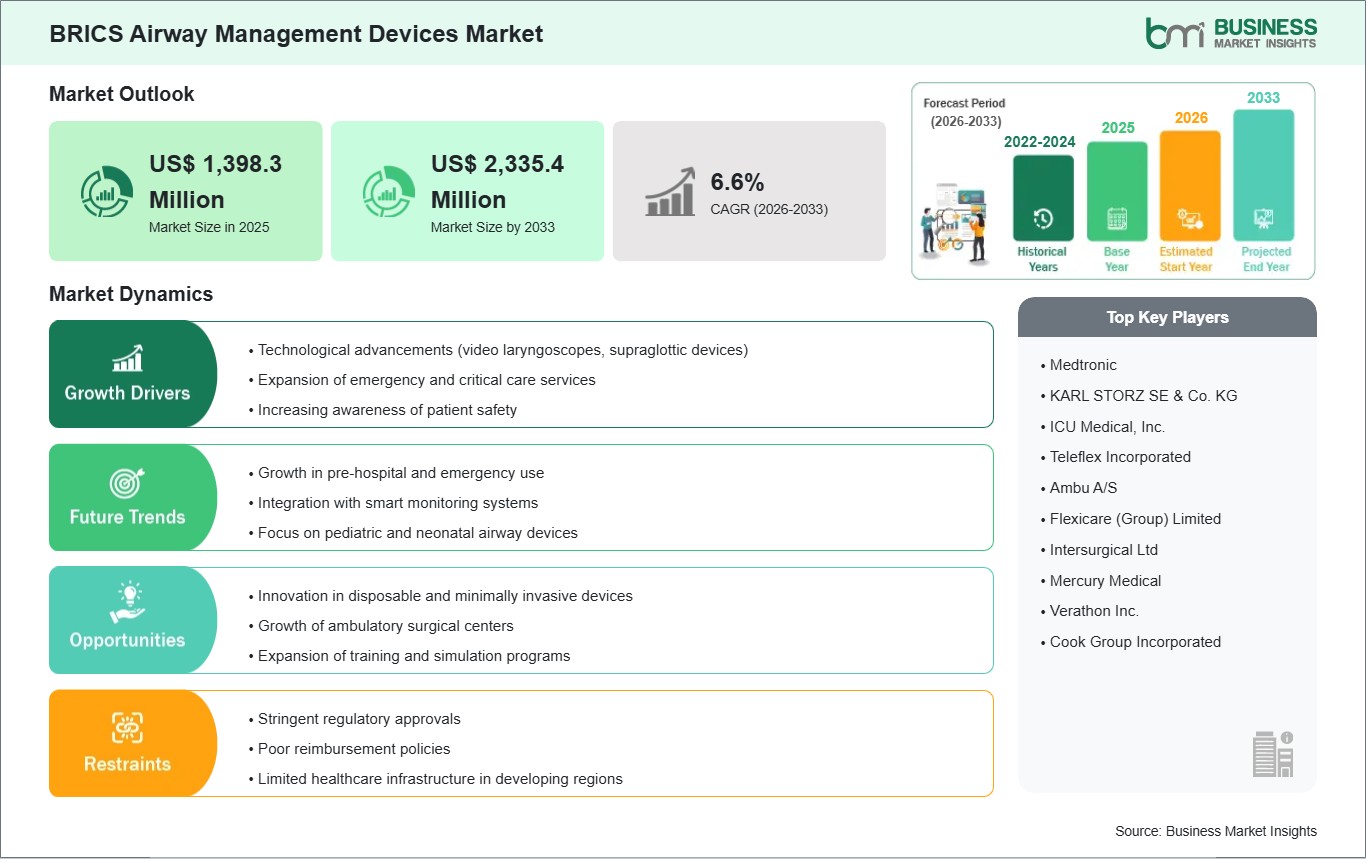
The BRICS Airway management devices market size is expected to reach US$ 2,335.4 million by 2033 from US$ 1,398.3 million in 2025. The market is estimated to record a CAGR of 6.6% from 2026 to 2033.
The BRICS airway management devices market demonstrates that the healthcare industry currently comprises an unevenly developed infrastructure that faces growing demand and greater attention from governments aiming to develop their critical care systems. With growing numbers of patients diagnosed with respiratory diseases and more surgical operations being carried out in the BRICS region, along with the importance of preparing for emergencies, airway management devices become especially demanded across Brazil, Russia, India, China, and South Africa, where China plays an important role due to its investments in the healthcare industry. Among the factors that affect the growth of the industry, there can be noted the rapid development of intensive care units and emergency response departments, which is promoted by local governments' concern about people's ability to get the necessary medical technology and results in the increase in the adoption of simple airway devices like endotracheal tubes and laryngeal masks as well as penetration of more complex technologies into tertiary facilities. Nevertheless, this market will face challenges due to differences in access to healthcare facilities within urban and rural environments, particularly in nations such as India and South Africa. Cost consciousness poses an important obstacle, which can restrict the uptake of high-end products and innovations. Nevertheless, the BRICS bloc offers promising opportunities in the future, given its favorable healthcare policies and increased awareness of clinical practices.

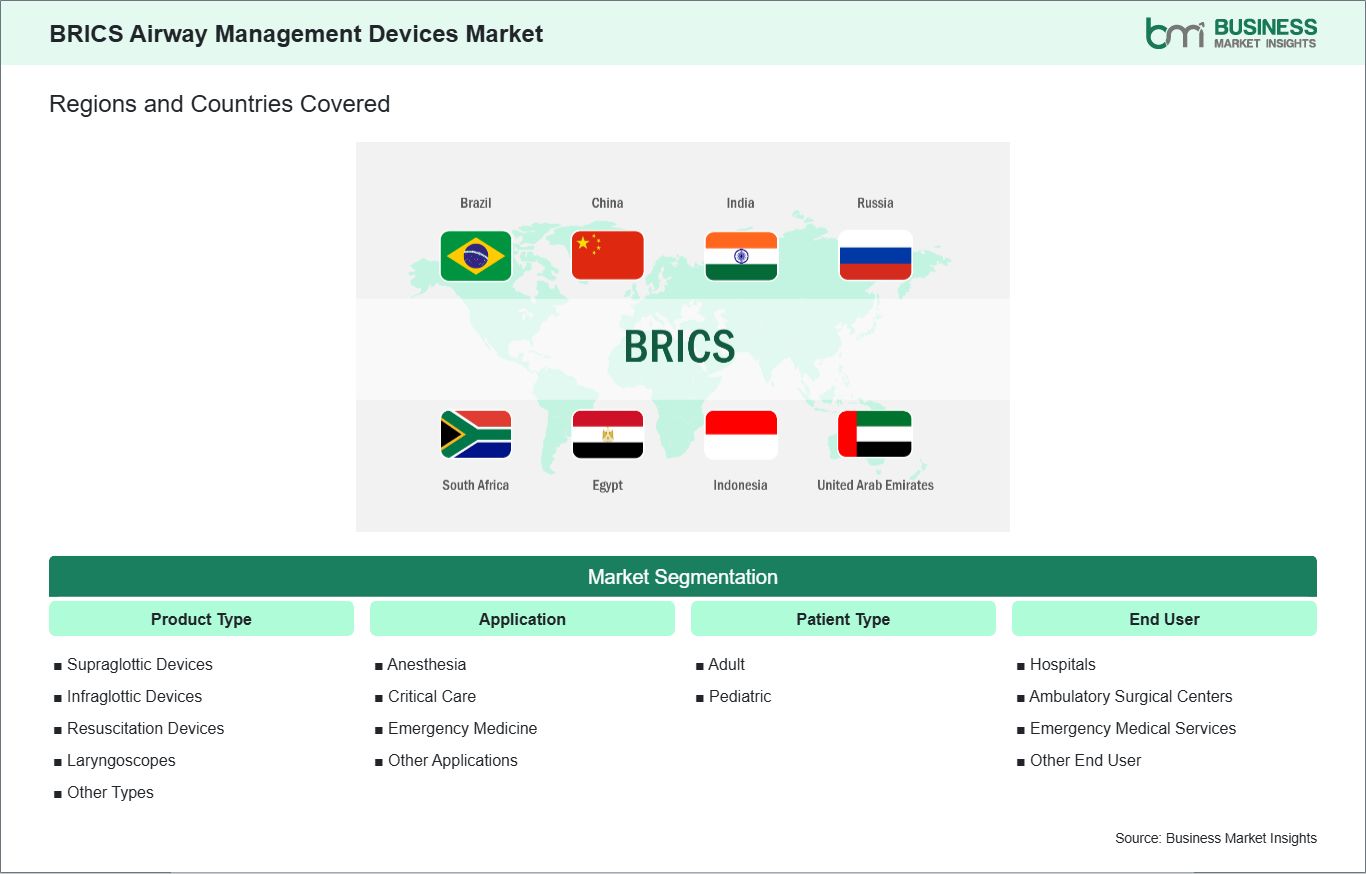
Key segments that contributed to the derivation of the airway management devices market analysis are product type, application, patient type, and end user.
There have been significant changes taking place in the market for BRICS' airway management devices due to the improvements within the healthcare infrastructure of these nations. For instance, in nations like China and India, larger tertiary care centers have begun using video laryngoscopes instead of the traditional method of direct laryngoscopy. The advantages offered by the use of these devices lie in the fact that they provide better visualization of the airway in difficult situations, such as trauma, obesity, and abnormal anatomy. As more educational institutions begin using these instruments, the current generation of clinicians becomes increasingly acquainted with airway management technologies.
In nations like Brazil and South Africa, supraglottic airway devices have become increasingly popular in surgical as well as emergency scenarios. These devices have the advantage of being quick to insert and do not require a great deal of skill in comparison with endotracheal intubations. Second-generation supraglottic airway devices that offer sealing and aspiration protection have been adopted in both public and private hospitals of these nations.
Domestic producers have taken the initiative to improve the availability of advanced airway devices in China and Russia. The availability of locally made video laryngoscopes equipped with affordable disposables and reusable screens has gained popularity among mid-tier facilities. Moreover, some cities are now considering adopting these technologies on the digital platform, which allows them to make videos and train their medical staff. This technology is contributing to both efficiency and standardizing of procedures within this region.
Innovation in Disposable and Minimally Invasive Devices
Disposable and minimally invasive airway devices have witnessed significant innovation within the BRICS nations owing to considerations relating to infections as well as the heavy volume of patients. Many hospitals in India and Brazil are beginning to prefer disposable airway devices in their ICUs and operating theaters. This has been influenced by stringent standards of sterilization as well as the objective to reduce hospital acquired infections in crowded hospital settings.
On the other hand, minimally invasive airway devices are gaining popularity in China and South Africa. These devices limit trauma to the airway and also facilitate faster recovery from anesthesia, thus making them appropriate for elective and emergency cases. The demand for ease of administration coupled with patient comfort in outpatient cases makes clinicians favor devices which incorporate these two characteristics.
Another significant trend has been the emergence of low-cost disposable airway kits specifically designed for use in rural settings and before the hospital. For instance, in Russia and India, EMS services have started operating in semi-urban and rural areas, which has created a need for portable and easy-to-use airway kits. The kits contain basic supraglottic devices, face masks, and other components. With the help of such trends, it has become easier to manage airways in regions that lack modern health facilities.
The BRICS airway management devices market is experiencing steady growth, with market size and share analysis reflecting evolving treatment preferences and competitive dynamics among key players. The report evaluates important subsegments categorized within product type, application, patient type, and end user, highlighting their respective contributions to overall market performance.
By product type, the infraglottic devices subsegment dominated the market in 2025. In anesthesia practice, infraglottic devices provide protection against aspiration and enable precise airway management, driving higher adoption in operating rooms and critical care settings compared to supraglottic devices.
Based on application, the anesthesia subsegment dominated the market in 2025 due to the need for definitive airway control across a wide range of surgical procedures, from routine elective surgeries to complex interventions. Because infraglottic devices are essential for intubation during anesthesia, this segment experiences consistent, high-volume usage, making it the largest segment compared to emergency or general critical care.
In terms of patient type, the adult subsegment dominated the market in 2025. Most procedural training, device designs, and usage guidelines are optimized for adult anatomy and usage scenarios, reinforcing higher market volume.
Based on end user, the hospital subsegment dominated the market in 2025, as hospitals remain the central hub for airway management, handling scheduled surgeries, emergency admissions, ICU care, and trauma cases. Their larger budgets, need for extensive airway inventories, and availability of multidisciplinary professionals make them the largest purchasers compared to outpatient centers or EMS, where volume and purchasing power are comparatively lower.
| Report Attribute | Details |
|---|---|
| Market size in 2025 | US$ 1,398.3 Million |
| Market Size by 2033 | US$ 2,335.4 Million |
| CAGR (2026 - 2033) | 6.6% |
| Historical Data | 2022-2024 |
| Forecast period | 2026-2033 |
| Segments Covered | By Product Type
|
|
Regions and Countries Covered
| |
| BRICS | Russia, Brazil, South Africa, India, China, Egypt, Indonesia, Saudi Arabia, United Arab Emirates |
| Market leaders and key company profiles |
|
The "BRICS Airway Management Devices Market Size and Forecast (2022–2033)" report provides a detailed analysis of the market covering below areas:
The geographical scope of the BRICS airway management devices market report is divided into: Russia, Brazil, South Africa, India, China, Egypt, Indonesia, Saudi Arabia, and the UAE. China held the largest share in 2025.
Chinese dominate the BRICS airway management devices market can be attributed to its extensive healthcare systems, along with an active government effort to embrace technology and become self-sufficient in medical products. The nation has been experiencing fast development of hospital structures, especially tertiary and specialized hospitals, which have been incorporating more advanced airway management devices into their practice. In particular, video laryngoscopes, disposable airway devices, and various other devices, which help in increasing precision and decreasing the risk of infections, are becoming popular. The important thing about China is that it focuses on innovation and also on manufacturing within the country. The local firms are creating new and cheaper options for foreign devices to increase their availability without reducing their quality levels. This has resulted in increased use not only in top-notch hospitals in the cities but also in other medical facilities. Moreover, due to its experience from previous disasters, China’s stress on readiness for emergencies ensures better usage of such devices. There is also improvement in training and standardization, with greater emphasis on the education and training of anesthesiologists and emergency care professionals. Nonetheless, there remains the issue of uneven development within China, especially concerning the availability of advanced technologies in the rural sector. China’s size, policies, and manufacturing capacity undoubtedly qualify the country as the major force behind the BRICS airway management device market.

The BRICS airway management devices market is evaluated by gathering qualitative and quantitative data post primary and secondary research, which includes important corporate publications, association data, and databases. A few of the key developments in the BRICS airway management devices market are:
The BRICS Airway Management Devices Market is valued at US$ 1,398.3 Million in 2025, it is projected to reach US$ 2,335.4 Million by 2033.
As per our report BRICS Airway Management Devices Market, the market size is valued at US$ 1,398.3 Million in 2025, projecting it to reach US$ 2,335.4 Million by 2033. This translates to a CAGR of approximately 6.6% during the forecast period.
The BRICS Airway Management Devices Market report typically cover these key segments-
The historic period, base year, and forecast period can vary slightly depending on the specific market research report. However, for the BRICS Airway Management Devices Market report:
The BRICS Airway Management Devices Market is populated by several key players, each contributing to its growth and innovation. Some of the major players include:
The BRICS Airway Management Devices Market report is valuable for diverse stakeholders, including:
Essentially, anyone involved in or considering involvement in the BRICS Airway Management Devices Market value chain can benefit from the information contained in a comprehensive market report.
Please tell us your area of interest
(Market Segments/ Regions and Countries/ Companies)