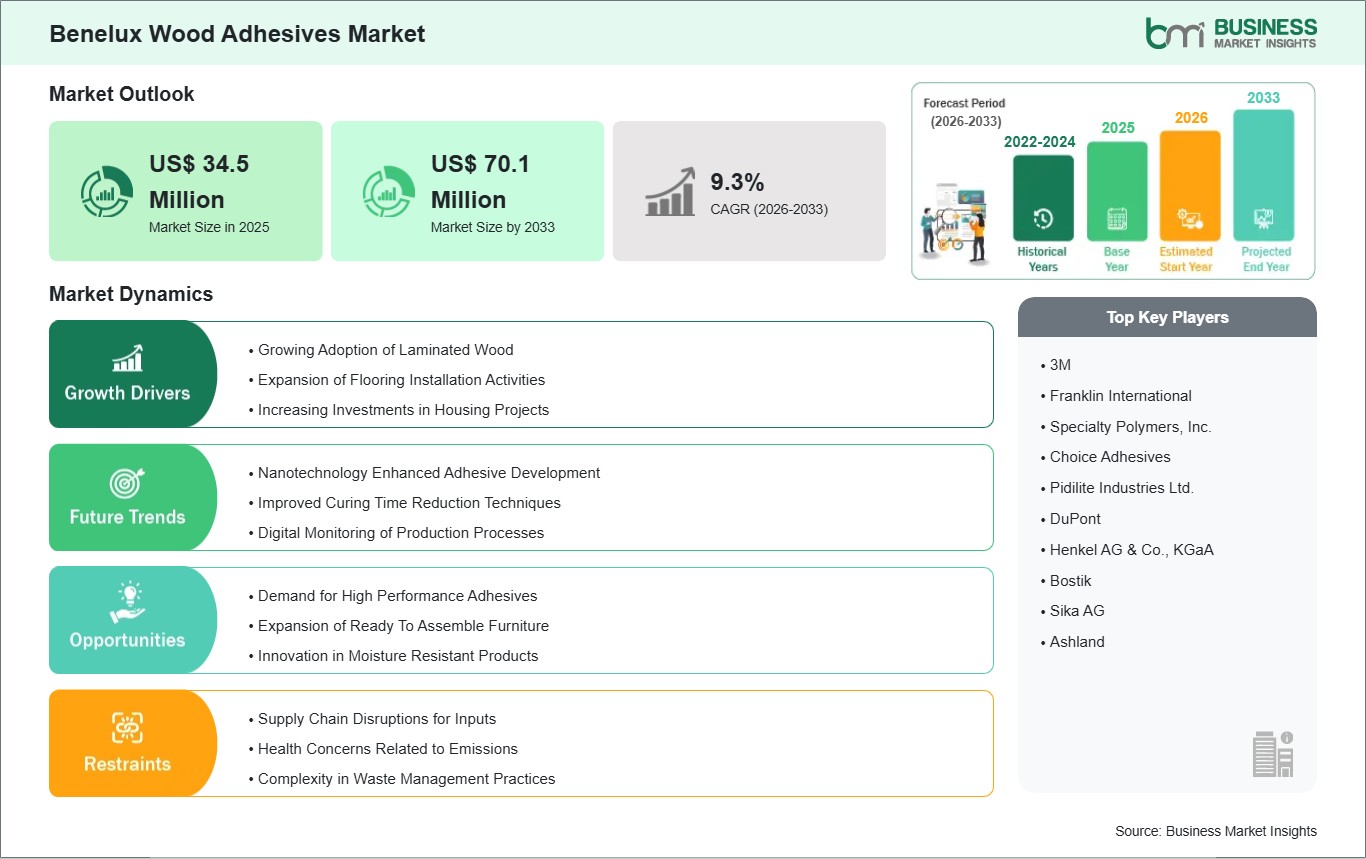
The Benelux wood adhesives market size is expected to reach US$ 128.3 million by 2033 from US$ 73.9 million in 2025. The market is estimated to register a CAGR of 7.1% from 2026 to 2033.
Wood adhesives in the Benelux region are widely utilized across furniture manufacturing, interior construction, flooring systems, and engineered wood applications, supporting high-precision bonding requirements in advanced building environments. The market reflects a mature industrial structure characterized by strong integration between chemical suppliers, woodworking industries, and construction contractors. Demand is increasingly influenced by renovation-led construction activity, energy-efficient building upgrades, and premium interior design projects across residential and commercial sectors. Manufacturers are prioritizing low-emission, water-based adhesive systems aligned with stringent European environmental regulations and indoor air quality standards. Technological sophistication in engineered wood products, including cross-laminated timber and laminated veneer lumber, is reinforcing adhesive consumption intensity. The region also benefits from strong logistics infrastructure and proximity to major European trade corridors, ensuring efficient supply chain operations. Competitive dynamics are shaped by high regulatory compliance requirements, encouraging product innovation and sustainability-focused formulations. Demand consistency is further supported by steady refurbishment cycles in commercial real estate and institutional infrastructure. Overall, the market demonstrates stable growth patterns driven by quality-focused consumption and advanced material engineering practices.

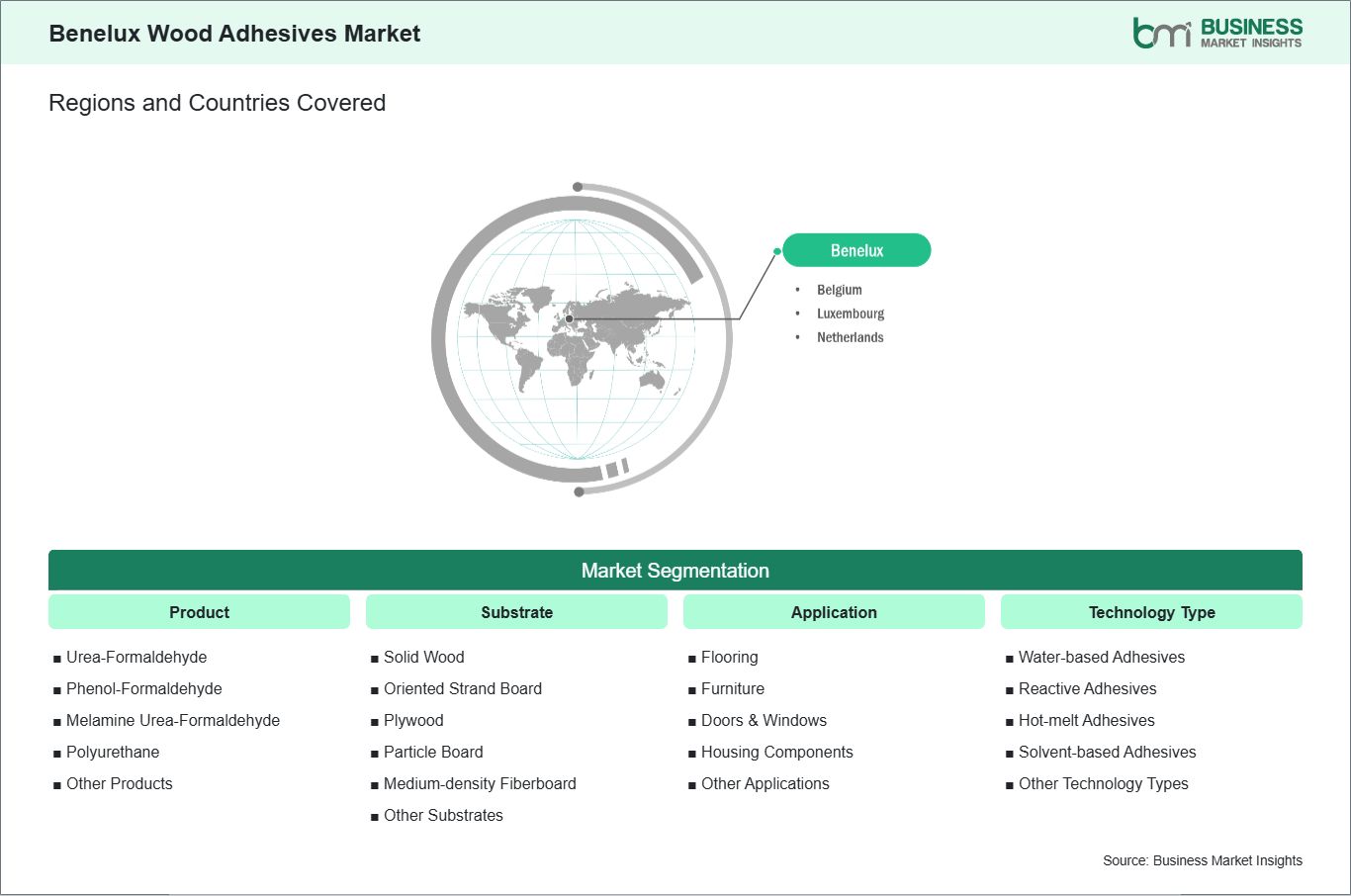
Key segments that contributed to the derivation of the Benelux wood adhesives market analysis are product, substrate, application, and technology type.
The Benelux wood adhesives market is witnessing steady growth driven by increasing adoption of laminated wood products in residential and commercial construction. In countries such as the Netherlands, Belgium, and Luxembourg, laminated veneer lumber (LVL), glulam beams, and cross-laminated timber (CLT) are being used more widely in modern architecture. Urban development in cities like Amsterdam, Brussels, and Luxembourg City is emphasizing sustainable and lightweight construction materials, strengthening demand for engineered wood systems.
Public and private construction projects are increasingly incorporating laminated wood due to its structural efficiency and lower carbon footprint compared to steel and concrete. The Netherlands, in particular, has promoted timber-based mid-rise housing projects in cities such as Utrecht and Rotterdam, where CLT usage is rising in apartment complexes and commercial buildings. This shift is directly increasing the need for structural-grade adhesives that ensure long-term bonding performance.
The renovation and retrofit segment is also contributing to market growth. Many older buildings across Belgium and the Netherlands are being modernized using laminated wood elements to improve energy efficiency and aesthetics. Government-backed sustainability programs encouraging green building certifications are further accelerating adoption. As laminated wood becomes more integrated into mainstream construction practices, adhesive demand continues to strengthen across the Benelux region.
The Benelux wood adhesives market is increasingly driven by demand for high-performance adhesive solutions that meet stringent European safety and environmental standards. Regulatory frameworks such as EU low-VOC and formaldehyde emission limits are pushing manufacturers toward advanced formulations, including polyurethane, melamine-urea-formaldehyde, and bio-based adhesives. This shift is particularly strong in Belgium and the Netherlands, where sustainable construction practices are widely enforced.
Furniture manufacturing and interior designing industries are also driving the need for the product. There are many manufacturers of quality furniture and cabinets operating within the region, catering to the local market and also for exports. Such manufacturers need adhesives offering excellent bonding capability, resistance to moisture and temperature changes, especially those meant for quality kitchen fitting, office furniture, and interior modular furniture.
Moreover, logistics facilities and prefabricated construction projects require a reliable source of adhesives. Due to its importance as a logistical center in Europe, the Netherlands has experienced an increase in the building of warehouses and factories, some of which utilize engineered wood products. With increasing demands from both the complexity of construction and the need for sustainability, wood adhesive will be continuously required in the Benelux market.

The wood adhesives market in Benelux is experiencing steady growth, with market size and share analysis reflecting evolving treatment preferences and competitive dynamics among key players. The report evaluates important subsegments categorized within product, substrate, application, and technology, highlighting their respective contributions to market performance.
By product, the urea-formaldehyde (UF) segment dominated the market in 2025, driven by its cost-effectiveness and widespread use in panel products such as particle board and MDF across Benelux woodworking industries.
Based on substrate, the particle board (PB) segment dominated the market in 2025, driven by strong demand for economical furniture and interior applications in renovation-heavy residential markets.
On the basis of application, the furniture segment dominated the market in 2025, driven by steady housing renovation activity and high demand for customized and modular furniture solutions.
In terms of technology, the water-based adhesives segment dominated the market in 2025, driven by strict environmental regulations in the EU region and growing preference for low-emission, sustainable adhesive systems.
| Report Attribute | Details |
|---|---|
| Market size in 2025 | US$ 73.9 Million |
| Market Size by 2033 | US$ 128.3 Million |
| CAGR (2026 - 2033) | 7.1% |
| Historical Data | 2022-2024 |
| Forecast period | 2026-2033 |
| Segments Covered | By Product
|
|
Regions and Countries Covered
| |
| Benelux | Belgium, Netherlands, Luxembourg |
| Market leaders and key company profiles |
|
The "Benelux Wood Adhesives Market Size and Forecast (2022–2033)" report provides a detailed analysis of the market covering below areas:
The geographical scope of the Benelux wood adhesives market report is divided into Belgium, Netherlands, and Luxembourg. Netherlands held the largest share in 2025.
The Netherlands represents the leading market within Benelux, supported by advanced construction practices, strong demand for engineered wood products, and a well-developed furniture and interior design industry. High adoption of sustainable building materials and circular construction practices continues to strengthen adhesive usage across residential and commercial projects. Belgium follows with significant demand driven by renovation activities, institutional infrastructure upgrades, and a strong presence of woodworking and panel manufacturing industries. The country’s focus on energy-efficient buildings and sustainable construction materials further supports adoption of environmentally compliant adhesive solutions. Luxembourg, while smaller in scale, demonstrates a premium-oriented market structure characterized by high-value construction projects, commercial real estate development, and demand for quality interior finishing materials. The country’s financial and administrative infrastructure sector contributes to steady utilization of engineered wood applications in office and institutional buildings. Across the Benelux region, regulatory alignment with European Union environmental directives strongly influences product selection, with increasing preference for low-VOC and formaldehyde-reduced adhesives. Additionally, cross-border trade integration with neighboring European manufacturing hubs enhances product availability and strengthens competitive supply chains across the region.

The Benelux wood adhesives market is evaluated by gathering qualitative and quantitative data post primary and secondary research, which includes important corporate publications, association data, and databases. A few of the key developments in the Benelux wood adhesives market are:
The Benelux Wood Adhesives Market is valued at US$ 73.9 Million in 2025, it is projected to reach US$ 128.3 Million by 2033.
As per our report Benelux Wood Adhesives Market, the market size is valued at US$ 73.9 Million in 2025, projecting it to reach US$ 128.3 Million by 2033. This translates to a CAGR of approximately 7.1% during the forecast period.
The Benelux Wood Adhesives Market report typically cover these key segments-
The historic period, base year, and forecast period can vary slightly depending on the specific market research report. However, for the Benelux Wood Adhesives Market report:
The Benelux Wood Adhesives Market is populated by several key players, each contributing to its growth and innovation. Some of the major players include:
The Benelux Wood Adhesives Market report is valuable for diverse stakeholders, including:
Essentially, anyone involved in or considering involvement in the Benelux Wood Adhesives Market value chain can benefit from the information contained in a comprehensive market report.
Please tell us your area of interest
(Market Segments/ Regions and Countries/ Companies)