Market Summary
Executive Summary and Market Analysis
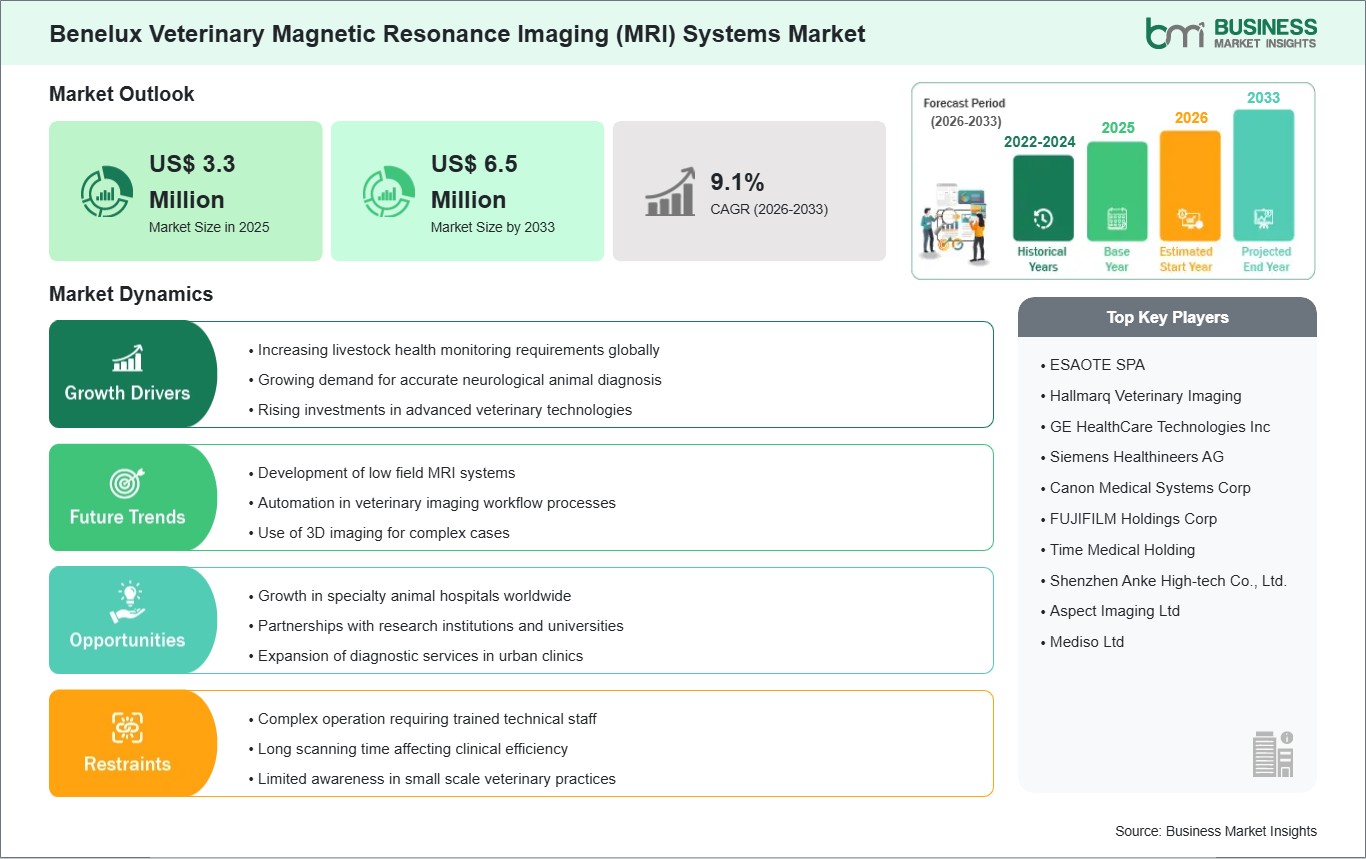
The Benelux Veterinary Magnetic Resonance Imaging (MRI) Systems Market functions as a specialized market segment that has begun to show its significance within the larger European veterinary diagnostic market. The region, which includes Belgium, the Netherlands, and Luxembourg, shows two main characteristics: its developed veterinary healthcare system, its high animal welfare standards and its growing demand for advanced diagnostic imaging systems used in treating companion animals and horses. The market experiences its main growth through the rising trend of pet humanization, which causes pet owners to treat their animals like family members and spend more money on expensive diagnostic tests, including MRI. The Benelux region experiences its main market expansion through its network of specialized veterinary hospitals and referral centers, which serve as the foundation for digital diagnostic services found throughout Belgium and the Netherlands. MRI systems have become popular because they enable better soft tissue visualization and more effective analysis of neurological structures and musculoskeletal disorders, which traditional imaging techniques cannot evaluate. The area receives advantages from its veterinary facilities, which work together with academic institutions and imaging equipment manufacturers to develop new diagnostic methods while providing ongoing medical education. The increasing number of chronic diseases that companion animals develop now includes neurological and orthopedic disorders because veterinarians today possess better diagnostic skills, and pets live longer. The rising trend of preventive veterinary care leads to veterinarians using advanced imaging technologies earlier and more often, which helps to increase the regional adoption of MRI systems. The market experiences major obstacles that prevent it from achieving widespread market expansion. The need for high capital investment to acquire MRI systems, along with their continuous upkeep and operational expenses, creates financial barriers that restrict their use to major veterinary hospitals and specialized medical facilities. Clinics with limited resources need to use outside referral systems because they lack their own MRI scanning facilities. The testing process requires additional time because veterinarians in specific regional areas do not have enough skilled veterinary radiologists and MRI operators who can assist with system operation. The veterinary MRI systems market in Benelux countries experiences two opposing forces that create clinical demand and veterinary infrastructure development, while cost problems, together with the necessity for specialized skills, create growth restrictions for the market.
Segment Analysis
Benelux Veterinary Magnetic Resonance Imaging (MRI) Systems Market Segmentation
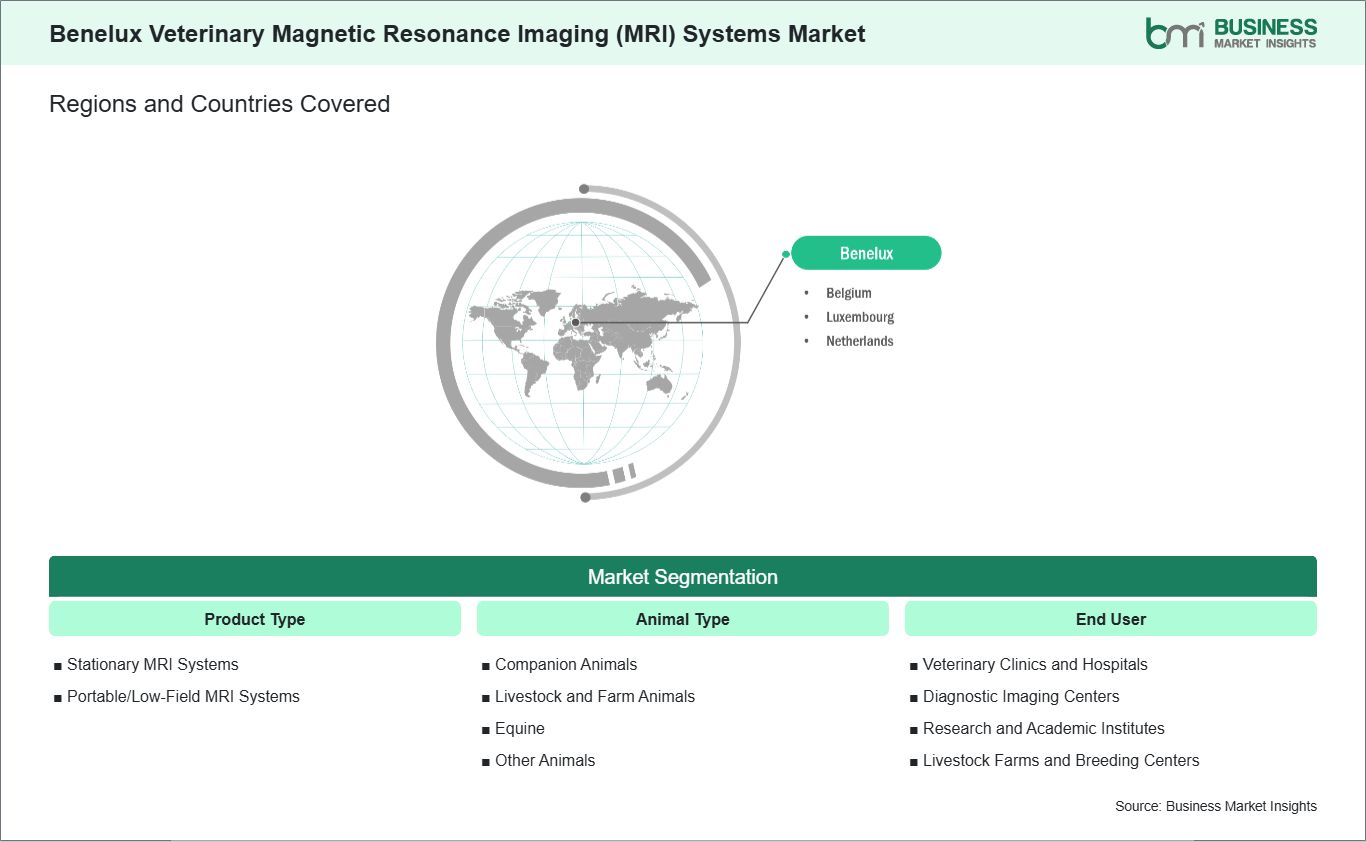
Key segments that contributed to the derivation of the Benelux veterinary magnetic resonance imaging (MRI) systems market analysis are product type, animal type, and end user.
- By product type, the veterinary magnetic resonance imaging (MRI) systems market is segmented into stationary MRI systems, portable/low-field MRI systems. The stationary MRI systems segment dominated the market in 2025.
- Based on animal type, the veterinary magnetic resonance imaging (MRI) systems market is categorized into companion animals, livestock and farm animals, equine, others. The companion animals segment dominated the market in 2025.
- In terms of end user, the veterinary magnetic resonance imaging (MRI) systems market is categorized into veterinary clinics and hospitals, diagnostic imaging centers, research and academic institutes, livestock farms and breeding centers. The veterinary clinics and hospitals segment dominated the market in 2025.
Market Forces
Benelux Veterinary Magnetic Resonance Imaging (MRI) Systems Market Drivers and Opportunities
Companion Animal Ownership Drives Veterinary MRI Demand
The Benelux region shows continuous growth for pet ownership, especially for dogs and cats, which urban Dutch and Belgian households now adopt as pets. Pet owners now require advanced veterinary diagnostics, which include MRI systems, because they use these tools to detect neurological and musculoskeletal conditions in their pets at an early stage.
Cities such as Amsterdam, Brussels and Luxembourg City have observed an upsurge in MRI adoption among veterinary hospitals and referral clinics, which use this technology to make better diagnoses. Government animal healthcare systems, together with insurance coverage expansion, enable medical facilities to use advanced imaging technology for their challenging cases, which need internal body evaluation without surgery.
Veterinary clinics in urban areas depend on large veterinary centers for MRI services because of their high equipment costs and operational difficulties. The veterinary schools in the Netherlands and Belgium are working together to improve training programs and create better awareness about veterinary training, while the pet market in Luxembourg, which has a small size and high income level, is starting to use expensive diagnostic imaging services. The region is starting to use mobile MRI units as a new diagnostic tool.
Expansion of Telemedicine in Veterinary Imaging Services
Belgium to reduce turnaround times and improve access to advanced MRI expertise for complex neurological and orthopedic cases.
The Benelux region establishes its cross-border digital health infrastructure to maintain operational health services across multiple countries. The veterinary MRI market in the Benelux region experiences rapid growth because telemedicine systems now permit expert radiologists to evaluate medical images from remote locations. The Netherlands veterinary clinics establish partnerships with diagnostic centers to enable direct exchange of veterinary imaging data between Luxembourg and adjacent Belgian hospitals. Veterinarians use cloud-based platforms for efficient diagnostic work because they can verify MRI results with European specialists without needing to move their patients.
The Benelux region faces ongoing difficultiesbecause the area struggles with expensive serviceswhich also includes insufficient payment optionsand the need for more MRI veterinary facilities located throughout the region. The ongoing funding for AI-powered imaging technology and digital process development will boost telemedicine usage while expanding diagnostic capabilities for veterinary clinics located in remote areas and secondary medical facilities. The EU regulatory framework establishes standardized ruleswhich help the market to continue its growth.
Size and Share Analysis
Benelux Veterinary Magnetic Resonance Imaging (MRI) Systems Market Size and Share Analysis
The Benelux veterinary magnetic resonance imaging (MRI) systems market is experiencing steady growth, with market size and share analysis reflecting evolving treatment preferences and competitive dynamics among key players. The report evaluates important subsegments categorized within product type, animal type, and end user, highlighting their respective contributions to market performance.
By product type, the stationary MRI systems subsegment dominated the market in 2025, driven by higher image quality, greater throughput, and widespread adoption in hospitals for comprehensive diagnostic imaging.
Based on animal type, the companion animals subsegment dominated the market in 2025, driven by increasing pet ownership and rising demand for advanced diagnostic imaging in routine veterinary care.
In terms of end user, the veterinary clinics and hospitals subsegment dominated the market in 2025, driven by the widespread adoption of x-ray systems for comprehensive diagnostic and treatment services.
Report Coverage
Benelux Veterinary Magnetic Resonance Imaging (MRI) Systems Market Report Coverage and Deliverables
The "Benelux Veterinary Magnetic Resonance Imaging (MRI) Systems Market Size and Forecast (2022–2033)" report provides a detailed analysis of the market covering below areas:
- Market size and forecast at regional and country levels for all market segments covered under the scope
- Market trends, as well as drivers, restraints, and opportunities
- Market analysis covering key trends, regional framework, major players, regulations, and recent developments
- Market concentration, heat map analysis, prominent players, and recent developments for the Market
- Detailed company profiles, including SWOT analysis
Geographic Insights
Benelux Veterinary Magnetic Resonance Imaging (MRI) Systems Market Geographic Insights
The geographical scope of the Benelux Veterinary Magnetic Resonance Imaging (MRI) Systems Market report is divided into Belgium, the Netherlands, and Luxembourg. Netherlands held the largest share in 2025.
The veterinary MRI systems market in Benelux, which includes Belgium, the Netherlands, and Luxembourg, represents a niche sector that is currently undergoing steady growth throughout Europe because people are acquiring more pets, and their knowledge about pet neurological and musculoskeletal disorders has increased, and veterinary hospitals and specialty clinics have started using advanced diagnostic technologies. The region's demand focuses mainly on companion animal diagnostics, which require MRI to perform complex soft-tissue imaging for neurological, orthopedic and oncology procedures. Belgium provides a stable yet smaller market share because its veterinary care system extends throughout the country, and its academic veterinary research centers maintain strong research programs; however, hospitals and university veterinary teaching centers restrict the use of expensive MRI systems because they cannot afford the high costs, and they do not have enough cases to justify expenses. Luxembourg operates as the smallest market, which depends on foreign veterinary services while its citizens travel to Belgium, France and Germany for advanced imaging treatment; Luxembourg's domestic veterinary MRI usage remains limited, but pet healthcare spending increases, and specialist services improve. The Netherlands serves as the primary regional center, which provides veterinary MRI systems because its veterinary healthcare system operates at high capacity, its research base is strong, and its advanced imaging technologies were first introduced to the country. Dutch veterinary hospitals and specialty diagnostic centers increasingly integrate high-field MRI systems to support precise non-invasive diagnosis of complex conditions in companion animals, especially neurological disorders and spinal injuries. The country maintains strong global imaging companies that develop new technologies together with AI-powered imaging systems and hybrid diagnostic methods that improve both diagnostic accuracy and operational performance. The combination of favorable reimbursement policies and patients' willingness to pay for high-quality veterinary services and veterinary institutions ' collaboration with medical imaging vendors leads to increased adoption of MRI technology. The Netherlands maintains its position as a medical imaging technology leader, which extends to veterinary applications, thus establishing the country as a testing site for new diagnostic technologies. Belgium serves as the second innovation-based market, which depends on academic research to drive its business development, yet exhibits limited commercial growth, while Luxembourg functions as a market that relies on access to services. The Netherlands functions as the primary market driver, which determines veterinary imaging technology development in Benelux despite the region's advanced veterinary imaging capabilities.
Industry Activity
Recent Developments
The Benelux Veterinary Magnetic Resonance Imaging (MRI) Systems Market is evaluated by gathering qualitative and quantitative data post primary and secondary research, which includes important corporate publications, association data, and databases. A few of the key developments in the Benelux veterinary magnetic resonance imaging (MRI) systems market are:
- In February 2024, Royal Philips announced the expansion of its BlueSeal helium-free MRI portfolio, highlighting that it had installed over 1,000 systems globally and continued scaling access to MRI in new clinical environments, including mobile and constrained-site installations that are also applicable to veterinary imaging use cases in Europe, including the Benelux region.
- In February 2024, Siemens Healthineers introduced its MAGNETOM Flow veterinary MRI platform, featuring DryCool helium-minimized magnet technology and AI-based imaging workflows, specifically designed for veterinary diagnostics with reduced infrastructure requirements and faster scan times—relevant to veterinary MRI adoption trends in Europe, including Benelux veterinary clinics.
Trust & Transparency
Research Methodology
The market analysis combines proprietary research with secondary data from government agencies, company disclosures, regulatory filings, industry databases and expert interviews. Market estimates are validated through data triangulation, cross-market benchmarking and analyst
review.
View Full Research Methodology
Key Sources Referred:
American College of Veterinary Radiology (ACVR)World Small Animal Veterinary Association (WSAVA)British Veterinary Association (BVA)International Veterinary Radiology Association (IVRA)American Veterinary Medical Association (AVMA)European College of Veterinary Diagnostic Imaging (ECVDI)World Organisation for Animal Health (WOAH / OIE)Veterinary Imaging & Radiation Oncology Society (VIROS)