Market Summary
Executive Summary and Market Analysis
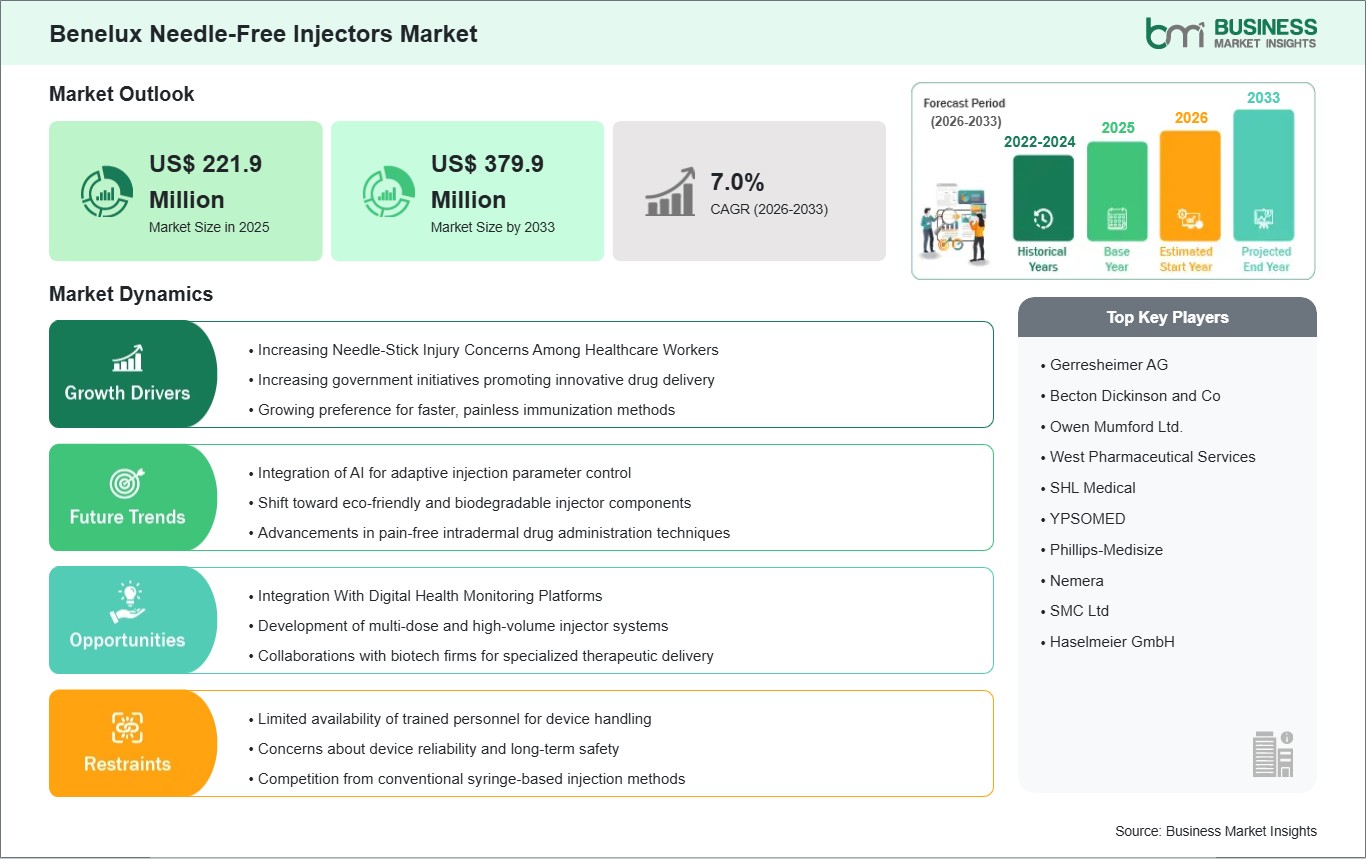
Hospitals, outpatient clinics, and specialized care centers in Belgium, the Netherlands, and Luxembourg are integrating needle-free injectors into vaccination programs, chronic disease management, and biologic therapies. The market landscape is characterized by multinational medical device manufacturers and local distributors focusing on product reliability, ease of use, and regulatory compliance within stringent European medical device standards. Clinical acceptance is driven by evidence demonstrating improved patient comfort, reduced anxiety, and minimized risk of cross-contamination, which resonates with healthcare institutions emphasizing patient-centric care. Purchasing decisions are influenced by device cost and the total cost of ownership, encompassing maintenance, training, and consumables management. Regulatory frameworks in the region are harmonized under the EU Medical Device Regulation (MDR), providing clear pathways for market entry but requiring rigorous clinical validation and post-market surveillance. Collaboration with healthcare professionals and pilot programs remains crucial to demonstrating operational efficiency and fostering adoption in hospital systems. Innovation trends are moving toward disposable and reusable injector systems, devices capable of delivering varying viscosities, and digital features enabling dose tracking and patient adherence monitoring. The Benelux market reflects a mature, compliance-driven environment where strategic differentiation through device performance, workflow integration, and patient experience drives competitive advantage, setting the stage for sustainable market growth.
Segment Analysis
Benelux Needle-Free Injectors Market Segmentation
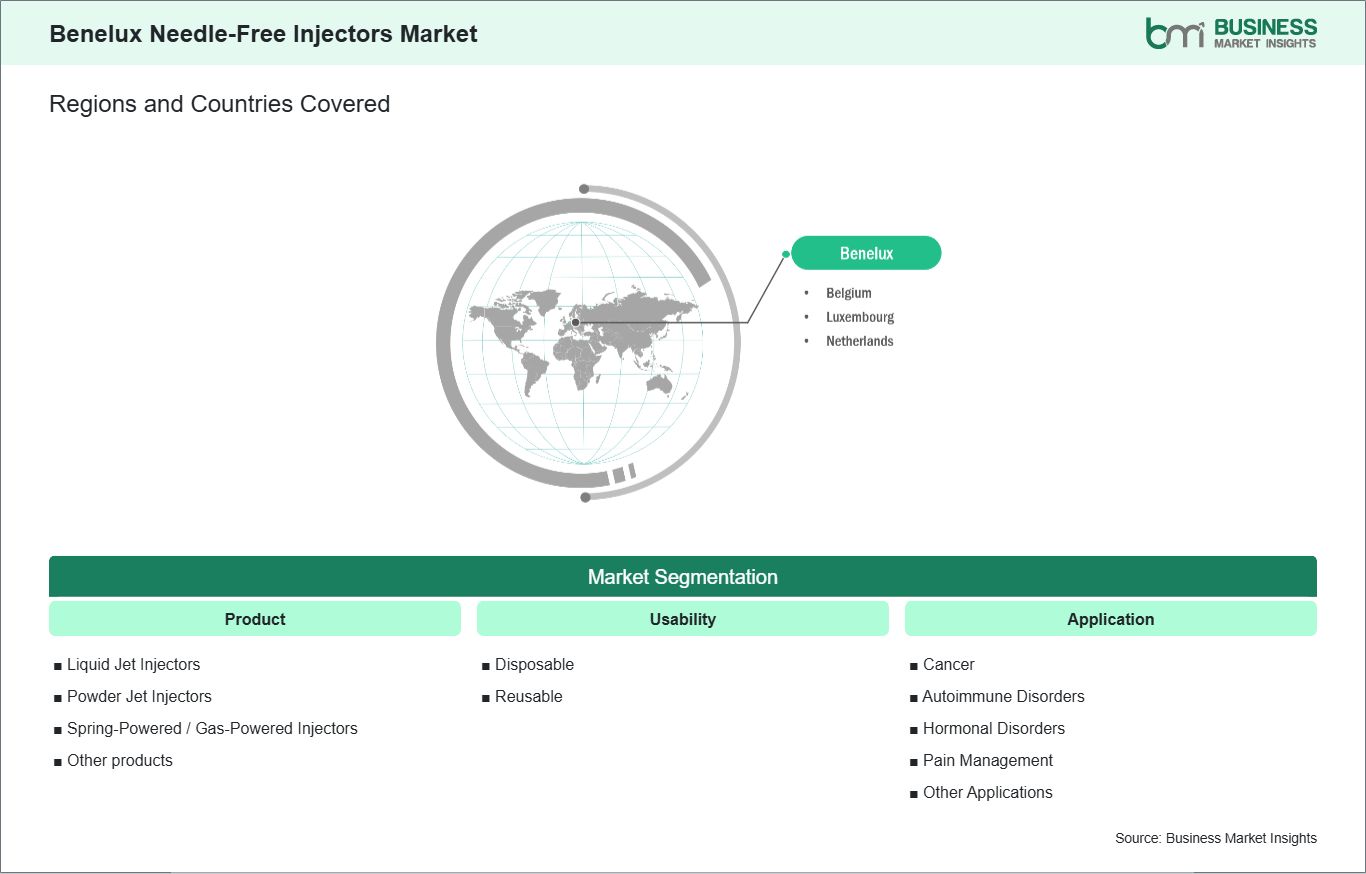
Key segments that contributed to the derivation of the Benelux needle-free injectors market analysis are product, usability, and application.
- By product, the needle-free injectors market is segmented into liquid jet injectors, powder jet injectors, spring-powered / gas-powered injectors, and other products. The liquid jet injectors segment dominated the market in 2025.
- Based on usability, the needle-free injectors market is categorized into disposable and reusable. The disposable segment dominated the market in 2025.
- In terms of application, the market is classified into cancer, autoimmune disorders, hormonal disorders, pain management, and other applications. The autoimmune disorders segment dominated the market in 2025.
Market Forces
Benelux Needle-Free Injectors Market Drivers and Opportunities
Increasing Needle-Stick Injury Concerns Among Healthcare Workers
Traditional needle-based injections carry dangers, including accidental punctures and exposure to bloodborne pathogens, which can lead to serious health complications and long-term liability concerns. Needle-free injectors provide a safer alternative by eliminating sharp instruments from routine administration, reducing the potential for such injuries, and promoting a safer working environment. Healthcare workers in Belgium, the Netherlands, and Luxembourg are subject to stringent workplace safety regulations and compliance standards. Institutions are adopting technologies that proactively minimize occupational hazards while maintaining clinical efficiency. Needle-free injectors align with these objectives, offering healthcare professionals a method of drug administration that significantly lowers the risk of accidental puncture. This trend is relevant in high-volume settings such as hospitals and vaccination centers, where repeated injections increase the likelihood of injuries. Beyond safety, the focus on staff wellbeing and retention is influencing procurement decisions. Hospitals and clinics recognize that technologies enhancing safety contribute to operational efficiency and staff morale. Needle-free injectors mitigate injury risk and streamline procedures, enabling faster and more confident administration of medications. As occupational safety initiatives strengthen across the Benelux countries, the adoption of needle-free injectors is expected to expand, becoming an integral component of healthcare safety protocols and workplace health strategies.
Integration With Digital Health Monitoring Platforms
Needle-free injectors integrated with digital monitoring platforms offer an opportunity to track dosage accuracy, patient usage patterns, and adherence in real time. This integration is valuable for managing chronic conditions, where continuous oversight is crucial to achieving therapeutic goals and preventing complications. Connected needle-free injectors are relevant in home-based care settings, where remote monitoring enables healthcare providers to maintain control without frequent in-person visits. By linking injection devices with digital platforms, patients can receive reminders, automated dosing feedback, and support for self-administration. This feature fosters patient engagement, empowers individuals to take a more active role in managing their conditions, and ensures that treatment protocols are followed consistently. In the region, where patient-centered care and preventive health strategies are emphasized, such integrated systems are aligned with national healthcare priorities. Digital integration allows institutions to enhance operational workflows and reduce errors. Real-time data from connected injectors can be used to generate reports, monitor adherence trends, and adjust treatment plans. Hospitals and clinics benefit from improved resource allocation and better clinical oversight, while patients enjoy safer, more reliable treatment experiences. As the Benelux healthcare landscape prioritizes technology-enabled care, needle-free injectors integrated with digital platforms are positioned to become a standard feature in modern therapeutic protocols, supporting clinical outcomes and patient convenience.
Size and Share Analysis
Benelux Needle-Free Injectors Market Size and Share Analysis
The Benelux Needle-free Injectors Market demonstrates steady growth, with size and share analysis highlighting evolving trends and competitive dynamics among key players. The report examines subsegments categorized within product, usability, and application, offering insights into their contribution to overall market performance.
By product, the liquid jet injectors subsegment dominated the market in 2025, driven by their ability to deliver precise doses safely and efficiently, making them well-suited for frequent clinical and home-based use.
Based on usability, the disposable subsegment dominated the market in 2025, driven by a strong emphasis on hygiene, infection prevention, and ease of handling in healthcare settings across Belgium, the Netherlands, and Luxembourg.
In terms of application, the autoimmune disorders subsegment dominated the market in 2025, driven by the need for regular, long-term medication administration where patient comfort and adherence are essential for disease management.
Report Coverage
Benelux Needle-Free Injectors Market Report Coverage and Deliverables
The "Benelux Needle-free Injectors Market Size and Forecast (2022–2033)" report provides a detailed analysis of the market covering below areas:
- Benelux Needle-free Injectors Market size and forecast at regional and country levels for all market segments covered under the scope
- Benelux Needle-free Injectors Market trends, as well as drivers, restraints, and opportunities
- Benelux Needle-free Injectors Market analysis covering key trends, regional framework, major players, regulations, and recent developments
- Industry landscape and competition analysis covering market concentration, heat map analysis, prominent players, and recent developments for the Benelux Needle-free Injectors Market
- Detailed company profiles, including SWOT analysis
Geographic Insights
Benelux Needle-Free Injectors Market Geographic Insights
The geographical scope of the Benelux Needle-free Injectors Market report is divided into Belgium, the Netherlands, and Luxembourg. The Netherlands held the largest share in 2025.
Netherlands demonstrates a strong preference for evidence-based solutions in hospital and outpatient settings, with demand concentrated in tertiary care centers and public vaccination programs. Belgium is characterized by a proactive approach to innovation adoption, with private clinics and research institutions acting as early adopters of needle-free injector technologies, supported by robust reimbursement mechanisms and public health initiatives. Luxembourg reflects a concentrated market driven by high per-capita healthcare spending, focus on patient-centric care, and streamlined regulatory processes that facilitate the introduction of novel devices. Across the region, pilot programs and clinical validation studies serve as critical benchmarks, influencing broader adoption patterns and procurement decisions. Distributor networks and localized training programs impact market penetration, particularly in multi-hospital group deployments. Urban centers act as early adoption hubs, creating reference points that inform secondary and tertiary healthcare facilities. Cross-border collaboration and knowledge sharing between Benelux countries help streamline best practices and accelerate device integration into standard clinical workflows. These country insights underline that success in the Benelux needle-free injectors market requires tailored approaches that account for national healthcare priorities, regulatory expectations, and institutional adoption behaviors.
Industry Activity
Recent Developments
The Benelux Needle-free Injectors Market is evaluated by gathering qualitative and quantitative data post primary and secondary research, which includes important corporate publications, association data, and databases. A few of the key developments in the Benelux needle-free injectors market are:
- In January 2025, Dutch medtech company FlowBeams showcased its BoldJet needle‑free injection technology at CES 2025, highlighting a laser‑based liquid microjet injector designed to deliver medication and vaccines pain‑free without needles. The BoldJet system, developed by a University of Twente spin‑off in Enschede (Netherlands), received recognition as a CES Innovation Award honoree, showcasing its potential for medical and cosmetic applications. This public debut placed the Netherlands‑based needle‑free technology on the global stage, attracting industry and investor attention. The demonstration underscored the device’s precision, minimal invasiveness, and potential to reduce needle‑related risks in healthcare and dermatology.
- In December 2023, NuGen Medical Devices signed a five‑year distribution agreement with Verrue Consulting Group to bring the InsuJet needle‑free injector to Belgium, targeting improved subcutaneous delivery for diabetic care and training local nurses and diabetes educators for deployment. The device was approved as a medical device in Belgium, and the partnership aims to reach thousands of type 1 diabetes patients via clinics, pharmacies, and direct sales.
Trust & Transparency
Research Methodology
The market analysis combines proprietary research with secondary data from government agencies, company disclosures, regulatory filings, industry databases and expert interviews. Market estimates are validated through data triangulation, cross-market benchmarking and analyst
review.
View Full Research Methodology
Key Sources Referred:
World Health Organization (WHO)Organisation for Economic Cooperation and Development (OECD)The World Bank GroupWorldometerThe LancetInternational Bar AssociationInternational Trade Administration