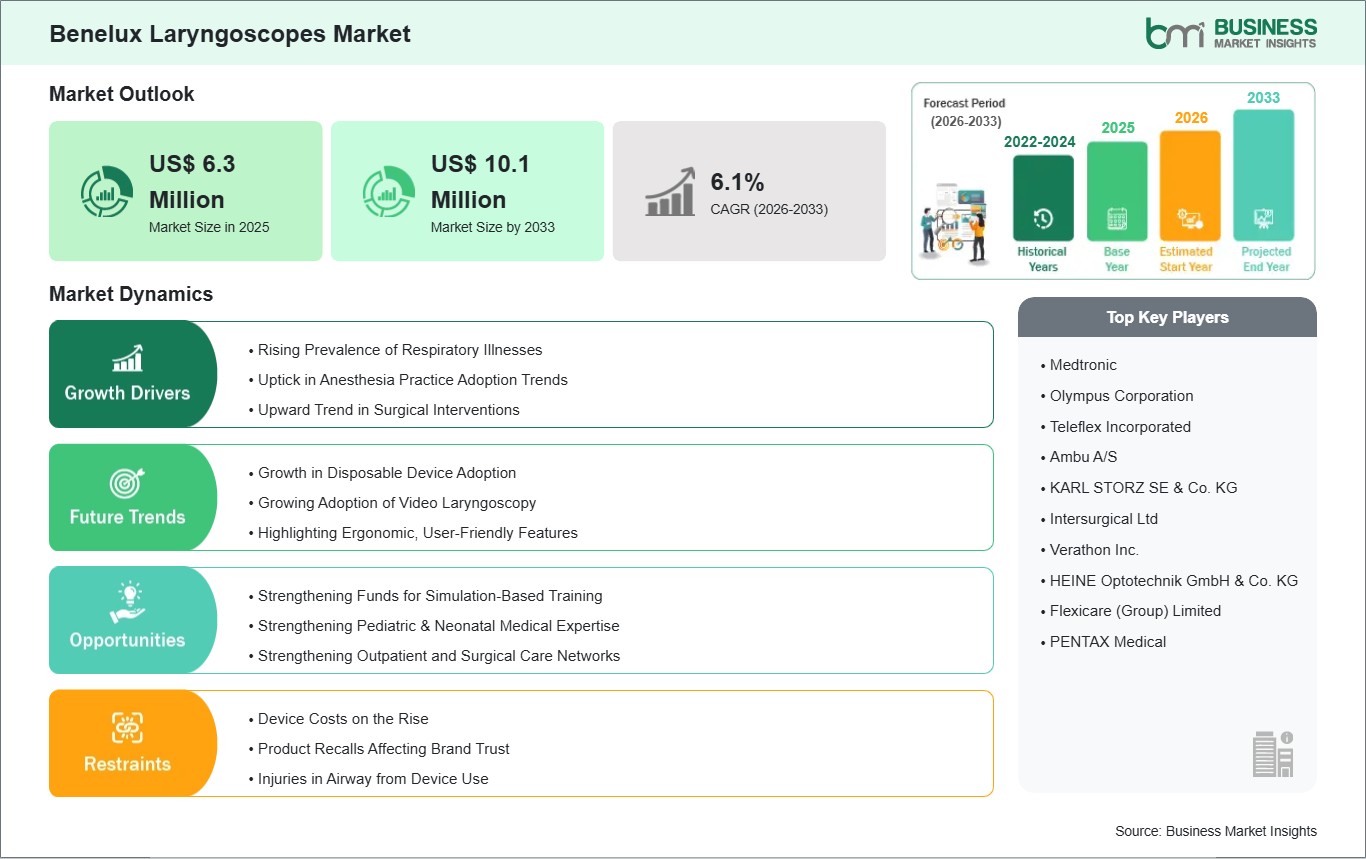
The Benelux laryngoscopes market size is expected to reach US$ 10.1 million by 2033 from US$ 6.3 million in 2025. The market is estimated to record a CAGR of 6.1% from 2026 to 2033.
The Benelux market for laryngoscopes within an advanced healthcare environment that exhibits good regulatory compliance, state-of-the-art hospitals, and high standards of clinical precision during airway manipulation. The need for laryngoscopes is mainly generated by the constant number of surgical procedures being performed, coupled with the rising number of cases of respiratory diseases and aging that require airway manipulation. Hospitals and specialized surgery centers in the Netherlands, Belgium, and Luxembourg are increasingly employing the use of video-laryngoscope equipment to increase the success rate of intubation and minimize complications.
Quality standards in the healthcare industry play an important role in shaping the region's market structure, and the quick adoption of technologically advanced medical equipment plays a significant role in this regard. In the healthcare industry of the Benelux region, the purchasing process favors clinically tested, reliable, and ergonomic equipment, and there will be constant demand for high-quality laryngoscope products. Besides, existing emergency medical services and trauma care networks ensure efficient utilization of airway management products both inside and outside hospital facilities. Budget control measures in the public healthcare organizations could restrain the pace of implementation of expensive technological advances, particularly in smaller healthcare organizations. Even though new technology is adopted quickly, the purchasing process takes a long time due to thorough testing procedures that can delay the launch of new product variants.

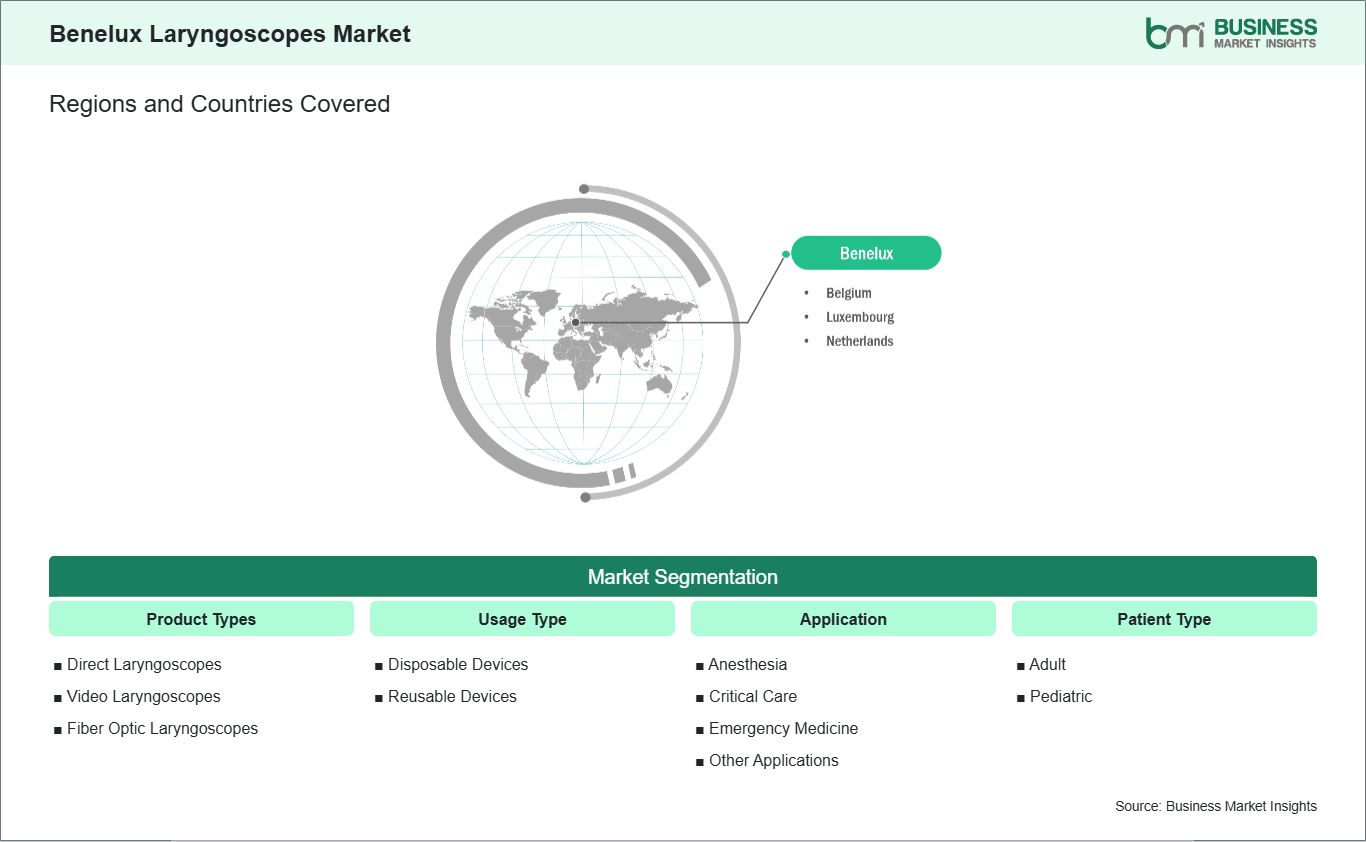
Key segments that contributed to the derivation of the Benelux laryngoscopes market analysis are product type, usage type, application, patient type, and end user.
The Benelux region is witnessing a steady rise in respiratory illnesses driven by urban density, industrial emissions, and aging demographics. Rotterdam, Brussels, and Luxembourg City experience periodic air quality concerns linked to traffic congestion and port-related industrial activity, which contributes to increased cases of asthma and chronic respiratory irritation. These conditions often escalate into emergency airway complications, reinforcing the clinical reliance on laryngoscopes in hospitals and emergency departments.
Besides environmental considerations, the growing number of elderly people in the area contributes to the burden of respiratory diseases. Elderly patients in Belgium and the Netherlands are especially vulnerable to diseases such as pneumonia, COPD, and post-surgery complications, requiring airway treatment. The growth in the percentage of the elderly increases the need for intubation procedures; thus, a laryngoscope becomes a common medical device used in critical care and anesthesiology departments.
Finally, another driving force behind the use of a laryngoscope is the prevalence of chronic respiratory diseases in the healthcare system. Although the region boasts an advanced healthcare system with preventive measures in place, the number of hospitalizations due to respiratory diseases is still quite high, especially around flu season.
Healthcare systems in the Benelux region are increasingly investing in simulation-based medical education as part of broader efforts to improve clinical outcomes and patient safety. Teaching hospitals in Leuven, Amsterdam, and Utrecht are expanding simulation labs where clinicians practice airway management techniques using realistic patient mannequins and digital feedback systems. This structured training environment is particularly important for mastering intubation procedures, where precision and timing are critical.
Funding for medical education innovation in Belgium and the Netherlands is taking place at both hospital university networks and through public-private partnerships. This funding has helped facilitate the introduction of innovative airway management instruments that will allow medical practitioners to get acquainted with new laryngoscopes before using them in clinical practice. This practice is leading to gradual improvement of skills related to the procedure and minimizing the variability between the procedures at different hospitals.
Finally, regional collaboration in healthcare, alongside the use of European Union-funded initiatives in education, is facilitating the standardization of training procedures in the area. Increasingly, simulation training has been used not only by specialists but also by emergency medicine residents and paramedics. Moreover, during the course of education, the use of video-assisted and fiber-optic laryngoscopy is being promoted, which also accelerates the spread of such innovations in practical work.

The Benelux Laryngoscopes market demonstrates steady growth, with size and share analysis highlighting evolving trends and competitive dynamics among key players. The report evaluates important subsegments categorized within product type, usage type, application, patient type, and end user, highlighting their respective contributions to overall market performance.
By product type, the video laryngoscopes subsegment dominated the laryngoscopes market in 2025. This is driven by the increasing demand for enhanced airway visualization, improved first-pass intubation success rates, and reduced complications in difficult airway management, making them a key revenue driver for manufacturers and supporting strong adoption in clinical practice.
In terms of usage type, the disposable devices subsegment led the market in 2025. The dominance of disposable devices is attributed to the growing emphasis on infection control, prevention of cross-contamination, and the operational convenience of eliminating reprocessing and sterilization requirements in high-volume healthcare settings.
Based on application, the anesthesia subsegment held the largest share in 2025. Hospitals and surgical centers widely rely on laryngoscopes during anesthesia procedures for airway management and intubation, supported by the rising number of surgeries and the increasing use of advanced airway management techniques.
In terms of patient type, the adult subsegment dominated the market in 2025. This is driven by the higher prevalence of surgical procedures, critical care admissions, and chronic respiratory conditions among adults, resulting in greater demand for airway management devices in this population group.
By end user, the hospitals subsegment held the largest share in 2025. Hospitals maintain leadership due to their advanced infrastructure, availability of skilled healthcare professionals, high patient inflow, and strong capability to perform complex surgical and emergency procedures requiring laryngoscopy.
| Report Attribute | Details |
|---|---|
| Market size in 2025 | US$ 6.3 Million |
| Market Size by 2033 | US$ 10.1 Million |
| CAGR (2026 - 2033) | 6.1% |
| Historical Data | 2022-2024 |
| Forecast period | 2026-2033 |
| Segments Covered | By Product Types
|
|
Regions and Countries Covered
| |
| Benelux | Belgium, Netherlands, Luxembourg |
| Market leaders and key company profiles |
|
The "Benelux Laryngoscopes Market Size and Forecast (2022-2033)" report provides a detailed analysis of the market covering below areas:
The geographical scope of the Benelux Laryngoscopes market report is divided into: Belgium, the Netherlands, and Luxembourg. The Netherlands held the largest share in 2025.
The Netherlands is considered a significant and highly organized laryngoscope market due to the existence of a centralized healthcare system in the country, as well as an active promotion of evidence-based practice in medicine. The hospital market of the Netherlands features sophisticated and state-of-the-art tertiary care facilities and university hospitals, which implement the latest innovations in airway management technology, including video laryngoscopy, especially in anesthesiology, intensive care, and emergency settings.
Standardization and centralization of procurement are crucial aspects of the Dutch market for medical devices, which allows guaranteeing a high level of quality in terms of introducing products and their distribution in healthcare organizations. This factor contributes to the selection of effective and relatively inexpensive solutions for laryngoscopy that need to meet the requirements of current guidelines. In addition, the Netherlands has high standards regarding physician education in airway management, which determines the use of simple and complicated airway equipment in medical practice.
Despite the country's highly developed medical sector, it maintains an approach to technology adoption characterized by rationality, considering both financial efficiency and technological innovation. Although the most prominent hospitals implement video-assisted devices, smaller healthcare organizations still apply laryngoscopes to conduct ordinary procedures.

The Benelux Laryngoscopes market is evaluated by gathering qualitative and quantitative data post primary and secondary research, which includes important corporate publications, association data, and databases. A few of the key developments in the Benelux Laryngoscopes market are:
The Benelux Laryngoscopes Market is valued at US$ 6.3 Million in 2025, it is projected to reach US$ 10.1 Million by 2033.
As per our report Benelux Laryngoscopes Market, the market size is valued at US$ 6.3 Million in 2025, projecting it to reach US$ 10.1 Million by 2033. This translates to a CAGR of approximately 6.1% during the forecast period.
The Benelux Laryngoscopes Market report typically cover these key segments-
The historic period, base year, and forecast period can vary slightly depending on the specific market research report. However, for the Benelux Laryngoscopes Market report:
The Benelux Laryngoscopes Market is populated by several key players, each contributing to its growth and innovation. Some of the major players include:
The Benelux Laryngoscopes Market report is valuable for diverse stakeholders, including:
Essentially, anyone involved in or considering involvement in the Benelux Laryngoscopes Market value chain can benefit from the information contained in a comprehensive market report.
Please tell us your area of interest
(Market Segments/ Regions and Countries/ Companies)