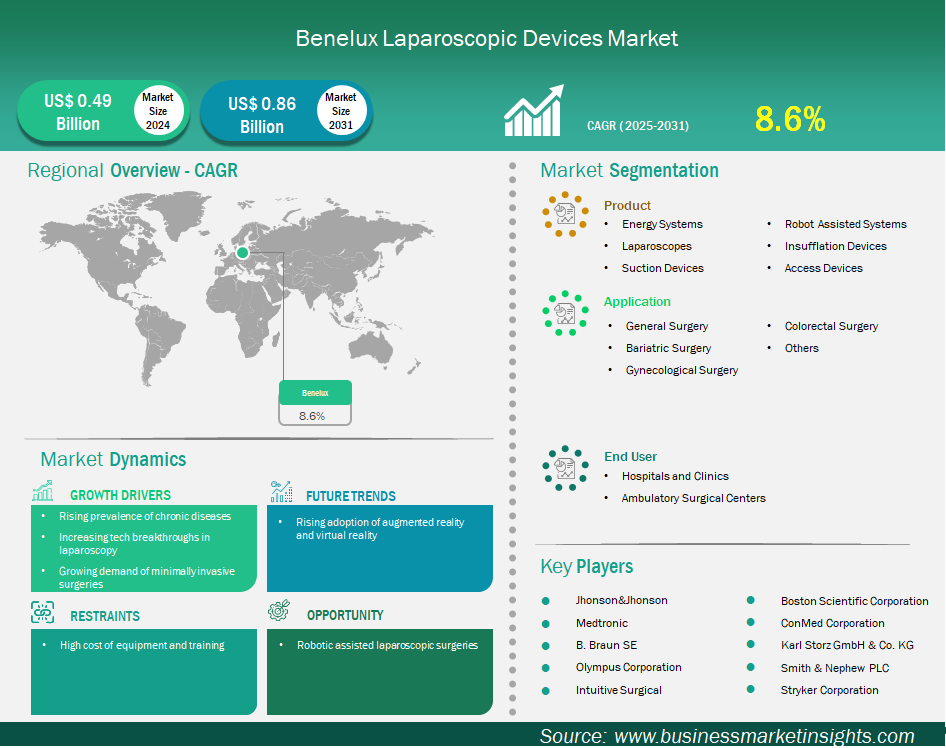
Benelux laparoscopic devices market size is expected to reach US$ 875.9 million by 2031 from US$ 492.6 million in 2024. The market is estimated to record a CAGR of 8.6% from 2025 to 2031.
Executive Summary and Benelux Laparoscopic Devices Market Analysis:
The laparoscopic devices market in Benelux is experiencing significant growth driven by rising prevalence of chronic diseases, increasing tech breakthroughs in laparoscopy, and growing demand of minimally invasive surgeries. The laparoscopic devices market is experiencing major advancements in the field of laparoscopic surgery, specifically in bariatric, colorectal and general surgery. This is driven by advancements in technology and the increased uptake of minimally invasive techniques. Key players in the European market, such as B. Braun has a notable presence in the Benelux region, contributing to the development and distribution of laparoscopic technologies. The implementation of diagnosis-related group (DRG)-based hospital payment systems in Europe has further incentivized healthcare institutions to adopt cost-effective and clinically efficient laparoscopic solutions. Despite challenges like the slow recovery from the European financial crisis, the market for laparoscopic devices continues to expand, particularly in countries like Germany, Austria, and Switzerland, which influence the broader European market dynamics.
Benelux Laparoscopic Devices Market Segmentation Analysis:
Key segments that contributed to the derivation of the laparoscopic devices market analysis are product, application, and end user.
- By product, laparoscopic devices market is segmented into energy systems, laparoscopes, suction devices, robot assisted systems, insufflation device, and access devices. The laparoscopes segment dominated the market in 2024.
- In terms of application, the market is segmented into general surgery, bariatric surgery, gynecological surgery, colorectal surgery, others. The general surgery segment held the largest share of the market in 2024.
- By end user, the market is segmented into hospitals and clinics, and ambulatory surgical centers. Hospitals and clinics segment held the largest share of the market in 2024.
Benelux Laparoscopic Devices Market Outlook
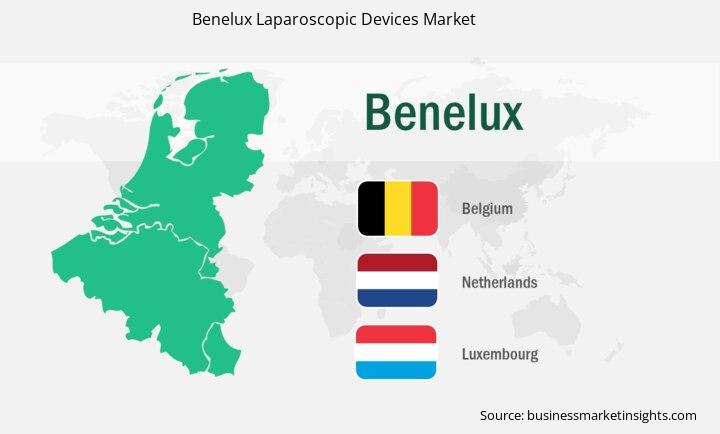
The Benelux laparoscopic devices market is segmented into Belgium, Netherlands, and Luxembourg. The region is increasingly adopting laparoscopic colorectal approach in order to have faster recovery times post-surgery. In Belgium, 45.9% of surgical residents have been trained to laparoscopically perform bariatric surgical procedures and this shows an increased emphasis on minimally invasive procedures during general surgery training. These patterns of practice show that this region is committed to improving outcomes for patients. The Benelux region benefits from a well-established healthcare system, a high standard of medical education, and a strong emphasis on research and development. These factors collectively foster an environment conducive to the growth and adoption of advanced laparoscopic technologies. Looking ahead, the market is expected to continue its upward trajectory, driven by technological innovations, an aging population, and a growing preference for minimally invasive surgical procedures. The adoption of laparoscopic techniques is bolstered by their benefits, including reduced recovery times, smaller incisions, and shorter hospital stays, leading to increased demand for specialized surgical instruments and imaging systems.
Benelux Laparoscopic Devices Market Country Insights
Based on region, the Benelux laparoscopic devices market is further segmented into the Belgium, Netherlands, and Luxembourg. The Belgium held the largest share in 2024.
In Belgium, laparoscopic cholecystectomies increased by 4.28% in 2023 for a total of 25,280 procedures, while in the Netherlands, laparoscopic cholecystectomies decreased by 1.57% in 2023 for 293 cases or 101.9 procedures per 100,000 persons. In Luxembourg, demand for bariatric procedures are anticipated to increase with the market projected to increase at a CAGR of 9.2% through 2031. In the Netherlands, the increased rates of overweight (50.8%) and obesity (15.4%) as of 2022 has driven a 35% uptake in laparoscopic and robotic bariatric surgeries from 2020 to 2023 with 85% being minimally invasive in 2022. Belgium's laparoscopic devices market is robust and dynamic, propelled by a strong national focus on integrating advanced medical technologies and continuously improving patient outcomes. In a significant move in 2024, public healthcare systems across Belgium made a substantial investment by introducing 220 new high-definition endoscopy towers supplied by Olympus. This major deployment aims to standardize advanced visualization capabilities across numerous healthcare facilities, thereby significantly enhancing the quality and efficiency of laparoscopic procedures performed nationwide.
Benelux Laparoscopic Devices Market Company Profiles
Medtronic Plc; Johnson & Johnson; Olympus Corp; Stryker Corp; Karl Storz SE & Co KG, Boston Scientific Corp, B Braun SE, Smith & Nephew Plc, Conmed Corp, and Intuitive Surgical Inc, are among the key players operating in the market. These players adopt strategies such as expansion, product innovation, and mergers and acquisitions to stay competitive in the market and offer innovative products to their consumers.
Benelux Laparoscopic Devices Market Research Methodology:
The following methodology has been followed for the collection and analysis of data presented in this report:
- Secondary Research
The research process begins with comprehensive secondary research, utilizing both internal and external sources to gather qualitative and quantitative data for each market. Commonly referenced secondary research sources include, but are not limited to:
- Company websites, annual reports, financial statements, broker analyses, and investor presentations
- Industry trade journals and other relevant publications
- Government documents, statistical databases, and market reports
- News articles, press releases, and webcasts specific to companies operating in the market
Note: All financial data included in the Company Profiles section has been standardized to US$. For companies reporting in other currencies, figures have been converted to US$ using the relevant exchange rates for the corresponding year.
- Primary Research
Business Market Insights conducts a significant number of primary interviews each year with industry stakeholders and experts to validate and analyze the data and gain valuable insights. These research interviews are designed to:
- Refine findings from secondary research
- Enhance the expertise and market understanding of the analysis team
- Gain insights into market size, trends, growth patterns, competitive dynamics, and future prospects
Primary research is conducted via email interactions and telephone interviews with industry experts across various markets, categories, segments, and sub-segments in different regions. Participants typically include:
- Industry stakeholders: Vice Presidents, business development managers, market intelligence managers, and national sales managers
- External experts: Valuation specialists, research analysts, and key opinion leaders with industry-specific expertise
Key Sources Referred:
- The World Bank World Development Indicators
- World Health Organization (WHO)
- Global Healthcare Academy
- BMC Medical Education
- The World Bank Group
- Eurostat
- LANCET
Benelux Laparoscopic Devices Market Strategic Insights
Benelux Laparoscopic DevicesMarket Report Highlights
| Report Attribute | Details |
| Market size in 2024 | US$ 492.6 Million |
| Market Size by 2031 | US$ 875.9 Million |
| CAGR (2025 - 2031) | 8.6% |
| Historical Data | 2021-2023 |
| Forecast period | 2025-2031 |
| Segments Covered |
By Product
|
|
Regions and Countries Covered
|
|
| Benelux | Belgium, Netherlands, Luxembourg |
| Market leaders and key company profiles |
|
Benelux Laparoscopic Devices Market Country and Regional Insights