Market Summary
Executive Summary and Market Analysis
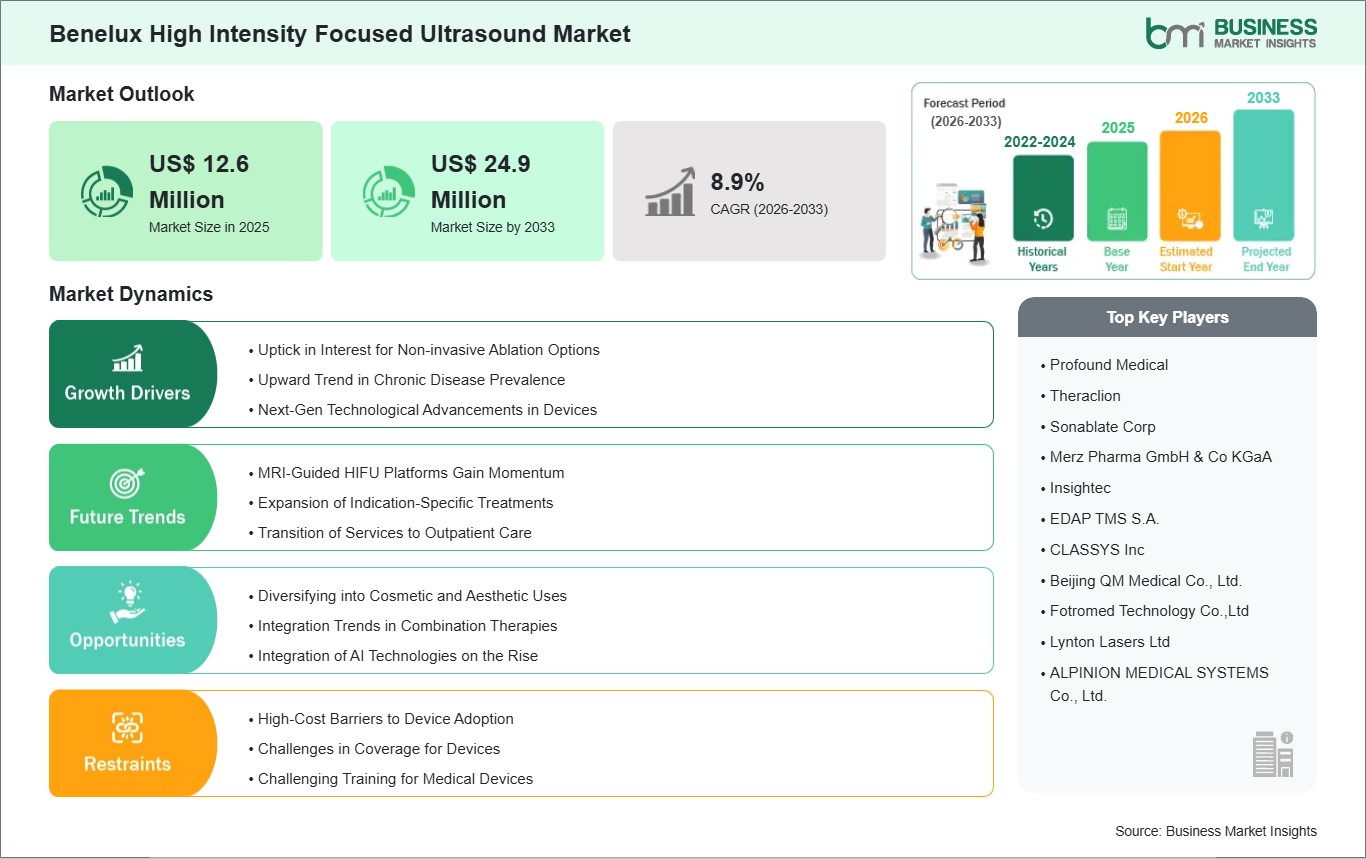
The Benelux region is progressively adopting high intensity focused ultrasound (HIFU) technologies, reflecting its reputation for advanced healthcare systems and early integration of minimally invasive medical solutions. Across the region, hospitals and specialized clinics are increasingly using HIFU for treating prostate disorders, uterine fibroids, and certain localized tumors, as it offers precision treatment while significantly reducing patient recovery time and procedural complications. Growing patient awareness and preference for non-invasive options are motivating healthcare providers to integrate HIFU into routine clinical pathways. Additionally, the region benefits from strong collaboration between research institutions, hospitals, and medical device companies, which fosters clinical trials, innovation, and the validation of new therapeutic applications. Despite these drivers, certain challenges constrain broader adoption. Differences in reimbursement policies across Belgium, the Netherlands, and Luxembourg create uncertainty in patient access and hospital investment decisions. Furthermore, the concentration of trained clinicians in urban medical centers limits HIFU availability in smaller towns or rural regions. Imaging infrastructure, critical for precise HIFU treatment, is unevenly distributed across the three countries, further slowing widespread uptake. With supportive regulatory frameworks, a focus on patient-centric care, and ongoing clinical validation, the Benelux region is expected to gradually expand its HIFU adoption, positioning itself as a hub for innovative non-invasive therapies in Europe.
Segment Analysis
Benelux High Intensity Focused Ultrasound Market Segmentation
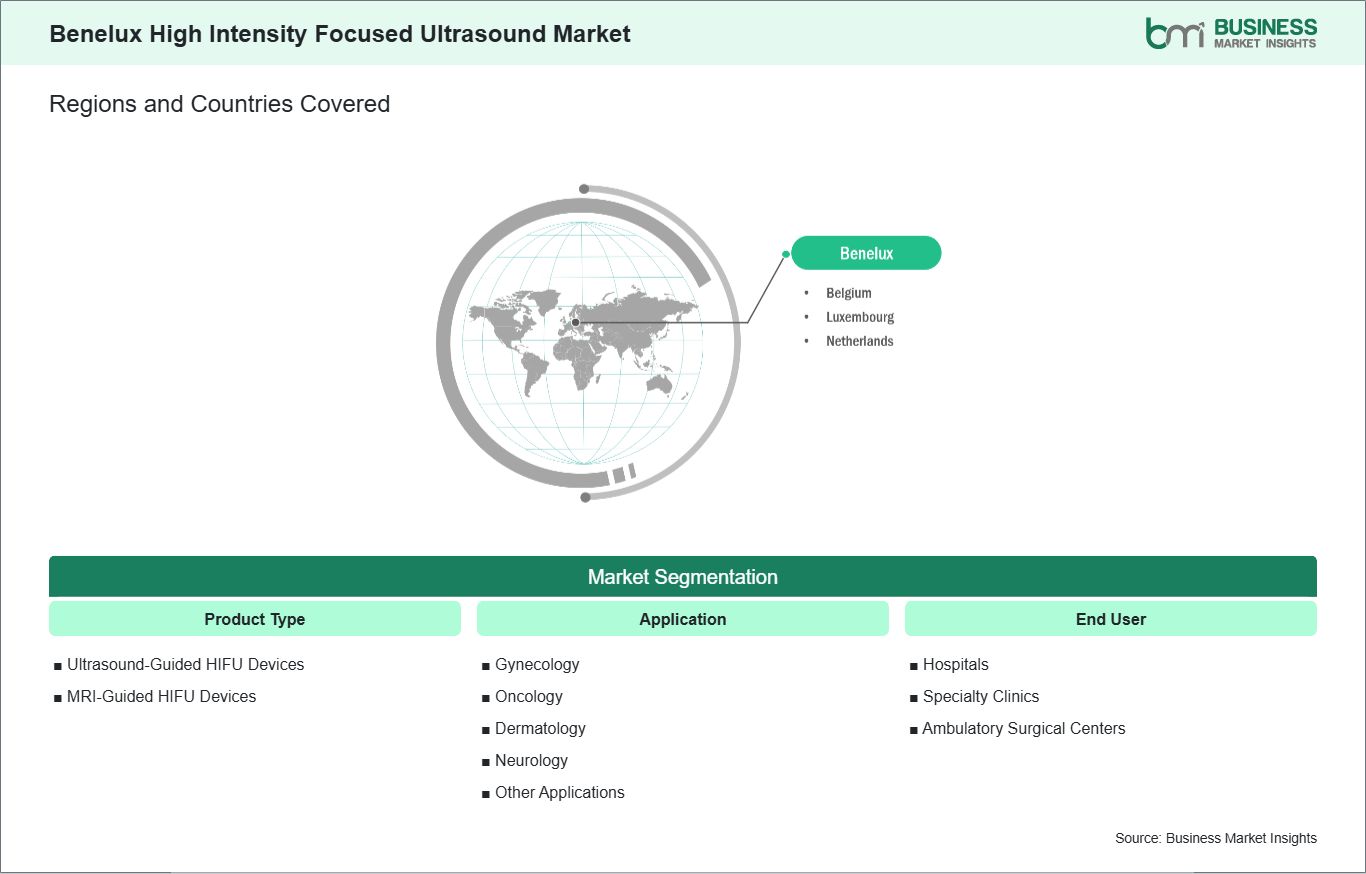
Key segments that contributed to the derivation of the Africa high intensity focused ultrasound market analysis are product type, application, and end user.
- By product type, the high intensity focused ultrasound market is segmented into ultrasound-guided HIFU devices, MRI-guided HIFU devices. The ultrasound-guided HIFU devices segment dominated the market in 2025.
- Based on application, the high intensity focused ultrasound market is classified into gynecology, oncology, dermatology, neurology, other applications. The gynecology segment dominated the market in 2025.
- In terms of end user, the high intensity focused ultrasound market is categorized into hospitals, specialty clinics, and ambulatory surgical centers. The hospitals segment dominated the market in 2025.
Market Forces
Benelux High Intensity Focused Ultrasound Market Drivers and Opportunities
Uptick in Interest for Non‑invasive Ablation Options
The Benelux healthcare market is seeing growing interest in non‑invasive ablation options such as High Intensity Focused Ultrasound (HIFU). Hospitals and medical centers are increasingly adopting HIFU for conditions like tumors and fibroids as it allows precise tissue treatment without surgical incisions. Clinicians appreciate that HIFU reduces procedural risk and shortens recovery time, making it an appealing alternative to traditional surgery.
Healthcare providers are integrating advanced imaging techniques, including real‑time ultrasound or MRI guidance, with HIFU treatments to enhance accuracy and safety. This combination allows medical teams to target affected tissue more precisely and manage complex cases with greater confidence. As a result, non‑invasive ablation is becoming a more accepted component of multidisciplinary care in areas such as oncology and gynecology.
Alongside established hospitals, smaller clinics and demonstration programs are helping broaden the adoption of HIFU. Training initiatives and collaborative knowledge‑sharing enable practitioners to gain hands-on experience and build expertise. These efforts are fostering a more widespread acceptance of non‑invasive ablation technologies, embedding them into routine treatment pathways and patient care strategies.
Diversifying into Cosmetic and Aesthetic Uses
HIFU is also expanding into cosmetic and aesthetic applications across the Benelux region. Aesthetic clinics are using the technology for non-surgical skin tightening, facial lifting, and body contouring, appealing to clients seeking noticeable results without invasive procedures or lengthy recovery. These treatments align with broader consumer interest in minimally invasive solutions that emphasize convenience and natural outcomes.
Practitioners are positioning HIFU as a complement to traditional aesthetic services, highlighting its ability to stimulate collagen production and improve skin elasticity. Clinics are integrating HIFU into broader portfolios of skincare and anti-aging treatments, offering clients more options for non-invasive rejuvenation alongside other technologies such as lasers or radiofrequency systems.
Consumer awareness is also shaping adoption, as individuals increasingly research non-surgical treatments and share their experiences. Clinics are educating prospective clients about the benefits and expected outcomes of HIFU procedures, helping to build trust and familiarity. This growing awareness is driving the expansion of HIFU in aesthetic practices, extending its appeal beyond clinical settings into everyday beauty and wellness care.
Size and Share Analysis
Benelux High Intensity Focused Ultrasound Market Size and Share Analysis
The Benelux high intensity focused ultrasound market demonstrates steady growth, with size and share analysis highlighting evolving trends and competitive dynamics among key players. The report evaluates important subsegments categorized within product type, application, and end user, highlighting their respective contributions to market performance.
By product type, the ultrasound-guided HIFU devices subsegment dominated the market in 2025. This is driven by the recurring need for precise and reliable imaging during HIFU procedures, which ensures accurate targeting and effective ablation of tissues, making these devices a key revenue driver for manufacturers and sustaining consistent demand in clinical settings.
In terms of application, the gynecology subsegment led the market in 2025. The dominance of gynecology applications is attributed to the rising prevalence of uterine fibroids and adenomyosis, growing adoption of non-invasive treatment methods, and increasing awareness among healthcare providers of HIFU’s effectiveness in providing safe, minimally invasive therapeutic options for women’s health conditions.
Based on end user, the hospitals subsegment held the largest share in 2025. Hospitals maintain leadership due to their well-established gynecology and surgical departments, access to advanced HIFU equipment, trained medical staff, and the capability to perform complex procedures while providing comprehensive patient care.
Report Coverage
Benelux High Intensity Focused Ultrasound Market Report Coverage and Deliverables
The "Benelux High Intensity Focused Ultrasound Market Size and Forecast (2022–2033)" report provides a detailed analysis of the market covering below areas:
- Benelux High Intensity Focused Ultrasound market size and forecast at regional and country levels for all market segments covered under the scope
- Benelux High Intensity Focused Ultrasound market trends, as well as drivers, restraints, and opportunities
- Benelux High Intensity Focused Ultrasound market analysis covering key trends, regional framework, major players, regulations, and recent developments
- Industry landscape and competition analysis covering market concentration, heat map analysis, prominent players, and recent developments for the Benelux High Intensity Focused Ultrasound market
- Detailed company profiles, including SWOT analysis
Geographic Insights
Benelux High Intensity Focused Ultrasound Market Geographic Insights
The geographical scope of the Benelux High Intensity Focused Ultrasound market report is divided into: Belgium, the Netherlands, and Luxembourg. The Netherlands held the largest share in 2025.
The Netherlands is the leading HIFU adopter within the Benelux region, supported by a highly developed healthcare system, a culture of medical innovation, and a strong emphasis on evidence-based treatment. Dutch hospitals and specialized clinics have integrated HIFU for a variety of therapeutic applications, including oncology, gynecology, and certain benign tumor treatments, where minimally invasive alternatives are particularly valued. The country benefits from structured collaboration between hospitals, research institutions, and medical technology providers, which has enabled clinical trials, procedural standardization, and the refinement of patient selection criteria. Training programs for physicians and technicians ensure that HIFU treatments are delivered safely and effectively, enhancing patient confidence and improving outcomes. Urban medical centers such as those in Amsterdam, Rotterdam, and Utrecht act as key hubs for HIFU deployment, while ongoing initiatives aim to increase accessibility in smaller cities and regional hospitals. Regulatory support in the Netherlands facilitates the introduction of innovative technologies, allowing smoother market entry and faster clinical adoption compared with some neighboring countries. While challenges such as cost, limited rural access, and specialized training needs remain, the Netherlands’ proactive approach to medical innovation and patient-centric care secures its position as the dominant HIFU market in the Benelux, serving as a model for the broader regional adoption of non-invasive therapeutic technologies.
Industry Activity
Recent Developments
The Benelux high intensity focused ultrasound market is evaluated by gathering qualitative and quantitative data post primary and secondary research, which includes important corporate publications, association data, and databases. A few of the key developments in the Benelux High Intensity Focused Ultrasound market are:
- In September 2024, EDAP TMS S.A. launched the world’s first AI‑assisted robotic HIFU procedure in collaboration with Avenda Health using its Focal One robotic HIFU platform, positioning the company’s technology pipeline for advanced clinical integration; this demonstrates product innovation that supports EDAP’s European commercial direction including markets like Benelux.
- In January 2024, Insightec Ltd. announced that its MR‑guided focused ultrasound (MRgFUS) technology was recommended for national health insurance coverage in the Netherlands for the treatment of essential tremor. This recommendation by the Dutch Healthcare Institute paves the way for broader access to Insightec’s Exablate MR‑HIFU system through the Dutch healthcare system, enabling more patients to receive incision‑less therapy.
Trust & Transparency
Research Methodology
The market analysis combines proprietary research with secondary data from government agencies, company disclosures, regulatory filings, industry databases and expert interviews. Market estimates are validated through data triangulation, cross-market benchmarking and analyst
review.
View Full Research Methodology
Key Sources Referred:
The World BankWorld Health Organization (WHO)Center for Disease Control and Prevention (CDC)Food and Drug Administration (FDA)European Database on Medical Devices (EUDAMED)European Society of Cardiology (ESC)American College of Cardiology (ACC)American Heart Association (AHA)Company WebsitesCompany Annual ReportsCompany Investor Presentations