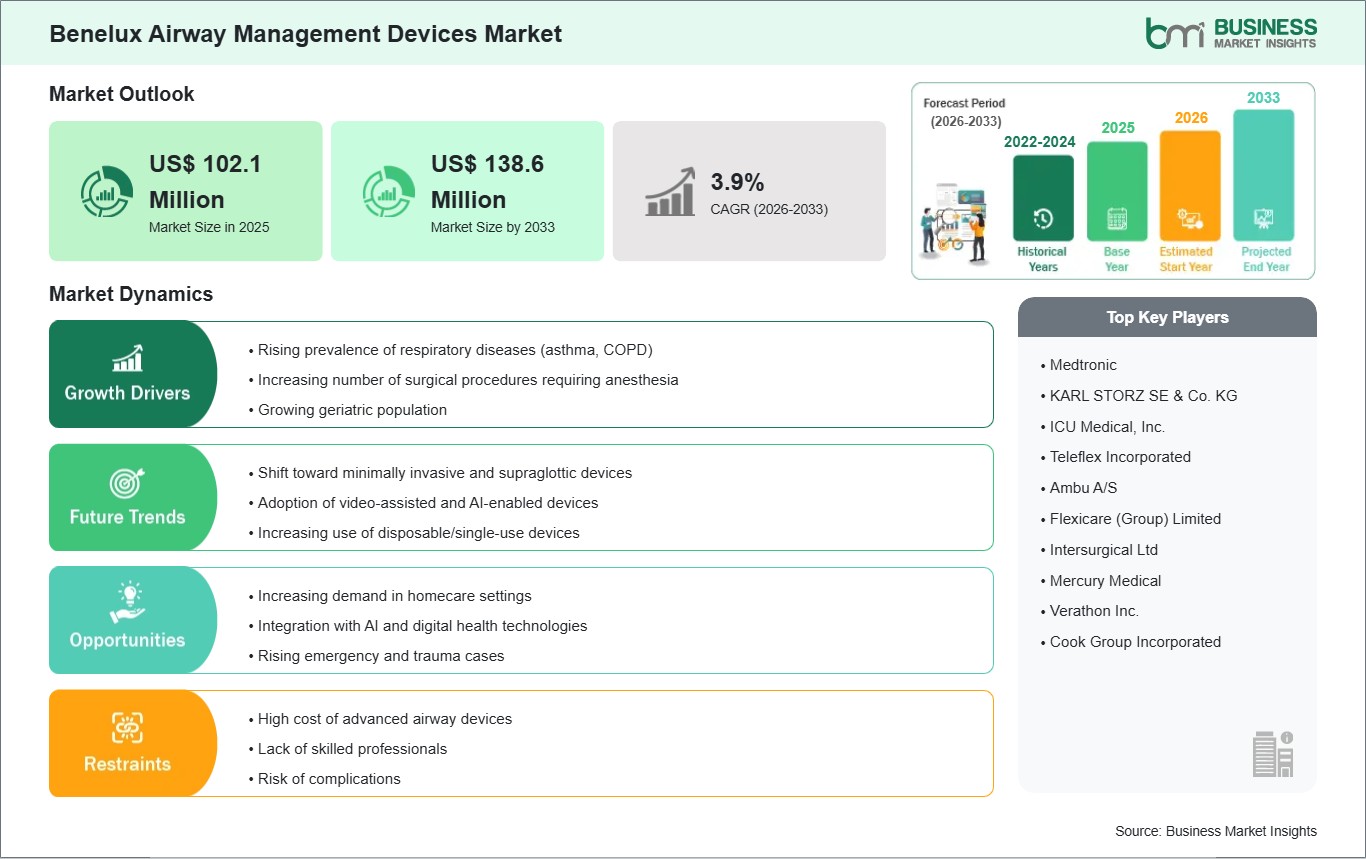
The Benelux airway management devices market size is expected to reach US$ 138.6 million by 2033 from US$ 102.1 million in 2025. The market is estimated to record a CAGR of 3.9% from 2026 to 2033.
The Benelux airway management devices market can be seen to represent an environment characterized by maturity combined with a lot of innovations, due to the well-established health care systems and focus on patient safety within the region. In particular, the Netherlands dominates the market, thanks to its extremely well-organized health care system, evidence-based medicine practices and the early incorporation of innovative airway management technologies including video laryngoscopes and supraglottic airway devices. Belgium follows suit, thanks to the continuous adoption of hospital innovations, whereas Luxembourg makes an impact through its high expenditure on health care. One of the key drivers behind the growth witnessed by the regional market involves the increasing attention being paid to improvement in terms of critical care and anesthesiology, especially when dealing with the increased number of surgeries and efficient airway management in the geriatric population. The highly developed pre-hospital emergency system in the Netherlands and Belgium also helps drive the demand for airway devices that are convenient to use. On the contrary, some major factors restraining the market in question involve the tough regulatory environment due to the European regulation of the medical device sector, making it difficult and time-consuming to receive approval for the devices. Moreover, a dependence on state funding for healthcare makes rapid procurement less likely in Belgium.

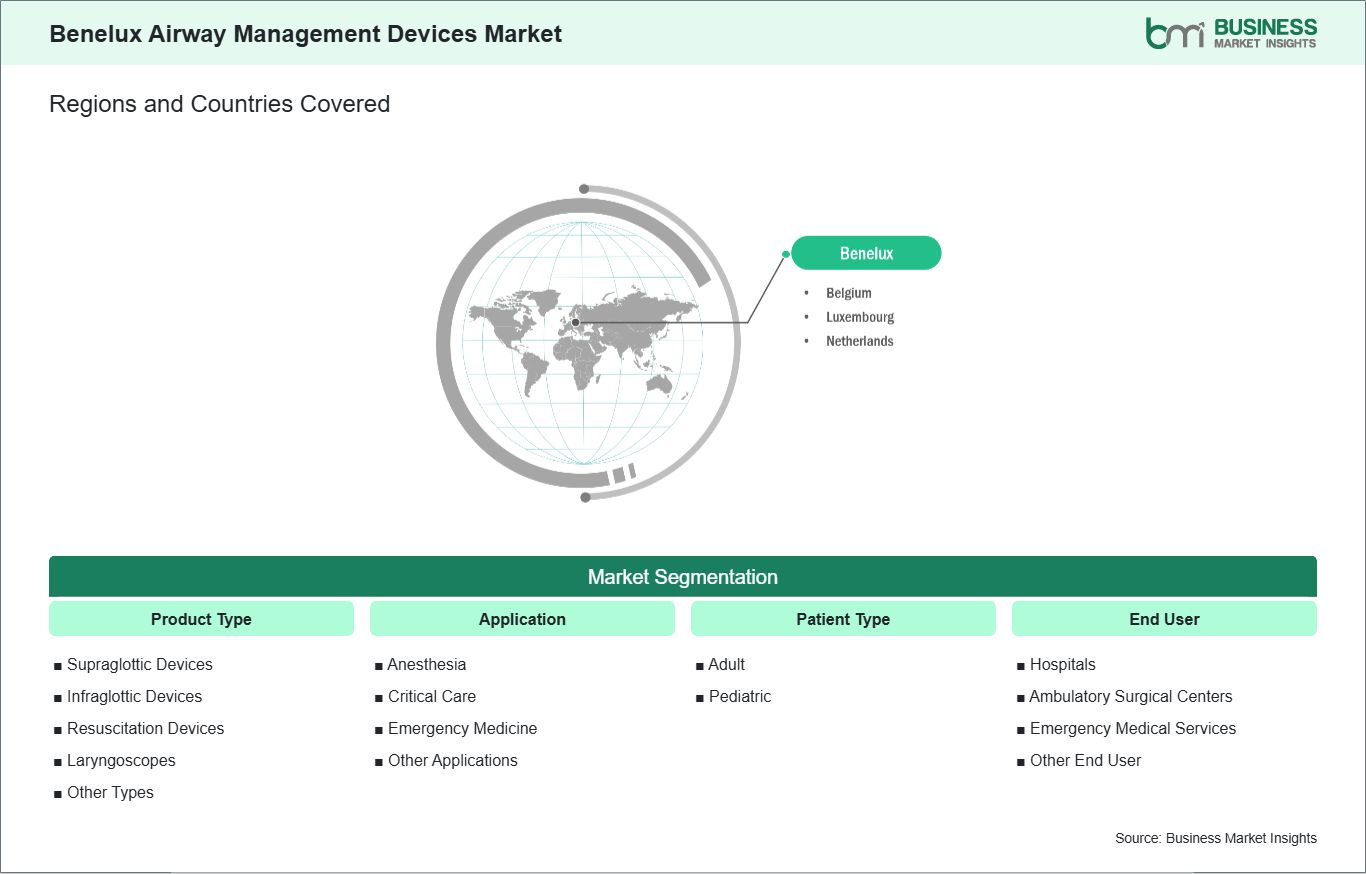
Key segments that contributed to the derivation of the airway management devices market analysis are product type, application, patient type, and end user.
The Benelux market for airway management devices is significantly impacted by the rising prevalence of chronic respiratory disorders such as asthma and COPD in the country. In the Netherlands, Belgium, and Luxembourg, there has been an increase in the prevalence of such respiratory disorders owing to their impact on lifestyle changes, environmental pollution, and aging populations. Airway management devices are essential in addressing the challenges associated with respiratory disorders in densely populated urban centers, where residents experience higher exposure to pollutants from industries.
There have been reported cases of increased admission rates to hospitals among individuals suffering from asthma and COPD due to the exacerbation of the underlying condition. Patients in such scenarios would need emergency oxygen delivery systems and ventilatory assistance. The recurrence of such conditions would result in patients repeatedly needing airway management devices, thereby enhancing the market potential in the country.
Another important factor that contributes to the market potential for airway management devices in the Benelux country is the aging population in the country. With a higher percentage of older people in the Benelux countries, there will be a need to provide appropriate care to address the challenges experienced by such patients. As a result, healthcare systems across the region continue to invest in modern devices to improve patient outcomes and manage the growing disease burden.
The need for devices that can help in managing airways in domestic settings is growing fast in the Benelux countries due to the ongoing trend towards decentralization of healthcare. Governments as well as healthcare organizations have been promoting healthcare delivery in alternative settings such as home because this reduces pressures on the system and makes access to health care easier for patients.
People with chronic respiratory diseases are being treated at home rather than in hospitals, particularly when they are stable and not experiencing any acute attacks of their illness. In the Netherlands and Belgium, for example, there are policies of early discharge followed by continued home-based respiratory care, which make this process of managing respiratory diseases in patients less stressful and more comfortable.
With the advent of new technology, the process is further being accelerated by the development of airway management devices that have been designed to be easy-to-use and have remote monitoring features. It means that users need very little training to use them, while medical professionals will find it easy to monitor the condition of their patients. Convenience and economy of such airway management devices have helped boost the growth of the home care segment within the Benelux region.
The Benelux airway management devices marketis experiencing steady growth, with market size and share analysis reflecting evolving treatment preferences and competitive dynamics among key players. The report evaluates important subsegments categorized within product type, application, patient type, and end user, highlighting their respective contributions to overall market performance.
By product type, the infraglottic devices subsegment dominated the market in 2025. In anesthesia practice, infraglottic devices provide protection against aspiration and enable precise airway management, driving higher adoption in operating rooms and critical care settings compared to supraglottic devices.
Based on application, the anesthesia subsegment dominated the market in 2025 due to the need for definitive airway control across a wide range of surgical procedures, from routine elective surgeries to complex interventions. Because infraglottic devices are essential for intubation during anesthesia, this segment experiences consistent, high-volume usage, making it the largest segment compared to emergency or general critical care.
In terms of patient type, the adult subsegment dominated the market in 2025. Most procedural training, device designs, and usage guidelines are optimized for adult anatomy and usage scenarios, reinforcing higher market volume.
Based on end user, the hospital subsegment dominated the market in 2025, as hospitals remain the central hub for airway management, handling scheduled surgeries, emergency admissions, ICU care, and trauma cases. Their larger budgets, need for extensive airway inventories, and availability of multidisciplinary professionals make them the largest purchasers compared to outpatient centers or EMS, where volume and purchasing power are comparatively lowe
| Report Attribute | Details |
|---|---|
| Market size in 2025 | US$ 102.1 Million |
| Market Size by 2033 | US$ 138.6 Million |
| CAGR (2026 - 2033) | 3.9% |
| Historical Data | 2022-2024 |
| Forecast period | 2026-2033 |
| Segments Covered | By Product Type
|
|
Regions and Countries Covered
| |
| Benelux | Belgium, Netherlands, Luxembourg |
| Market leaders and key company profiles |
|
The "Benelux Airway Management Devices Market Size and Forecast (2022–2033)" report provides a detailed analysis of the market covering below areas:
The geographical scope of the Benelux airway management devices marketreport is divided into: Belgium, the Netherlands, and Luxembourg. The Netherlands held the largest share in 2025.
The Netherlands dominates in the Benelux airway management devices market because of the centralized and effective healthcare system in the country. The Netherlands is famous for early application of the latest medical innovations that help doctors make procedures safer and more effective. The airway management techniques in the Netherlands are consistent with the guidelines established by the international community. Modern equipment, including video-assisted intubation systems and second generation supraglottic airway devices, is widely used in hospitals in the Netherlands.An important feature of the Netherlands market is tight cooperation of hospitals and ambulance services. In the Netherlands, ambulances have advanced technical capabilities to perform procedures involving airway management equipment outside hospitals. Thus, the use of airway management devices is not limited to hospitals only in the Netherlands. Moreover, a trend towards simulation education of anesthesia specialists and emergency response personnel is emerging in the Netherlands. Sustainability and cost efficiency are equally important, as healthcare facilities tend to select medical devices which offer excellent performance in conjunction with environmental aspects. The existence of reliable distribution channels and purchasing programs further facilitates access to the market for vendors. In general, the Dutch healthcare system still sets an example in terms of airway management among all nations of the Benelux community.

The Benelux airway management devices marketis evaluated by gathering qualitative and quantitative data post primary and secondary research, which includes important corporate publications, association data, and databases. A few of the key developments in the Benelux airway management devices marketare:
The Benelux Airway Management Devices Market is valued at US$ 102.1 Million in 2025, it is projected to reach US$ 138.6 Million by 2033.
As per our report Benelux Airway Management Devices Market, the market size is valued at US$ 102.1 Million in 2025, projecting it to reach US$ 138.6 Million by 2033. This translates to a CAGR of approximately 3.9% during the forecast period.
The Benelux Airway Management Devices Market report typically cover these key segments-
The historic period, base year, and forecast period can vary slightly depending on the specific market research report. However, for the Benelux Airway Management Devices Market report:
The Benelux Airway Management Devices Market is populated by several key players, each contributing to its growth and innovation. Some of the major players include:
The Benelux Airway Management Devices Market report is valuable for diverse stakeholders, including:
Essentially, anyone involved in or considering involvement in the Benelux Airway Management Devices Market value chain can benefit from the information contained in a comprehensive market report.
Please tell us your area of interest
(Market Segments/ Regions and Countries/ Companies)