Market Summary
Executive Summary and Market Analysis
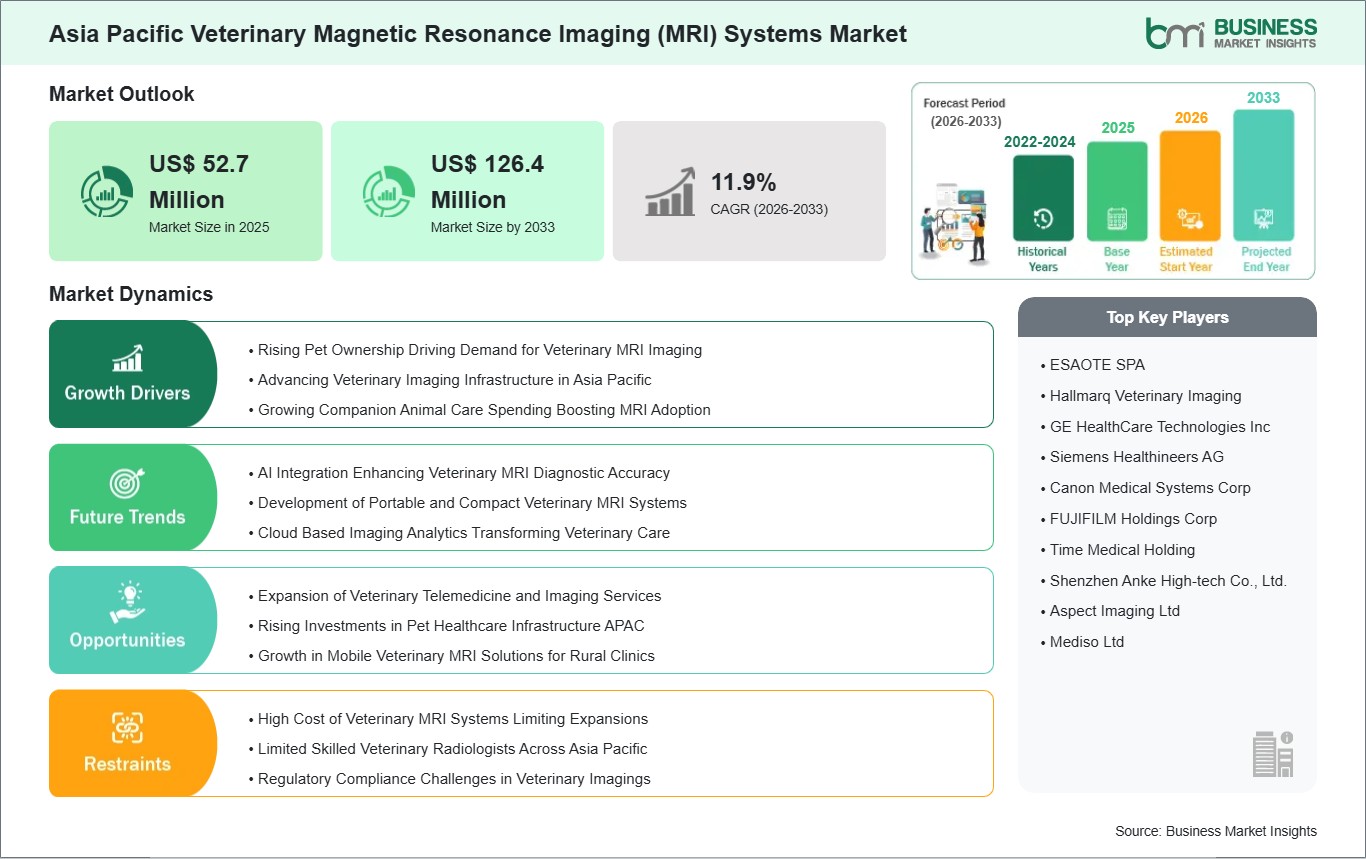
The Asia Pacific Veterinary Magnetic Resonance Imaging (MRI) Systems Market develops as a new branch of the veterinary diagnostic imaging market because the region advances to better healthcare for companion animals and specialized veterinary services. Veterinary hospitals and referral centers throughout the region now use MRI systems to achieve precise diagnosis of animal neurological, orthopedic, oncology and soft tissue disorders. The market operates through two distinct segments, which include developed countries that use advanced technology in Japan and Australia and South Korea and developing countries that use affordable technology in India and China and Indonesia and Thailand. Pet owners now view their pets as family members, which drives market growth because they spend money on advanced diagnostic tests that match human medical standards. Veterinary institutions now use MRI technology to achieve high-resolution imaging, which helps them detect diseases at early stages with better accuracy. Urban areas with growing pet healthcare expenses need advanced imaging equipment because veterinary specialty clinics and referral networks keep expanding their services. The adoption of MRI systems in companion and livestock applications receives support from increasing animal welfare awareness and the need for preventive diagnostics. The regional market experiences its development through technological progress, which serves as a vital force for its advancement. The combination of compact MRI systems and superior imaging software with AI-based diagnostic tools has made veterinary MRI technology more affordable and easier to use for veterinary professionals. The local manufacturing ecosystems found in various Asian regions have achieved cost reductions which make veterinary services more affordable for mid-sized veterinary clinics. The market experiences significant restrictions, which create ongoing challenges for its operations. The acquisition costs and maintenance expenses associated with MRI systems create a major obstacle that affects small and medium-sized veterinary clinics in developing countries. The system's effective use faces challenges because of two factors, which include the shortage of skilled veterinary radiologists and imaging technicians who are needed to operate it outside of large urban areas. The different regulatory systems in Asia Pacific countries and their dependence on foreign high-tech equipment create operational challenges that slow down implementation processes. The Asia Pacific Veterinary MRI Systems Market will experience constant growth because veterinary care in the region becomes more advanced yet cost and skill restrictions create different limitations throughout the various parts of the region.
Segment Analysis
Asia Pacific Veterinary Magnetic Resonance Imaging (MRI) Systems Market Segmentation
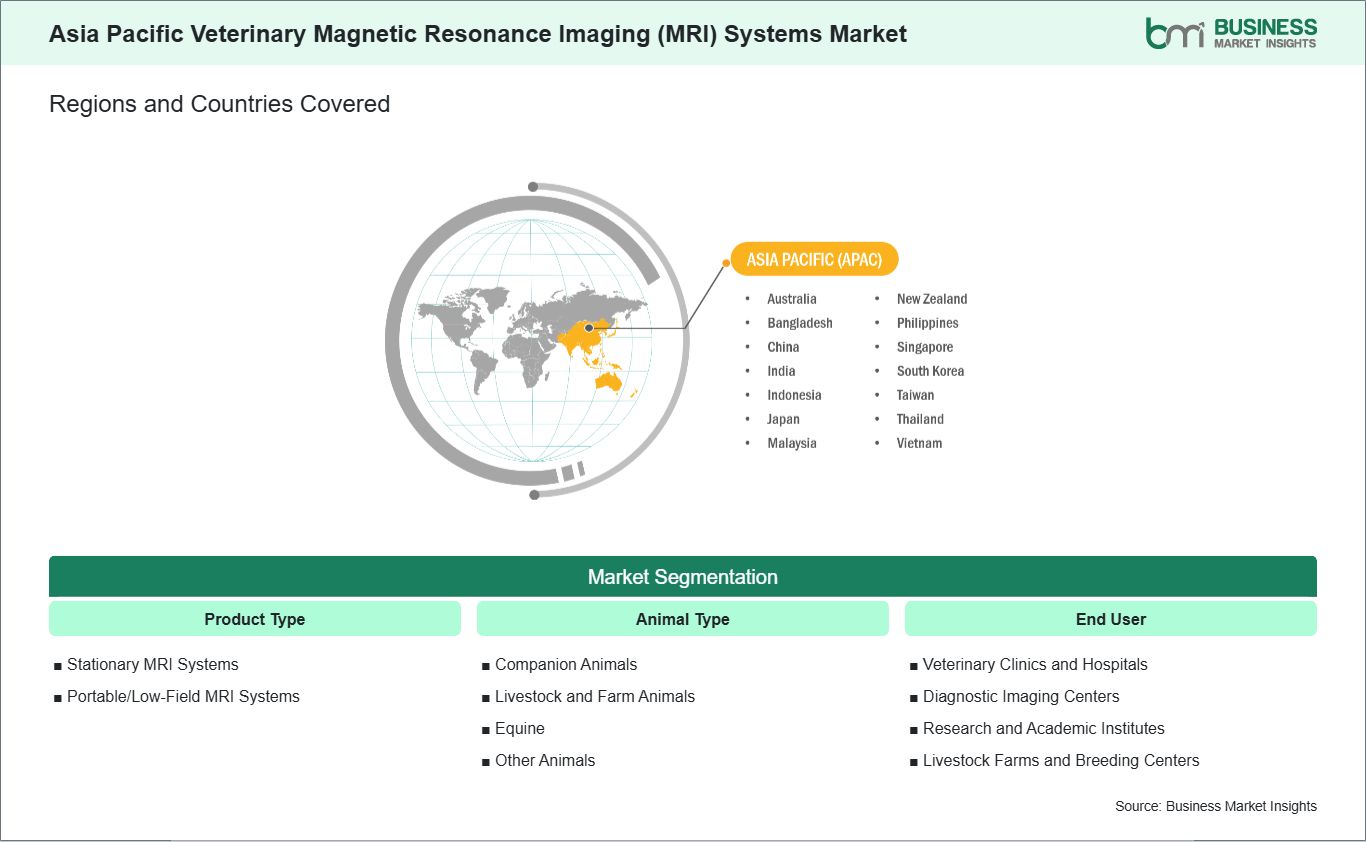
Key segments that contributed to the derivation of the Asia Pacific veterinary magnetic resonance imaging (MRI) systems market analysis are product type, animal type, and end user.
- By product type, the veterinary magnetic resonance imaging (MRI) systems market is segmented into stationary MRI systems, portable/low-field MRI systems. The stationary MRI systems segment dominated the market in 2025.
- Based on animal type, the veterinary magnetic resonance imaging (MRI) systems market is categorized into companion animals, livestock and farm animals, equine, others. The companion animals segment dominated the market in 2025.
- In terms of end user, the veterinary magnetic resonance imaging (MRI) systems market is categorized into veterinary clinics and hospitals, diagnostic imaging centers, research and academic institutes, livestock farms and breeding centers. The veterinary clinics and hospitals segment dominated the market in 2025.
Market Forces
Asia Pacific Veterinary Magnetic Resonance Imaging (MRI) Systems Market Drivers and Opportunities
Rising Pet Ownership Driving Demand for Veterinary MRI Imaging
The veterinary MRI systems market in the Asia Pacific region is experiencing rapid expansion because pet ownership numbers are increasing and pet healthcare spending is rising in countries that include China, Japan, Australia and India. Advanced diagnostic imaging systems, which include MRI technology for diagnosing complex neurological and musculoskeletal conditions, are experiencing higher demand because urban areas grow and people treat their pets like family members.
Veterinary hospitals and specialty clinics across the Asia Pacific are increasingly investing in high-resolution MRI systems to improve diagnostic accuracy. Japan and South Korea lead the adoption of advanced technologies for veterinary care, while China and India develop their veterinary networks through private funding and improved understanding of modern pet medical technologies.
The area faces two major obstacles, which include expensive medical equipment and a shortage of skilled veterinary radiologists. The Australian market shows increased demand for advanced imaging technology because pet insurance rates have risen, while Japan faces an increasing number of elderly pets that need medical treatment, thus creating a long-term growth opportunity for the Asia Pacific market.
Expansion of Veterinary Telemedicine and Imaging Services
The expansion of veterinary telemedicine and imaging services in the Asia Pacific creates new opportunities to use MRI systems through their ability to enable remote diagnostics and cloud-based image sharing. Veterinary hospitals in urban centers of Singapore, Japan, and Australia are implementing complete imaging systems to enhance their consultation processes and enable better access to specialists.
The digital veterinary platforms in China and India are experiencing rapid growth because they need better imaging support systems with advanced capabilities. The teleconsultation system between rural clinics and urban specialists enables better access to MRI diagnosis services, which results in faster diagnosis times and improved treatment results for companion animals throughout the region.
The rising use of cloud-based veterinary imaging analytics, together with artificial intelligence tools, will drive MRI usage growth throughout the Asia Pacific. The countries of Japan and South Korea head the field of technology integration, while the ASEAN markets proceed to build their veterinary systems through rising financial support for pet healthcare digitalization and international veterinary partnership programs.
Size and Share Analysis
Asia Pacific Veterinary Magnetic Resonance Imaging (MRI) Systems Market Size and Share Analysis
The Asia Pacific veterinary magnetic resonance imaging (MRI) systems market is experiencing steady growth, with market size and share analysis reflecting evolving treatment preferences and competitive dynamics among key players. The report evaluates important subsegments categorized within product type, animal type, and end user, highlighting their respective contributions to market performance.
By product type, the stationary MRI systems subsegment dominated the market in 2025, driven by higher image quality, greater throughput, and widespread adoption in hospitals for comprehensive diagnostic imaging.
Based on animal type, the companion animals subsegment dominated the market in 2025, driven by increasing pet ownership and rising demand for advanced diagnostic imaging in routine veterinary care.
In terms of end user, the veterinary clinics and hospitals subsegment dominated the market in 2025, driven by the widespread adoption of x-ray systems for comprehensive diagnostic and treatment services.
Report Coverage
Asia Pacific Veterinary Magnetic Resonance Imaging (MRI) Systems Market Report Coverage and Deliverables
The "Asia Pacific Veterinary Magnetic Resonance Imaging (MRI) Systems Market Size and Forecast (2022–2033)" report provides a detailed analysis of the market covering below areas:
- Market size and forecast at regional and country levels for all market segments covered under the scope
- Market trends, as well as drivers, restraints, and opportunities
- Market analysis covering key trends, regional framework, major players, regulations, and recent developments
- Market concentration, heat map analysis, prominent players, and recent developments for the Market
- Detailed company profiles, including SWOT analysis
Geographic Insights
Asia Pacific Veterinary Magnetic Resonance Imaging (MRI) Systems Market Geographic Insights
The geographical scope of the Asia Pacific Veterinary Magnetic Resonance Imaging (MRI) Systems Market report is divided into China, India, Japan, Australia, Bangladesh, Indonesia, Malaysia, New Zealand, Philippines, Singapore, South Korea, Taiwan, Thailand, and Vietnam. China held the largest share in 2025.
The Asia Pacific veterinary MRI systems market develops as a specialized market within veterinary diagnostics, which exists because of increasing pet ownership and higher spending on veterinary care and the ongoing development of veterinary facilities in both developed countries and developing nations. The region's largest market exists in China because its companion animal population requires more veterinary services, there are more veterinary hospitals, and people use advanced diagnostic instruments throughout their cities. The country maintains its leading position because of its strong domestic medical imaging manufacturing capacity, which enables veterinary education institutions and specialty clinics to adopt high-end diagnostic devices. The veterinary MRI market in Japan represents a developed market that has reached full technological development because Japanese referral hospitals use veterinary MRI technology to treat pets, which are becoming more common among the elderly pet population and due to the nation's dedication to precision medicine. South Korea and Taiwan demonstrate equivalent development patterns, which include extensive but superior veterinary medical systems that utilize MRI technology in their specialized veterinary medical facilities and emergency animal treatment centers. Australia functions as a crucial developed market because its high animal welfare standards, its citizens' substantial spending power and its extensive pet insurance coverage lead to ongoing demand for advanced imaging services, which are most commonly used in equine medicine and companion animal treatment. New Zealand displays consistent growth for equine and livestock industries because its agricultural foundation supports this development. India has developed into one of the fastest-growing markets because urban areas experience rapid growth, and people adopt pets in cities while veterinary specialty clinics slowly extend their reach. Southeast Asian nations, which include Indonesia, Thailand, Vietnam, Malaysia and the Philippines, face initial adoption stages where veterinary diagnostics still depend on ultrasound and X-ray systems, although private veterinary chains and urban pet care services and veterinary education programs enable hospitals to use MRI technology. Singapore operates as a high-end veterinary center that provides advanced diagnostic services and international patient transfer systems despite its limited geographic area. Bangladesh has reached its initial development phase because it has few MRI machines and because high costs and inadequate veterinary facilities act as obstacles. The veterinary market in the Asia Pacific region exhibits three different growth patterns, which include Chinese market demand and technological progress, but Japanese and Australian markets maintain consistent revenue streams, while India and Southeast Asia present the highest possibilities for future development as veterinary health systems develop throughout the region.
Industry Activity
Recent Developments
The Asia Pacific Veterinary Magnetic Resonance Imaging (MRI) Systems Market is evaluated by gathering qualitative and quantitative data post primary and secondary research, which includes important corporate publications, association data, and databases. A few of the key developments in the Asia Pacific veterinary magnetic resonance imaging (MRI) systems market are:
- In June 2023, Hallmarq Veterinary Imaging, announced increased manufacturing and deployment capacity driven by rising global demand for its Standing Equine MRI and Small Animal MRI systems, supporting installations across veterinary referral hospitals worldwide through direct sales and partner networks.
- In November 2023, Hallmarq Veterinary Imaging announced the opening of a new US manufacturing facility in Chicago to expand production of its Standing Equine MRI and Small Animal MRI systems, supporting growing global demand including Asia Pacific veterinary referral markets. The expansion was aimed at increasing production capacity, improving delivery times, and strengthening international supply of veterinary MRI systems.
Trust & Transparency
Research Methodology
The market analysis combines proprietary research with secondary data from government agencies, company disclosures, regulatory filings, industry databases and expert interviews. Market estimates are validated through data triangulation, cross-market benchmarking and analyst
review.
View Full Research Methodology
Key Sources Referred:
American College of Veterinary Radiology (ACVR)World Small Animal Veterinary Association (WSAVA)British Veterinary Association (BVA)International Veterinary Radiology Association (IVRA)American Veterinary Medical Association (AVMA)European College of Veterinary Diagnostic Imaging (ECVDI)World Organisation for Animal Health (WOAH / OIE)Veterinary Imaging & Radiation Oncology Society (VIROS)