analysis - by Product Type (Bioreactors/Fermenters, Cell Culture, Filters, Bags and Containers, and Others), Workflow (Media Preparation, Cell Culture, and Cell Separation), Usage Type (Single-use and Multi-use), and Mode (In-house and Outsourced)
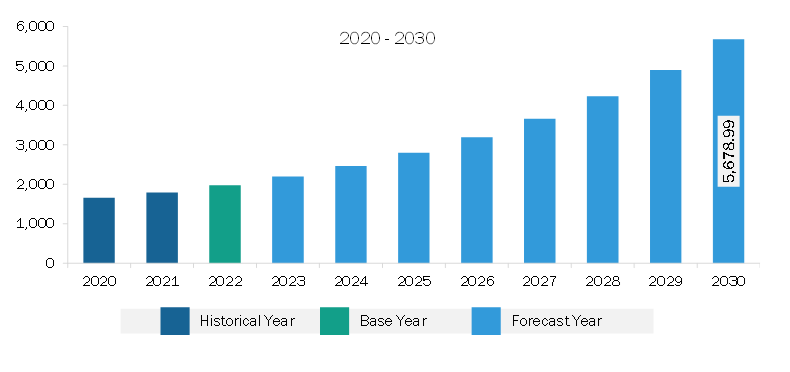
The Asia Pacific upstream bioprocessing market was valued at US$ 1,976.10 million in 2022 and is expected to reach US$ 5,678.99 million by 2030; it is estimated to grow at a CAGR of 14.1% from 2022 to 2030.
Technological Advancements Boost Asia Pacific Upstream Bioprocessing Market.
The upstream bioprocessing market is experiencing a wave of technological advancements, presenting considerable industry opportunities. These advancements include innovative developments in cell culture systems, bioreactor design, process monitoring, and control, as well as the integration of automation and digitalization. In September 2023, Repligen Corporation and Sartorius introduced an integrated bioreactor system. Repligen's XCell Alternating Tangential Flow (ATF) upstream intensification technology has been integrated into the Sartorius Biostat stirred-tank reactor (STR). This bioreactor technology is designed to make the application of N perfusion and intensified seed train easier for biopharmaceutical firms. An embedded XCell ATF hardware and software module that combines integrated process analytical technologies with predefined advanced control recipes is incorporated into Biostat STR. This module is intended to simplify the management of cell growth and enhance cell retention in perfusion procedures, eliminating the need for a separate cell retention control tower. Such modern products feature enhanced process efficiency, scalability, and adaptability, which are crucial for meeting the evolving demands of biopharmaceutical production.
Advanced cell culture media formulations and next-generation bioreactor technologies are contributing to the optimization of upstream bioprocessing, in turn, enabling higher product yields, improved product quality, and the efficient production of complex biologics. The ongoing integration of advanced analytics and real-time process monitoring is revolutionizing data-driven decision-making in bioprocessing, driving precision and process optimization opportunities. Progress in biotechnology also fosters the development of flexible and modular manufacturing platforms. Additionally, the convergence of machine learning, artificial intelligence, and predictive analytics is paving the way for predictive bioprocessing, thereby unlocking proactive process control, quality assurance, and cost optimization opportunities. Thus, technological advancements in upstream bioprocessing are reshaping the industry, presenting new avenues for innovation, efficiency, and adaptability.
Asia Pacific Upstream Bioprocessing Market Overview
The Asia Pacific upstream bioprocessing market is segmented into China, Japan, Australia, India, South Korea, and the Rest of Asia Pacific. The market in this region is expected to grow at the highest CAGR during 2022-2030. China, India, and Japan are three major contributors to the growth of the market in Asia Pacific, which is mainly driven by rising demand for bioreactors as well as an increase in research centers and government funding. Moreover, many international market players are focusing on countries in Asia Pacific for geographic expansion and other strategies.
Asia Pacific Upstream Bioprocessing Market Revenue and Forecast to 2030 (US$ Million)
Asia Pacific Upstream Bioprocessing Market Segmentation
The Asia Pacific upstream bioprocessing market is segmented based on product type, workflow, usage type, mode, and country. Based on product type, the Asia Pacific upstream bioprocessing market is segmented into bioreactors/fermenters, cell culture, filters, bags and containers, and others. The bioreactors/fermenters services held the largest market share in 2022.
Based on workflow, the Asia Pacific upstream bioprocessing market is categorized into media preparation, cell culture, and cell separation. The cell separation held the largest market share in 2022.
Based on usage type, the Asia Pacific upstream bioprocessing market is bifurcated into single-use and multi-use. The single-use held a larger market share in 2022.
Based on mode, the Asia Pacific upstream bioprocessing market is bifurcated into In-house and outsourced. The In-house held a larger market share in 2022.
Based on country, the Asia Pacific upstream bioprocessing market is segmented into China, Japan, India, Australia, South Korea, and the Rest of Asia Pacific. China dominated the Asia Pacific upstream bioprocessing market share in 2022.
Thermo Fisher Scientific Inc, Esco Micro Pte Ltd, Sartorius AG, Danaher Corp, Getinge AB, Merck KGaA, Corning Inc, and Entegris Inc are some of the leading companies operating in the Asia Pacific upstream bioprocessing market.
Asia Pacific Upstream Bioprocessing Market Strategic Insights
Get more information on this report
Asia Pacific Upstream Bioprocessing Market Segmentation Analysis
Asia Pacific Upstream Bioprocessing Market Report Highlights
Asia Pacific Upstream Bioprocessing Report Scope
Report Attribute
Details
Market size in 2022
US$ 1,976.10 Million
Market Size by 2030
US$ 5,678.99 Million
CAGR (2022 - 2030)
14.1%
Historical Data
2020-2021
Forecast period
2023-2030
Segments Covered
By Product Type
Bioreactors/Fermenters
Cell Culture
Filters
Bags and Containers
By Workflow
Media Preparation
Cell Culture
Cell Separation
By Mode
In-house
Outsourced
Regions and Countries Covered
Asia-Pacific
China, India, Japan, Australia, Rest of Asia-Pacific
Market leaders and key company profiles
Thermo Fisher Scientific Inc
Esco Micro Pte Ltd
Sartorius AG
Danaher Corp
Getinge AB
Merck KGaA
Corning Inc
Entegris Inc
Get more information on this report
Asia Pacific Upstream Bioprocessing Market Country and Regional Insights
Get more information on this report
Identical Market Reports with other Region/Countries
The List of Companies - Asia Pacific Upstream Bioprocessing Market
1. Thermo Fisher Scientific Inc2. Esco Micro Pte Ltd3. Sartorius AG4. Danaher Corp5. Getinge AB6. Merck KGaA7. Corning Inc8. Entegris Inc
Frequently Asked Questions
How big is the Asia Pacific Upstream Bioprocessing Market?
The Asia Pacific Upstream Bioprocessing Market is valued at US$ 1,976.10 Million in 2022, it is projected to reach US$ 5,678.99 Million by 2030.
What is the CAGR for Asia Pacific Upstream Bioprocessing Market by (2022 - 2030)?
As per our report Asia Pacific Upstream Bioprocessing Market, the market size is valued at US$ 1,976.10 Million in 2022, projecting it to reach US$ 5,678.99 Million by 2030. This translates to a CAGR of approximately 14.1% during the forecast period.
What segments are covered in this report?
The Asia Pacific Upstream Bioprocessing Market report typically cover these key segments-
Product Type (Bioreactors/Fermenters, Cell Culture, Filters, Bags and Containers)
What is the historic period, base year, and forecast period taken for Asia Pacific Upstream Bioprocessing Market?
The historic period, base year, and forecast period can vary slightly depending on the specific market research report. However, for the Asia Pacific Upstream Bioprocessing Market report:
Historic Period : 2020-2021
Base Year : 2022
Forecast Period : 2023-2030
Who are the major players in Asia Pacific Upstream Bioprocessing Market?
The Asia Pacific Upstream Bioprocessing Market is populated by several key players, each contributing to its growth and innovation. Some of the major players include:
Thermo Fisher Scientific Inc
Esco Micro Pte Ltd
Sartorius AG
Danaher Corp
Getinge AB
Merck KGaA
Corning Inc
Entegris Inc
Who should buy this report?
The Asia Pacific Upstream Bioprocessing Market report is valuable for diverse stakeholders, including:
Investors: Provides insights for investment decisions pertaining to market growth, companies, or industry insights. Helps assess market attractiveness and potential returns.
Industry Players: Offers competitive intelligence, market sizing, and trend analysis to inform strategic planning, product development, and sales strategies.
Suppliers and Manufacturers: Helps understand market demand for components, materials, and services related to concerned industry.
Researchers and Consultants: Provides data and analysis for academic research, consulting projects, and market studies.
Financial Institutions: Helps assess risks and opportunities associated with financing or investing in the concerned market.
Essentially, anyone involved in or considering involvement in the Asia Pacific Upstream Bioprocessing Market value chain can benefit from the information contained in a comprehensive market report.





 Get Free Sample For Asia Pacific Upstream Bioprocessing Market