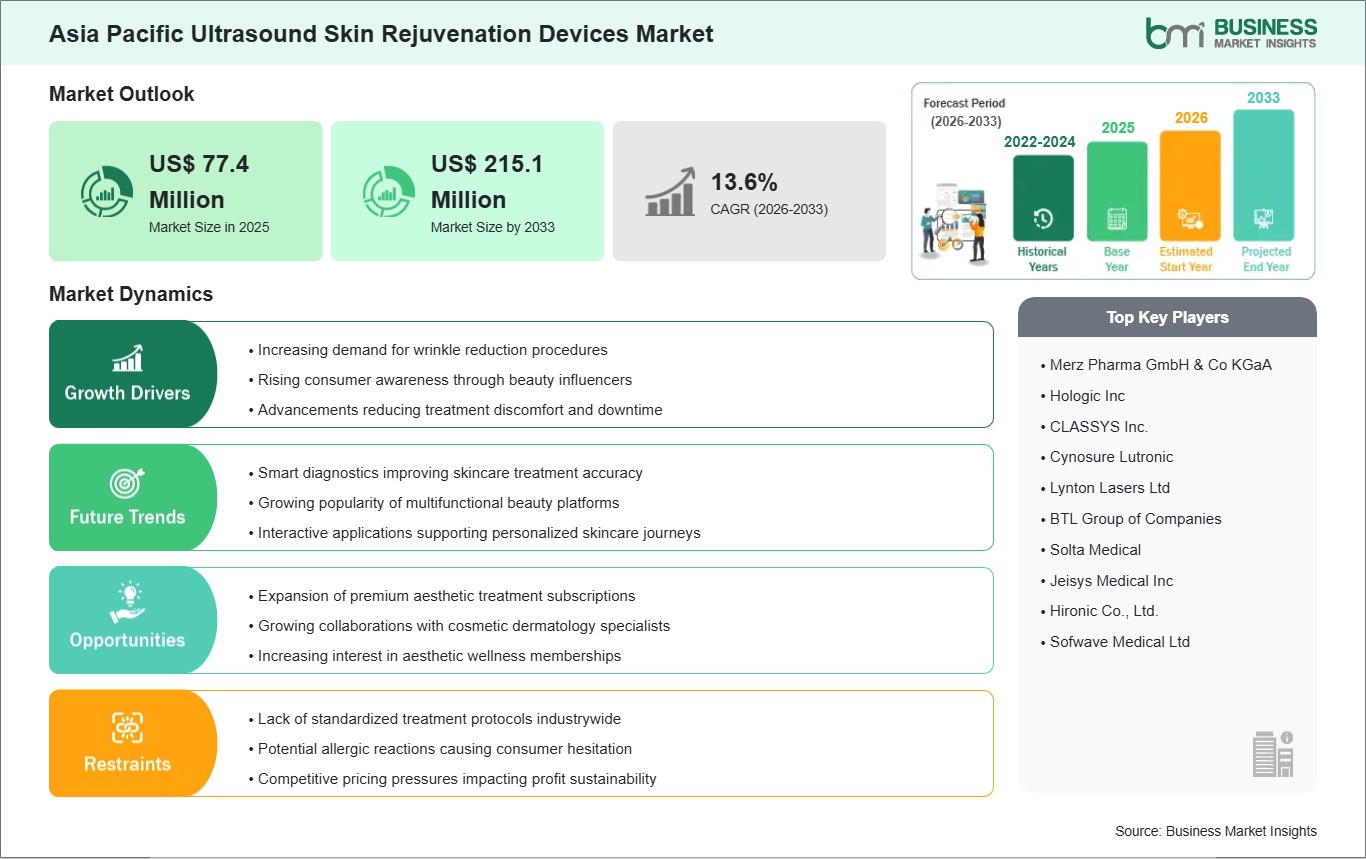
The Asia Pacific ultrasound skin rejuvenation devices market size is expected to reach US$ 215.1 million by 2033 from US$ 77.4 million in 2025. The market is estimated to record a CAGR of 13.6% from 2026 to 2033.
The Asia Pacific ultrasound skin rejuvenation devices market is undergoing robust structural expansion, driven by rapid convergence of medical aesthetics, consumer wellness behavior, and technology-enabled dermatology practices. Ultrasound devices, especially HIFU (high-intensity focused ultrasound), have been gaining popularity and recognition as key components of non-invasive skin lifting and collagen stimulation. The demand will be fueled by a change in customer preferences towards out-patient cosmetic treatment rather than surgery, as it implies shorter recovery periods and more predictable results. In addition, there is an increasing trend of adopting multi-functional aesthetic solutions that utilize ultrasound alongside radiofrequency, laser, and AI-assisted imaging diagnosis technologies. Private dermatology chains and medical spas are rapidly growing in metropolitan areas, thereby providing scalable demand for aesthetic devices. Moreover, growing online influence and social media communities that focus on beauty are transforming patients' needs, especially those of young people who want to prevent aging. International producers have established a dominating position due to their distributor-orchestrated ecosystems and local clinical training initiatives aimed at increasing the competence level of practitioners. Nevertheless, the uneven growth of the market is due to the regulatory differences between various countries, different certification needs, and the maturity levels of healthcare infrastructures in question. The high initial cost of investment in addition to the lack of available financing opportunities still prevents the penetration of smaller and medium-size clinics. Moreover, the existence of inexpensive and non-certified equipment in some countries adds uncertainty to the quality of offered products and creates additional problems with regulation. On the other hand, there are no signs of a slowdown in innovation activity in the industry.

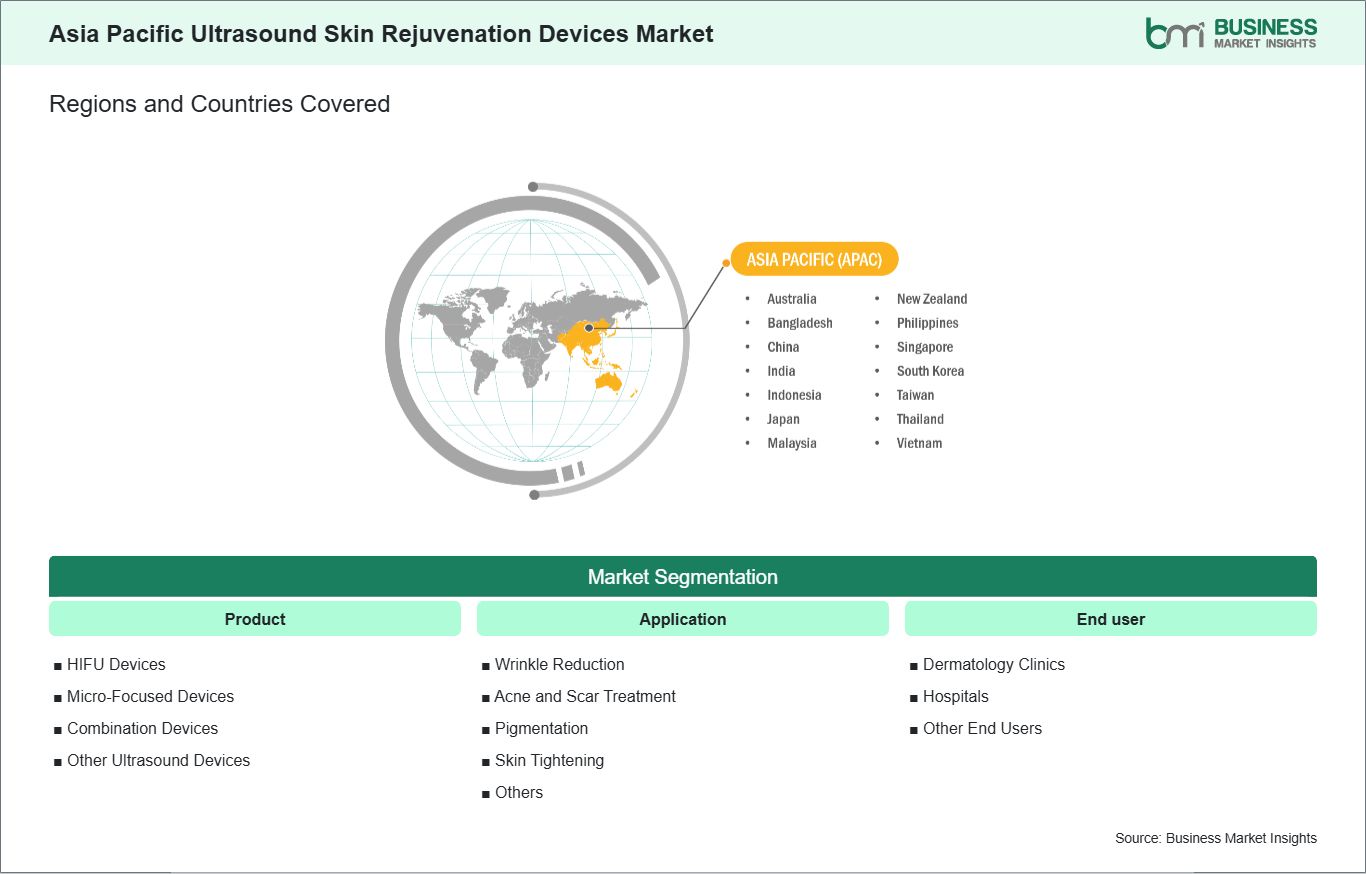
Key segments that contributed to the derivation of the Asia Pacific ultrasound skin rejuvenation devices market analysis are product, application, and end user.
The Asia Pacific ultrasound skin rejuvenation devices market is being reshaped by continuous improvements in energy delivery precision, device portability, and multi-modal integration. Japanese, South Korean, Chinese, and Australian manufacturers are increasingly working towards optimizing HIFU machines and multi-frequency ultrasound devices that offer deep targeting of the skin layer for collagen stimulation. In technologically advanced regions such as Japan and South Korea, ultrasound devices are transforming from simple instruments to sophisticated aesthetic systems that integrate imaging and precise energy delivery. This development is especially essential in clinics where precision is emphasized in order to achieve cosmetic results for different skin types prevalent in these regions.
In China and India, the need for affordable and scalable aesthetics has been the main factor that drives innovation. Ultrasound equipment that can be carried around or used handheld is becoming popular among mid-range aesthetic providers, and therefore allowing clinics to perform skin rejuvenation procedures without the need for huge investments in infrastructure. In addition to that, the move towards compact and user-friendly ultrasound machines is making it easier for dermatology practices and medi-spas in tier-2 and tier-3 cities to access the technology. On the other hand, manufacturers are incorporating intelligent control systems, AI treatment maps, and variable frequency in ultrasound machines to make them suitable for various skin thicknesses and age-related conditions.
Yet another important development in this area includes the incorporation of ultrasound technology with other forms of energy technology including radiofrequency and laser technology. The hybrid systems are becoming popular especially in sophisticated regions such as South Korea and Singapore, which are known for their use of combined treatments in dermatology clinics for better skin tightening and rejuvenation results. With more innovations taking place in this field, the Asia Pacific region continues to be one of the centers where devices are being tested and used.
Dermatology outpatient centers across Asia Pacific are increasingly adopting ultrasound skin rejuvenation devices due to rising demand for minimally invasive aesthetic procedures that can be performed in short consultation cycles. In many nations like Japan and South Korea, outpatient clinics of dermatologists have been using aesthetic treatments for years, and the application of ultrasound in these procedures has become increasingly common. Outpatient clinics are favoring ultrasound treatments since they offer a nonsurgical way of lifting without much downtime, which fits the need for efficiency and high capacity at such facilities.
The establishment of private clinics offering dermatology outpatients' care in India, Thailand, and Indonesia has played an important role in the adoption of the market. Clinics have been increasingly adopting the use of compact ultrasound machines due to the rising demand for face rejuvenation, acne scar treatment, and anti-aging. There has been a trend towards the specialization of dermatology treatment from hospitals to outpatient clinics especially in urban centers due to the need for convenient treatment that can be done within a short time.
Australia and Singapore are considered to be relatively advanced markets for outpatient dermatology services, which have achieved their current adoption level as a result of clinical excellence and patients' demand for scientific results of aesthetic procedures. The clinics in these countries usually combine ultrasound machines with other dermatological services like laser treatments and injections, providing their clients with different treatment programs. In addition, the centers are paying more attention to customized treatment programs, applying ultrasound machines in order to adjust the depth and intensity of energy depending on specific characteristics of patients' skin. Such development of precision-based approach to dermatology treatment makes ultrasound machines an important tool of modern aesthetics.

The Asia Pacific ultrasound skin rejuvenation devices market demonstrates steady growth, with size and share analysis highlighting evolving trends and competitive dynamics among key players. The report examines subsegments categorized within product, application, and end user, offering insights into their contribution to overall market performance.
By product, the HIFU devices segment dominated the market in 2025, driven by strong clinical preference for high-precision focused ultrasound systems that deliver long-lasting lifting results with minimal downtime.
Based on application, the wrinkle reduction segment dominated the market in 2025, driven by widespread demand for early intervention aesthetic treatments targeting visible signs of aging and skin laxity.
In terms of end user, the dermatology clinics segment dominated the market in 2025, driven by their role as primary treatment hubs for advanced cosmetic procedures requiring expert supervision and customized patient care.
| Report Attribute | Details |
|---|---|
| Market size in 2025 | US$ 77.4 Million |
| Market Size by 2033 | US$ 215.1 Million |
| CAGR (2026 - 2033) | 13.6% |
| Historical Data | 2022-2024 |
| Forecast period | 2026-2033 |
| Segments Covered | By Product
|
|
Regions and Countries Covered
| |
| Asia Pacific | China, India, Japan, Australia, Bangladesh, Indonesia, Malaysia, New Zealand, Philippines, Singapore, South Korea, Taiwan, Thailand, Vietnam |
| Market leaders and key company profiles |
|
The "Asia Pacific Ultrasound Skin Rejuvenation Devices Market Size and Forecast (2022-2033)" report provides a detailed analysis of the market covering below areas:
The geographical scope of the Asia Pacific ultrasound skin rejuvenation devices market report is divided into China, India, Japan, Australia, Bangladesh, Indonesia, Malaysia, New Zealand, Philippines, Singapore, South Korea, Taiwan, Thailand, Vietnam. China held the largest share in 2025.
Country-level dynamics in the Asia Pacific ultrasound skin rejuvenation devices market reflect a complex mix of maturity, innovation leadership, and high-growth emerging demand centers. China leads the regional landscape with an extensive aesthetic medicine infrastructure supported by large-scale dermatology hospitals, rapidly expanding private cosmetic clinic networks, and strong consumer spending on premium beauty procedures in Tier 1 and Tier 2 cities. South Korea plays a pivotal role as a global innovation hub for aesthetic medicine, where highly competitive cosmetic clinics in Seoul drive continuous adoption of next-generation ultrasound technologies aligned with advanced procedural protocols and trend-driven beauty standards. Japan exhibits steady demand characterized by a conservative yet highly quality-focused consumer base, emphasizing safety, precision, and long-term skin health outcomes, which encourages adoption of clinically validated ultrasound systems. India is emerging as a significant growth market due to rapid urbanization, expansion of organized dermatology chains, and increasing acceptance of non-invasive cosmetic treatments among younger working populations in major metropolitan areas. Australia demonstrates mature demand dynamics with strong regulatory oversight and high penetration of premium aesthetic clinics, particularly in Sydney and Melbourne, where consumers favor advanced anti-aging technologies. Thailand continues to strengthen its position as a regional medical aesthetics and wellness tourism destination, attracting both domestic and international patients seeking cost-effective cosmetic procedures. Across the region, China remains the dominant market due to its scale, clinic density, and accelerating adoption of advanced aesthetic technologies, while South Korea and Japan continue to set benchmarks for procedural sophistication and technological advancement within the ultrasound skin rejuvenation segment.

The Asia Pacific ultrasound skin rejuvenation devices market is evaluated by gathering qualitative and quantitative data post primary and secondary research, which includes important corporate publications, association data, and databases. A few of the key developments in the Asia Pacific ultrasound skin rejuvenation devices market are:
The Asia Pacific Ultrasound Skin Rejuvenation Devices Market is valued at US$ 77.4 Million in 2025, it is projected to reach US$ 215.1 Million by 2033.
As per our report Asia Pacific Ultrasound Skin Rejuvenation Devices Market, the market size is valued at US$ 77.4 Million in 2025, projecting it to reach US$ 215.1 Million by 2033. This translates to a CAGR of approximately 13.6% during the forecast period.
The Asia Pacific Ultrasound Skin Rejuvenation Devices Market report typically cover these key segments-
The historic period, base year, and forecast period can vary slightly depending on the specific market research report. However, for the Asia Pacific Ultrasound Skin Rejuvenation Devices Market report:
The Asia Pacific Ultrasound Skin Rejuvenation Devices Market is populated by several key players, each contributing to its growth and innovation. Some of the major players include:
The Asia Pacific Ultrasound Skin Rejuvenation Devices Market report is valuable for diverse stakeholders, including:
Essentially, anyone involved in or considering involvement in the Asia Pacific Ultrasound Skin Rejuvenation Devices Market value chain can benefit from the information contained in a comprehensive market report.
Please tell us your area of interest
(Market Segments/ Regions and Countries/ Companies)