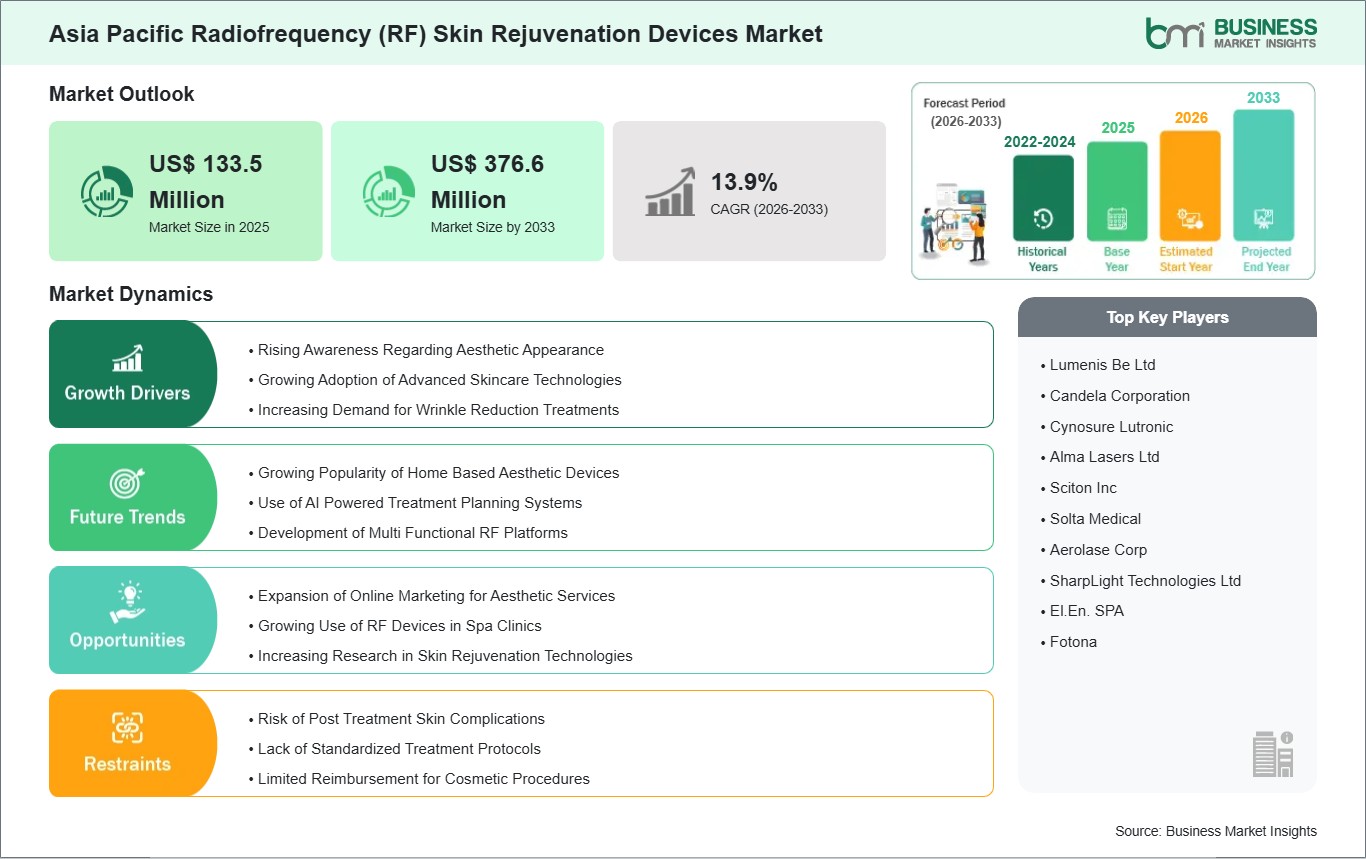
The Asia Pacific radiofrequency (RF) skin rejuvenation devices market size is expected to reach US$ 376.6 million by 2033 from US$ 133.5 million in 2025. The market is estimated to register a CAGR of 13.9% from 2026 to 2033.
Market growth for RF skin rejuvenation devices in the Asia Pacific is booming, owing to increased customer awareness regarding modern techniques of skin tightening and growing demand for minimally invasive treatment methods. There is an increasing number of middle-class individuals in the Asia Pacific, and an increasing adoption rate of technologically advanced treatment methods in both clinic and medspa environments. Countries such as China, South Korea, Japan, and India are instrumental in contributing towards market growth due to a combination of high cosmetic procedure rates and enhanced healthcare accessibility. The phenomenon of medical tourism, especially in South Korea and Thailand, is expected to boost demand for skin rejuvenation products. An important factor contributing to market expansion includes the trend toward the adoption of less invasive techniques in the cosmetic industry, which provide excellent results with minimal downtime. The introduction of new technologies, such as multipolar RF devices and their combination with microneedling, is also playing a crucial role in enhancing the accuracy and expanding the scope of application of RF devices. Nevertheless, there are some factors hampering market growth, including the costly nature of RF devices in developing countries. Another important constraint is the existence of aesthetic providers without licenses and counterfeit devices in certain parts of Southeast Asia and South Asia, which adversely affects market prices. Nonetheless, increased regulation and investments in dermatological practices will ensure market stability over the forecast period.

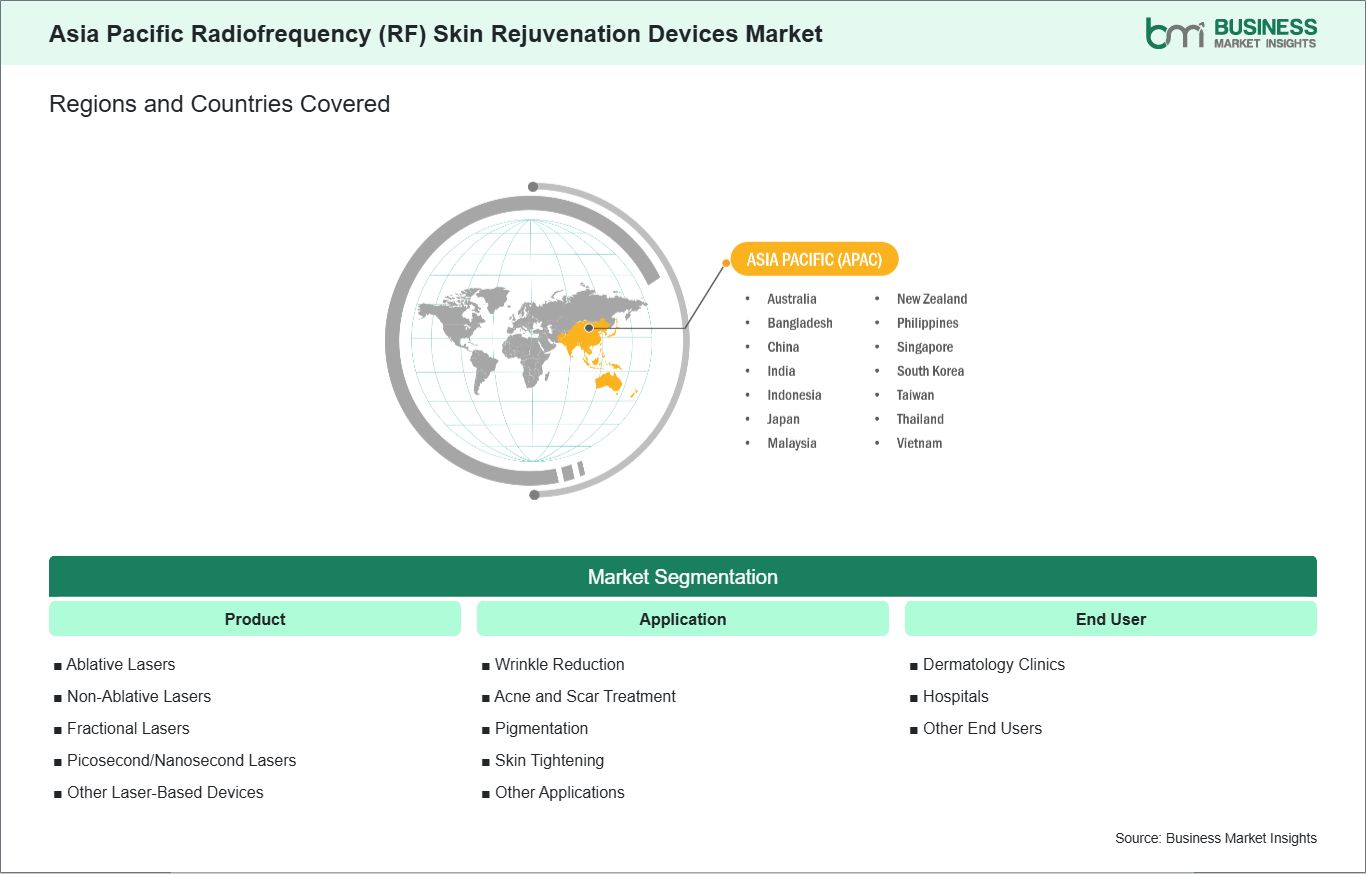
Key segments that contributed to the derivation of the Asia Pacific radiofrequency (RF) skin rejuvenation devices market analysis are product, application and end user.
There is a high likelihood that the demand for skin rejuvenation using RF technology will increase significantly in the coming years due to the increased aesthetic awareness among urban citizens in countries like China, Japan, South Korea, and India. With people becoming increasingly exposed to various social media trends and beauty trends, there is a huge increase in the number of individuals opting for skin tightening and wrinkle reduction therapies using RF machines. For instance, RF procedures are already widely used in South Korea during normal dermatology consultations.
In addition, a high level of disposable income in Southeast Asian countries such as Indonesia, Vietnam, and Thailand allows many people to indulge in premium procedures offered at dermatology clinics. The use of RF-based treatments is reported to be increasing in metropolitan areas such as Bangkok and Singapore, which are known to be highly developed and have high economic activity.
Furthermore, the region's medical tourism market in countries such as Malaysia, South Korea, and India is likely to play a crucial role in increasing the popularity of RF-based procedures, as a number of foreigners visit these locations for skin tightening services that are cost-effective.
Digital transformation and aggressive online marketing strategies are reshaping the Asia Pacific RF skin rejuvenation devices market. Clinics and medspas in countries like India, China, and Australia are increasingly using Instagram, TikTok, and WeChat to promote RF-based skin treatments, leveraging influencer endorsements and before-after visuals to attract younger consumers. This has significantly improved awareness of non-surgical aesthetic solutions.
In India, urban dermatology chains in cities such as Mumbai, Delhi, and Bengaluru are investing heavily in SEO-based marketing and targeted digital ads to promote RF skin tightening procedures. Similarly, South Korean aesthetic clinics use livestream consultations and social commerce platforms to convert online engagement into treatment bookings, reflecting a highly digital-first consumer journey.
Moreover, online appointment platforms and tele-dermatology services are expanding access to RF aesthetic consultations across the region. Countries like Japan and Singapore are seeing increased adoption of virtual skin analysis tools, enabling clinics to reach semi-urban and international clients. This growing digital ecosystem is accelerating adoption of RF devices by connecting consumers directly with aesthetic service providers.

The Asia Pacific radiofrequency (RF) skin rejuvenation devices market is experiencing steady growth, with market size and share analysis reflecting evolving treatment preferences and competitive dynamics among key players. The report evaluates important subsegments categorized within product, application and end user, highlighting their respective contributions to market performance.
By product, the non-ablative lasers subsegment dominated the market in 2025, driven by increasing consumer preference for minimally invasive skin rejuvenation procedures with reduced downtime and improved safety profiles.
Based on application, the wrinkle reduction subsegment dominated the market in 2025, driven by the rising demand for anti-aging treatments and growing awareness regarding aesthetic skin enhancement procedures.
In terms of end user, the dermatology clinics subsegment dominated the market in 2025, driven by the increasing availability of advanced aesthetic treatment solutions and the growing number of patients seeking specialized skincare services.
| Report Attribute | Details |
|---|---|
| Market size in 2025 | US$ 133.5 Million |
| Market Size by 2033 | US$ 376.6 Million |
| CAGR (2026 - 2033) | 13.9% |
| Historical Data | 2022-2024 |
| Forecast period | 2026-2033 |
| Segments Covered | By Product
|
|
Regions and Countries Covered
| |
| Asia Pacific | China, Japan, South Korea, India, Australia, New Zealand, Indonesia, Malaysia, Philippines, Singapore, Thailand, Vietnam, Taiwan, Bangladesh |
| Market leaders and key company profiles |
|
The "Asia Pacific Radiofrequency (RF) Skin Rejuvenation Devices Market Size and Forecast (2022–2033)" report provides a detailed analysis of the market covering below areas:
The geographical scope of the Asia Pacific Radiofrequency (RF) Skin Rejuvenation Devices Market report is divided into China, Japan, South Korea, India, Australia, New Zealand, Indonesia, Malaysia, Philippines, Singapore, Thailand, Vietnam, Taiwan, Bangladesh. China held the largest share in 2025.
Asia Pacific RF Skin Rejuvenation Devices market is witnessing robust growth impetus owing to enhanced aesthetic consciousness, higher disposable incomes, rising presence of medspas and dermatology clinics, and surge in the demand for non-surgical cosmetic treatments. China is the leading market in the region, backed by rapid urbanization, booming e-commerce beauty expenditure, early adoption of aesthetic devices, and a huge pool of recipients of cosmetic procedures. Japan comes next in terms of maturity and innovation, as well as high acceptance of premium RF technology and clinical infrastructure, fueled by aging populations looking for skin tightening solutions. South Korea is a very influential aesthetics market, backed up by K-Beauty, dermatology clinics, and medical tourism numbers. India has emerged as one of the fastest-growing aesthetic markets, thanks to increasing middle-income populations, beauty awareness, and clinic penetration. Australia and New Zealand demonstrate moderate adoption fueled by well-developed healthcare infrastructures and a non-invasive culture. Countries from the Southeast Asia region, such as Indonesia, Malaysia, the Philippines, Thailand, and Vietnam, witness the rapid expansion of medspas. Singapore and Taiwan represent high-value niche markets characterized by innovation and early adoption, whereas Bangladesh represents an early adopter country experiencing increased awareness and slow clinic growth, all contributing to China’s dominance in the region.

The Asia Pacific Radiofrequency (RF) Skin Rejuvenation Devices Market is evaluated by gathering qualitative and quantitative data post primary and secondary research, which includes important corporate publications, association data, and databases. A few of the key developments in the Asia Pacific radiofrequency (RF) skin rejuvenation devices market are:
The Asia Pacific Radiofrequency (RF) Skin Rejuvenation Devices Market is valued at US$ 133.5 Million in 2025, it is projected to reach US$ 376.6 Million by 2033.
As per our report Asia Pacific Radiofrequency (RF) Skin Rejuvenation Devices Market, the market size is valued at US$ 133.5 Million in 2025, projecting it to reach US$ 376.6 Million by 2033. This translates to a CAGR of approximately 13.9% during the forecast period.
The Asia Pacific Radiofrequency (RF) Skin Rejuvenation Devices Market report typically cover these key segments-
The historic period, base year, and forecast period can vary slightly depending on the specific market research report. However, for the Asia Pacific Radiofrequency (RF) Skin Rejuvenation Devices Market report:
The Asia Pacific Radiofrequency (RF) Skin Rejuvenation Devices Market is populated by several key players, each contributing to its growth and innovation. Some of the major players include:
The Asia Pacific Radiofrequency (RF) Skin Rejuvenation Devices Market report is valuable for diverse stakeholders, including:
Essentially, anyone involved in or considering involvement in the Asia Pacific Radiofrequency (RF) Skin Rejuvenation Devices Market value chain can benefit from the information contained in a comprehensive market report.
Please tell us your area of interest
(Market Segments/ Regions and Countries/ Companies)