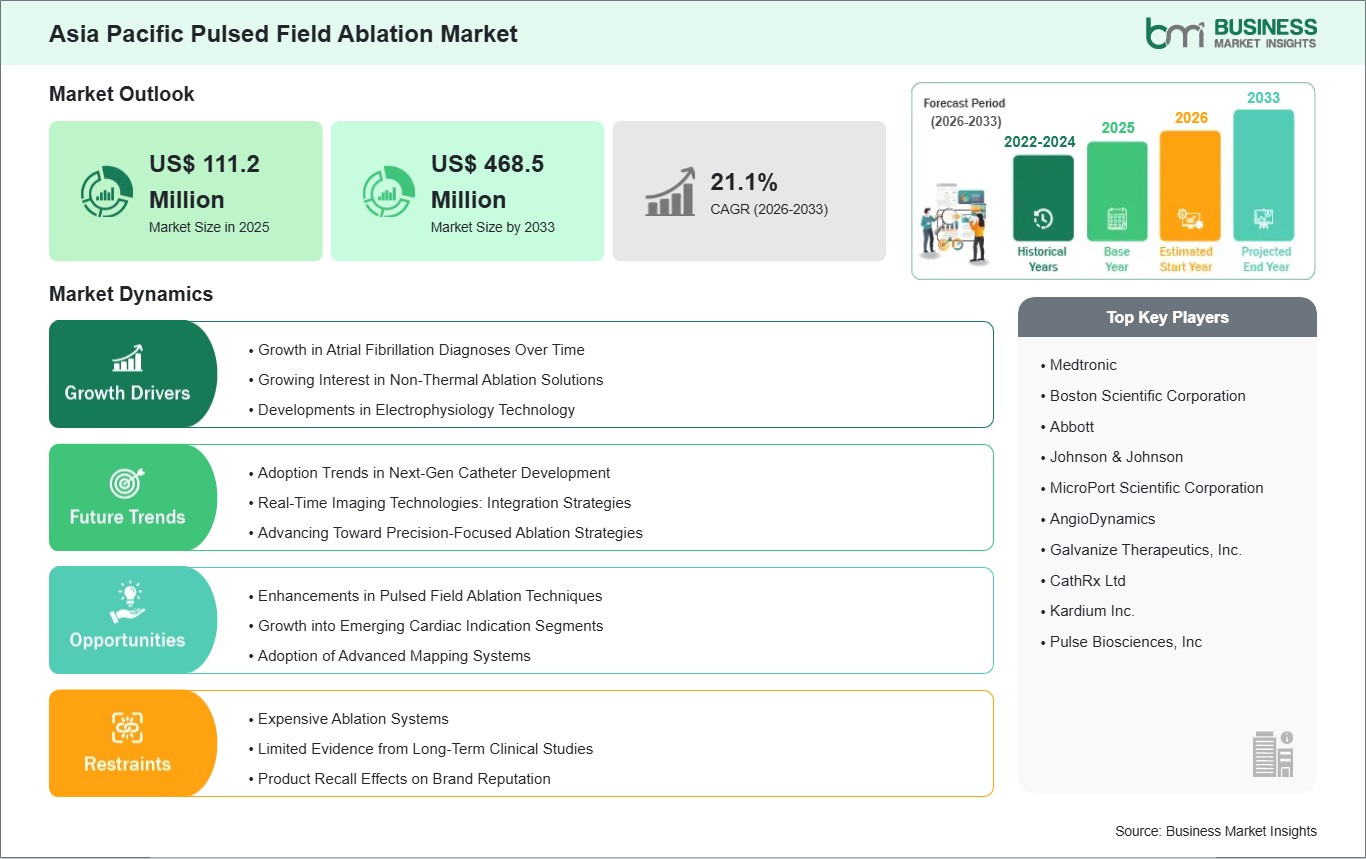
The Asia Pacific pulsed field ablation market size is expected to reach US$ 468.5 million by 2033 from US$ 111.2 million in 2025. The market is estimated to register a CAGR of 21.1% from 2026 to 2033.
In the Asia Pacific region, the use of pulsed field ablation (PFA) therapy has become increasingly popular due to increased prevalence of heart diseases, heightened awareness among doctors, and continued technological advancements in cardiology care facilities in leading nations within the region. A growing number of patients with arrhythmia problems like atrial fibrillation has led many hospitals and cardiology centers in the region to adopt advanced treatment procedures for better patient outcomes and minimal risks involved. As opposed to previous radiofrequency catheter ablation approaches, which resulted in collateral injuries to healthy cardiac cells, the advent of pulsed field ablation is based on selective tissue targeting without heat and leads to a fast recovery time for patients.
Market expansion will also be stimulated by investment in state-of-the-art electrophysiology laboratories, collaborations with global medical device manufacturers, and rising numbers of cardiologists with expertise in advanced ablation techniques. Early adoption is primarily concentrated in metropolitan hospitals, which are running pilot programs and early clinical trials to establish procedural efficacy and safety. The high procedural and device costs limit access to specialized treatments outside major cities, while the uneven distribution of trained electrophysiologists poses a barrier to scaling adoption. Regulatory frameworks also vary across countries, which can delay device approvals and market entry. Growing clinical awareness, positive early outcomes, and ongoing infrastructure development indicate that the Asia Pacific PFA market is poised for steady and gradual growth.

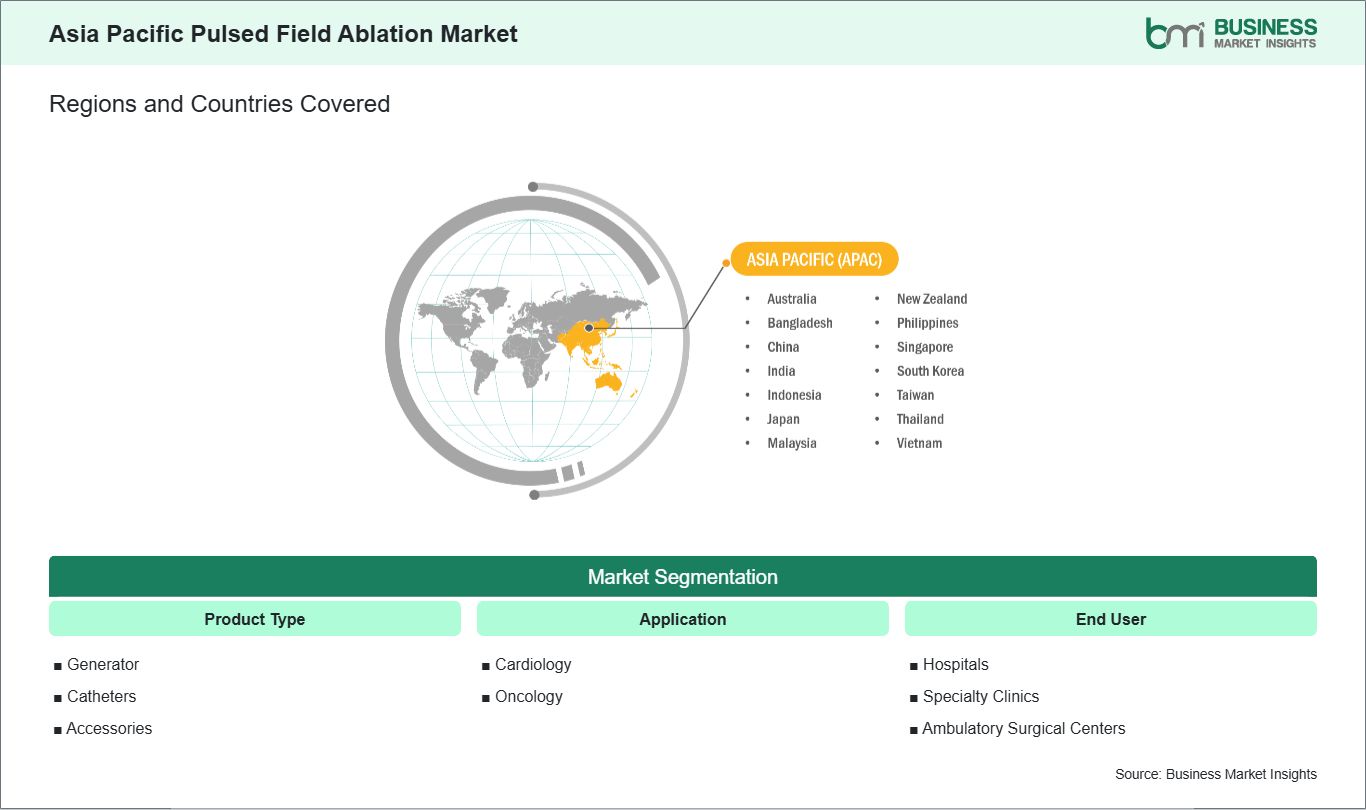
Key segments that contributed to the derivation of the Asia Pacific pulsed field ablation market analysis are product type, application, and end user.
Atrial fibrillation (AF) has emerged as a growing concern in the Asia Pacific region due to shifting demographics, urbanization, and lifestyle changes. Increased life expectancy and an aging population contribute to a higher number of patients presenting with arrhythmias. Sedentary lifestyles, dietary transitions, and the rising prevalence of cardiovascular risk factors have further amplified the burden on healthcare systems. Hospitals and cardiac centers are responding by enhancing screening protocols and investing in early detection programs, emphasizing timely intervention to prevent complications such as stroke and heart failure.
Healthcare providers across Asia Pacific are strengthening cardiology and electrophysiology services to manage the rising caseloads efficiently. Clinicians are focusing on minimally invasive and precise treatment approaches that offer consistent outcomes while reducing procedural risk. Hospitals are also optimizing care pathways to manage higher patient volumes, ensuring that clinical standards are maintained without compromising operational efficiency.
The increasing diagnosis of AF in the region has created a clear opportunity for advanced therapies. Pulsed field ablation (PFA) is gaining attention as a targeted, tissue-selective approach that minimizes collateral damage and procedural complications. Its adoption supports safer and more efficient interventions, enabling healthcare providers to deliver effective arrhythmia management and strengthen cardiac service capabilities across Asia Pacific.
Pulsed field ablation (PFA) is revolutionizing arrhythmia management in the Asia Pacific region by offering precision, safety, and operational efficiency. Unlike traditional thermal ablation methods, PFA selectively targets cardiac tissue with electrical pulses while sparing surrounding structures, reducing procedural complications and improving recovery times. Innovations in catheter design, energy delivery, and integration with real-time mapping systems have enhanced procedural accuracy and consistency, allowing clinicians to perform complex ablations with greater confidence.
Healthcare institutions are increasingly investing in PFA technology alongside training programs to equip cardiology teams with the necessary expertise. Standardized procedural protocols, intuitive interfaces, and operational guidance support adoption while reducing the learning curve. These initiatives enable hospitals to manage growing patient volumes effectively, providing consistent, high-quality arrhythmia care across diverse healthcare settings in the region.
Future advances in PFA technology will play a key role in ensuring continuous modernization of arrhythmia management in Asia Pacific. Better mapping technology and more efficient workflows, as well as improved devices, will enable healthcare facilities to deliver more effective results without compromising on efficiency. Integration of PFA technology will empower cardiac services, enhance safety and prepare healthcare organizations for managing the rising cases of atrial fibrillation.

The Asia Pacific pulsed field ablation market demonstrates steady growth, with size and share analysis highlighting evolving trends and competitive dynamics among key players. The report evaluates important subsegments categorized within product type, application, and end user, highlighting their respective contributions to overall market performance.
By product type, the catheters subsegment dominated the market in 2025. Catheter devices offer improved procedural efficiency, reduced risk of complications, and real-time control for electrophysiologists, making them a crucial component for effective PFA therapy and a key revenue driver for manufacturers.
In terms of application, the cardiology subsegment dominated the market in 2025. The leadership of cardiology applications is attributed to the rising prevalence of atrial fibrillation and other cardiac arrhythmias, growing preference for non-thermal and tissue-selective ablation techniques, and increasing awareness among healthcare providers about the clinical benefits of PFA.
Based on end user, the hospitals subsegment dominated the market in 2025. Hospitals maintain a stronghold due to their established cardiology and electrophysiology departments, access to advanced PFA systems, trained physicians and clinical staff, and the capability to perform specialized cardiac procedures with comprehensive patient monitoring and post-procedure care.
| Report Attribute | Details |
|---|---|
| Market size in 2025 | US$ 111.2 Million |
| Market Size by 2033 | US$ 468.5 Million |
| CAGR (2026 - 2033) | 21.1% |
| Historical Data | 2022-2024 |
| Forecast period | 2026-2033 |
| Segments Covered | By Product Type
|
|
Regions and Countries Covered
| |
| Asia Pacific | China, Japan, South Korea, India, Australia, New Zealand, Indonesia, Malaysia, Philippines, Singapore, Thailand, Vietnam, Taiwan, Bangladesh |
| Market leaders and key company profiles |
|
The "Asia Pacific Pulsed Field Ablation Market Size and Forecast (2022–2033)" report provides a detailed analysis of the market covering below areas:
The geographical scope of the Asia Pacific pulsed field ablation market report is divided into: China, Japan, South Korea, India, Australia, New Zealand, Indonesia, Malaysia, the Philippines, Singapore, Thailand, Vietnam, Taiwan, Bangladesh, and Rest of Asia. China held the largest share in 2025.
The China pulsed field ablation industry in Asia Pacific ranks highest owing to the large number of patients and the country’s efforts in developing innovative technology to improve cardiac health among the populace. The increasing cases of atrial fibrillation among others have increased the need for less invasive and safe treatment methods. PFA technology offers one such approach because of the non-thermal nature of the process involved, whereby only heart tissues are affected without collateral harm. The safety concerns and post-treatment complications experienced with other treatment options are significantly reduced. Electrophysiology laboratories equipped with special equipment for diagnosis and procedures for PFA are being established, which will enable more hospitals to adopt this new technology. Training programs will be initiated to enhance the skills of health practitioners in performing PFA processes. Collaboration with medical technology providers has further enhanced procedural knowledge and operational integration, helping PFA gain credibility as a reliable treatment option.
Despite all these developments, the high cost associated with the machinery and procedures hampers access beyond the larger healthcare centers, with the need for increased numbers of skilled electrophysiologists also being an aspect that needs to be addressed. The regulatory processes are slowly improving and may have an impact on how fast new technology is implemented. China’s resolve to invest in state-of-the-art technology in heart care makes the nation the dominant market in the Asia Pacific for pulsed field ablation treatments.

The Asia Pacific pulsed field ablation market is evaluated by gathering qualitative and quantitative data post primary and secondary research, which includes important corporate publications, association data, and databases. A few of the key developments in the Asia Pacific pulsed field ablation market are:
The Asia Pacific Pulsed Field Ablation Market is valued at US$ 111.2 Million in 2025, it is projected to reach US$ 468.5 Million by 2033.
As per our report Asia Pacific Pulsed Field Ablation Market, the market size is valued at US$ 111.2 Million in 2025, projecting it to reach US$ 468.5 Million by 2033. This translates to a CAGR of approximately 21.1% during the forecast period.
The Asia Pacific Pulsed Field Ablation Market report typically cover these key segments-
The historic period, base year, and forecast period can vary slightly depending on the specific market research report. However, for the Asia Pacific Pulsed Field Ablation Market report:
The Asia Pacific Pulsed Field Ablation Market is populated by several key players, each contributing to its growth and innovation. Some of the major players include:
The Asia Pacific Pulsed Field Ablation Market report is valuable for diverse stakeholders, including:
Essentially, anyone involved in or considering involvement in the Asia Pacific Pulsed Field Ablation Market value chain can benefit from the information contained in a comprehensive market report.
Please tell us your area of interest
(Market Segments/ Regions and Countries/ Companies)