Market Summary
Executive Summary and Market Analysis
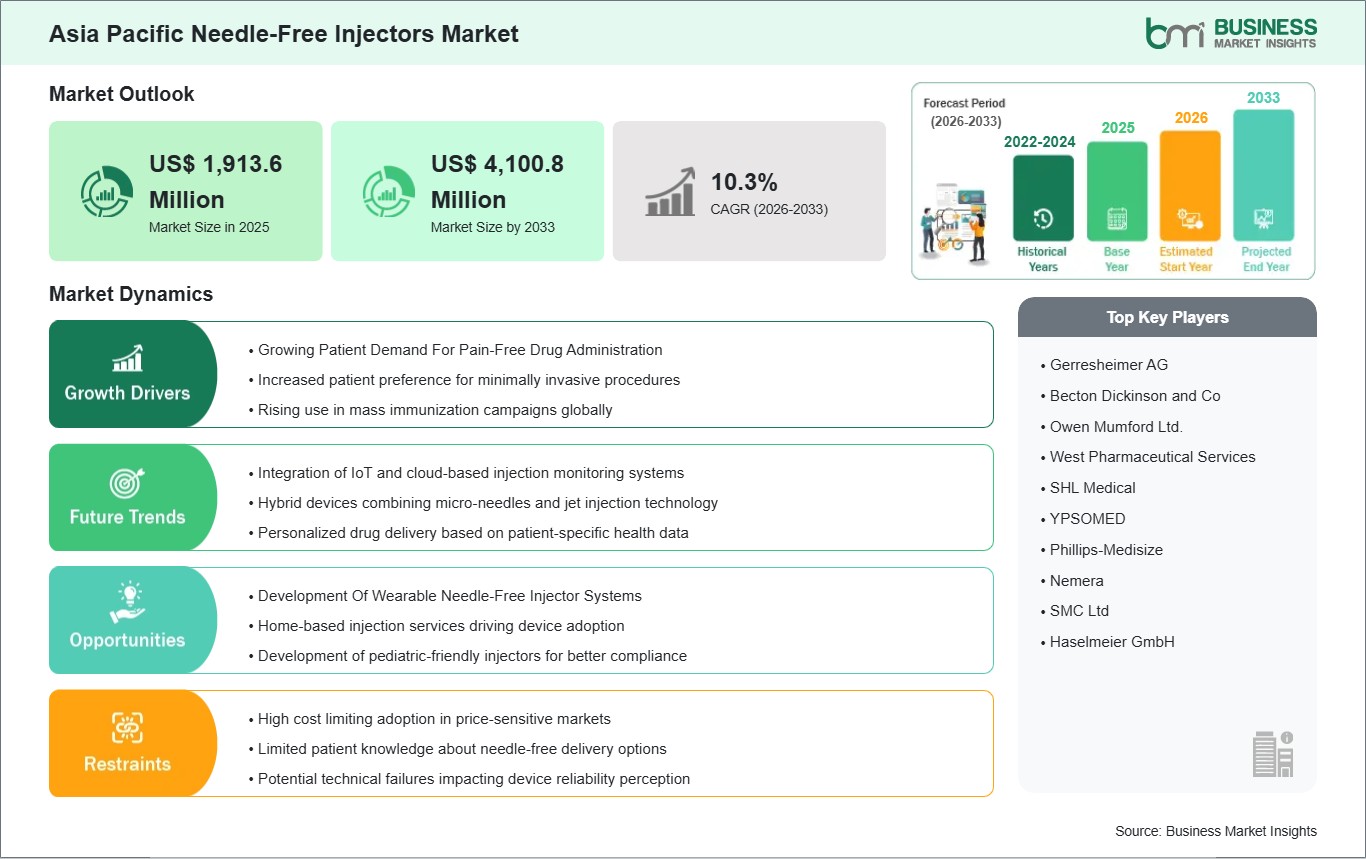
Across the region, healthcare providers are evaluating needle-free technologies to enhance treatment safety, reduce procedural variability, and modernize drug administration practices. Market participation includes multinational device manufacturers, regional medical technology firms, and local distributors with strong hospital networks. The competitive environment emphasizes device durability, adaptability across therapeutic categories, and compliance with diverse regulatory frameworks. Unlike mature Western markets, purchasing decisions in APAC are influenced by institutional pilots, physician advocacy, and alignment with national healthcare priorities rather than purely standardized protocols. The market analysis highlights a focus on operational efficiency, particularly in high-throughput clinical settings such as vaccination centers, specialty clinics, and ambulatory care units. Buyers assess needle-free injectors based on workflow integration, training requirements, and long-term maintenance considerations. Regulatory diversity across the region adds complexity, prompting manufacturers to pursue country-specific certification strategies and localized documentation. Distribution models vary widely, with direct sales favored in developed markets and multi-tier distribution prevalent in emerging economies. Companies are investing in product differentiation through ergonomic design, reusable platforms, and compatibility with advanced drug formulations. The market reflects a gradual shift from awareness-building to structured evaluation, indicating a maturing commercial landscape supported by healthcare modernization initiatives and rising expectations for patient-centric care delivery.
Segment Analysis
Asia Pacific Needle-Free Injectors Market Segmentation
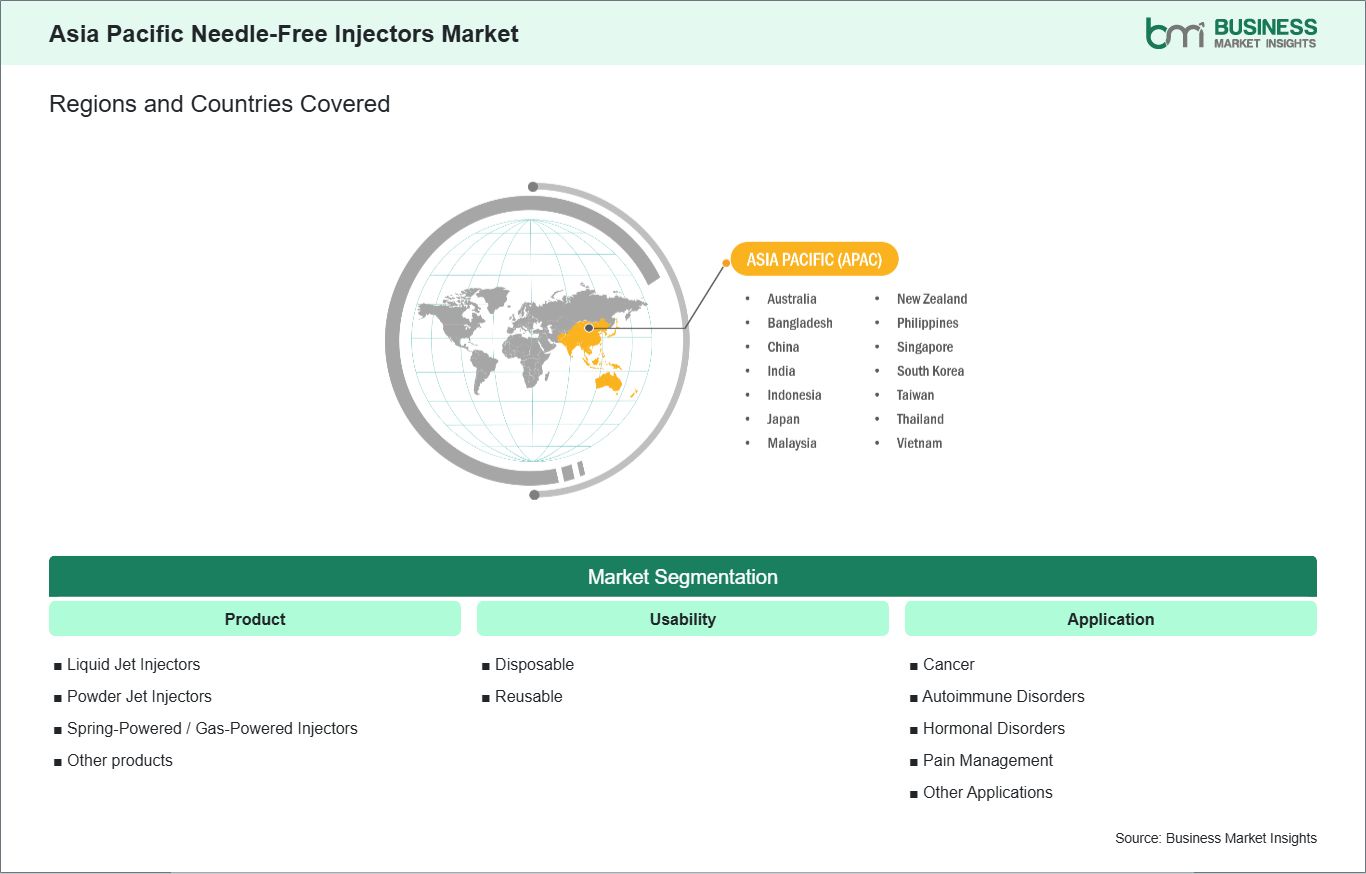
Key segments that contributed to the derivation of the Asia Pacific needle-free injectors market analysis are product, usability, and application.
- By product, the needle-free injectors market is segmented into liquid jet injectors, powder jet injectors, spring-powered / gas-powered injectors, and other products. The liquid jet injectors segment dominated the market in 2025.
- Based on usability, the needle-free injectors market is categorized into disposable and reusable. The disposable segment dominated the market in 2025.
- In terms of application, the market is classified into cancer, autoimmune disorders, hormonal disorders, pain management, and other applications. The autoimmune disorders segment dominated the market in 2025.
Market Forces
Asia Pacific Needle-Free Injectors Market Drivers and Opportunities
Growing Patient Demand For Pain-Free Drug Administration
Traditional needle-based injections are associated with fear, pain, and anxiety, which can impact treatment adherence, particularly for chronic conditions requiring frequent administration. Needle-free injectors offer an attractive alternative by delivering medications effectively while minimizing discomfort, aligning with the increasing emphasis on patient-centric care models. The demand is strong in urbanized areas where healthcare awareness and access to advanced medical technologies are higher. Patients in metropolitan centers are seeking treatment options that reduce the physical and psychological burden of repeated injections. This trend is influencing healthcare providers to adopt needle-free delivery methods for chronic disease management, vaccines, and preventive therapies, reinforcing the need for painless and convenient administration tools. Growing patient advocacy and education campaigns are encouraging healthcare institutions to prioritize patient comfort alongside therapeutic effectiveness. Needle-free injectors support these initiatives by improving compliance, reducing injection-related stress, and enabling self-administration at home. As awareness continues to spread across urban and secondary cities, the adoption of pain-free drug delivery solutions is expected to gain momentum, establishing needle-free injectors as a preferred option in the Asia Pacific healthcare landscape.
Development Of Wearable Needle-Free Injector Systems
Innovation in the market is focused on wearable devices that allow continuous or on-demand drug delivery. These systems are designed to integrate seamlessly into patients’ daily routines, providing discreet and convenient medication administration. Wearable injectors are appealing in the region due to growing interest in home-based care and remote disease management, which reduces dependency on frequent hospital visits. Manufacturers are collaborating with healthcare providers to develop compact, user-friendly designs suitable for long-term use. These devices are being tailored to meet the lifestyle needs of patients managing chronic illnesses, such as diabetes and autoimmune disorders, where regular dosing is critical. The portability and ease of operation of wearable injectors make them attractive in countries with dense urban populations, where patients value time efficiency and independence in managing their care. Healthcare ecosystems are encouraging the adoption of digital health technologies, which support the integration of wearable injectors with monitoring and feedback systems. This trend enables personalized dosing, treatment tracking, and improved adherence. As wearable needle-free injectors evolve with enhanced functionality and patient-oriented design, they are expected to play a pivotal role in transforming drug delivery practices, driving market growth.
Size and Share Analysis
Asia Pacific Needle-Free Injectors Market Size and Share Analysis
The Asia Pacific Needle-free Injectors Market demonstrates steady growth, with size and share analysis highlighting evolving trends and competitive dynamics among key players. The report examines subsegments categorized within product, usability, and application, offering insights into their contribution to overall market performance.
By product, the liquid jet injectors subsegment dominated the market in 2025, driven by their ability to deliver accurate doses quickly and painlessly, making them suitable for frequent use in chronic therapies.
Based on usability, the disposable subsegment dominated the market in 2025, driven by the emphasis on hygiene, infection control, and ease of use in hospital and home-care settings.
In terms of application, the autoimmune disorders subsegment dominated the market in 2025, driven by the need for repeated, long-term medication administration where patient comfort and adherence are critical in managing chronic conditions.
Report Coverage
Asia Pacific Needle-Free Injectors Market Report Coverage and Deliverables
The "Asia Pacific Needle-free Injectors Market Size and Forecast (2022–2033)" report provides a detailed analysis of the market covering below areas:
- Asia Pacific Needle-free Injectors Market size and forecast at regional and country levels for all market segments covered under the scope
- Asia Pacific Needle-free Injectors Market trends, as well as drivers, restraints, and opportunities
- Asia Pacific Needle-free Injectors Market analysis covering key trends, regional framework, major players, regulations, and recent developments
- Industry landscape and competition analysis covering market concentration, heat map analysis, prominent players, and recent developments for the Asia Pacific Needle-free Injectors Market
- Detailed company profiles, including SWOT analysis
Geographic Insights
Asia Pacific Needle-Free Injectors Market Geographic Insights
The geographical scope of the Asia Pacific Needle-free Injectors Market report is divided into China, India, Japan, Australia, Bangladesh, Indonesia, Malaysia, New Zealand, Philippines, Singapore, South Korea, Taiwan, Thailand, and Vietnam. China held the largest share in 2025.
China represents a technology-intensive market where clinical precision, device reliability, and regulatory compliance strongly influence purchasing behavior, particularly in specialty care and pharmaceutical research applications. Japan demonstrates a scale-driven dynamic, with demand shaped by domestic manufacturing capabilities, public healthcare reforms, and growing interest in advanced drug delivery platforms. India reflects a cost-conscious but opportunity-rich environment, where private hospitals, diagnostic chains, and vaccination initiatives drive selective adoption, supported by distributor-led education programs. Australia and South Korea exhibit strong uptake in outpatient and specialty clinics, supported by well-defined regulatory pathways and higher acceptance of innovative medical devices. Southeast Asian markets outside ASEAN’s core economies, such as Cambodia and Laos, remain at an early adoption stage, with usage linked to international aid programs and pilot-based deployments. Urban healthcare centers act as early adopters, setting benchmarks that influence secondary and tertiary facilities. Country insights indicate that market success depends on aligning product positioning with local clinical priorities, reimbursement structures, and procurement practices. These variations underscore the necessity for tailored go-to-market strategies rather than a standardized regional approach.
Industry Activity
Recent Developments
The Asia Pacific Needle-free Injectors Market is evaluated by gathering qualitative and quantitative data post primary and secondary research, which includes important corporate publications, association data, and databases. A few of the key developments in the Asia Pacific needle-free injectors market are:
- In December 2025, Intas Pharmaceuticals partnered with IntegriMedical to bring needle‑free injection technology into IVF and gynecological treatment delivery in India, positioning the N‑FIS device within specialised therapeutic domains and expanding its clinical adoption in advanced care settings. This collaboration blends product innovation with therapeutic expansion in the region.
- In April 2024, IntegriMedical launched India’s first commercially available needle‑free injection system (N‑FIS), designed to deliver medication without needles using a high‑pressure jet mechanism, reducing injection pain. The device is approved by Indian regulatory authorities and is being adopted in clinical settings for paediatric and adult use. This launch marked a major novel product introduction in the region’s needle‑free injection landscape.
Trust & Transparency
Research Methodology
The market analysis combines proprietary research with secondary data from government agencies, company disclosures, regulatory filings, industry databases and expert interviews. Market estimates are validated through data triangulation, cross-market benchmarking and analyst
review.
View Full Research Methodology
Key Sources Referred:
World Health Organization (WHO)Organisation for Economic Cooperation and Development (OECD)The World Bank GroupWorldometerThe LancetInternational Bar AssociationInternational Trade Administration