
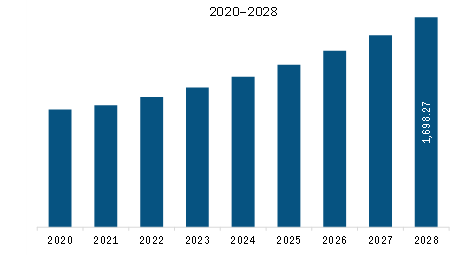
The Asia-Pacific natural fiber composites market is expected to grow from US$ 1,053.67 million in 2022 to US$ 1,698.27 million by 2028. It is estimated to grow at a CAGR of 8.3% from 2022 to 2028.
Development of Natural/Synthetic Fiber-Based Hybrid Composites in Asia-Pacific Natural Fiber Composites Market
Natural/synthetic fiber-based hybrid composites are developed by combining two or more reinforcements in a common matrix. Hybrid materials are gaining popularity and are the fastest-growing classes of novel natural fiber composite material technology. Hybridization of two fibers in a single matrix provides various material properties of both natural and synthetic fibers, such as renewability, sustainability, and superior mechanical and thermal properties. Growing environmental impact associated with production such as, non-biodegradability and recycling issues of synthetic fiber composites has encouraged manufacturers to develop eco-friendly composites using natural fibers for various applications, including automotive, marine, construction, and sporting goods. Many natural fiber types such as kenaf, jute, cotton, flax, hemp, and sisal are considered suitable for composite development, as these reinforcement materials are abundantly available at low cost, and they are eco-friendly and possess required mechanical properties. However, the moisture absorption property and hydrophilic nature of natural fibers damage the internal composite structure and complicate the composite processing. These drawbacks and other poor mechanical properties of natural fiber composites can be overcome by the hybridization of natural and synthetic fibers. Manufacturers and researchers are focused on the development of polymer hybrid composites that are reinforced with various combinations of nano carbon fibers and natural fibers to increase the applications in the field of engineering and technology. In 2022, Faurecia SE was honored with German Innovation Award 2022 for developing sustainable composite materials, NAFILean-R and rCF NFPP. The NAFILean and NFPP, bio-composite materials range, are used for instrument panels, center consoles, and door trim. Recycled Carbon Fiber Natural Fibers and Polypropylene (rCF NFPP) is a composite material consisting of 40% natural fibers, 50% polypropylene, and 10% recycled carbon fibers. The combination of natural and recycled carbon fibers results in a weight reduction that reduces the greenhouse potential by up to 50%. Thus, research and development of natural/synthetic fiber-based hybrid composites allow manufacturers and end-users to design the material properties according to the requirements.
Asia-Pacific Natural Fiber Composites Market Overview
Asia Pacific is home to major semiconductor and automobile players across the world, including Samsung Electronics Co., Ltd.; Sony Group Corporation; SK Hynix Inc.; Toyota Motor Corporation; Tata Motors Ltd.; Hyundai Motor Company; Nissan Motor Co., Ltd.; and Honda Motor Co., Ltd. These companies are focused on expansion, research and development, and product innovation. In 2020, Covestro AG and Toyota Boshoku Corp partnered to develop kenaf fiber-reinforced polyurethane foam composite material for utilization in electric concept car LQ door trims. Moreover, in 2023, Hyundai Motor Group introduced plant-based “ekoa” composite material made from renewable flax fibers and bio-based thermoplastic. The composite material was featured in the door spear of Hyundai Palisade concept vehicle as a luxury and interactive finish.
Asia-Pacific Natural Fiber Composites market Revenue and Forecast to 2028 (US$ Million)
Asia-Pacific Natural Fiber Composites market Segmentation
The Asia-Pacific natural fiber composites market is segmented on the basis of raw material, technology, and end user. On the basis of raw material, the Asia-Pacific natural fiber composites market is segmented into wood, cotton, flax, kenaf, hemp, and others. The wood segment registered a larger market share in 2022.
Based on technology, the Asia-Pacific natural fiber composites market is further segmented into injection molding, compression molding, pultrusion, and others. The others segment registered a larger market share in 2022.
Based on end user, the Asia-Pacific natural fiber composites market is segmented into automotive & aerospace, building & construction, electrical & electronics, sporting goods, and others. The automotive & aerospace registered the largest market share in 2022.
Based on country, the Asia-Pacific natural fiber composites market is segmented into Australia, China, India, Japan, South Korea, and the Rest of Asia-Pacific. China dominated the market share in 2022.
Amorim Cork Composites SA, Cobra Advanced Composites Co Ltd, Lanxess AG, Polyvlies Franz Beyer GmbH, and UPM-Kymmene Corp are the leading companies operating in Asia-Pacific natural fiber composites market.
Asia-Pacific Natural Fiber Composites Market Strategic Insights

Asia-Pacific Natural Fiber CompositesMarket Report Highlights
| Report Attribute | Details |
| Market size in 2022 | US$ 1,053.67 Million |
| Market Size by 2028 | US$ 1,698.27 Million |
| CAGR (2022 - 2028) | 8.3% |
| Historical Data | 2020-2021 |
| Forecast period | 2023-2028 |
| Segments Covered |
By Wood, Cotton, Flax, Kenaf, Hemp)By Technology
|
|
Regions and Countries Covered
|
|
| Asia-Pacific | China, India, Japan, Australia, Rest of Asia-Pacific |
| Market leaders and key company profiles |
|
Asia-Pacific Natural Fiber Composites Market Country and Regional Insights



