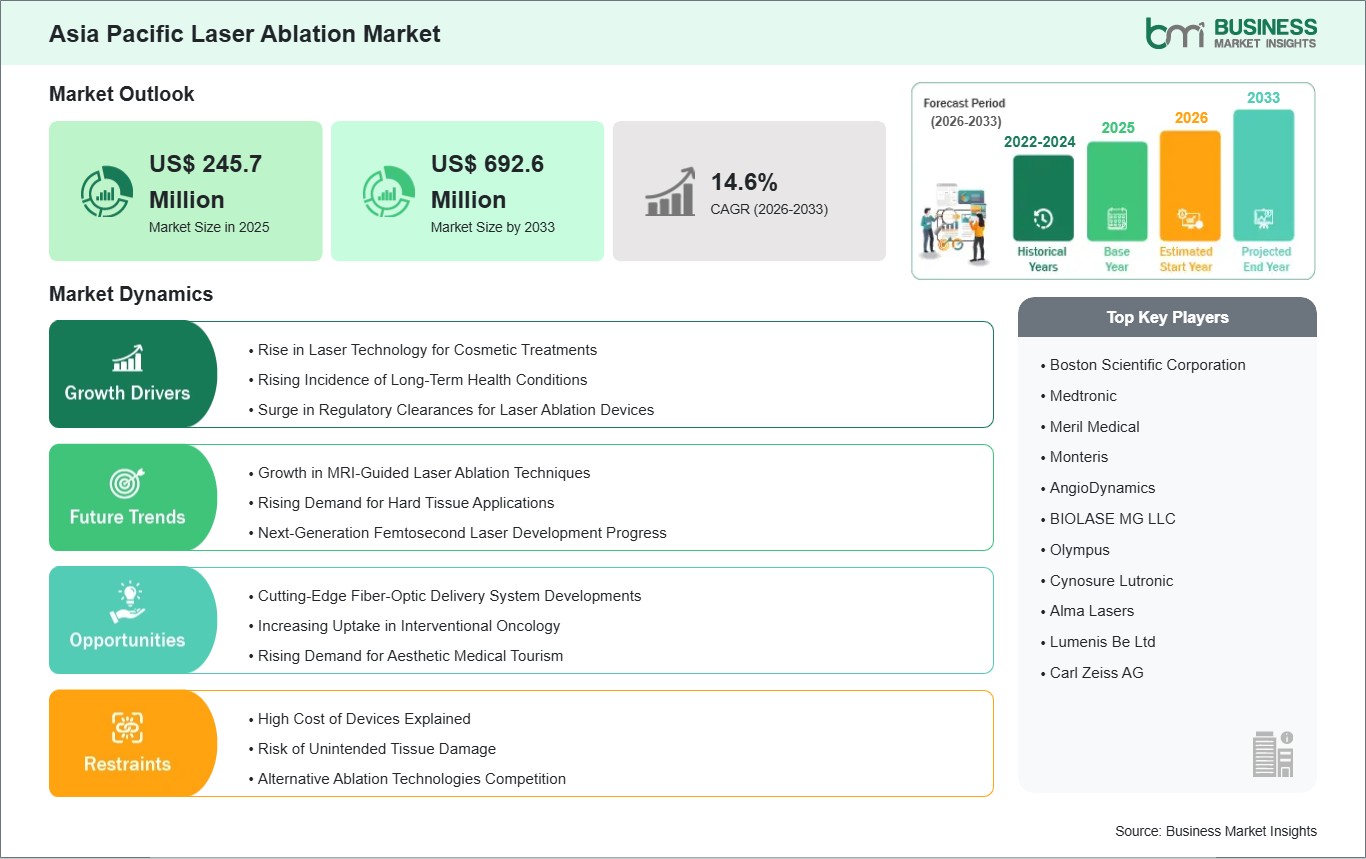
The Asia Pacific Laser Ablation market size is expected to reach US$ 692.6 million by 2033 from US$ 245.7 million in 2025. The market is estimated to record a CAGR of 14.6% from 2026 to 2033.
The Asia Pacific laser ablation market is witnessing steady expansion, driven by increasing adoption of minimally invasive and precision-based treatment technologies. Across the region, laser ablation is emerging as a preferred procedure in medical specialties such as oncology, cardiology, dermatology, and urology, due to its ability to target diseased tissues precisely while minimizing damage to surrounding areas. Patients and healthcare providers are increasingly favoring procedures that reduce recovery time, limit complications, and offer improved outcomes, which has positioned laser ablation as a key alternative to conventional surgical methods. The growth of private healthcare facilities, particularly in urban centers, has also fueled adoption, as these hospitals and clinics are more likely to invest in advanced technologies and attract patients seeking high-quality care.
In addition to medical applications, laser ablation is gaining traction in dental, cosmetic, and dermatological procedures, broadening its relevance in the region. Government investments in healthcare modernization, including infrastructure upgrades, technology integration, and training programs for medical professionals, are further supporting market growth. Urban hospitals and specialized clinics serve as key hubs for introducing advanced laser systems, creating centers of expertise and driving patient acceptance.
Disparities in healthcare access between developed and developing parts of the region limit uniform adoption. A shortage of trained specialists and regulatory inconsistencies across countries also hinder widespread integration, resulting in a market that is robust in urban and developed areas but still emerging in less developed regions.

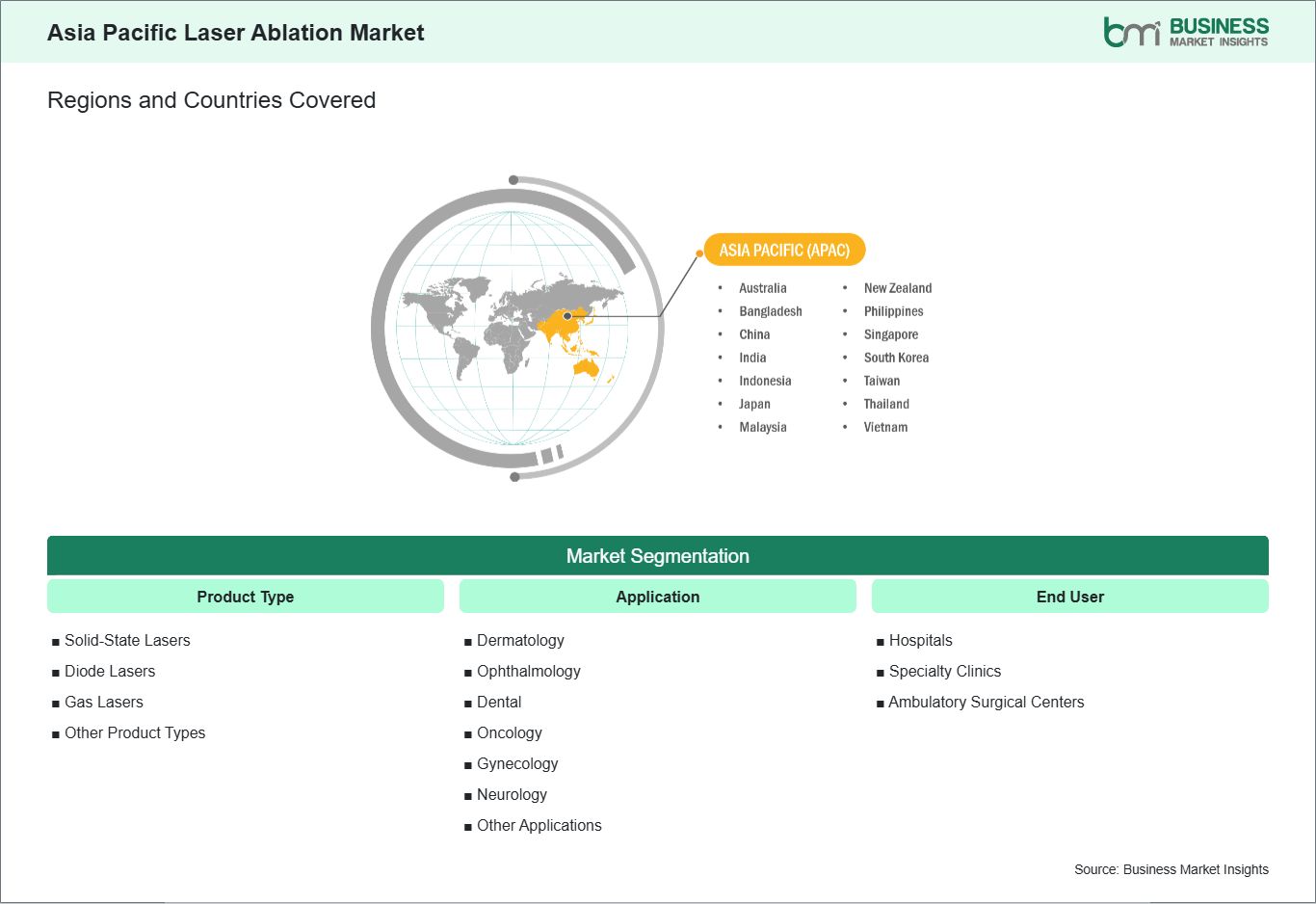
Key segments that contributed to the derivation of the Asia Pacific Laser Ablation market analysis are product type, application, and end user.
The Asia Pacific region has experienced a notable increase in the adoption of laser technology for cosmetic treatments, driven by growing consumer awareness and shifting perceptions of aesthetic procedures. Urban populations in countries such as Japan, South Korea, China, and Australia are increasingly seeking minimally invasive treatments that provide visible results with minimal recovery time. Procedures including fractional laser resurfacing, laser-based scar revision, hair removal, and pigmentation correction have become especially popular because they are precise, relatively low-risk, and suitable for a wide range of skin types. Clinics in major metropolitan areas are now equipped with advanced laser systems, allowing dermatologists and aesthetic practitioners to tailor treatments to individual patient needs and skin characteristics.
Cultural beauty ideals strongly shape the demand for specific procedures. In Southeast Asia, skin brightening and pigmentation-correcting treatments dominate due to concerns about sun exposure and uneven skin tone. Meanwhile, in East Asian countries such as South Korea and Japan, anti-aging treatments that enhance skin texture, firmness, and overall radiance are highly sought after. This variation demonstrates how regional aesthetics influence both the types of procedures offered and how clinics market their services to patients.
Accessibility also plays a significant role. In cities like Bangkok, Manila, Jakarta, and Sydney, the growth of private dermatology clinics and medspas has made laser treatments more widely available. This combination of advanced technology, cultural alignment, and convenience has helped normalize laser procedures, making them a preferred option for younger adults and professionals seeking effective, minimally invasive cosmetic solutions.
Fiber-optic delivery systems are transforming laser ablation technology across the Asia Pacific region by providing clinicians with enhanced precision, control, and safety. These systems allow practitioners to accurately focus laser energy on specific tissue layers, reducing the risk of damage to surrounding areas and improving treatment outcomes. In advanced healthcare markets such as Japan, South Korea, and Singapore, fiber-optic technology is increasingly integrated into both cosmetic and medical laser applications. This enables complex procedures, including fractional resurfacing, scar correction, vascular lesion treatment, and delicate skin rejuvenation, to be performed efficiently with consistent results.
The advantages of fiber-optic systems extend well beyond aesthetics. Hospitals in Sydney, Singapore, and Hong Kong employ these devices in minimally invasive surgical procedures, such as ophthalmology, urology, and endoscopic surgery. By improving energy control and precision, these systems reduce procedural risks, enhance patient safety, and shorten recovery times. Their multifunctionality makes them a valuable investment for clinics and hospitals seeking versatile equipment capable of supporting a range of treatments.
Emerging markets like Vietnam, Malaysia, and Indonesia benefit from portable, compact fiber-optic laser systems, which allow smaller clinics and outpatient centers to provide advanced laser care without large-scale infrastructure. This combination of flexibility, precision, and accessibility is driving broader adoption across the Asia Pacific, making fiber-optic systems central to the region’s expanding laser ablation capabilities.

The Asia Pacific Laser Ablation market demonstrates steady growth, with size and share analysis highlighting evolving trends and competitive dynamics among key players. The report evaluates important subsegments categorized within product type, application, and end user, highlighting their respective contributions to overall market performance.
By product type, the solid-state lasers subsegment dominated the market in 2025, driven by the superior performance and versatility of solid-state lasers in clinical applications. These devices offer high precision, consistent energy delivery, and compatibility with a wide range of tissues, making them the preferred choice for laser ablation procedures.
In terms of application, the dermatology subsegment dominated the market in 2025, propelled by the increasing prevalence of skin disorders such as acne scars, pigmentation issues, and vascular lesions, coupled with a growing demand for minimally invasive cosmetic procedures.
Based on end user, the hospitals subsegment dominated the market in 2025 due to their well-established dermatology and surgical departments, access to advanced laser ablation systems, and availability of trained physicians and clinical staff.
| Report Attribute | Details |
|---|---|
| Market size in 2025 | US$ 245.7 Million |
| Market Size by 2033 | US$ 692.6 Million |
| CAGR (2026 - 2033) | 14.6% |
| Historical Data | 2022-2024 |
| Forecast period | 2026-2033 |
| Segments Covered | By Product Type
|
|
Regions and Countries Covered
| |
| Asia Pacific | China, Japan, South Korea, India, Australia, New Zealand, Indonesia, Malaysia, Philippines, Singapore, Thailand, Vietnam, Taiwan, Bangladesh |
| Market leaders and key company profiles |
|
The "Asia Pacific Laser Ablation Market Size and Forecast (2022–2033)" report provides a detailed analysis of the market covering below areas:
The geographical scope of the Asia Pacific Laser Ablation market report is divided into: China, Japan, South Korea, India, Australia, New Zealand, Indonesia, Malaysia, the Philippines, Singapore, Thailand, Vietnam, Taiwan, Bangladesh, and Rest of Asia. China held the largest share in 2025.
China market is driven by a combination of modern healthcare infrastructure, rising patient awareness, and significant investments in advanced medical technologies. Within the country, laser ablation is widely used in oncology, cardiology, dermatology, and urology, reflecting growing confidence in minimally invasive procedures that reduce hospital stays and improve treatment precision. The preference for early diagnosis and targeted therapy is increasing demand for laser-based solutions, particularly in tertiary hospitals and specialty clinics across major urban centers.
A major factor supporting China’s market dominance is the availability of skilled medical professionals trained in laser ablation techniques. Extensive training programs, collaborations with global medical technology providers, and partnerships between hospitals and research institutions have strengthened clinical expertise. Private hospitals, in particular, play a crucial role in adopting advanced technologies, offering specialized procedures that attract patients from across the country. Government-led initiatives aimed at upgrading healthcare infrastructure and increasing access to modern treatments further reinforce the adoption of laser ablation. Investments in diagnostic imaging, interventional technologies, and digital health platforms complement the deployment of laser systems, creating a cohesive ecosystem for advanced medical care.
However, challenges remain in rural and less developed areas, where healthcare infrastructure and trained personnel are limited. While urban centers continue to drive adoption, the uneven distribution of resources restricts nationwide access to advanced laser treatments. Despite these constraints, China remains the leading force in Asia Pacific, combining infrastructure, expertise, and patient demand to shape the market.

The Asia Pacific Laser Ablation market is evaluated by gathering qualitative and quantitative data post primary and secondary research, which includes important corporate publications, association data, and databases. A few of the key developments in the Asia Pacific Laser Ablation market are:
The Asia Pacific Laser Ablation Market is valued at US$ 245.7 Million in 2025, it is projected to reach US$ 692.6 Million by 2033.
As per our report Asia Pacific Laser Ablation Market, the market size is valued at US$ 245.7 Million in 2025, projecting it to reach US$ 692.6 Million by 2033. This translates to a CAGR of approximately 14.6% during the forecast period.
The Asia Pacific Laser Ablation Market report typically cover these key segments-
The historic period, base year, and forecast period can vary slightly depending on the specific market research report. However, for the Asia Pacific Laser Ablation Market report:
The Asia Pacific Laser Ablation Market is populated by several key players, each contributing to its growth and innovation. Some of the major players include:
The Asia Pacific Laser Ablation Market report is valuable for diverse stakeholders, including:
Essentially, anyone involved in or considering involvement in the Asia Pacific Laser Ablation Market value chain can benefit from the information contained in a comprehensive market report.
Please tell us your area of interest
(Market Segments/ Regions and Countries/ Companies)