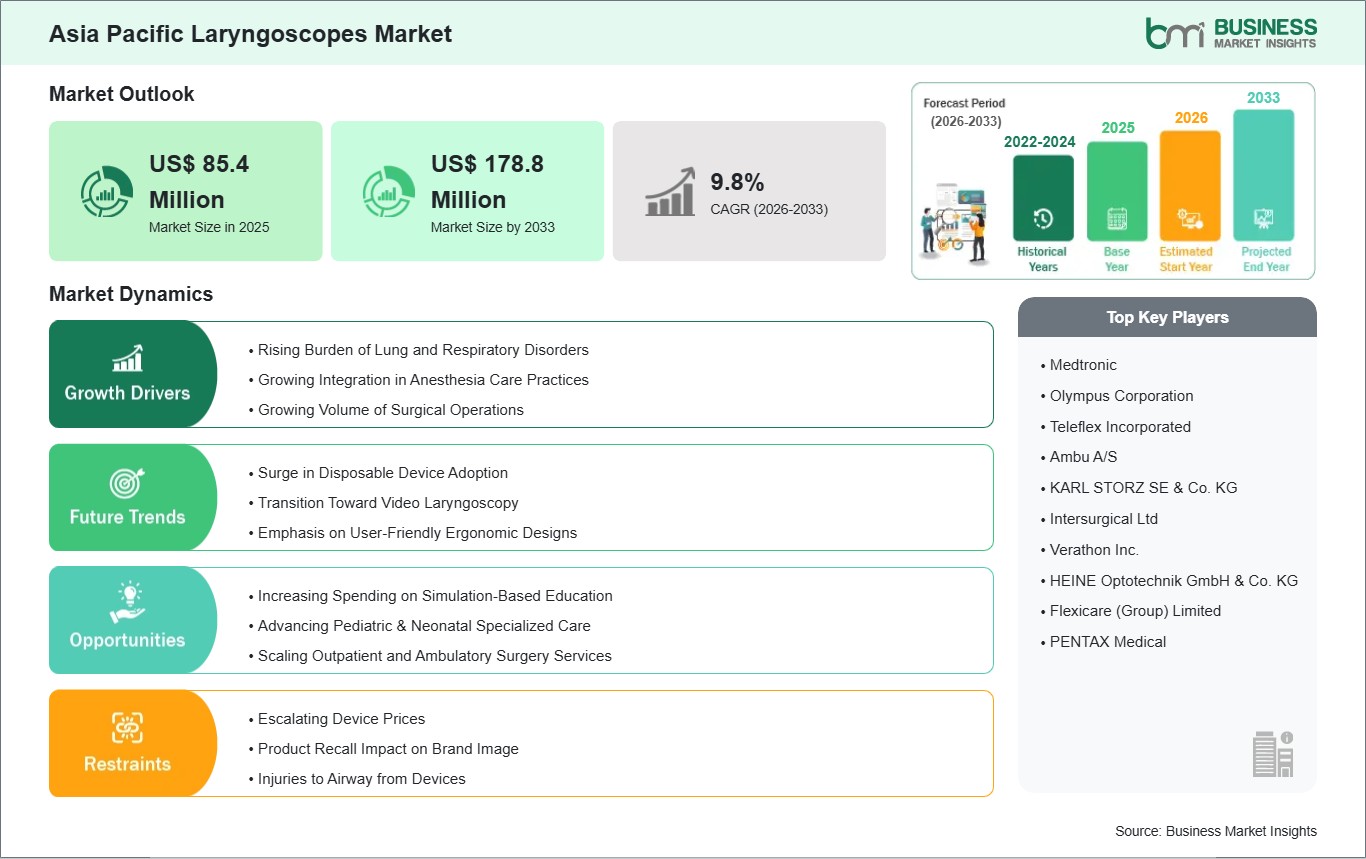
The Asia Pacific laryngoscopes market size is expected to reach US$ 178.8 million by 2033 from US$ 85.4 million in 2025. The market is estimated to record a CAGR of 9.8% from 2026 to 2033.
The Asia Pacific market for laryngoscopes is growing at a steady pace due to factors such as rapid developments in the healthcare system, rise in the volume of surgeries performed, and advancements in techniques for airway management. The use of laryngoscopes is growing in popularity since these instruments serve an important function in anesthesia, emergency, and intensive care environments. In this regard, the Asia Pacific laryngoscope market is experiencing a shift from traditional direct laryngoscopes to technologically advanced video-assisted devices owing to greater accuracy, better success rate in intubation, and better patient outcomes.
The growth of the market will be driven by the increase in the number of patients suffering from respiratory diseases, advancements in the intensive care facilities and healthcare spending across developing and developed markets in the region. Additionally, better training practices and greater knowledge about innovations in airway device technology play an important role in boosting their adoption rate. Laryngoscopes represent a very lucrative business for many firms due to their huge market base in China, as a result of large health care establishments and patients there. There are regional differences as far as adoption rates go, based on the difference in availability of modern healthcare infrastructure, which means that rural and semi-urban areas use traditional airway instruments. Furthermore, sensitivity to price in developing countries limits access to high-end models of laryngoscopes.

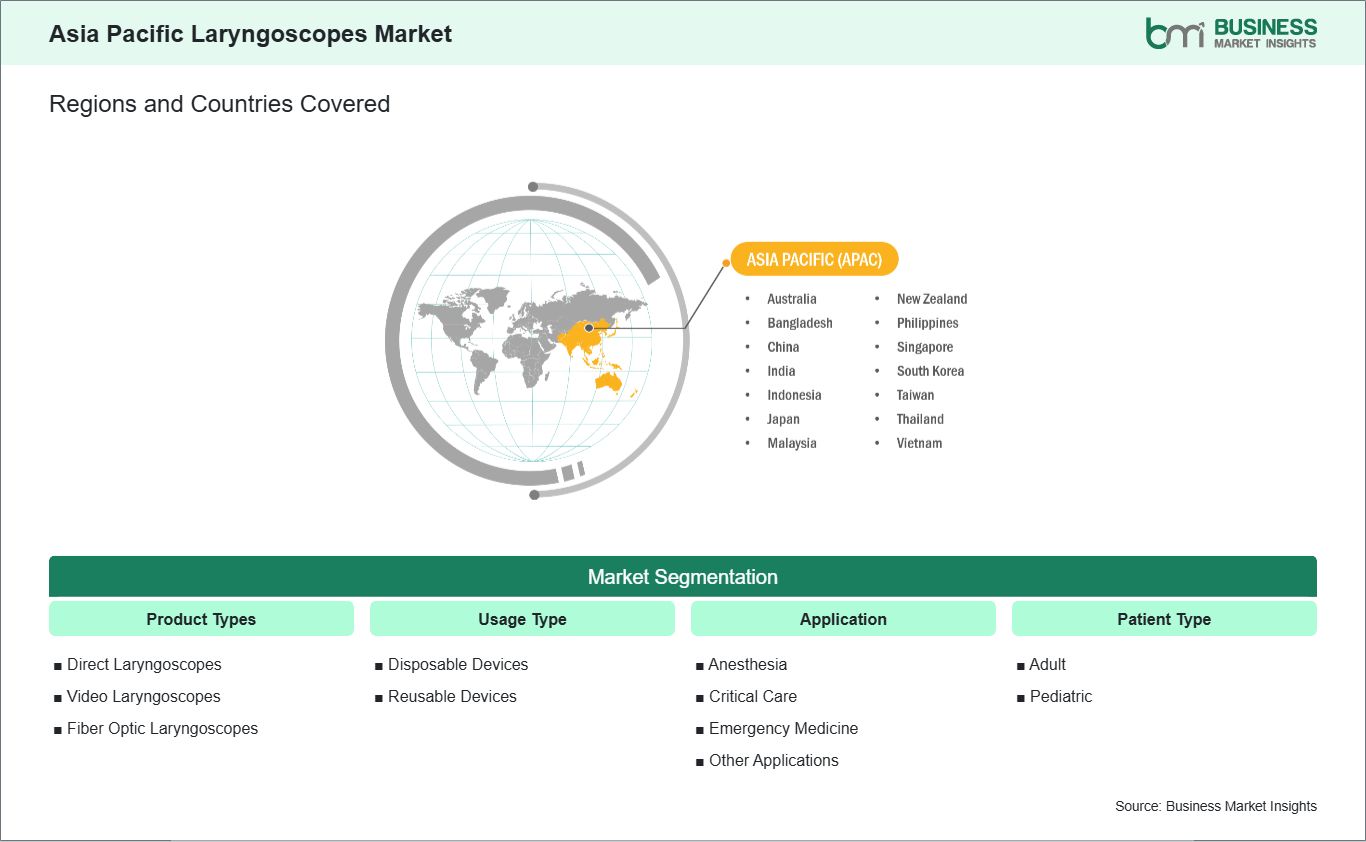
Key segments that contributed to the derivation of the Asia Pacific laryngoscopes market analysis are product type, usage type, application, patient type, and end user.
The growing incidence of pulmonary and respiratory disease among patients in the Asia Pacific region can be attributed to the quick spread of cities and industries, along with changes in lifestyle factors. Cities such as Delhi, Shanghai, Bangkok, and Manila commonly encounter problems with their air quality. Consequently, there is a greater risk of developing diseases such as asthma and bronchitis. In the end, this results in an increase in patients requiring medical attention and hospitalization with a need for airway management and emergency intubation, which in turn boosts demand for laryngoscopes in hospitals.
Another key aspect in the region's demographics is the aging population of many countries in the Asia Pacific, along with urban and relatively young populations in other countries. Aging individuals are at risk for infections like pneumonia and respiratory failure, while younger people are at risk because of pollution exposure and smoking. This means that there is sustained demand in many places for laryngoscopes as an aid in airway management and emergency intubation.
At the same time, respiratory infections continue to place pressure on healthcare systems in several Asia Pacific economies. Seasonal influenza, tuberculosis in certain developing areas, and post-infection complications still contribute significantly to respiratory distress cases. These conditions often require urgent airway intervention, reinforcing the importance of reliable laryngoscopy tools. As hospitals expand their critical care capabilities and emergency preparedness, the role of laryngoscopes in routine and emergency airway management continues to strengthen across the region.
The healthcare organizations in the Asia-Pacific region are more inclined towards simulation-based training for enhancing the effectiveness of clinical training programs. The medical colleges and hospitals in nations like Australia, Singapore, and Japan have begun using simulation labs for practicing intricate procedures such as intubations. This will enable the healthcare professionals to gain procedural confidence without putting their patients at any undue risks, thus underlining the importance of simulation in medical training programs.
In new healthcare systems being developed in India, Vietnam, Indonesia, and the Philippines, simulation training has been gaining popularity as an efficient approach to fill the skills gap in medical professionals. Such training involves practicing with the help of airway mannequins and computer-based learning materials that imitate respiratory emergencies. As trainees gain experience handling various kinds of laryngoscopes, particularly video-assisted ones, their readiness to handle such equipment in the clinical setting is significantly improved.
Moreover, cooperation between medical organizations and manufacturers of medical technologies has started to play an increasingly important role in the development of training programs. Collaboration with suppliers helps to develop simulation learning materials involving difficult airways and emergency scenarios, thus shaping the preferences of clinicians in favor of modern laryngoscopes.

The Asia Pacific Laryngoscopes market demonstrates steady growth, with size and share analysis highlighting evolving trends and competitive dynamics among key players. The report evaluates important subsegments categorized within product type, usage type, application, patient type, and end user, highlighting their respective contributions to overall market performance.
By product type, the video laryngoscopes subsegment dominated the laryngoscopes market in 2025. This is driven by the increasing demand for enhanced airway visualization, improved first-pass intubation success rates, and reduced complications in difficult airway management, making them a key revenue driver for manufacturers and supporting strong adoption in clinical practice.
In terms of usage type, the disposable devices subsegment led the market in 2025. The dominance of disposable devices is attributed to the growing emphasis on infection control, prevention of cross-contamination, and the operational convenience of eliminating reprocessing and sterilization requirements in high-volume healthcare settings.
Based on application, the anesthesia subsegment held the largest share in 2025. Hospitals and surgical centers widely rely on laryngoscopes during anesthesia procedures for airway management and intubation, supported by the rising number of surgeries and the increasing use of advanced airway management techniques.
In terms of patient type, the adult subsegment dominated the market in 2025. This is driven by the higher prevalence of surgical procedures, critical care admissions, and chronic respiratory conditions among adults, resulting in greater demand for airway management devices in this population group.
By end user, the hospitals subsegment held the largest share in 2025. Hospitals maintain leadership due to their advanced infrastructure, availability of skilled healthcare professionals, high patient inflow, and strong capability to perform complex surgical and emergency procedures requiring laryngoscopy.
| Report Attribute | Details |
|---|---|
| Market size in 2025 | US$ 85.4 Million |
| Market Size by 2033 | US$ 178.8 Million |
| CAGR (2026 - 2033) | 9.8% |
| Historical Data | 2022-2024 |
| Forecast period | 2026-2033 |
| Segments Covered | By Product Types
|
|
Regions and Countries Covered
| |
| Asia Pacific | China, Japan, South Korea, India, Australia, New Zealand, Indonesia, Malaysia, Philippines, Singapore, Thailand, Vietnam, Taiwan, Bangladesh |
| Market leaders and key company profiles |
|
The "Asia Pacific Laryngoscopes Market Size and Forecast (2022-2033)" report provides a detailed analysis of the market covering below areas:
The geographical scope of the Asia Pacific Laryngoscopes market report is divided into: China, Japan, South Korea, India, Australia, New Zealand, Indonesia, Malaysia, the Philippines, Singapore, Thailand, Vietnam, Taiwan, Bangladesh, and Rest of Asia. China held the largest share in 2025.
China holds the most dominant position among the Asia Pacific laryngoscope market due to the existence of well-developed health care facilities and high clinical demand for products. The health care industry in China has achieved great advancements in recent years, which is characterized by continuous investments in hospital construction, intensive care units, and emergency care systems. Consequently, there is an increased need for airway management devices such as laryngoscopes in various health care settings.
In China, the utilization of sophisticated medical equipment is highly prevalent in teaching and tertiary hospitals, which prefer using video laryngoscopes to facilitate accurate procedures and minimize complications associated with intubation. In contrast, hospitals at lower tiers and rural health centers still make use of conventional laryngoscopes as a result of budgetary and technological constraints. Healthcare reforms and programs initiated by the government towards the enhancement of emergency care systems have added more pressure to the need for quality products for airway management. In addition, the existence of local medical equipment producers has increased the availability of these products. However, uneven access to healthcare services in both urban and rural areas, along with budget restrictions at public hospitals, has affected the adoption rate of advanced laryngoscopes in China.

The Asia Pacific Laryngoscopes market is evaluated by gathering qualitative and quantitative data post primary and secondary research, which includes important corporate publications, association data, and databases. A few of the key developments in the Asia Pacific Laryngoscopes market are:
The Asia Pacific Laryngoscopes Market is valued at US$ 85.4 Million in 2025, it is projected to reach US$ 178.8 Million by 2033.
As per our report Asia Pacific Laryngoscopes Market, the market size is valued at US$ 85.4 Million in 2025, projecting it to reach US$ 178.8 Million by 2033. This translates to a CAGR of approximately 9.8% during the forecast period.
The Asia Pacific Laryngoscopes Market report typically cover these key segments-
The historic period, base year, and forecast period can vary slightly depending on the specific market research report. However, for the Asia Pacific Laryngoscopes Market report:
The Asia Pacific Laryngoscopes Market is populated by several key players, each contributing to its growth and innovation. Some of the major players include:
The Asia Pacific Laryngoscopes Market report is valuable for diverse stakeholders, including:
Essentially, anyone involved in or considering involvement in the Asia Pacific Laryngoscopes Market value chain can benefit from the information contained in a comprehensive market report.
Please tell us your area of interest
(Market Segments/ Regions and Countries/ Companies)