Market Summary
Executive Summary and Market Analysis
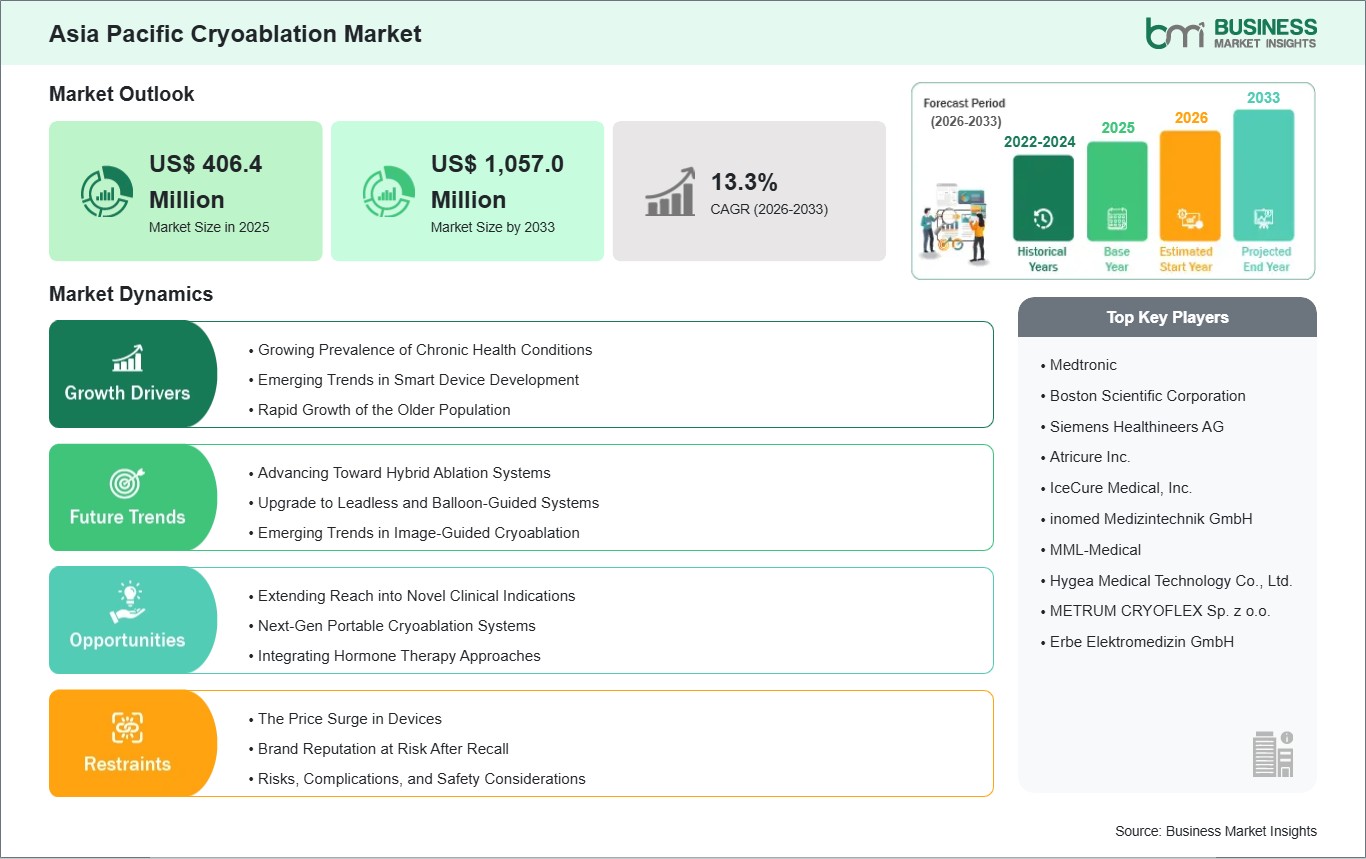
The Asia Pacific cryoablation market is experiencing significant growth driven by rising awareness of minimally invasive treatment options and a growing demand for advanced therapies in oncology and cardiology. The region’s expanding healthcare infrastructure and increasing accessibility to interventional procedures are major factors supporting market adoption. China leads the region in procedural volume and adoption of cryoablation technologies, while Japan and South Korea contribute through technological innovation and advanced clinical practices. Emerging markets such as India, Southeast Asia, and Australia are seeing gradual uptake as hospitals and specialty clinics expand their service offerings. The preference for therapies that minimize patient recovery time and procedural risks has strengthened the market, encouraging healthcare providers to invest in cryoablation systems and training.
Regulatory complexities across countries can delay approvals and market entry, while disparities in healthcare infrastructure between urban and rural areas limit the widespread adoption of these technologies. Despite these challenges, increased clinical awareness, supportive healthcare policies, and growing patient interest in minimally invasive procedures are creating a positive environment for market development across Asia Pacific.
Segment Analysis
Asia Pacific Cryoablation Market Segmentation
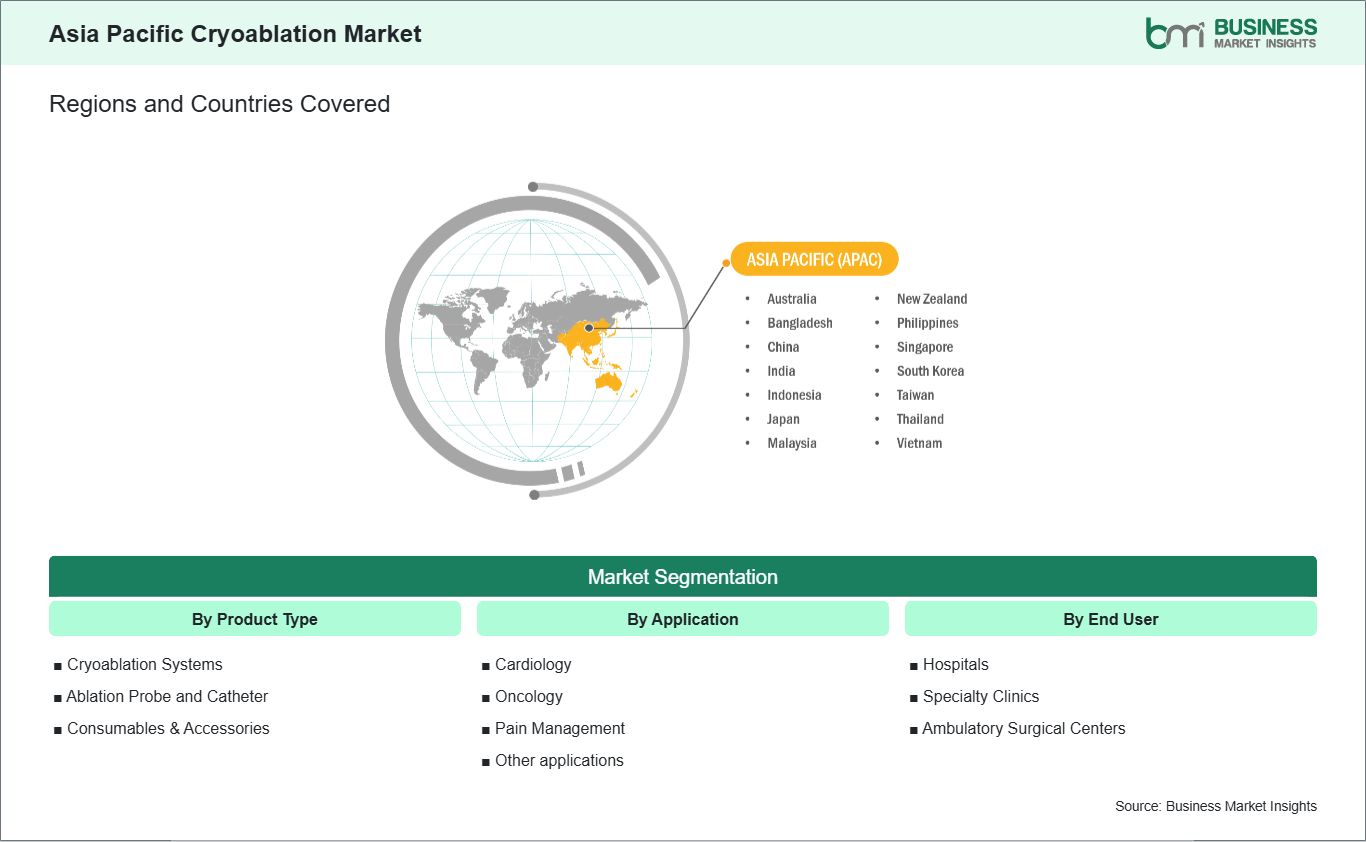
Key segments that contributed to the derivation of the Asia Pacific cryoablation market analysis are product type, application, and end user.
- By product type, the cryoablation market is segmented into cryoablation systems, ablation probes and catheters, and consumables & accessories. The ablation probe and catheter segment dominated the market in 2025.
- Based on application, the cryoablation market is classified into cardiology, oncology, pain management, and other applications. The oncology segment dominated the market in 2025.
- In terms of end user, the cryoablation market is categorized into hospitals, specialty clinics, and ambulatory surgical centers. The hospitals segment dominated the market in 2025.
Market Forces
Asia Pacific Cryoablation Market Drivers and Opportunities
Growing Prevalence of Chronic Health Conditions
The Asia Pacific region is witnessing a significant rise in chronic health conditions, including cardiac disorders, cancers, and metabolic diseases. As populations age and lifestyles evolve, healthcare providers are seeing more patients who require advanced, minimally invasive procedures. Cryoablation is increasingly considered a suitable solution for treating arrhythmias and localized tumors, offering an alternative to traditional surgical approaches.
Cardiology departments in major cities across the region are adopting cryoablation to address complex heart rhythm disorders. Hospitals are expanding their procedural offerings to include advanced ablation techniques, allowing patients to benefit from shorter recovery times and reduced procedural risks. Physicians and patients alike are recognizing the value of these minimally invasive options in managing chronic cardiac conditions.
In addition to cardiac applications, oncology centers are exploring cryoablation for tumor management. Hospitals with advanced imaging and interventional capabilities are integrating the procedure into treatment plans for select patients, positioning cryoablation as a complementary approach to conventional cancer therapies. This trend underscores the growing role of minimally invasive interventions in the region’s response to chronic health conditions.
Extending Reach into Novel Clinical Indications
Cryoablation in the Asia Pacific region is expanding beyond traditional cardiac applications into oncology, pain management, and other therapeutic areas. Hospitals that initially adopted the technology for arrhythmias are increasingly exploring its use for tumor ablation and soft-tissue interventions, reflecting confidence in the versatility of the procedure.
Oncology is emerging as a major area for cryoablation adoption. Hospitals are using the procedure for patients who may not be suitable for conventional surgery, allowing for targeted and patient-friendly treatments. Clinicians are incorporating cryoablation into multidisciplinary care programs, enhancing its role in comprehensive cancer management.
Beyond cardiac and oncology uses, cryoablation is also being considered for managing chronic pain and providing palliative care. Its ability to target specific areas with minimal invasiveness is gaining attention among specialists, paving the way for wider clinical acceptance. As hospitals expand their procedural capabilities, cryoablation is poised to play an increasingly important role in the Asia Pacific region’s healthcare landscape.
Size and Share Analysis
Asia Pacific Cryoablation Market Size and Share Analysis
The Asia Pacific cryoablation market demonstrates steady growth, with size and share analysis highlighting evolving trends and competitive dynamics among key players. The report evaluates important subsegments categorized within product type, application, and end user, highlighting their respective contributions to overall market performance.
By product type, the ablation probe and catheter subsegment dominated the market in 2025. This is driven by the recurring need for precise and reliable probes and catheters during cryoablation procedures, essential for effective freezing and destruction of targeted tissues, making them a key revenue driver for manufacturers and ensuring consistent demand in clinical settings.
In terms of application, the oncology subsegment dominated the market in 2025. The leadership of oncology applications is attributed to the rising incidence of cancer cases, growing preference for minimally invasive tumor ablation techniques, and increasing awareness among healthcare providers about the effectiveness of cryoablation in treating liver, kidney, prostate, and other solid tumors.
Based on end user, the hospitals subsegment dominated the market in 2025. Hospitals maintain a stronghold due to their well-established oncology and surgical departments, access to advanced cryoablation equipment, trained interventional radiologists and staff, and the capability to perform complex procedures with comprehensive patient care.
Report Coverage
Asia Pacific Cryoablation Market Report Coverage and Deliverables
The "Asia Pacific Cryoablation Market Size and Forecast (2022–2033)" report provides a detailed analysis of the market covering below areas:
- Asia Pacific Cryoablation market size and forecast at regional and country levels for segments covered under the scope
- Asia Pacific Cryoablation market trends, as well as drivers, restraints, and opportunities
- Asia Pacific Cryoablation market analysis covering key trends, regional framework, major players, regulations, and recent developments
- Industry landscape and competition analysis covering market concentration, heat map analysis, prominent players, and recent developments for the Asia Pacific Cryoablation market
- Detailed company profiles, including SWOT analysis
Geographic Insights
Asia Pacific Cryoablation Market Geographic Insights
The geographical scope of the Asia Pacific cryoablation market report is divided into: China, Japan, South Korea, India, Australia, New Zealand, Indonesia, Malaysia, the Philippines, Singapore, Thailand, Vietnam, Taiwan, Bangladesh, and Rest of Asia. China held the largest share in 2025.
China is the dominant player in the Asia Pacific cryoablation market, driven by a combination of strong healthcare infrastructure and growing clinical expertise. Major urban centers such as Beijing, Shanghai, and Guangzhou are home to advanced hospitals and specialty clinics offering cryoablation for solid tumors and cardiac arrhythmias. Government initiatives promoting minimally invasive therapies and early disease intervention have supported wider adoption across both public and private healthcare facilities.
In China, local collaborations between domestic hospitals and medical technology providers have enhanced device availability and physician training, further boosting the use of cryoablation. Patient awareness of less invasive treatment options has grown, particularly for oncology and cardiac procedures, encouraging hospitals to expand interventional programs. While regional differences in healthcare quality exist, the overall ecosystem in China is highly favorable, with ongoing investments in clinical capacity, professional education, and technology adoption sustaining the country’s leadership in the Asia Pacific market.
Industry Activity
Recent Developments
The Asia Pacific cryoablation market is evaluated by gathering qualitative and quantitative data post primary and secondary research, which includes important corporate publications, association data, and databases. A few of the key developments in the Asia Pacific cryoablation market are:
- In March 2025, Cryofocus Medtech (Shanghai) Co., Ltd. announced that it obtained NMPA regulatory approval in China for its Malignant Stenosis Cryoablation System, signaling continued product expansion in the region’s interventional cryotherapy landscape beyond cardiac indications.
- In November 2023, IceCure Medical Ltd. announced that the Central Drugs Standard Control Organization (CDSCO) in India granted updated regulatory approval for its ProSense cryoablation system under the new regulatory framework, reinforcing its commercial positioning in the India segment of the Asia Pacific region.
Trust & Transparency
Research Methodology
The market analysis combines proprietary research with secondary data from government agencies, company disclosures, regulatory filings, industry databases and expert interviews. Market estimates are validated through data triangulation, cross-market benchmarking and analyst
review.
View Full Research Methodology
Key Sources Referred:
The World Bank World Health Organization (WHO) Center for Disease Control and Prevention (CDC) Food and Drug Administration (FDA) European Database on Medical Devices (EUDAMED) European Society of Cardiology (ESC) American College of Cardiology (ACC) American Heart Association (AHA) Company Websites Company Annual Reports Company Investor Presentations