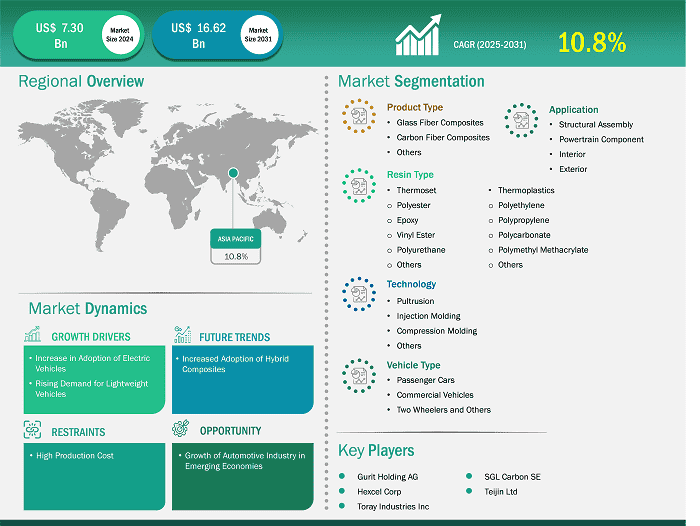
The Asia Pacific Automotive Composites Market size is expected to reach US$ 16.62 billion by 2031 from US$ 7.30 billion in 2024. The market is estimated to record a CAGR of 10.8% from 2025 to 2031.
Executive Summary and Asia Pacific Automotive Composites Market Analysis:
The automotive composites market in Asia Pacific is experiencing robust growth, owing to the region's significant automotive production and increasing demand for lightweight, durable, and fuel-efficient vehicles. Asia Pacific is a key player in the global automotive industry, with the presence of some of the world's largest automotive manufacturers, such as Toyota, Honda, Hyundai, and Tata Motors. The demand for composites in this region is spurred by the need to reduce vehicle weight, improve fuel efficiency, and meet stringent environmental regulations, which are becoming increasingly important in countries such as China, India, Japan, and South Korea. According to a report published by Fastener World Inc., Asia Pacific experienced a significant increase in production volume from over 46 million units in 2021 to over 50 million units in 2022 and over 55 million units in 2023. The region is growing rapidly in the car market owing to the rising middle-class population and disposable income. It is the largest regional base for automobile production and home to the largest vehicle buyers. The top 5 automobile producing countries are China, with more than 30 million vehicles; Japan, with nearly 9 million vehicles; India, with ~5.9 million vehicles; South Korea, with more than 4 million vehicles; and Thailand, with nearly 1.9 million vehicles.
Asia Pacific Automotive Composites Market Segmentation Analysis:
Key segments that contributed to the derivation of the automotive composites market analysis are product type, resin type, technology, vehicle type and application.
- Based on product type, the automotive composites market is segmented into glass fiber composites, carbon fiber composites, and others. The glass fiber composites segment dominated the market in 2023.
- By resin type, the automotive composites market is divided into thermoset (polyester, epoxy, vinyl ester, polyurethane, and others) and thermoplastics (polyethylene, polypropylene, polycarbonate, polymethyl methacrylate, and others). The thermoplastics segment dominated the market in 2023.
- On the basis of technology, the automotive composites market is segmented into pultrusion, injection molding, compression molding, and others. The injection molding segment dominated the market in 2023.
- In terms of vehicle type, the market is segmented into passenger cars, commercial vehicles, and two wheelers and others. The passenger cars segment held the largest share of the market in 2023.
- Based on application, the automotive composites market is segmented into structural assembly, powertrain component, interior, and exterior. The interior segment dominated the market in 2023.
Asia Pacific Automotive Composites Market Outlook
Automotive composites market in Asia Pacific is growing due to the rise in demand for electric vehicles (EVs) and hybrid vehicles. As these vehicles require lighter components to offset the weight of heavy batteries, automotive manufacturers are turning to composites to reduce the vehicle's overall weight. Composites, such as carbon fiber, glass fiber, and thermoplastic materials, offer an excellent strength-to-weight ratio, making them ideal for various applications in electric vehicle bodies, interiors, and powertrains. The growth of the EV market, particularly in China, is expected to continue fueling demand for composite materials during the forecast period as manufacturers aim to improve range and performance while maintaining lower environmental impact. The automotive industry is expanding rapidly in growing economies in Asia Pacific, such as India and Southeast Asia. Local manufacturers seek to meet the rising demand for affordable, fuel-efficient, and sustainable vehicles. Introducing government policies that promote lightweight materials, lower emissions, and sustainable production processes incentivize the adoption of composites. In India, initiatives such as the Faster Adoption and Manufacturing of Hybrid and Electric Vehicles (FAME) scheme are driving the adoption of EVs, boosting the demand for composites in the automotive sector.
Asia Pacific Automotive Composites Market Country Insights
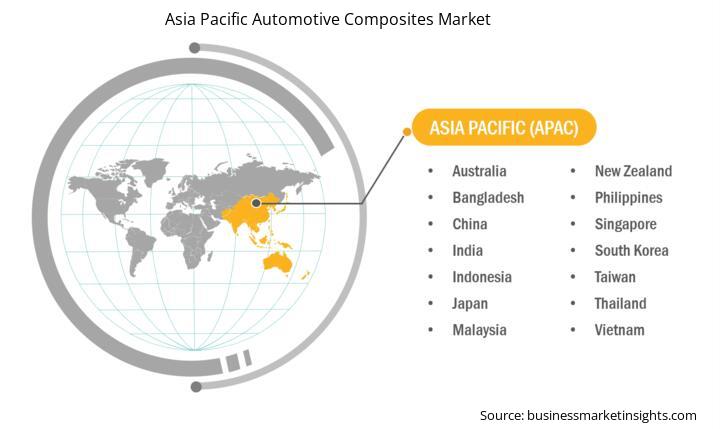
Based on region, the Asia Pacific automotive composites market is further segmented into the China, India, South Korea, Japan, Australia, Indonesia, Malaysia, Philippines, Singapore, Thailand, and Vietnam. China held the largest share in 2023.
China's automotive composites market is experiencing rapid growth, fueled by the country's expanding automotive industry and increasing demand for lightweight, high-performance materials. As China shifts toward electric vehicles (EVs) and stricter emissions regulations are enforced, automakers increasingly adopt composites such as carbon fiber, fiberglass, and natural fibers to improve fuel efficiency and extend battery life. The government of China has taken several initiatives to stimulate the production capacities of automobile manufacturers to 35 million units by 2025. According to the 2022 report by the International Energy Agency, China recorded EV sales of 3.3 million in 2021. The market is also driven by China's significant investment in advanced manufacturing technologies and the growth of the EV sector. With a strong focus on sustainability, China is poised to become a global leader in the automotive composites market, supporting both domestic and international demand.
Asia Pacific Automotive Composites Market Company Profiles
Gurit Holding AG, Hexcel Corp, Mitsubishi Chemical Group Corp, SGL Carbon SE, Solvay SA, Teijin Ltd, DuPont de Nemours Inc, Toray Industries Inc, Atlas Fibre, and Elaghmore Advisor LLP are among the key players operating in the market. These players adopt strategies such as expansion, product innovation, and mergers and acquisitions to stay competitive in the market and offer innovative products to their consumers.
Asia Pacific Automotive Composites Market Research Methodology:
The following methodology has been followed for the collection and analysis of data presented in this report:
- Secondary Research
The research process begins with comprehensive secondary research, utilizing both internal and external sources to gather qualitative and quantitative data for each market. Commonly referenced secondary research sources include, but are not limited to:
- Company websites, annual reports, financial statements, broker analyses, and investor presentations
- Industry trade journals and other relevant publications
- Government documents, statistical databases, and market reports
- News articles, press releases, and webcasts specific to companies operating in the market
Note: All financial data included in the Company Profiles section has been standardized to US$. For companies reporting in other currencies, figures have been converted to US$ using the relevant exchange rates for the corresponding year.
- Primary Research
The Insight Partners conducts a significant number of primary interviews each year with industry stakeholders and experts to validate and analyze the data and gain valuable insights. These research interviews are designed to:
- Refine findings from secondary research
- Enhance the expertise and market understanding of the analysis team
- Gain insights into market size, trends, growth patterns, competitive dynamics, and future prospects
Primary research is conducted via email interactions and telephone interviews with industry experts across various markets, categories, segments, and sub-segments in different regions. Participants typically include:
- Industry stakeholders: Vice Presidents, business development managers, market intelligence managers, and national sales managers
- External experts: Valuation specialists, research analysts, and key opinion leaders with industry-specific expertise
Key Sources Referred:
- National Association of Automotive Component and Allied Manufacturers
- American Automotive Policy Council
- Automotive Parts Remanufacturers Association
- American Automobile Association
- American Composites Manufacturers Association
- European Composites Industry Association
- Japan Society for Composite Materials
- China Composites Industry Association
Asia Pacific Automotive Composites Market Strategic Insights
Asia Pacific Automotive CompositesMarket Report Highlights
| Report Attribute | Details |
| Market size in 2024 | US$ 7.30 Billion |
| Market Size by 2031 | US$ 16.62 Billion |
| CAGR (2025 - 2031) | 10.8% |
| Historical Data | 2021-2023 |
| Forecast period | 2025-2031 |
| Segments Covered |
By Fiber Type
|
|
Regions and Countries Covered
|
|
| Asia Pacific | China, India, Japan, Australia, Rest of Asia-Pacific |
| Market leaders and key company profiles |
|
Asia Pacific Automotive Composites Market Country and Regional Insights