Asia Pacific Airway Management Devices Market Outlook (2022-2033)

Historic Data: 2022-2024   |   Base Year: 2025   |   Forecast Period: 2026-2033
Report Content: Market Scope, Market Segmentation, Market Dynamics, and Competitive Analysis

Report Coverage:
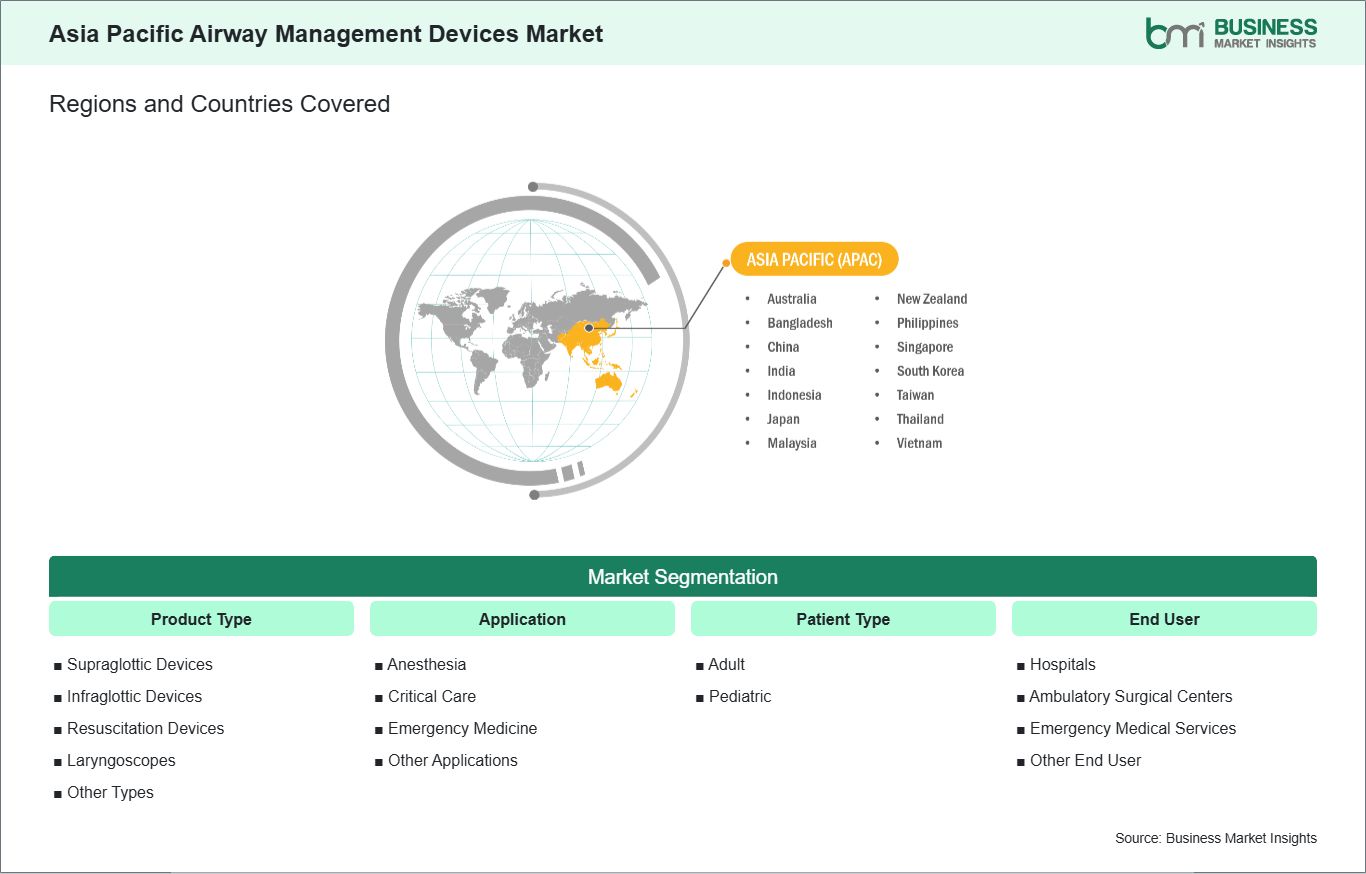
  • Product Type (Supraglottic Devices, Infraglottic Devices, Resuscitation Devices, Laryngoscopes, Other Types)
  • Application (Anesthesia, Critical Care, Emergency Medicine, Other Applications)
  • Patient Type (Adult, Pediatric)
  • End User (Hospitals, Ambulatory Surgical Centers, Emergency Medical Services, Other End User)

No. of Pages: 150
Report Code: BMIPUB00034851
Category: Life Sciences
Asia Pacific Airway Management Devices Market

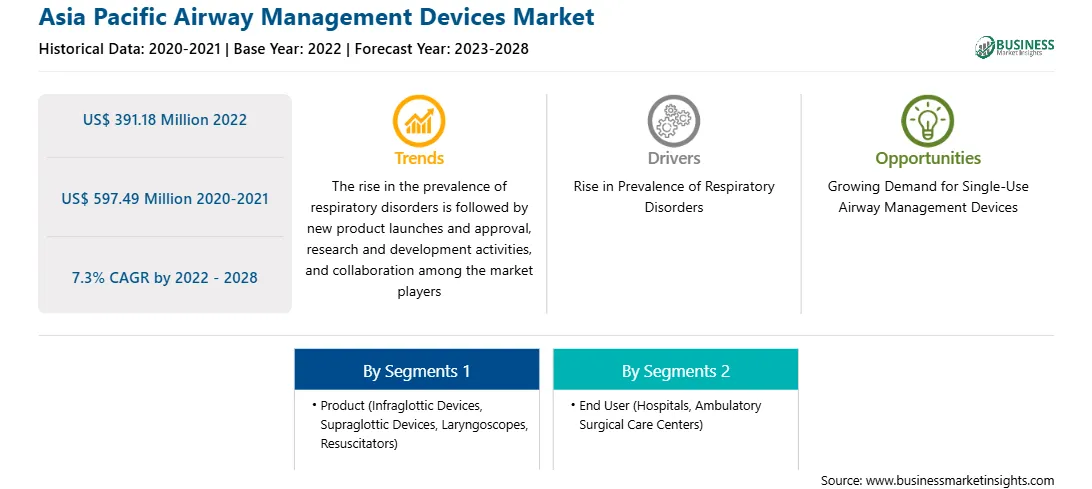
The Asia Pacific airway management devices market size is expected to reach US$ 2,342.4 million by 2033 from US$ 1,427.1 million in 2025. The market is estimated to record a CAGR of 6.5% from 2026 to 2033.

Executive Summary and Asia Pacific Airway Management Devices Market Analysis:

The Asia Pacific airway management devices market in the Asia Pacific region is experiencing exponential growth, fueled by advancements in the healthcare sector, an increase in the number of surgical procedures, and heightened awareness regarding respiratory health issues. There has been significant funding directed towards the development and improvement of hospital infrastructure and emergency departments in the region, especially in urban areas, resulting in an increased requirement for different types of airway management devices, such as endotracheal tubes, laryngeal masks, video laryngoscopes, and supraglottic airway devices. Technology innovation is one of the main factors propelling this market, since equipment manufacturers offer affordable yet high-quality devices specifically designed for hospitals lacking resources. Disposable or single-use airway management equipment also appears popular among other trends, especially regarding infection prevention and simplifying clinical practice. Professional training related to the management of airways is growing as well, which positively impacts the skills of healthcare professionals performing airway intervention. Nevertheless, there are barriers to further development in this industry, including disparities in access to quality healthcare services in cities and remote areas that result in disparities in advanced airway devices use. Expensive devices and absence of payment models in some countries are other barriers to the use of advanced medical technology. Nonetheless, continuous investments in healthcare in the region will facilitate sustainable market growth.

Asia Pacific Airway Management Devices Market - Strategic Insights:

global-market-strategic-framework
Get more information on this report

Asia Pacific Airway Management Devices Market Segmentation Analysis:

Key segments that contributed to the derivation of the airway management devices market analysis are product type, application, patient type, and end user.

  • By product type, the airway management devices market is segmented into supraglottic devices, infraglottic devices, resuscitation devices, laryngoscopes, and other types. The infraglottic devices segment dominated the market in 2025.
  • Based on application, the airway management devices market is classified into anesthesia, critical care, emergency medicine, and other applications. The anesthesia segment dominated the market in 2025.
  • On the basis of patient type, the airway management devices market is bifurcated into adult and pediatric. The adult segment dominated the market in 2025.
  • In terms of end user, the airway management devices market is categorized into hospitals, ambulatory surgical centers, emergency medical services, and other end user. The hospitals segment dominated the market in 2025.

Asia Pacific Airway Management Devices Market Drivers and Opportunities:

Increasing Prevalence of Sleep Apnea Disorders

The healthcare community within the Asia-Pacific region is noticing an increase in diagnosed sleep apnea cases. It has been particularly noted in cities like Tokyo, Seoul, Beijing, and Singapore due to certain lifestyle issues including obesity, aging patients, and sitting jobs, which can all be contributing factors. The hospitals in these locations have increased instances of polysomnographies being conducted for patients undergoing overnight sleep tests. There is therefore an increase in the detection of patients suffering from sleep apnea. Because sleep apnea necessitates airway assistance when being managed, particularly while conducting sleep test and moderate/severe cases, there is a need for airway management technology.

Sleep-related breathing disorders have been receiving increasing attention from primary care network systems and ENT professionals in countries such as India and Malaysia, with a focus on early detection and the treatment of these conditions in outpatients. Portable devices meant to assist in airways, which include CPAP accessories and airway devices, are increasingly being prescribed by healthcare professionals in communities. Also, there have been establishments of specialized sleep centers in private health organizations, which incorporate sleep monitoring equipment and airway management devices in one setting.

Public health programs that are targeted at sensitizing populations about the dangers of sleep apnea have succeeded in reducing stigmatization and encouraging clinical consultations. With increasing awareness of this chronic disease, patients are developing demands for airway devices that are comfortable to use and affordable to middle-class consumers. There are growing realizations that sleep apnea requires consistent airway management over extended periods, and this is driving the growth of airway devices in Asia Pacific.

Expansion of Emergency Response and Ambulance Services

In many Asia Pacific countries, there is a concerted effort to strengthen emergency medical response infrastructure, including ambulance services and pre‑hospital care. Nations such as China, Australia, and Thailand are investing in expanding EMS capacity, adding more ambulances, upgrading communications systems, and training paramedics in advanced life support protocols. As emergency teams engage with a broader range of acute conditions such as cardiac arrests, respiratory distress, and trauma—the need for reliable airway management devices in pre‑hospital settings has become more pronounced.

The ambulance fleets in the area are becoming increasingly equipped with airway management tools capable of aiding a quick response. The modern EMS fleet includes small video laryngoscopes, portable resuscitators, and sophisticated airways devices. Such equipment helps realize the understanding that the timely airway control can have a positive effect on survival rate and avoid complications that might arise because of delayed airway intervention. Countries with large rural territories, such as India and Indonesia, also examine mobile EMS teams with simple yet reliable airway management devices to fill time gaps when the necessary assistance may not be provided timely.

Airway management training programs are conducted in close cooperation with regional associations dealing with emergency medicine and representatives from abroad. Paramedics get specialized courses on the usage of different airway management devices outside of hospitals in an emergency situation, and their confidence in handling them is positively influencing purchases made by governmental healthcare agencies as well as private EMS companies. Thus, with the improvement of emergency systems in Asia-Pacific countries, airway management devices are expected to become popular among ambulances and other facilities that provide urgent treatment.

Asia Pacific Airway Management Devices Market Size and Share Analysis:

The Asia Pacific airway management devices market is experiencing steady growth, with market size and share analysis reflecting evolving treatment preferences and competitive dynamics among key players. The report evaluates important subsegments categorized within product type, application, patient type, and end user, highlighting their respective contributions to overall market performance.

By product type, the infraglottic devices subsegment dominated the market in 2025. In anesthesia practice, infraglottic devices provide protection against aspiration and enable precise airway management, driving higher adoption in operating rooms and critical care settings compared to supraglottic devices.

Based on application, the anesthesia subsegment dominated the market in 2025 due to the need for definitive airway control across a wide range of surgical procedures, from routine elective surgeries to complex interventions. Because infraglottic devices are essential for intubation during anesthesia, this segment experiences consistent, high-volume usage, making it the largest segment compared to emergency or general critical care.

In terms of patient type, the adult subsegment dominated the market in 2025. Most procedural training, device designs, and usage guidelines are optimized for adult anatomy and usage scenarios, reinforcing higher market volume.

Based on end user, the hospital subsegment dominated the market in 2025, as hospitals remain the central hub for airway management, handling scheduled surgeries, emergency admissions, ICU care, and trauma cases. Their larger budgets, need for extensive airway inventories, and availability of multidisciplinary professionals make them the largest purchasers compared to outpatient centers or EMS, where volume and purchasing power are comparatively lower.

Asia Pacific Airway Management Devices Market Report Highlights:

Report Attribute Details
Market size in 2025 US$ 1,427.1 Million
Market Size by 2033 US$ 2,342.4 Million
CAGR (2026 - 2033)6.5%
Historical Data 2022-2024
Forecast period 2026-2033
Segments Covered By Product Type
  • Supraglottic Devices
  • Infraglottic Devices
  • Resuscitation Devices
  • Laryngoscopes
  • Other Types
By Application
  • Anesthesia
  • Critical Care
  • Emergency Medicine
  • Other Applications
By Patient Type
  • Adult
  • Pediatric
By End User
  • Hospitals
  • Ambulatory Surgical Centers
  • Emergency Medical Services
  • Other End User
Regions and Countries Covered
Asia Pacific China, Japan, South Korea, India, Australia, New Zealand, Indonesia, Malaysia, Philippines, Singapore, Thailand, Vietnam, Taiwan, Bangladesh
Market leaders and key company profiles
  • Medtronic
  • KARL STORZ SE & Co. KG
  • ICU Medical, Inc.
  • Teleflex Incorporated
  • Ambu A/S
  • Flexicare (Group) Limited
  • Intersurgical Ltd
  • Mercury Medical
  • Verathon Inc.
  • Cook Group Incorporated
Get more information on this report

Asia Pacific Airway Management Devices Market Report Coverage and Deliverables:

The "Asia Pacific Airway Management Devices Market Size and Forecast (2022–2033)" report provides a detailed analysis of the market covering below areas:

  • Asia Pacific airway management devices market size and forecast at the regional and country levels for segments covered under the scope
  • Asia Pacific airway management devices market trends, as well as drivers, restraints, and opportunities
  • Asia Pacific airway management devices market analysis covering key trends, regional framework, major players, regulations, and recent developments
  • Industry landscape and competition analysis covering market concentration, heat map analysis, prominent players, and recent developments for the Asia Pacific airway management devices market
  • Detailed company profiles, including SWOT analysis

Asia Pacific Airway Management Devices Market Geographic Insights:

The geographical scope of the Asia Pacific airway management devices market report is divided into: China, Japan, South Korea, India, Australia, New Zealand, Indonesia, Malaysia, the Philippines, Singapore, Thailand, Vietnam, Taiwan, Bangladesh, and the Rest of Asia. China held the largest share in 2025.

China dominate in the Asia Pacific market for airway management devices, thanks to its sizable population, rising infrastructure development within its healthcare sector, and growing demand for advanced healthcare technologies in the country. Advanced airway management equipment such as video laryngoscope, fiber optic endoscopes, and single-use supraglottic devices are being adopted rapidly by urban hospitals based in major cities like Beijing, Shanghai, and Guangzhou. There has been an increased emphasis on critical care medicine and emergency care in the country, making hospitals purchase advanced airway management devices. Airway management has also been incorporated into digital health records to help monitor and educate healthcare practitioners. Innovative airway management devices tend to be purchased fast by private hospitals, but public healthcare institutions prefer to make airway management equipment available to more patients. Nevertheless, problems remain due to disparities in access to and quality of equipment between urban and rural facilities. Moreover, high expenses and complicated regulations may hinder the adoption of new technologies as well. Nevertheless, the country continues to be the main engine of regional development through modernization of healthcare systems, growing number of surgeries, and improved safety in respiratory and critical care medicine.

global-market-geography
Get more information on this report

Asia Pacific Airway Management Devices Market Research Report Guidance:

  • The report includes qualitative and quantitative data in the Asia Pacific airway management devices market across product type, application, patient type, end user, and geography.
  • The report starts with the key takeaways (chapter 2), highlighting the key trends and outlook of the Asia Pacific Airway management devices market.
  • Chapter 3 focuses on the research methodology of the study.
  • Chapter 4 includes ecosystem analysis.
  • Chapter 5 highlights the major industry dynamics in the Asia Pacific airway management devices market, including factors that are driving the market, prevailing deterrents, potential opportunities, as well as future trends. Impact analysis of these drivers and restraints is also covered in this section.
  • Chapter 6 discusses the Asia Pacific airway management devices market scenario, in terms of historical market revenues, and forecast till the year 2033.
  • Chapters 7 to 11 cover Asia Pacific airway management devices market segments by product type, application, patient type, end user, and geography across China, Japan, South Korea, India, Australia, New Zealand, Indonesia, Malaysia, the Philippines, Singapore, Thailand, Vietnam, Taiwan, Bangladesh, and the Rest of Asia Pacific. They cover the market revenue, forecast, and factors driving the market.
  • Chapter 12 describes the competitive analysis along with the heat map analysis for the key players operating in the market.
  • Chapter 13 describes the industry landscape analysis. It provides detailed descriptions of business activities such as market initiatives, new developments, mergers, and joint ventures globally, along with a competitive landscape.
  • Chapter 14 provides detailed profiles of the major companies operating in the Asia Pacific airway management devices market. Companies have been profiled on the basis of their key facts, business descriptions, products, financial overview, SWOT analysis, and key developments.
  • Chapter 15, i.e., the appendix, is inclusive of a brief overview of the company, list of abbreviations, and disclaimer.

Asia Pacific Airway Management Devices Market News and Key Development:

The Asia Pacific airway management devices market is evaluated by gathering qualitative and quantitative data post primary and secondary research, which includes important corporate publications, association data, and databases. A few of the key developments in the Asia Pacific airway management devices market are:

  • In February 2024, Teleflex Incorporated announced positive clinical trial results for a new generation of its Laryngeal Mask Airway device, demonstrating improved airway seal and patient comfort an outcome likely to support broader uptake in Asia‑Pacific clinical settings.
  • In October 2023, Teleflex Incorporated announced that it received regulatory approval for a bronchial intervention product in the Asia‑Pacific region, supporting expansion of its portfolio of airway‑related technologies across markets including Asia‑Pacific health systems.

Key Sources Referred:

  • The World Bank
  • World Health Organization (WHO)
  • Center for Disease Control and Prevention (CDC)
  • European Database on Medical Devices (EUDAMED)
  • European Society of Cardiology
  • American College of Cardiology
  • American Heart Association
  • Company Websites
  • Company Annual Reports
  • Company Investor Presentations
The List of Companies - Asia Pacific Airway Management Devices Market
  • Medtronic
  • KARL STORZ SE & Co. KG
  • ICU Medical, Inc.
  • Teleflex Incorporated
  • Ambu A/S
  • Flexicare (Group) Limited
  • Intersurgical Ltd
  • Mercury Medical
  • Verathon Inc.
  • Cook Group Incorporated
Frequently Asked Questions
How big is the Asia Pacific Airway Management Devices Market?

The Asia Pacific Airway Management Devices Market is valued at US$ 1,427.1 Million in 2025, it is projected to reach US$ 2,342.4 Million by 2033.

What is the CAGR for Asia Pacific Airway Management Devices Market by (2026 - 2033)?

As per our report Asia Pacific Airway Management Devices Market, the market size is valued at US$ 1,427.1 Million in 2025, projecting it to reach US$ 2,342.4 Million by 2033. This translates to a CAGR of approximately 6.5% during the forecast period.

What segments are covered in this report?

The Asia Pacific Airway Management Devices Market report typically cover these key segments-

  • Product Type (Supraglottic Devices, Infraglottic Devices, Resuscitation Devices, Laryngoscopes, Other Types)
  • Application (Anesthesia, Critical Care, Emergency Medicine, Other Applications)
  • Patient Type (Adult, Pediatric)
  • End User (Hospitals, Ambulatory Surgical Centers, Emergency Medical Services, Other End User)

What is the historic period, base year, and forecast period taken for Asia Pacific Airway Management Devices Market?

The historic period, base year, and forecast period can vary slightly depending on the specific market research report. However, for the Asia Pacific Airway Management Devices Market report:

  • Historic Period : 2022-2024
  • Base Year : 2025
  • Forecast Period : 2026-2033
  • Who are the major players in Asia Pacific Airway Management Devices Market?

    The Asia Pacific Airway Management Devices Market is populated by several key players, each contributing to its growth and innovation. Some of the major players include:

  • Medtronic
  • KARL STORZ SE & Co. KG
  • ICU Medical, Inc.
  • Teleflex Incorporated
  • Ambu A/S
  • Flexicare (Group) Limited
  • Intersurgical Ltd
  • Mercury Medical
  • Verathon Inc.
  • Cook Group Incorporated
  • Who should buy this report?

    The Asia Pacific Airway Management Devices Market report is valuable for diverse stakeholders, including:

    • Investors: Provides insights for investment decisions pertaining to market growth, companies, or industry insights. Helps assess market attractiveness and potential returns.
    • Industry Players: Offers competitive intelligence, market sizing, and trend analysis to inform strategic planning, product development, and sales strategies.
    • Suppliers and Manufacturers: Helps understand market demand for components, materials, and services related to concerned industry.
    • Researchers and Consultants: Provides data and analysis for academic research, consulting projects, and market studies.
    • Financial Institutions: Helps assess risks and opportunities associated with financing or investing in the concerned market.

    Essentially, anyone involved in or considering involvement in the Asia Pacific Airway Management Devices Market value chain can benefit from the information contained in a comprehensive market report.

    Available Report Formats

    pdf-format excel-format pptx-format
    Buy Now
    Sales Assistance
    +1 646 791 7070 (US & UK)
    Customization Form

    Please tell us your area of interest
    (Market Segments/ Regions and Countries/ Companies)