Market Summary
Executive Summary and Market Analysis
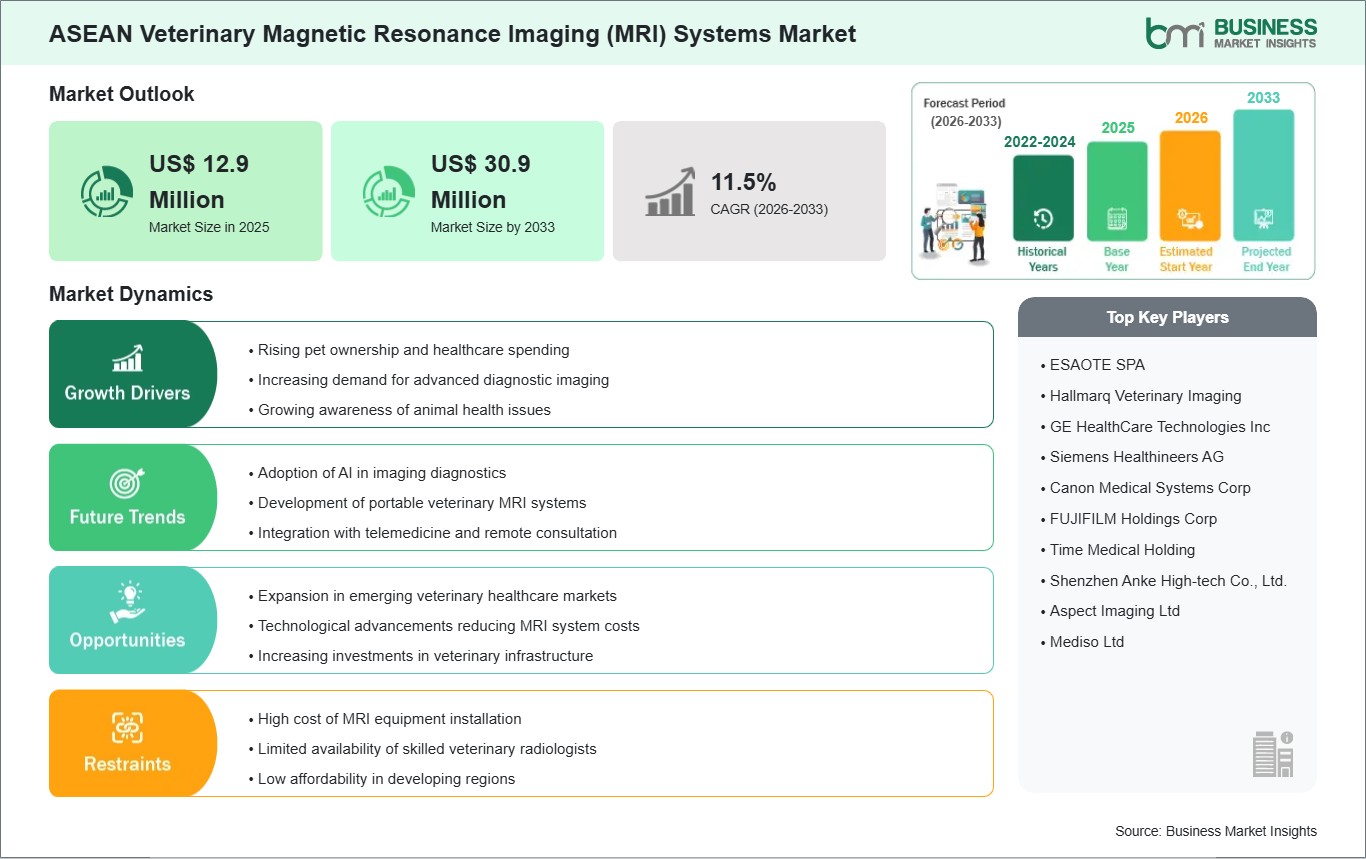
The ASEAN Veterinary Magnetic Resonance Imaging (MRI) systems market is experiencing a significant shift. The region's veterinary healthcare systems are adopting advanced diagnostic systems, which drive this change. The evolution now occurs in urban centers which have developed economies throughout Singapore, Malaysia, Thailand, Indonesia, Vietnam and the Philippines. Companion animal healthcare systems in these areas are becoming more advanced and organized. The market growth originates from urban households, which drive the increasing demand for pet humanization. Pet ownership now requires families to provide their pets with advanced medical treatment and precise diagnostic procedures. The veterinary field is now moving toward high-precision imaging solutions, which include MRI systems for diagnosing complex conditions that involve neurological disorders, spinal injuries and soft tissue damage. The veterinary specialty infrastructure in the area continues to expand, which creates a crucial element that drives market development. Veterinary hospitals and referral centers are building advanced imaging departments, which will enhance their diagnostic capabilities and clinical functions. The enhanced development of ASEAN countries shows higher levels of private company involvement, which improves veterinary healthcare services by providing advanced diagnostic equipment. The region benefits from improved diagnostic skills through better veterinary education and international clinical training activities. Practitioners who observe international veterinary standards develop the habit of using advanced imaging methods for their normal medical operations and their specialized treatment programs. The increasing complexity of animal health cases results from two main factors, which include longer pet life spans and greater occurrence of chronic musculoskeletal and neurological disorders. The market experiences persistent structural problems that prevent companies from developing their full potential. The high capital investment required for MRI systems remains a major barrier for smaller veterinary clinics and independent practitioners. The restricted number of certified veterinary radiologists prevents full system usage, which is especially noticeable in areas that are not close to big cities. The cost-related challenges of system operation, together with the need for ongoing maintenance, have led cost-sensitive providers to adopt a cautious approach toward implementation. The ASEAN veterinary MRI systems market shows development potential because it experiences increasing demand from clinics, better infrastructure and veterinarians who use new diagnostic imaging technologies.
Segment Analysis
ASEAN Veterinary Magnetic Resonance Imaging (MRI) Systems Market Segmentation
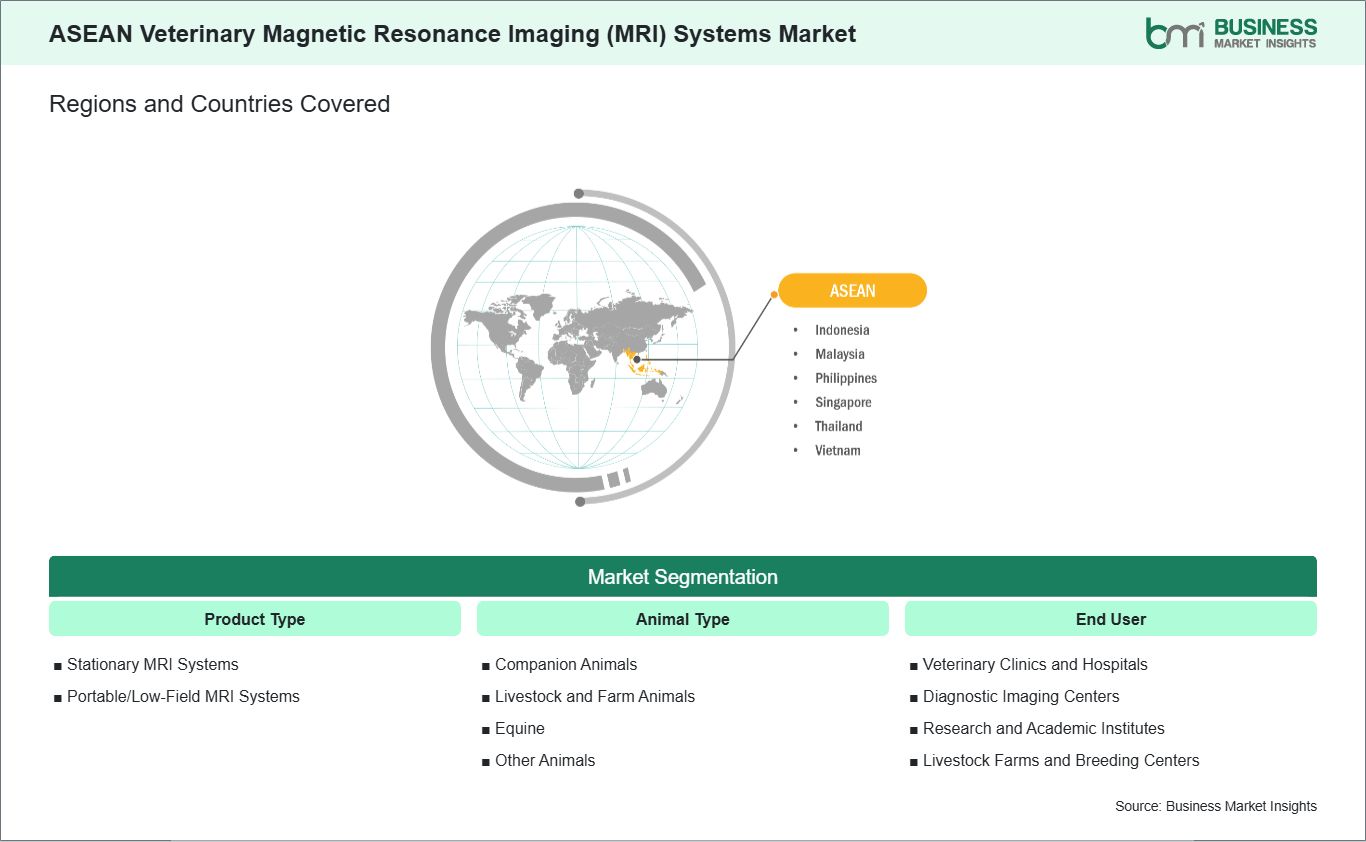
Key segments that contributed to the derivation of the ASEAN veterinary magnetic resonance imaging (MRI) systems market analysis are product type, animal type, and end user.
- By product type, the veterinary magnetic resonance imaging (MRI) systems market is segmented into stationary MRI systems, portable/low-field MRI systems. The stationary MRI systems segment dominated the market in 2025.
- Based on animal type, the veterinary magnetic resonance imaging (MRI) systems market is categorized into companion animals, livestock and farm animals, equine, others. The companion animals segment dominated the market in 2025.
- In terms of end user, the veterinary magnetic resonance imaging (MRI) systems market is categorized into veterinary clinics and hospitals, diagnostic imaging centers, research and academic institutes, livestock farms and breeding centers. The veterinary clinics and hospitals segment dominated the market in 2025.
Market Forces
ASEAN Veterinary Magnetic Resonance Imaging (MRI) Systems Market Drivers and Opportunities
Rising pet healthcare expenditure boosting vet MRI adoption
The adoption of veterinary MRI systems in Southeast Asian cities, which include Singapore, Kuala Lumpur and Bangkok and Ho Chi Minh City, has increased because of the growing pet healthcare costs in these urban areas. Pet owners are increasingly willing to spend on advanced diagnostic procedures, particularly for companion animals treated as family members, leading veterinary hospitals to invest in high-end imaging capabilities for improved clinical outcomes.
The clinical need for MRI technology has grown because more pets in Southeast Asian countries now suffer from neurological disorders, spinal injuries and complex musculoskeletal conditions. Veterinary specialists use MRI technology to acquire soft-tissue images, which help them establish accurate diagnoses and design treatment plans for patients in referral hospitals and specialty animal care centers situated in major cities.
The high equipment costs and the short supply of specialists in certain ASEAN areas have not stopped pet insurance payments and private veterinary group investments from enabling cities to adopt MRI technology through their urban veterinary systems, which are now developing upgraded diagnostic systems with training programs that will extend throughout clinics across ASEAN during the next few years.
Expanding veterinary clinics in emerging economies demand
The establishment of veterinary clinic networks within developing ASEAN nations, which include Indonesia, the Philippines, Vietnam and Thailand, leads to a substantial rise in the need for advanced diagnostic equipment, which includes MRI systems. The increasing ownership of pets, together with the requirement for monitoring livestock health, drives clinics to transition from their existing basic imaging systems toward advanced technologies that provide better diagnostic outcomes.
The implementation of veterinary infrastructure improvements, together with government animal health programs, enables urban and semi-urban areas to start using MRI systems. The specialized veterinary hospitals in Malaysia and Thailand are expanding because they need MRI technology to conduct surgical planning for complex operations and to provide ongoing care for chronic conditions in animals that belong to their expanding network of veterinary facilities, which link to multiple regional hospitals.
Veterinary chains and diagnostic service providers are acquiring MRI machines to create unique service offerings that enable them to secure valuable customers. The increasing number of clinic partnerships with imaging specialists enables better access to advanced diagnostic tools, while facilities throughout the region use cost-sharing arrangements together with leasing systems to implement MRI technology for sustainable expansion over extended time periods.
Size and Share Analysis
ASEAN Veterinary Magnetic Resonance Imaging (MRI) Systems Market Size and Share Analysis
The ASEAN veterinary magnetic resonance imaging (MRI) systems market is experiencing steady growth, with market size and share analysis reflecting evolving treatment preferences and competitive dynamics among key players. The report evaluates important subsegments categorized within product type, animal type, and end user, highlighting their respective contributions to market performance.
By product type, the stationary MRI systems subsegment dominated the market in 2025, driven by higher image quality, greater throughput, and widespread adoption in hospitals for comprehensive diagnostic imaging.
Based on animal type, the companion animals subsegment dominated the market in 2025, driven by increasing pet ownership and rising demand for advanced diagnostic imaging in routine veterinary care.
In terms of end user, the veterinary clinics and hospitals subsegment dominated the market in 2025, driven by the widespread adoption of x-ray systems for comprehensive diagnostic and treatment services.
Report Coverage
ASEAN Veterinary Magnetic Resonance Imaging (MRI) Systems Market Report Coverage and Deliverables
The "ASEAN Veterinary Magnetic Resonance Imaging (MRI) Systems Market Size and Forecast (2022–2033)" report provides a detailed analysis of the market covering below areas:
- Market size and forecast at regional and country levels for all market segments covered under the scope
- Market trends, as well as drivers, restraints, and opportunities
- Market analysis covering key trends, regional framework, major players, regulations, and recent developments
- Market concentration, heat map analysis, prominent players, and recent developments for the Market
- Detailed company profiles, including SWOT analysis
Geographic Insights
ASEAN Veterinary Magnetic Resonance Imaging (MRI) Systems Market Geographic Insights
The geographical scope of the ASEAN Veterinary Magnetic Resonance Imaging (MRI) Systems Market report is divided into Indonesia, Malaysia, the Philippines, Singapore, Thailand, and Vietnam. Indonesia held the largest share in 2025.
The veterinary MRI systems market for Indonesia, Malaysia, Philippines, Singapore, Thailand, and Vietnam shows uneven development because urban referral hospitals and academic veterinary institutions represent the primary adoption sites, and Indonesia functions as the main regional market driver. The Indonesian market leads because its urban centers maintain a large companion animal population, its livestock industry needs advanced diagnostic technology, and its private veterinary sector continues to develop rapidly. The major cities of Jakarta and Surabaya are developing multi-specialty veterinary hospitals which use advanced imaging technologies, with MRI becoming their main diagnostic method for neurological, musculoskeletal and oncological cases. The veterinary healthcare infrastructure in Malaysia and Thailand enables private investors to develop referral centers that provide companion animal and equine MRI services. The markets experience growth because more people get pets and pet owners show increased interest in spending money for advanced diagnostic tests, but the high costs of equipment and limited availability of specialists restrict their use. Vietnam shows its first growth phase because livestock health management needs and veterinary education investments show growing development. The medical field uses MRI technology mainly through university hospitals, while only a few urban specialty clinics use it. The Philippines shows moderate potential because most people who own companion animals live in Metro Manila, but the veterinary system needs more diagnostic tools to reach all areas. Singapore has major technological capabilities that exceed its small land area and population because its advanced veterinary specialized centers use MRI technology to perform difficult soft tissue and brain examinations, which they use to treat patients from other countries. The region experiences growth through two factors, which include the rising humanization of pets and increasing chronic and degenerative diseases, together with better veterinary expertise. The system needs trained veterinary radiologists, but it requires high capital costs and operational difficulties to achieve complete system usage. The veterinary MRI system expansion operates through Indonesia as the main demand center, while Singapore has the highest technological level, and Malaysia and Thailand show equal market growth, and Vietnam and the Philippines develop as new markets that face market restrictions.
Industry Activity
Recent Developments
The ASEAN Veterinary Magnetic Resonance Imaging (MRI) Systems Market is evaluated by gathering qualitative and quantitative data post primary and secondary research, which includes important corporate publications, association data, and databases. A few of the key developments in the ASEAN veterinary magnetic resonance imaging (MRI) systems market are:
- In February 2025, GE HealthCare introduced the Freelium MRI platform, a new MRI magnet technology designed to reduce helium dependency and improve imaging accessibility in regions with limited infrastructure.
- In July 2025, Esaote announced the Vet-MR Grande ELITE, a next-generation veterinary MRI system developed in collaboration with veterinary clinics worldwide, featuring improved imaging performance, workflow optimization, and sustainability-focused design.
Trust & Transparency
Research Methodology
The market analysis combines proprietary research with secondary data from government agencies, company disclosures, regulatory filings, industry databases and expert interviews. Market estimates are validated through data triangulation, cross-market benchmarking and analyst
review.
View Full Research Methodology
Key Sources Referred:
American College of Veterinary Radiology (ACVR)World Small Animal Veterinary Association (WSAVA)British Veterinary Association (BVA)International Veterinary Radiology Association (IVRA)American Veterinary Medical Association (AVMA)European College of Veterinary Diagnostic Imaging (ECVDI)World Organisation for Animal Health (WOAH / OIE)Veterinary Imaging & Radiation Oncology Society (VIROS)