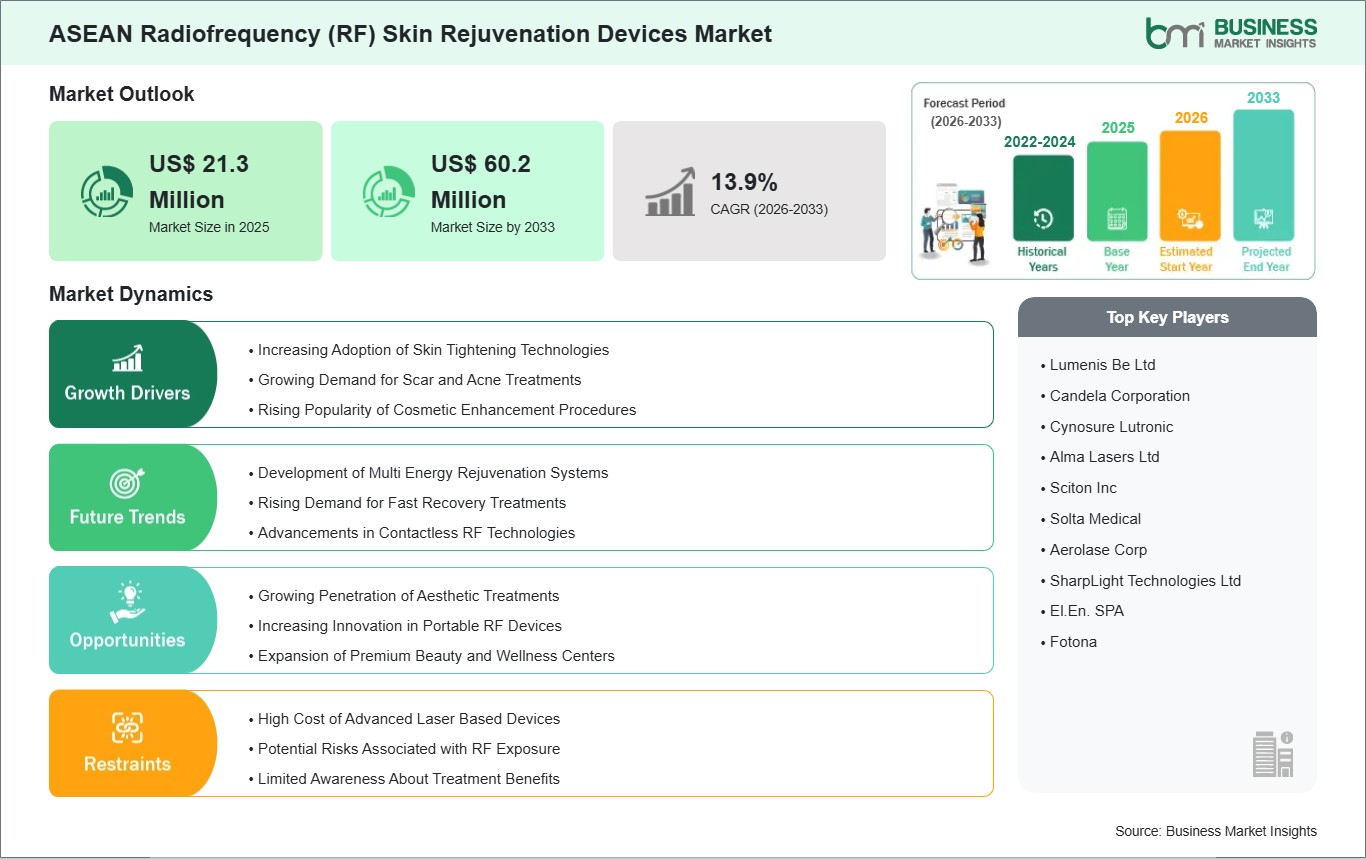
The ASEAN radiofrequency (RF) skin rejuvenation devices market size is expected to reach US$ 60.2 million by 2033 from US$ 21.3 million in 2025. The market is estimated to register a CAGR of 13.9% from 2026 to 2033.
The ASEAN RF Skin Rejuvenation Devices market is witnessing healthy growth owing to the rising levels of aesthetic awareness, higher disposable incomes in urban areas, and greater acceptance of minimally invasive procedures. Consumers in countries such as Thailand, Malaysia, Singapore, Indonesia, Vietnam, and the Philippines have been increasingly adopting energy-based skin rejuvenation treatments involving skin tightening, wrinkle removal, and skin rejuvenation without significant recovery time. Further, the growing influence of social media, K-beauty trends, and the increasing adoption of preventive anti-aging products among young people is boosting the demand for these devices. Another key factor fueling the growth of the market in ASEAN is the presence of rapidly expanding networks of aesthetic centers and medspas in major urban cities. In addition, the region’s rich medical tourism infrastructure, especially in countries like Thailand and Singapore, has continued to act as a key factor influencing the growth of the market. Another major factor contributing to the growth of the RF skin rejuvenation devices market in ASEAN is the introduction of multifunctional RF platforms. Nonetheless, there exist several constraints for the market. Firstly, the high cost of purchasing and maintaining the RF system is a major constraint preventing small-scale clinics from embracing the product, especially in poor ASEAN countries. Another constraint to the market is the existence of unlicensed practitioners and fake equipment in some countries. Regardless of these constraints, developments in technology and an increased preference for non-invasive solutions are likely to propel the growth of the market.

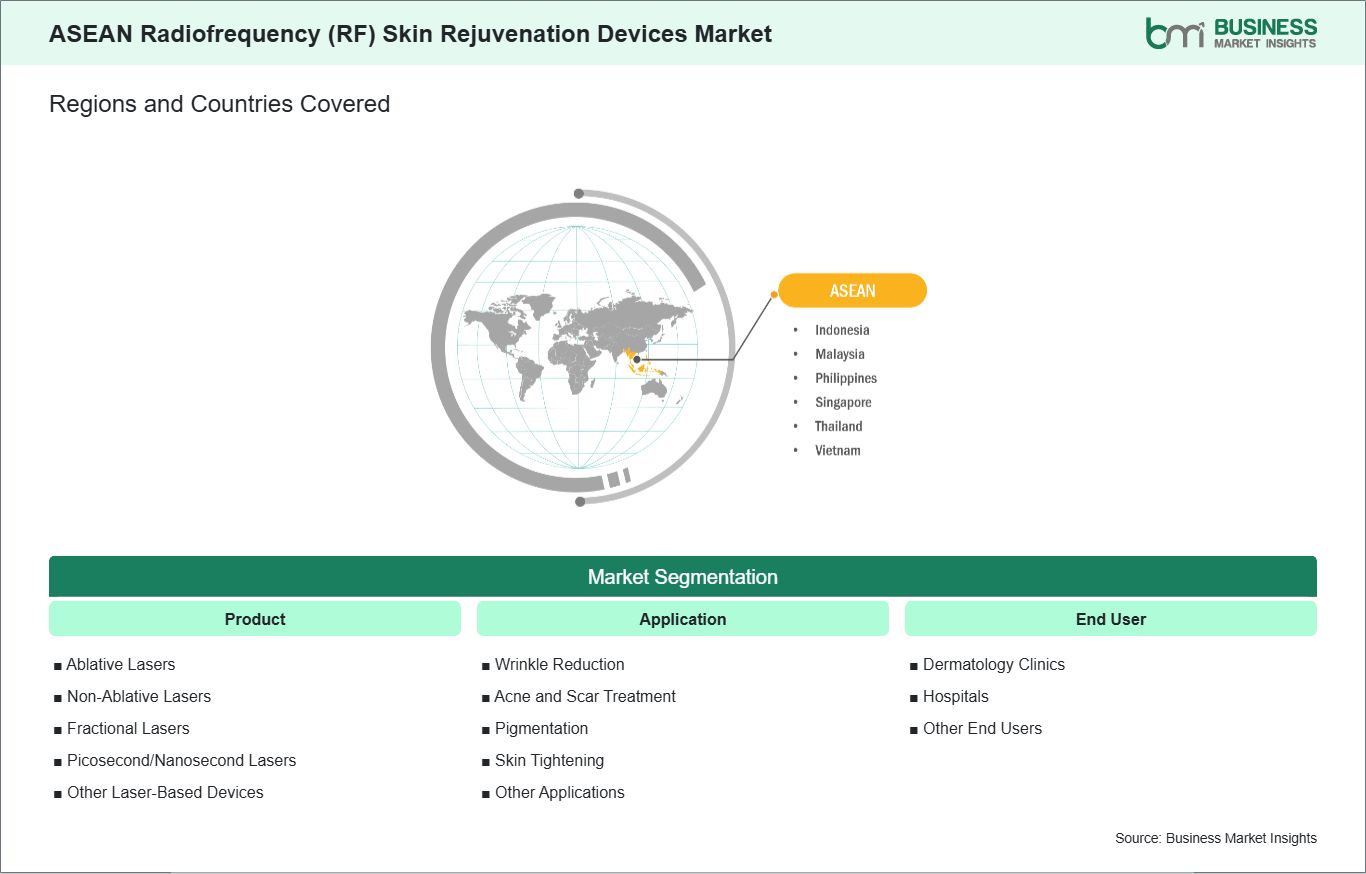
Key segments that contributed to the derivation of the ASEAN radiofrequency (RF) skin rejuvenation devices market analysis are product, application and end user.
The RF skin rejuvenation devices market in ASEAN nations is experiencing tremendous growth due to the increasing popularity of non-invasive skin tightening methods in Thailand, Indonesia, and Malaysia. Early skin aging, attributed to increasing urbanization and exposure to tropical UV radiation, is becoming increasingly prevalent in densely populated cities such as Bangkok and Jakarta. Consequently, the demand for RF skin tightening technology is rising, given its efficacy in treating different Asian skin types with low risk of complications.
In Singapore and Vietnam, dermatology practices are incorporating RF microneedling technology and multi-frequency RF devices to cater to issues such as jawline drooping and wrinkles. In addition, the popularity of minimally invasive outpatient procedures is fueling demand, especially among people who live hectic lives in metropolitan areas.
Moreover, innovations in portable and home-based RF devices are making the technology more accessible to a wider population. In Malaysia and the Philippines, there is a noticeable trend among middle-class individuals to adopt RF skin tightening methods owing to rising disposable incomes and heightened awareness of cosmetic skin procedures.
The penetration of aesthetic treatments in the ASEAN RF skin rejuvenation devices market is increasing steadily, driven by evolving beauty standards and expanding medical tourism hubs. Thailand remains a regional leader, with Bangkok emerging as a key destination for non-surgical cosmetic procedures, supported by a growing network of dermatology clinics and medispas catering to international patients from China and Australia.
Indonesia and the Philippines are also experiencing rising adoption, fueled by a young population increasingly influenced by social media beauty trends and K-beauty culture. This has encouraged wider acceptance of RF-based skin tightening procedures for anti-aging and contouring purposes, particularly among first-time aesthetic consumers seeking non-invasive solutions.
Additionally, Singapore and Malaysia are benefiting from strong healthcare infrastructure and regulatory support for aesthetic medicine, which is improving consumer trust in energy-based devices. As awareness of collagen-stimulating treatments grows, RF technologies are becoming a standard offering in clinics, reinforcing long-term market expansion across the ASEAN region.

The ASEAN radiofrequency (RF) skin rejuvenation devices market is experiencing steady growth, with market size and share analysis reflecting evolving treatment preferences and competitive dynamics among key players. The report evaluates important subsegments categorized within product, application and end user, highlighting their respective contributions to market performance.
By product, the non-ablative lasers subsegment dominated the market in 2025, driven by increasing consumer preference for minimally invasive skin rejuvenation procedures with reduced downtime and improved safety profiles.
Based on application, the wrinkle reduction subsegment dominated the market in 2025, driven by the rising demand for anti-aging treatments and growing awareness regarding aesthetic skin enhancement procedures.
In terms of end user, the dermatology clinics subsegment dominated the market in 2025, driven by the increasing availability of advanced aesthetic treatment solutions and the growing number of patients seeking specialized skincare services.
| Report Attribute | Details |
|---|---|
| Market size in 2025 | US$ 21.3 Million |
| Market Size by 2033 | US$ 60.2 Million |
| CAGR (2026 - 2033) | 13.9% |
| Historical Data | 2022-2024 |
| Forecast period | 2026-2033 |
| Segments Covered | By Product
|
|
Regions and Countries Covered
| |
| ASEAN | Indonesia, Malaysia, Philippines, Singapore, Thailand, Vietnam |
| Market leaders and key company profiles |
|
The "ASEAN Radiofrequency (RF) Skin Rejuvenation Devices Market Size and Forecast (2022–2033)" report provides a detailed analysis of the market covering below areas:
The geographical scope of the ASEAN Radiofrequency (RF) Skin Rejuvenation Devices Market report is divided into Indonesia, Malaysia, Philippines, Singapore, Thailand, Vietnam. Indonesia held the largest share in 2025.
The market of ASEAN RF skin rejuvenation equipment is witnessing robust growth due to the increasing awareness about aesthetics, the development of medical tourism, and use of non-invasive skin tightening and anti-aging treatments. The Indonesian market is considered the leading one because of the country’s substantial population, urbanization process, growth of the middle class, and expansion of beauty clinics. The other two important countries with respect to RF skin rejuvenation equipment sales are Malaysia and Thailand, which can be explained by their developed medical tourism and the presence of a number of medical clinics in cities such as Kuala Lumpur, Penang, and Bangkok. While being relatively smaller in volume, Singapore emerges as a highly lucrative innovation and medical aesthetic destination owing to the highly developed health care ecosystem as well as consumer affluence. Vietnam is poised for rapid growth due to rising disposable income, young consumers' demand for skincare procedures, and the increased availability of Korean and international skin rejuvenation technology in urban cities such as Ho Chi Minh City and Hanoi. Likewise, the Philippines exhibits moderate growth on account of a highly developed beauty consciousness, along with the growing popularity of clinical skin rejuvenation in Metro Manila. In the region of ASEAN, Thailand has witnessed significant adoption of RF skin rejuvenation devices, especially body contouring and RF skin tightening treatments, because of its highly tourism-oriented aesthetics market. Indonesia continues to dominate the market in terms of volume due to its large-scale demand.

The ASEAN Radiofrequency (RF) Skin Rejuvenation Devices Market is evaluated by gathering qualitative and quantitative data post primary and secondary research, which includes important corporate publications, association data, and databases. A few of the key developments in the ASEAN radiofrequency (RF) skin rejuvenation devices market are:
The ASEAN Radiofrequency (RF) Skin Rejuvenation Devices Market is valued at US$ 21.3 Million in 2025, it is projected to reach US$ 60.2 Million by 2033.
As per our report ASEAN Radiofrequency (RF) Skin Rejuvenation Devices Market, the market size is valued at US$ 21.3 Million in 2025, projecting it to reach US$ 60.2 Million by 2033. This translates to a CAGR of approximately 13.9% during the forecast period.
The ASEAN Radiofrequency (RF) Skin Rejuvenation Devices Market report typically cover these key segments-
The historic period, base year, and forecast period can vary slightly depending on the specific market research report. However, for the ASEAN Radiofrequency (RF) Skin Rejuvenation Devices Market report:
The ASEAN Radiofrequency (RF) Skin Rejuvenation Devices Market is populated by several key players, each contributing to its growth and innovation. Some of the major players include:
The ASEAN Radiofrequency (RF) Skin Rejuvenation Devices Market report is valuable for diverse stakeholders, including:
Essentially, anyone involved in or considering involvement in the ASEAN Radiofrequency (RF) Skin Rejuvenation Devices Market value chain can benefit from the information contained in a comprehensive market report.
Please tell us your area of interest
(Market Segments/ Regions and Countries/ Companies)