Market Summary
Executive Summary and Market Analysis
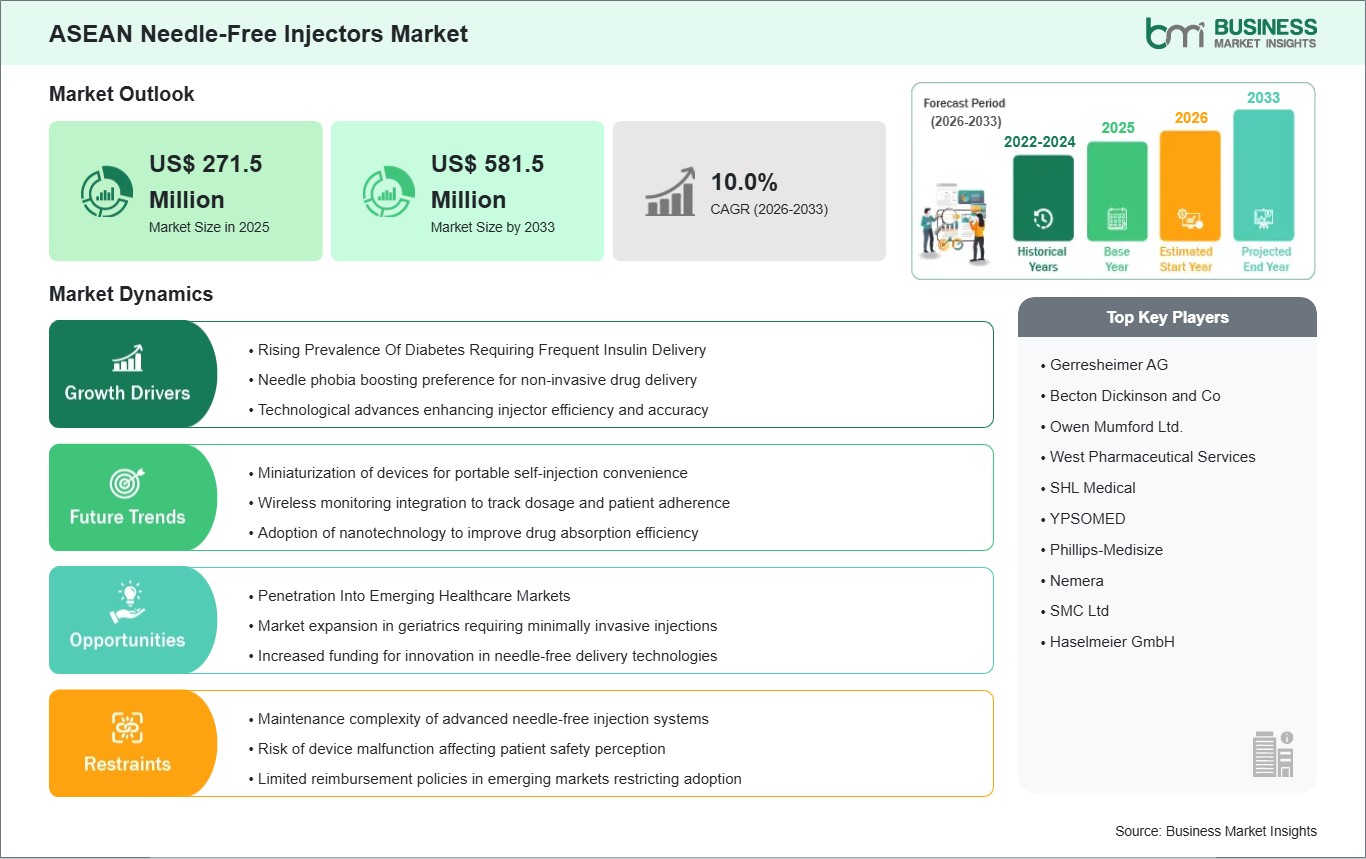
Needle-free injectors are gaining relevance due to their ability to reduce needle-stick injuries, improve patient compliance, and support mass immunization and chronic therapy programs. Market activity is shaped by public-sector procurement, private hospital adoption, and increasing participation from regional distributors partnering with global device manufacturers. Competitive dynamics emphasize product reliability, ease of use, compatibility with multiple drug formulations, and after-sales service capabilities. Regulatory alignment within ASEAN, while not fully harmonized, has improved market accessibility through clearer device classification and faster approval pathways in select countries. Demand is influenced by the growing role of outpatient care and home-based treatment models, where needle-free systems offer logistical and safety advantages. Manufacturers are investing in clinician education and pilot programs to demonstrate clinical equivalence and workflow benefits compared to conventional syringes. Pricing strategies remain sensitive, with buyers focusing on the total cost of ownership rather than unit pricing alone, factoring in waste reduction, training efficiencies, and risk mitigation. The market analysis indicates that innovation is shifting toward disposable-cartridge systems, digitally assisted dosing, and devices suitable for vaccines, insulin, and biologics. The ASEAN market reflects a transition from early adoption to structured commercialization, supported by healthcare modernization initiatives and a shift toward value-based procurement practices.
Segment Analysis
ASEAN Needle-Free Injectors Market Segmentation
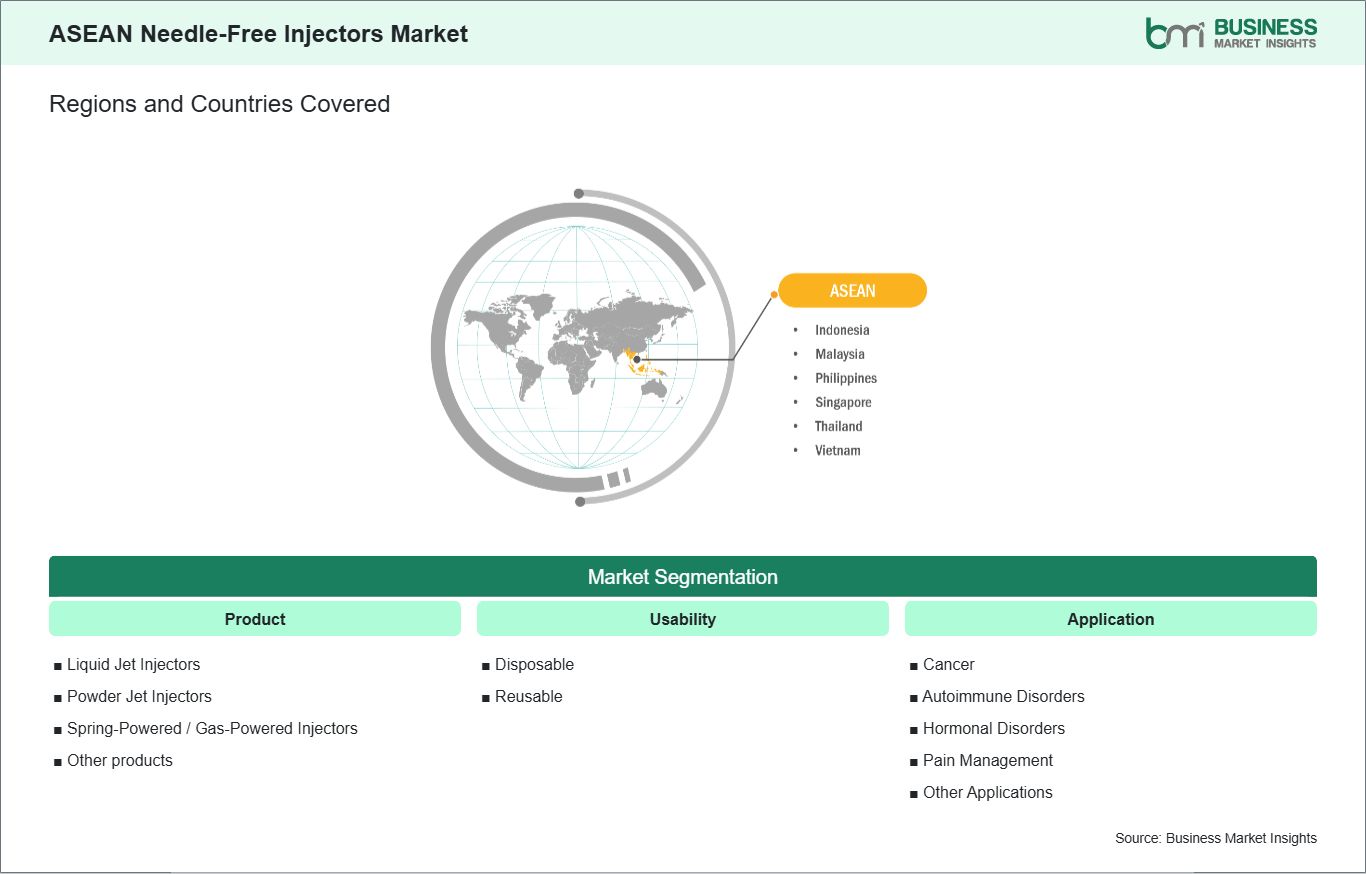
Key segments that contributed to the derivation of the ASEAN needle-free injectors market analysis are product, usability, and application.
- By product, the needle-free injectors market is segmented into liquid jet injectors, powder jet injectors, spring-powered / gas-powered injectors, and other products. The liquid jet injectors segment dominated the market in 2025.
- Based on usability, the needle-free injectors market is categorized into disposable and reusable. The disposable segment dominated the market in 2025.
- In terms of application, the market is classified into cancer, autoimmune disorders, hormonal disorders, pain management, and other applications. The autoimmune disorders segment dominated the market in 2025.
Market Forces
ASEAN Needle-Free Injectors Market Drivers and Opportunities
Rising Prevalence Of Diabetes Requiring Frequent Insulin Delivery
As more individuals require lifelong insulin therapy, the frequency of injections has become a critical consideration in treatment adherence. Traditional needle-based delivery methods lead to discomfort and injection fatigue, which can negatively affect consistent use. Needle-free injectors offer an alternative that aligns with the growing need for less invasive and more tolerable insulin administration. Patients managing diabetes over long periods experience emotional and physical barriers related to repeated injections. Fear of needles, pain, and visible injection marks can discourage proper treatment routines. Needle-free injectors address these challenges by improving the injection experience, which supports better compliance. This advantage is relevant in ASEAN markets where awareness of patient-centric care models is increasing, and healthcare providers are seeking solutions that encourage long-term disease control. Healthcare systems are shifting toward self-management and home-based care for chronic conditions. Needle-free injectors support this transition by enabling easier and more confident self-administration of insulin. As diabetes education programs expand and patients become more involved in managing their condition, demand for delivery technologies that combine convenience, comfort, and reliability is expected to rise. This trend positions needle-free injectors as an important component of evolving diabetes care strategies in ASEAN.
Penetration Into Emerging Healthcare Markets
Emerging healthcare markets across ASEAN are undergoing steady transformation, driven by investments in infrastructure, technology adoption, and service quality. Within this environment, needle-free injectors are gaining recognition as innovative drug delivery solutions that enhance patient experience. Hospitals and specialized care centers are open to adopting advanced devices that differentiate their services and align with modern treatment expectations. Awareness and acceptance of needle-free technology are expanding among healthcare professionals and patients. Clinicians are exploring alternatives that reduce treatment-related discomfort while maintaining therapeutic effectiveness. Patients, particularly those managing chronic conditions, are showing greater interest in solutions that simplify daily care routines. This growing familiarity supports gradual market penetration beyond early adopters and into a wider range of healthcare settings. Market expansion is influenced by collaboration with local partners who understand regional healthcare practices and purchasing behavior. Companies that focus on education, training, and long-term engagement with providers are better positioned to build trust and drive adoption. As emerging healthcare markets prioritize quality of care and patient satisfaction, needle-free injectors are expected to see broader acceptance. Over time, improved accessibility and integration into standard treatment protocols will support sustained growth across the region.
Size and Share Analysis
ASEAN Needle-Free Injectors Market Size and Share Analysis
The ASEAN Needle-free Injectors Market demonstrates steady growth, with size and share analysis highlighting evolving trends and competitive dynamics among key players. The report examines subsegments categorized within product, usability, and application, offering insights into their contribution to overall market performance.
By product, the liquid jet injectors subsegment dominated the market in 2025, driven by their ability to deliver precise doses of liquid medications without needles, making them well-suited for chronic therapies and routine clinical use across ASEAN healthcare settings.
Based on usability, the disposable subsegment dominated the market in 2025, driven by growing emphasis on infection control, ease of use, and reduced risk of cross-contamination in both hospital and home-care environments across the region.
In terms of application, the autoimmune disorders subsegment dominated the market in 2025, driven by the need for frequent, long-term medication administration where patient comfort and treatment adherence are critical.
Report Coverage
ASEAN Needle-Free Injectors Market Report Coverage and Deliverables
The "ASEAN Needle-free Injectors Market Size and Forecast (2022–2033)" report provides a detailed analysis of the market covering below areas:
- ASEAN Needle-free Injectors Market size and forecast at regional and country levels for all market segments covered under the scope
- ASEAN Needle-free Injectors Market trends, as well as drivers, restraints, and opportunities
- ASEAN Needle-free Injectors Market analysis covering key trends, regional framework, major players, regulations, and recent developments
- Industry landscape and competition analysis covering market concentration, heat map analysis, prominent players, and recent developments for the ASEAN Needle-free Injectors Market
- Detailed company profiles, including SWOT analysis
Geographic Insights
ASEAN Needle-Free Injectors Market Geographic Insights
The geographical scope of the ASEAN Needle-free Injectors Market report is divided into Indonesia, Malaysia, the Philippines, Singapore, Thailand, and Vietnam. Indonesia held the largest share in 2025.
Indonesia represents a technologically advanced market where adoption is driven by private hospitals, specialty clinics, and research institutions emphasizing innovation, patient comfort, and premium care delivery. Malaysia and Thailand demonstrate balanced demand, supported by public healthcare initiatives and an expanding private hospital network that values standardized treatment protocols. Singapore presents a volume-oriented opportunity, where large-scale immunization programs and decentralized healthcare delivery create interest in robust, easy-to-deploy injector systems, although adoption decisions remain highly price- and tender-driven. Vietnam shows increasing engagement from private providers and international NGOs, positioning needle-free injectors as tools for improving outreach and compliance in preventive care. The Philippines reflects growing awareness, with demand influenced by urban private hospitals and donor-funded health programs rather than nationwide procurement. Across these countries, distributor capability, regulatory familiarity, and local training infrastructure play a decisive role in market penetration. Purchasing decisions are influenced by pilot outcomes at flagship hospitals, which then set benchmarks for wider adoption. These country insights underline that ASEAN is a collection of distinct healthcare ecosystems, each requiring tailored market entry, pricing, and partnership strategies.
Industry Activity
Recent Developments
The ASEAN Needle-free Injectors Market is evaluated by gathering qualitative and quantitative data post primary and secondary research, which includes important corporate publications, association data, and databases. A few of the key developments in the ASEAN needle-free injectors market are:
- In October 2025, the existing partnership between Hyphens Pharma and medac was extended to include Thailand and Cambodia, broadening the commercial footprint of the Metoject subcutaneous autoinjector pen across six ASEAN countries — building on the earlier agreement covering Singapore, Malaysia, the Philippines, and Vietnam. This expansion underscores a deepening regional collaboration in delivering advanced injectable therapies with safer, user-centric delivery formats.
- In December 2023, NuGen Medical Devices Inc. signed a 5-year exclusive distribution agreement with Advance Medical Life Co., Ltd. of Bangkok, Thailand, to introduce the needle-free InsuJet insulin delivery system in the Thai market. Under this agreement, Advance Medical Life becomes the exclusive distributor of the InsuJet needle-free device in Thailand, supported by dedicated sales teams and diabetes care training to promote adoption among insulin-dependent patients.
Trust & Transparency
Research Methodology
The market analysis combines proprietary research with secondary data from government agencies, company disclosures, regulatory filings, industry databases and expert interviews. Market estimates are validated through data triangulation, cross-market benchmarking and analyst
review.
View Full Research Methodology
Key Sources Referred:
World Health Organization (WHO)Organisation for Economic Cooperation and Development (OECD)The World Bank GroupWorldometerThe LancetInternational Bar AssociationInternational Trade Administration