Market Summary
Executive Summary and Market Analysis
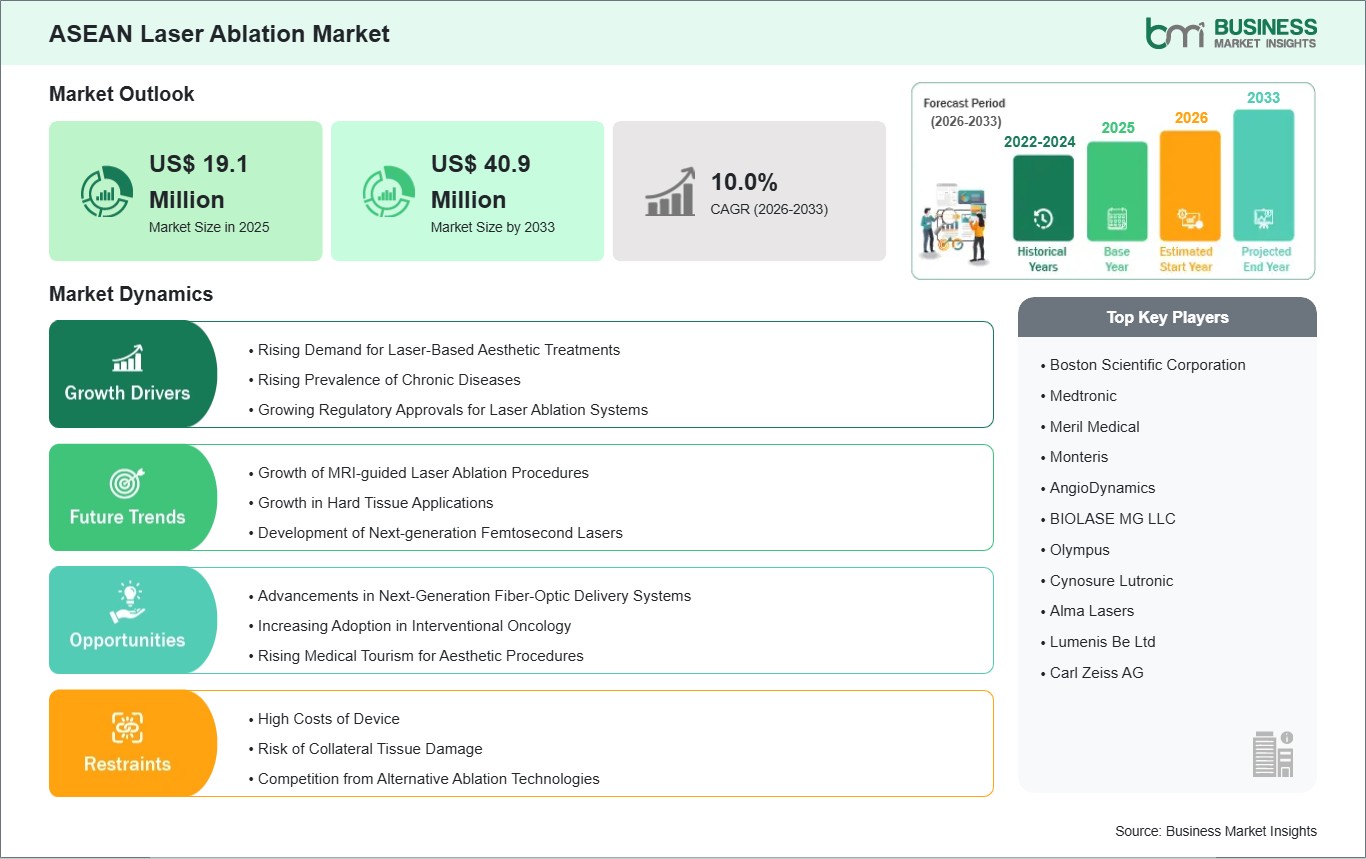
The ASEAN laser ablation market is gradually advancing, driven by increasing awareness of minimally invasive treatment solutions and the growing demand for precision-based medical procedures. Across the region, healthcare providers are increasingly adopting laser ablation technologies in oncology, dermatology, cardiology, and urology due to their ability to target affected tissues accurately while minimizing patient recovery time. Patients are showing a strong preference for treatments that reduce hospitalization and procedural complications, which positions laser ablation as a favorable alternative to traditional surgical methods. The expansion of private healthcare infrastructure across urban centers in ASEAN countries is another factor driving adoption, as these facilities often have the resources and expertise to invest in advanced medical technologies.
Beyond healthcare, industrial applications of laser ablation, such as in precision manufacturing and materials processing, are gradually contributing to the overall market ecosystem, supporting demand for advanced laser systems and related equipment. Governments in several ASEAN countries are also investing in healthcare modernization initiatives, which is enhancing access to advanced technologies and encouraging the integration of laser-based treatments into clinical protocols.
However, the market faces several challenges. Unequal healthcare infrastructure across member states limits access to advanced laser systems in rural or underserved regions. Additionally, high costs of equipment, regulatory complexities, and a shortage of trained specialists pose significant barriers to uniform adoption. As a result, the ASEAN laser ablation market exhibits a fragmented growth pattern, with adoption concentrated in countries with more developed healthcare ecosystems.
Segment Analysis
ASEAN Laser Ablation Market Segmentation
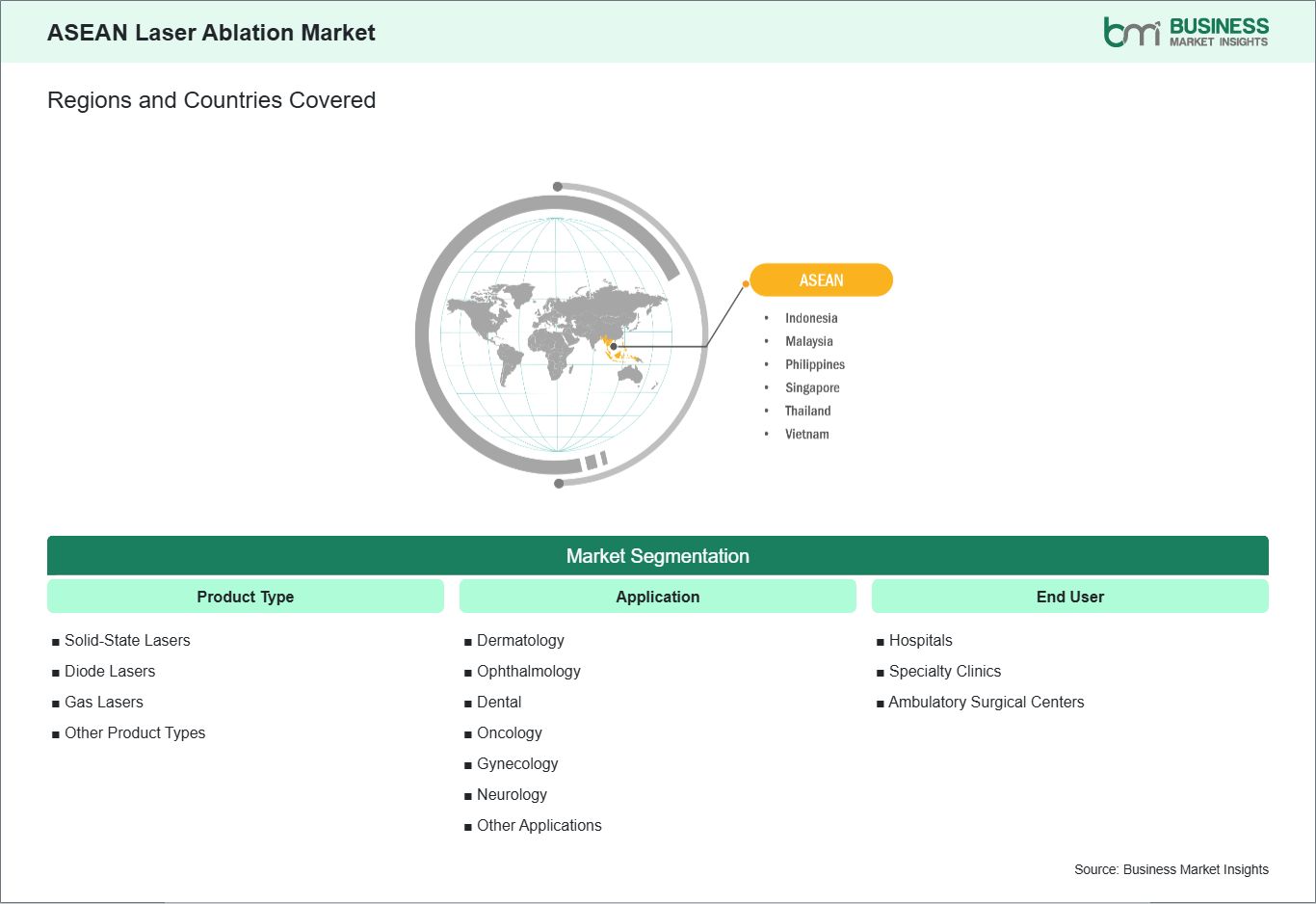
Key segments that contributed to the derivation of the ASEAN Laser Ablation market analysis are product type, application, and end user.
- By product type, the laser ablation market is segmented into solid-state lasers, diode lasers, gas lasers, and other product types. The solid-state lasers segment dominated the market in 2025.
- Based on application, the laser ablation market is classified into dermatology, ophthalmology, dental, oncology, gynecology, neurology, and other applications. The dermatology segment dominated the market in 2025.
- In terms of end user, the laser ablation market is categorized into hospitals, specialty clinics, and ambulatory surgical centers. The hospitals segment dominated the market in 2025.
Market Forces
ASEAN Laser Ablation Market Drivers and Opportunities
Rising Demand for Laser-Based Aesthetic Treatments
In the ASEAN region, the demand for laser-based aesthetic treatments has been steadily increasing as urban populations in countries like Thailand, Singapore, Malaysia, and Indonesia become more appearance-conscious. Laser procedures such as skin resurfacing, hair removal, and scar treatment are gaining popularity due to their minimally invasive nature and shorter recovery periods compared with traditional cosmetic surgeries. This growing interest is evident in metropolitan areas, where dermatology clinics and medspas are increasingly incorporating laser technologies into their service offerings.
Cultural trends and lifestyle changes are also driving the uptake of laser treatments. Younger adults and professionals in cities such as Bangkok and Kuala Lumpur are integrating aesthetic procedures into their routine self-care and wellness practices. The perception of laser treatments as not only cosmetic but also confidence-boosting interventions has helped normalize their use across broader social and professional circles, making these procedures more mainstream than ever before.
Another factor fueling demand is the diversity of skin concerns across the region. For example, pigmentation correction and skin brightening treatments are particularly popular in the Philippines and Vietnam, while collagen-stimulating and hair reduction procedures are more common in Singapore. These regional preferences highlight how local cultural beauty ideals and patient expectations shape the adoption of laser technologies differently in each ASEAN country.
Advancements in Next-Generation Fiber-Optic Delivery Systems
Next-generation fiber-optic delivery systems are transforming the way laser ablation technologies are used across ASEAN. These systems offer improved precision and flexibility, enabling practitioners to perform targeted treatments more safely and effectively. In Singapore and Malaysia, clinics are adopting these advanced devices to enhance treatment accuracy and patient comfort, particularly for delicate procedures that require high control.
The flexibility and portability of modern fiber-optic systems are especially valuable in countries with varying healthcare access. Compact devices allow practitioners to offer laser treatments in smaller clinics or outpatient centers without relying on large, centralized facilities. This adaptability is helping expand access to high-quality laser care in regions where infrastructure may be more limited.
Technological improvements in fiber-optic delivery also include enhanced safety features, real-time monitoring, and customizable energy settings. These refinements allow treatments to be tailored to individual skin types and conditions, which is critical in ASEAN markets with a wide range of skin tones and textures. By reducing the risk of side effects and improving treatment outcomes, next-generation systems are encouraging more clinics to adopt laser technologies for both aesthetic and therapeutic applications.
Size and Share Analysis
ASEAN Laser Ablation Market Size and Share Analysis
The ASEAN Laser Ablation market is experiencing steady growth, with market size and share analysis reflecting evolving treatment preferences and competitive dynamics among key players. The report evaluates important subsegments categorized within product type, application, and end user, highlighting their respective contributions to overall market performance.
By product type, the solid-state lasers subsegment dominated the market in 2025, driven by the superior performance and versatility of solid-state lasers in clinical applications. These devices offer high precision, consistent energy delivery, and compatibility with a wide range of tissues, making them the preferred choice for laser ablation procedures.
In terms of application, the dermatology subsegment dominated the market in 2025, propelled by the increasing prevalence of skin disorders such as acne scars, pigmentation issues, and vascular lesions, coupled with a growing demand for minimally invasive cosmetic procedures.
Based on end user, the hospitals subsegment dominated the market in 2025 due to their well-established dermatology and surgical departments, access to advanced laser ablation systems, and availability of trained physicians and clinical staff.
Report Coverage
ASEAN Laser Ablation Market Report Coverage and Deliverables
The "ASEAN Laser Ablation Market Size and Forecast (2022–2033)" report provides a detailed analysis of the market covering below areas:
- ASEAN Laser Ablation market size and forecast at regional and country levels for all market segments covered under the scope
- ASEAN Laser Ablation market trends, as well as drivers, restraints, and opportunities
- ASEAN Laser Ablation market analysis covering key trends, regional framework, major players, regulations, and recent developments
- Industry landscape and competition analysis covering market concentration, heat map analysis, prominent players, and recent developments for the ASEAN Laser Ablation market
- Detailed company profiles, including SWOT analysis
Geographic Insights
ASEAN Laser Ablation Market Geographic Insights
The geographical scope of the ASEAN Laser Ablation market report is divided into: Indonesia, Malaysia, the Philippines, Singapore, Thailand, and Vietnam. Indonesia held the largest share in 2025.
Indonesia dominates the ASEAN laser ablation market, supported by a rapidly developing healthcare system and increasing adoption of advanced treatment technologies. The country’s healthcare landscape is marked by an expanding private hospital network, growing diagnostic centers, and specialty clinics that are investing in cutting-edge medical equipment. Laser ablation is being increasingly used across multiple medical disciplines, including oncology, cardiology, urology, and dermatology. Its minimally invasive nature, precision, and ability to reduce complications make it highly preferred in urban hospitals where patients are more aware of advanced treatment options.
The rising focus on early detection and treatment of chronic diseases, particularly cancer and cardiovascular conditions. As patient awareness grows, there is a shift toward adopting technologies that provide faster recovery and more targeted therapeutic outcomes. The presence of trained medical professionals capable of performing laser ablation procedures has further encouraged adoption, particularly in major cities.
Government initiatives aimed at modernizing healthcare infrastructure also support the market by improving accessibility to advanced equipment in both public and private facilities. However, challenges remain in expanding these services to rural and remote regions, where healthcare infrastructure is limited. The uneven distribution of skilled professionals and high operational costs of laser equipment continue to influence adoption rates. Despite these challenges, Indonesia remains the leader in ASEAN due to its combination of infrastructure, expertise, and patient demand.
Industry Activity
Recent Developments
The ASEAN Laser Ablation market is evaluated by gathering qualitative and quantitative data post primary and secondary research, which includes important corporate publications, association data, and databases. A few of the key developments in the ASEAN Laser Ablation market are:
- In July 2025, Johnson & Johnson MedTech announced the launch of its VARIPULSE pulsed field ablation platform, including regulatory approvals in several APAC markets. While not limited to ASEAN only, the Asia‑Pacific launch reflects the company’s strategic expansion of advanced ablation technologies that are entering clinical practice across the broader region.
- In March 2025, Baird Medical Investment Holdings Ltd. announced that it had secured regulatory approval from the Indonesian Ministry of Health for its Great Wall Microwave Therapeutic Instrument and Great Wall Disposable Microwave Ablation Needle, enabling the company to introduce its advanced microwave ablation (MWA) technology used for tumor ablation and minimally invasive treatment into Indonesia’s healthcare market as part of its broader Southeast Asia expansion.
Trust & Transparency
Research Methodology
The market analysis combines proprietary research with secondary data from government agencies, company disclosures, regulatory filings, industry databases and expert interviews. Market estimates are validated through data triangulation, cross-market benchmarking and analyst
review.
View Full Research Methodology
Key Sources Referred:
The World BankWorld Health Organization (WHO)Center for Disease Control and Prevention (CDC)Food and Drug Administration (FDA)European Database on Medical Devices (EUDAMED)European Society of Cardiology (ESC)American College of Cardiology (ACC)American Heart Association (AHA)Company WebsitesCompany Annual ReportsCompany Investor Presentations