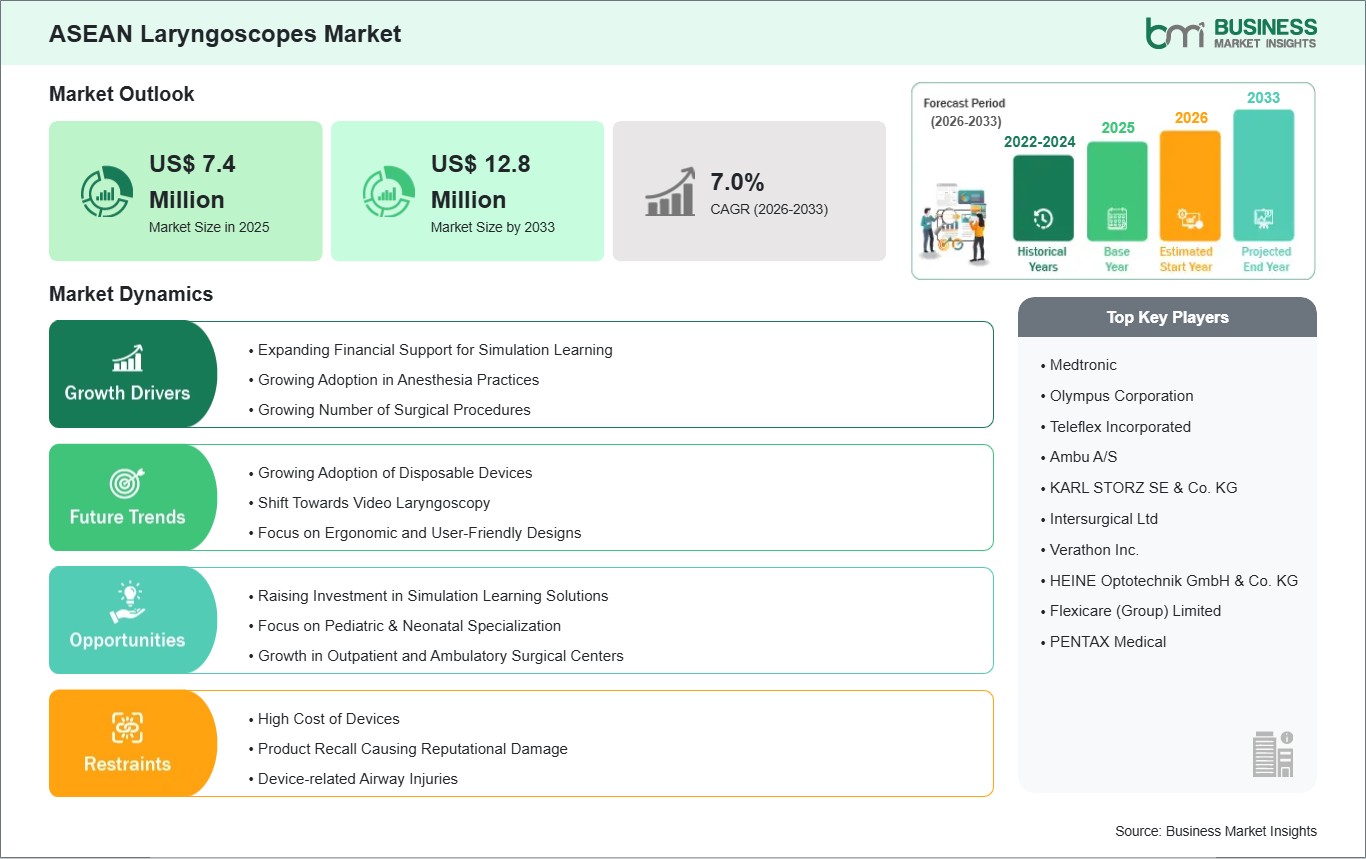
The ASEAN laryngoscopes market size is expected to reach US$ 12.8 million by 2033 from US$ 7.4 million in 2025. The market is estimated to record a CAGR of 7.0% from 2026 to 2033.
The ASEAN laryngoscopes market exhibits growth trends, which are directly attributed to the evolving healthcare facilities and focus on providing services through surgical and emergency procedures in the region. The need for laryngoscopes mainly comes from the increasing number of surgeries that involve airway management in areas like anesthesia, intensive care units, and emergency medicine. There is a slow but steady shift among healthcare practitioners in the ASEAN countries towards more technologically developed laryngoscopes, such as video laryngoscope models, compared to the use of traditional laryngoscopes. Increased knowledge of the importance of infection prevention has promoted the use of sterilizable or disposable devices.
Moreover, regional development is further aided by constant efforts to upgrade the quality of healthcare in terms of technological advancement in the field, as well as growing investment in medical training and education. As more developed ASEAN countries exert their influence in terms of procurement policies, there is an ongoing trend towards the introduction of increasingly high-quality and sophisticated equipment within the region. Due to major differences between ASEAN nations in terms of healthcare development and accessibility, there will be a great disparity in usage, with many facilities resorting to using less advanced technology owing to the need for low-cost devices. High-cost sensitivity is another crucial aspect that affects widespread implementation within the public healthcare system, especially with imported medical equipment being used.

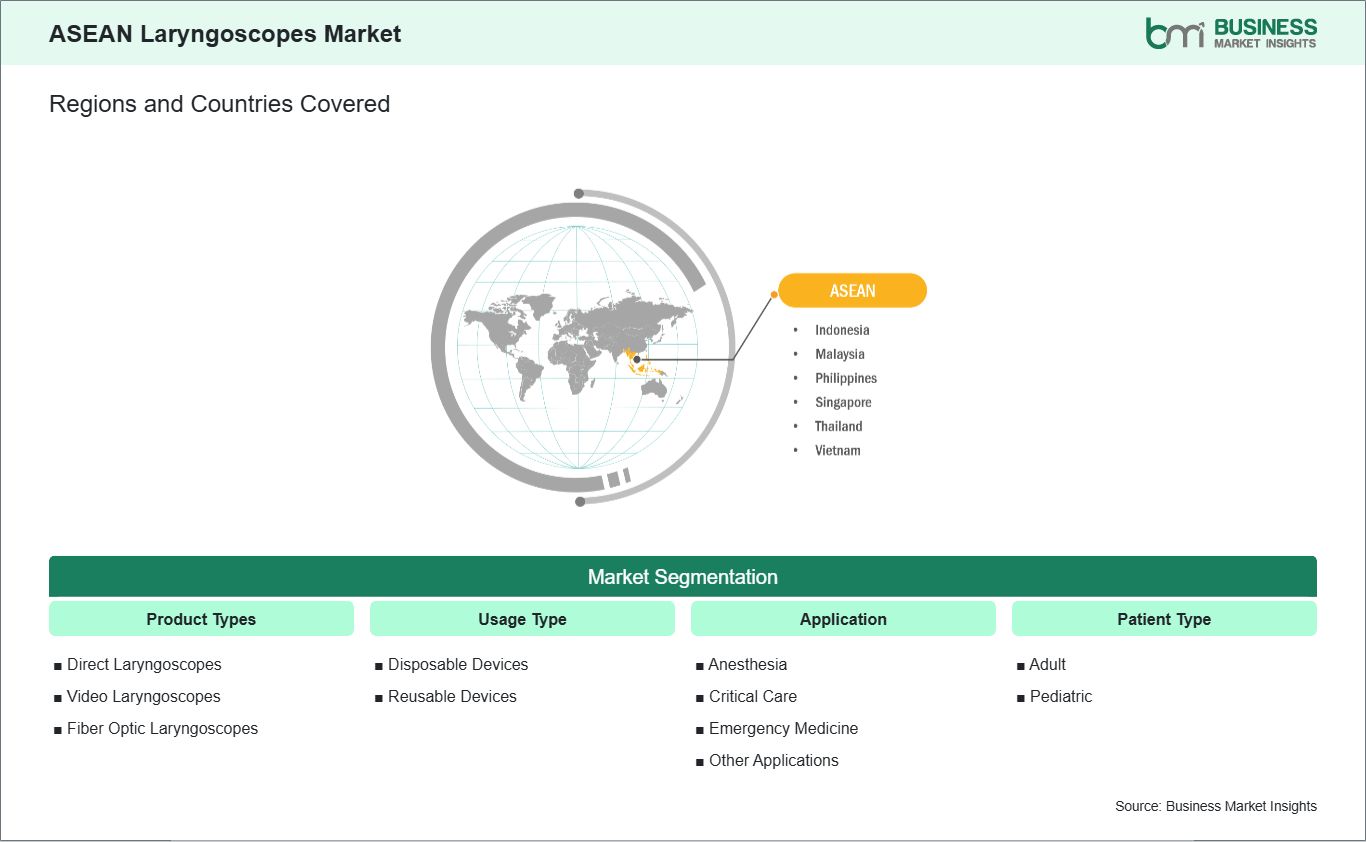
Key segments that contributed to the derivation of the ASEAN laryngoscopes market analysis are product type, usage type, application, patient type, and end user.
Across ASEAN countries, the growing incidence of respiratory diseases is becoming a structural driver for airway management demand. Urban air quality has deteriorated in several major cities due to traffic congestion, industrial emissions, and seasonal haze, leading to higher rates of asthma exacerbations and chronic lung conditions. At the same time, tobacco consumption remains widespread in parts of Southeast Asia, particularly among male populations, further increasing the likelihood of airway complications that require clinical intervention. This combination is steadily raising the number of hospital cases where laryngoscopes are essential for airway visualization and intubation.
The healthcare system within the region is also grappling with a two-fold impact of infections as well as non-communicable respiratory diseases. Respiratory ailments such as pneumonia and tuberculosis have continued to remain prevalent in the less developed ASEAN economies, whereas more advanced economies are witnessing an increase in the prevalence of chronic respiratory disease due to aging and other factors. The simultaneous occurrence leads to a continuous requirement for urgent as well as elective airway interventions that necessitates a greater need for laryngoscopy equipment.
In addition, the expansion of critical care capacity following the COVID-19 pandemic has left a lasting impact on airway management practices in ASEAN. Many hospitals have strengthened their intensive care infrastructure and are better equipped to handle respiratory emergencies. As a result, the routine use of laryngoscopes in ventilatory support, surgical procedures, and emergency medicine has increased, making them a more integral part of standard clinical protocols rather than a specialized tool used only in high-acuity scenarios.
ASEAN healthcare systems are increasingly prioritizing simulation-based training as a way to improve clinical outcomes and reduce procedural risks. In airway management, where precision and speed are critical, simulation labs provide a controlled environment for practitioners to practice intubation techniques without endangering patients. This has led to a growing preference for training tools that closely resemble real-world devices, including modern laryngoscopes with enhanced visualization capabilities. As a result, procurement decisions are often influenced not only by clinical needs but also by compatibility with training programs.
Moreover, the adoption of simulation exercises in universities and teaching hospitals in Southeast Asian nations such as Singapore, Malaysia, and Thailand is steadily becoming commonplace in anesthesiology and emergency medicine departments. The trend is slowly spilling over into the surrounding ASEAN nations, with governments and private institutions making significant investments in the professional growth of medical practitioners to bridge any existing shortages in the workforce. The increased familiarity of clinicians with sophisticated airway equipment through education and training is likely to expedite the rate of adoption once they start using the same tools in real-life scenarios.
Additionally, it is crucial to consider the influence of technological partnerships and transfers in the region. Strategic alliances between medical device corporations based in Europe and North America and local medical institutions are instrumental in setting standards and disseminating knowledge about different airway management methods and newer generation laryngoscope products. Such collaborations have proven to be very successful in emerging ASEAN nations where practical training has been a scarce resource in the past.
The ASEAN Laryngoscopes market demonstrates steady growth, with size and share analysis highlighting evolving trends and competitive dynamics among key players. The report evaluates important subsegments categorized within product type, usage type, application, patient type, and end user, highlighting their respective contributions to overall market performance.
By product type, the video laryngoscopes subsegment dominated the laryngoscopes market in 2025. This is driven by the increasing demand for enhanced airway visualization, improved first-pass intubation success rates, and reduced complications in difficult airway management, making them a key revenue driver for manufacturers and supporting strong adoption in clinical practice.
In terms of usage type, the disposable devices subsegment led the market in 2025. The dominance of disposable devices is attributed to the growing emphasis on infection control, prevention of cross-contamination, and the operational convenience of eliminating reprocessing and sterilization requirements in high-volume healthcare settings.
Based on application, the anesthesia subsegment held the largest share in 2025. Hospitals and surgical centers widely rely on laryngoscopes during anesthesia procedures for airway management and intubation, supported by the rising number of surgeries and the increasing use of advanced airway management techniques.
In terms of patient type, the adult subsegment dominated the market in 2025. This is driven by the higher prevalence of surgical procedures, critical care admissions, and chronic respiratory conditions among adults, resulting in greater demand for airway management devices in this population group.
By end user, the hospitals subsegment held the largest share in 2025. Hospitals maintain leadership due to their advanced infrastructure, availability of skilled healthcare professionals, high patient inflow, and strong capability to perform complex surgical and emergency procedures requiring laryngoscopy.
| Report Attribute | Details |
|---|---|
| Market size in 2025 | US$ 7.4 Million |
| Market Size by 2033 | US$ 12.8 Million |
| CAGR (2026 - 2033) | 7.0% |
| Historical Data | 2022-2024 |
| Forecast period | 2026-2033 |
| Segments Covered | By Product Types
|
|
Regions and Countries Covered
| |
| ASEAN | Indonesia, Malaysia, Philippines, Singapore, Thailand, Vietnam |
| Market leaders and key company profiles |
|
The "ASEAN Laryngoscopes Market Size and Forecast (2022-2033)" report provides a detailed analysis of the market covering below areas:
The geographical scope of the ASEAN Laryngoscopes market report is divided into: Indonesia, Malaysia, the Philippines, Singapore, Thailand, and Vietnam. Indonesia held the largest share in 2025.
Indonesia is the top market among all ASEAN countries due to its high population base and increasing growth in the health sector. Indonesia is currently focusing on enhancing the delivery system of the healthcare sector, which has contributed to an increase in the demand for various medical devices for better patient care. The hospital and surgery centers operating in big cities like Jakarta, Surabaya, and Bandung have been increasingly preferring the use of technologically advanced laryngoscopy devices.
An important factor about the Indonesian market is the presence of different stages of technology adoption. Whereas some of the top-level institutions and private hospitals have adopted video laryngoscope devices in their operation, most other institutions, especially in semi-rural and rural areas, prefer the use of direct laryngoscope devices due to limitations. Therefore, there exists a diversified market in which the demand for different products exists. Healthcare programs that seek to increase access to health care and improve facilities within public hospitals have resulted in increased access to medical equipment. Centralized purchasing processes in the public sector focus on cost-effectiveness, which affects their purchases and results in a reduced uptake of costly innovations. While there is robust demand, access inequalities across regions and financial constraints are major determinants of laryngoscope uptake in Indonesia.

The ASEAN Laryngoscopes market is evaluated by gathering qualitative and quantitative data post primary and secondary research, which includes important corporate publications, association data, and databases. A few of the key developments in the ASEAN Laryngoscopes market are:
The ASEAN Laryngoscopes Market is valued at US$ 7.4 Million in 2025, it is projected to reach US$ 12.8 Million by 2033.
As per our report ASEAN Laryngoscopes Market, the market size is valued at US$ 7.4 Million in 2025, projecting it to reach US$ 12.8 Million by 2033. This translates to a CAGR of approximately 7.0% during the forecast period.
The ASEAN Laryngoscopes Market report typically cover these key segments-
The historic period, base year, and forecast period can vary slightly depending on the specific market research report. However, for the ASEAN Laryngoscopes Market report:
The ASEAN Laryngoscopes Market is populated by several key players, each contributing to its growth and innovation. Some of the major players include:
The ASEAN Laryngoscopes Market report is valuable for diverse stakeholders, including:
Essentially, anyone involved in or considering involvement in the ASEAN Laryngoscopes Market value chain can benefit from the information contained in a comprehensive market report.
Please tell us your area of interest
(Market Segments/ Regions and Countries/ Companies)