Market Summary
Executive Summary and Market Analysis
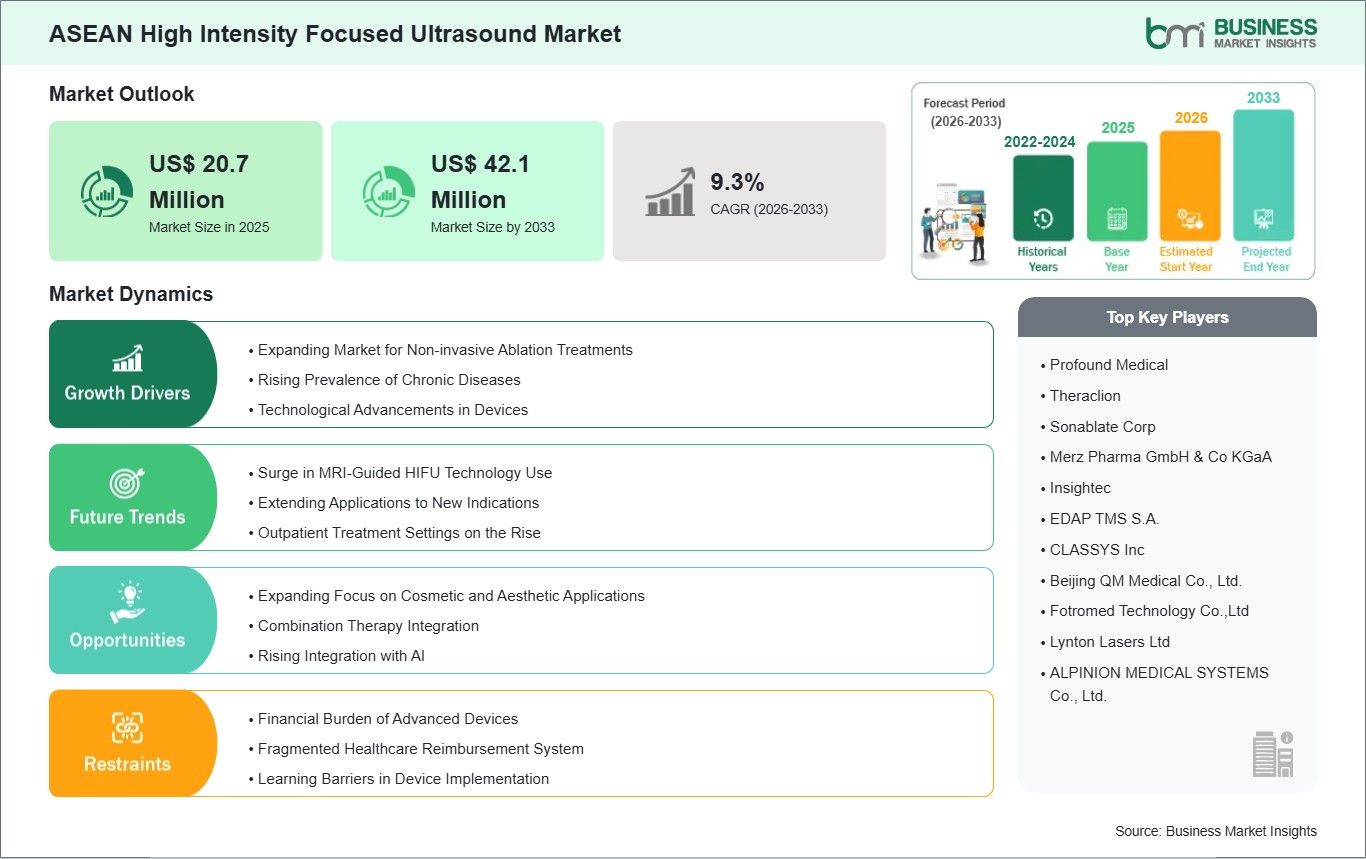
The ASEAN high intensity focused ultrasound (HIFU) market reflects a dynamic interplay between increasing clinical demand and evolving healthcare delivery models across Southeast Asia. HIFU technology, valued for its non‑invasive therapeutic capabilities, is gaining traction in the region for both medical and aesthetic applications. Clinicians in ASEAN countries are increasingly exploring HIFU for treatment of uterine fibroids and other benign tumors, supported by emerging clinical evidence demonstrating safety and effectiveness in regional patient cohorts. The technology’s appeal is also amplified by a growing preference among patients for non‑surgical options that reduce recovery time and procedural discomfort, particularly in urban centers. Additionally, ASEAN’s expanding private healthcare sector is investing in advanced medical technologies to differentiate services and attract international medical tourists. Despite these favorable trends, market expansion is moderated by several challenges, including uneven access to advanced imaging infrastructure required for HIFU guidance and varying levels of regulatory maturity across ASEAN member states. Procedural reimbursement pathways remain underdeveloped in many markets, limiting wider adoption among public healthcare providers. Early regional experience with HIFU suggests a foundation for broader clinical integration as familiarity with the technology grows and supporting healthcare infrastructure continues to evolve.
Segment Analysis
ASEAN High Intensity Focused Ultrasound Market Segmentation
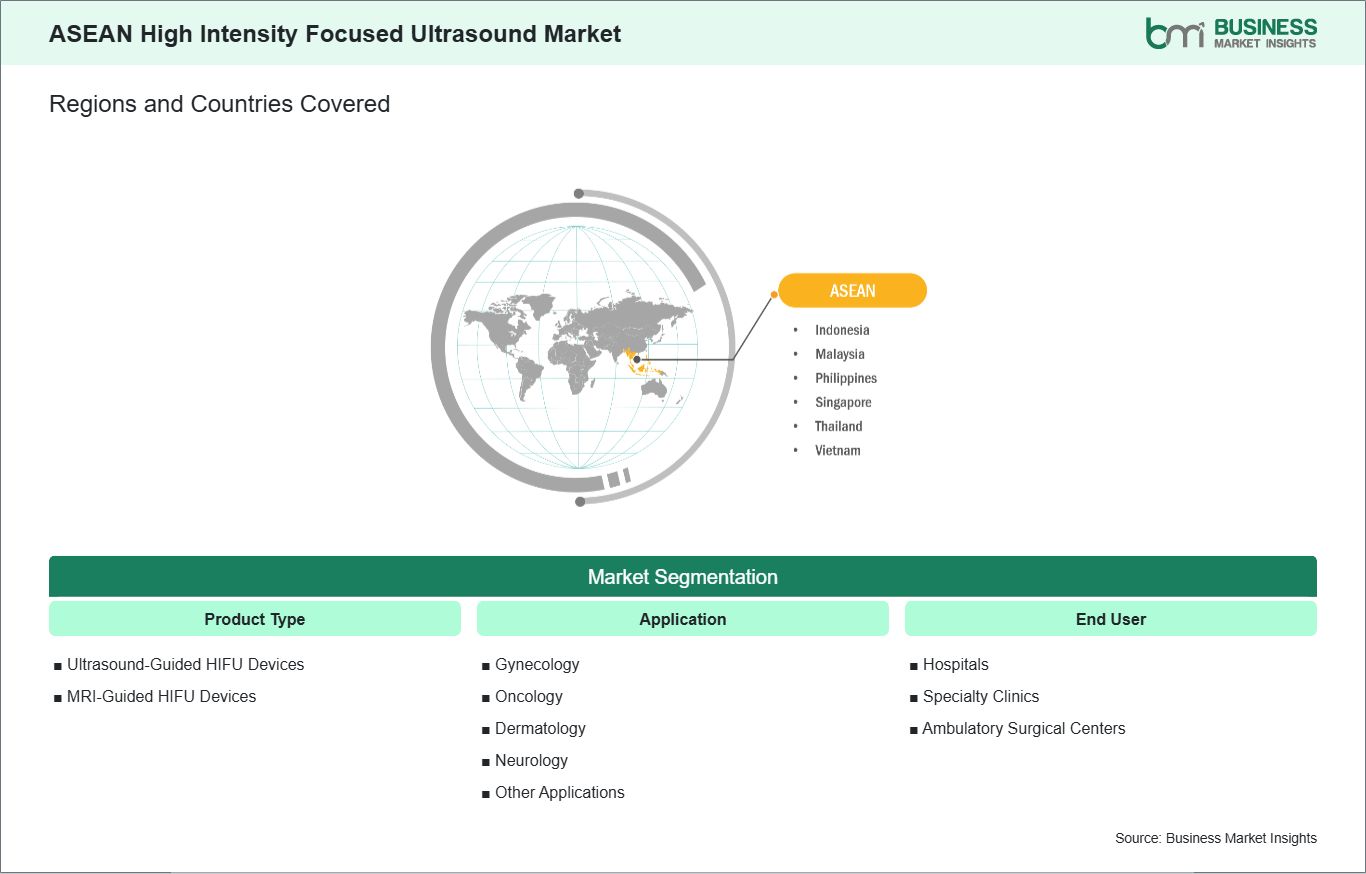
Key segments that contributed to the derivation of the ASEAN high intensity focused ultrasound market analysis are product type, application, and end user.
- By product type, the high intensity focused ultrasound market is segmented into ultrasound-guided HIFU devices, MRI-guided HIFU devices. The ultrasound-guided HIFU devices segment dominated the market in 2025.
- Based on application, the high intensity focused ultrasound market is classified into gynecology, oncology, dermatology, neurology, other applications. The gynecology segment dominated the market in 2025.
- In terms of end user, the high intensity focused ultrasound market is categorized into hospitals, specialty clinics, and ambulatory surgical centers. The hospitals segment dominated the market in 2025.
Market Forces
ASEAN High Intensity Focused Ultrasound Market Drivers and Opportunities
Expanding Market for Non‑invasive Ablation Treatments
The ASEAN region is growing interest in non-invasive ablation treatments such as High Intensity Focused Ultrasound (HIFU). Hospitals and specialty clinics are increasingly considering HIFU for conditions such as uterine fibroids, benign tumors, and select cancers, as it provides targeted tissue destruction without surgical incisions. This approach aligns well with regional priorities to improve patient safety and reduce recovery times in minimally invasive care.
Healthcare providers in major cities are integrating HIFU into existing clinical services, particularly in gynecology and oncology departments. Ultrasound-guided therapy allows for precise treatment while avoiding the complexities of traditional surgery, and local clinicians are participating in training programs and professional exchanges to build confidence in using HIFU effectively. This professional development is helping accelerate adoption across larger urban centers.
While adoption remains limited in smaller markets, public and private healthcare institutions are exploring HIFU as a way to modernize treatment options. Policymakers and hospital administrators in Singapore and Malaysia are particularly interested in non-invasive ablation to reduce the procedural burden on hospitals and improve patient comfort. Early pilot programs and demonstration clinics are helping build trust in HIFU’s clinical effectiveness across the region.
Expanding Focus on Cosmetic and Aesthetic Applications
In addition to therapeutic uses, HIFU is gaining popularity in cosmetic and aesthetic applications throughout ASEAN. Urban clinics in Bangkok, Kuala Lumpur, Jakarta, and Manila are offering non-surgical face lifts, skin tightening, and body contouring procedures, appealing to clients seeking treatments that avoid surgery and long recovery times. The technology’s ability to stimulate collagen production and improve skin texture aligns well with growing consumer interest in minimally invasive beauty solutions.
Dermatology and wellness centers are adopting HIFU aesthetic systems because of their compact design and ease of integration into existing treatment portfolios. Many clinics are using HIFU alongside other non-invasive modalities, creating comprehensive beauty programs that cater to local residents as well as international medical tourists. This combination helps clinics differentiate their services in highly competitive urban markets.
Consumer awareness and social media influence are also driving HIFU adoption in aesthetic applications. Patients increasingly research options online, comparing results and safety profiles before selecting treatments. Clinics are responding by emphasizing HIFU’s minimal downtime, non-invasive nature, and long-term skin benefits. As knowledge spreads, HIFU is becoming a familiar option for cosmetic procedures in Southeast Asia, particularly in major metropolitan areas.
Size and Share Analysis
ASEAN High Intensity Focused Ultrasound Market Size and Share Analysis
The ASEAN high intensity focused ultrasound market is experiencing steady growth, with market size and share analysis reflecting evolving treatment preferences and competitive dynamics among key players. The report evaluates important subsegments categorized within product type, application, and end user, highlighting their respective contributions to market performance.
By product type, the ultrasound-guided HIFU devices subsegment dominated the market in 2025. This is driven by the recurring need for precise and reliable imaging during HIFU procedures, which ensures accurate targeting and effective ablation of tissues, making these devices a key revenue driver for manufacturers and sustaining consistent demand in clinical settings.
In terms of application, the gynecology subsegment led the market in 2025. The dominance of gynecology applications is attributed to the rising prevalence of uterine fibroids and adenomyosis, growing adoption of non-invasive treatment methods, and increasing awareness among healthcare providers of HIFU’s effectiveness in providing safe, minimally invasive therapeutic options for women’s health conditions.
Based on end user, the hospitals subsegment held the largest share in 2025. Hospitals maintain leadership due to their well-established gynecology and surgical departments, access to advanced HIFU equipment, trained medical staff, and the capability to perform complex procedures while providing comprehensive patient care.
Report Coverage
ASEAN High Intensity Focused Ultrasound Market Report Coverage and Deliverables
The "ASEAN High Intensity Focused Ultrasound Market Size and Forecast (2022–2033)" report provides a detailed analysis of the market covering below areas:
- ASEAN High Intensity Focused Ultrasound market size and forecast at regional and country levels for all market segments covered under the scope
- ASEAN High Intensity Focused Ultrasound market trends, as well as drivers, restraints, and opportunities
- ASEAN High Intensity Focused Ultrasound market analysis covering key trends, regional framework, major players, regulations, and recent developments
- Industry landscape and competition analysis covering market concentration, heat map analysis, prominent players, and recent developments for the ASEAN High Intensity Focused Ultrasound market
- Detailed company profiles, including SWOT analysis
Geographic Insights
ASEAN High Intensity Focused Ultrasound Market Geographic Insights
The geographical scope of the ASEAN High Intensity Focused Ultrasound market report is divided into: Indonesia, Malaysia, the Philippines, Singapore, Thailand, and Vietnam. Indonesia held the largest share in 2025.
Indonesia stands as a prominent adopter of HIFU technology within the ASEAN region, driven by a combination of rising demand for non‑invasive treatments and growing consumer interest in advanced aesthetic procedures. Within the Indonesian healthcare landscape, HIFU is positioned both in specialized medical facilities and increasingly within high‑end dermatology and cosmetic clinics, where it is marketed for facial rejuvenation and body contouring in addition to therapeutic use. Awareness among patients regarding HIFU’s ability to address uterine fibroids and reduce reliance on invasive surgery has grown, supported by preliminary regional clinical data on safety and treatment outcomes. Major urban centers such as Jakarta and Surabaya host a growing number of facilities offering HIFU services, reflecting the willingness of private providers to invest in cutting‑edge equipment. However, expansion beyond metropolitan markets is constrained by disparities in access to trained clinicians and imaging infrastructure necessary for precise HIFU treatment delivery. Regulatory oversight and procedural coding frameworks are also relatively nascent, which can slow integration into mainstream hospital offerings. Still, Indonesia’s blend of medical and aesthetic HIFU applications highlights its role as a leading ASEAN market, setting the stage for future adoption trends across Southeast Asia.
Industry Activity
Recent Developments
The ASEAN high intensity focused ultrasound market is evaluated by gathering qualitative and quantitative data post primary and secondary research, which includes important corporate publications, association data, and databases. A few of the key developments in the ASEAN High Intensity Focused Ultrasound market are:
- In August 2025, HIRONIC announced that it had obtained certification from the Indonesian Ministry of Health (KEMENKES RI) for its ‘New Doublo 2.0’ platform, a multi‑energy device combining advanced HIFU and radiofrequency (RF) technologies, enabling commercial distribution of the product in Indonesia’s aesthetic and medical device market and supporting broader Southeast Asia growth plans.
- In June 2025, EpiSonica announced that it had secured medical device approvals for its ArcBlate MRgHIFU system in both Indonesia and Thailand, with Indonesia’s Ministry of Health and the Thai Food and Drug Administration granting clearance for the treatment of adenomyosis and uterine fibroids advancing the company’s strategic expansion into key ASEAN healthcare markets.
Trust & Transparency
Research Methodology
The market analysis combines proprietary research with secondary data from government agencies, company disclosures, regulatory filings, industry databases and expert interviews. Market estimates are validated through data triangulation, cross-market benchmarking and analyst
review.
View Full Research Methodology
Key Sources Referred:
The World BankWorld Health Organization (WHO)Center for Disease Control and Prevention (CDC)Food and Drug Administration (FDA)European Database on Medical Devices (EUDAMED)European Society of Cardiology (ESC)American College of Cardiology (ACC)American Heart Association (AHA)Company WebsitesCompany Annual ReportsCompany Investor Presentations