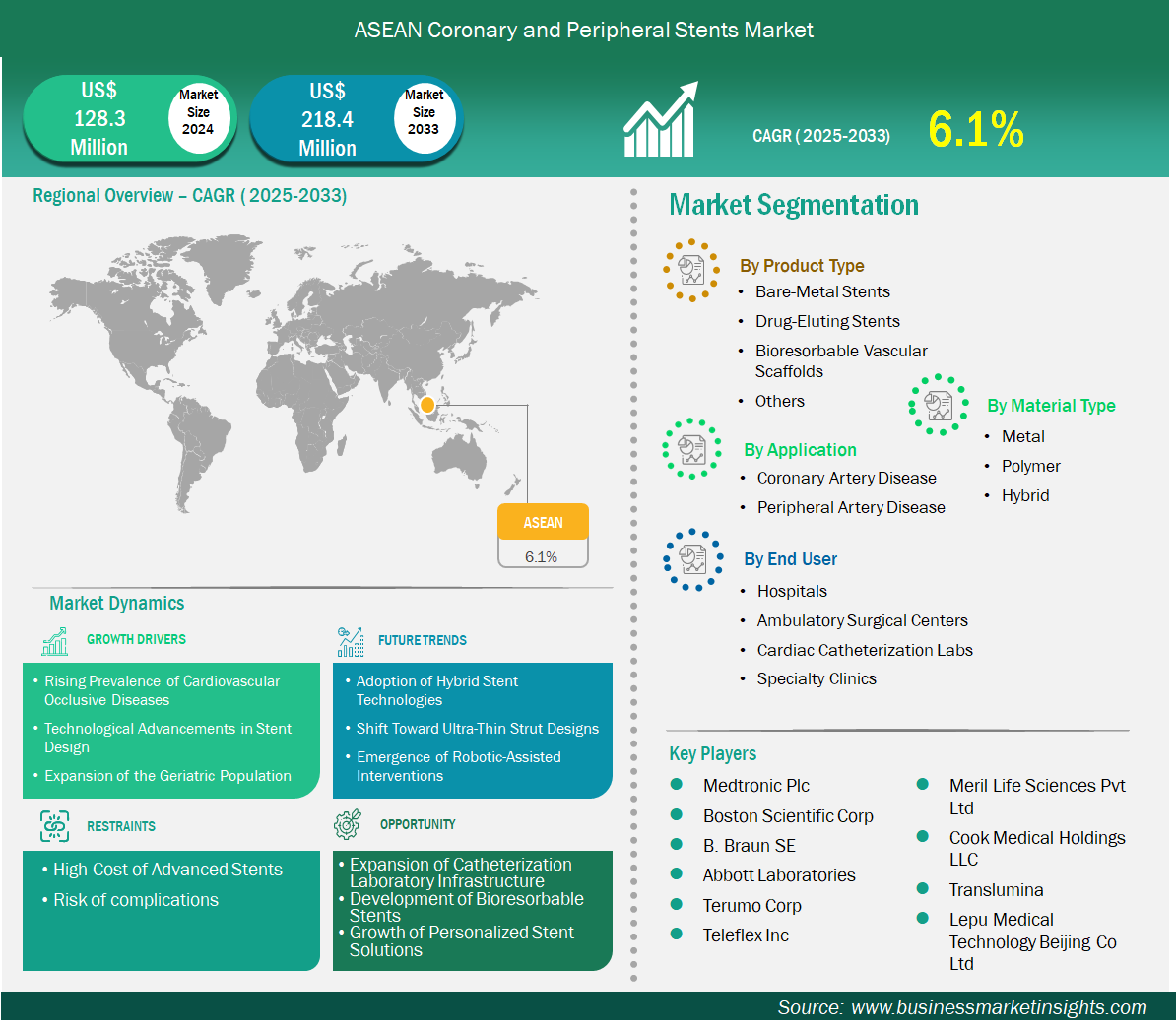
The ASEAN coronary and peripheral stents market size is expected to reach US$ 218.4 million by 2033 from US$ 128.3 million in 2024. The market is estimated to record a CAGR of 6.1% from 2025 to 2033.
Executive Summary and ASEAN Coronary and Peripheral Stents Market Analysis:
The ASEAN coronary and peripheral stents market, dominated by Indonesia, is evolving rapidly due to a growing cardiovascular disease burden and progressive healthcare system reforms. The region is witnessing a steady shift toward minimally invasive endovascular treatments as awareness of early interventional management improves among both clinicians and patients. Indonesia’s dominance stems from its large addressable patient pool, expanding hospital infrastructure, and increasing prioritization of non-communicable disease control at the policy level. Coronary artery disease remains the primary contributor to stent demand, while peripheral interventions are gaining relevance due to diabetes-associated vascular complications. Private hospitals and government-supported tertiary centers are central to procedural growth. However, the market faces structural restraints such as uneven access to catheterization laboratories across island geographies and supply chain complexities related to imported stent devices. Cost containment pressures within public healthcare settings also influence product selection. Despite these challenges, ongoing investments in specialist training, hospital upgrades, and national insurance coverage continue to reinforce Indonesia’s leadership within the ASEAN stents landscape.
ASEAN Coronary and Peripheral Stents Market Segmentation Analysis:
Key segments that contributed to the derivation of the coronary and peripheral stents market analysis are product type, material type, application and end user.
- By product type, the coronary and peripheral stents market is segmented into bare-metal stents, drug-eluting stents, bioresorbable vascular scaffolds, and others. The drug-eluting stents segment dominated the market in 2024. Superior efficacy in reducing restenosis, longer-term patient outcomes, and widespread physician preference drove adoption, making them the most trusted choice compared to bare-metal or bioresorbable alternatives.
- By material type, the coronary and peripheral stents market is segmented into metal, polymer, and hybrid. The metal segment dominated the market in 2024. High durability, proven biocompatibility, cost-effectiveness, and established clinical success ensured dominance, as polymer and hybrid options remain limited in availability, scalability, and long-term performance validation.
- By application, the coronary and peripheral stents market is segmented into coronary artery disease and peripheral artery disease. The coronary artery disease segment dominated the market in 2024. Higher global prevalence, significant clinical burden, and greater demand for interventional procedures positioned coronary stents as the leading application, overshadowing peripheral artery disease interventions in overall market share.
- By end user, the market is segmented into hospitals, ambulatory surgical centers, cardiac catheterization labs, and specialty clinics. The hospitals segment held the largest share of the market in 2024. Comprehensive infrastructure, advanced catheterization facilities, skilled specialists, and ability to handle complex cases ensured hospitals remained the primary setting for stent implantation, surpassing smaller clinics and ambulatory centers.
ASEAN Coronary and Peripheral Stents Market Outlook
The ASEAN coronary and peripheral stents market is characterized by demand concentration in metropolitan referral hospitals, with Indonesia contributing significantly to overall procedural volumes. Coronary stents represent the core of market activity, supported by increasing diagnosis rates and broader acceptance of percutaneous coronary interventions as standard care. Peripheral stents are progressively adopted for advanced limb ischemia and complex vascular disease cases, particularly among diabetic patients. A key driver of market expansion is the strengthening of Indonesia’s national health insurance framework, which has improved affordability and accessibility of interventional cardiology procedures. Reimbursement inclusion for stenting has encouraged hospitals to expand cath lab capacity and streamline patient referral pathways. This policy-driven access has reduced procedural delays and increased clinician confidence in recommending interventional solutions. Additionally, partnerships with international cardiology societies and regional training programs are enhancing procedural expertise. Together, these factors are driving consistent growth in stent utilization across Indonesia’s major healthcare hubs within ASEAN.
ASEAN Coronary and Peripheral Stents Market Country Insights
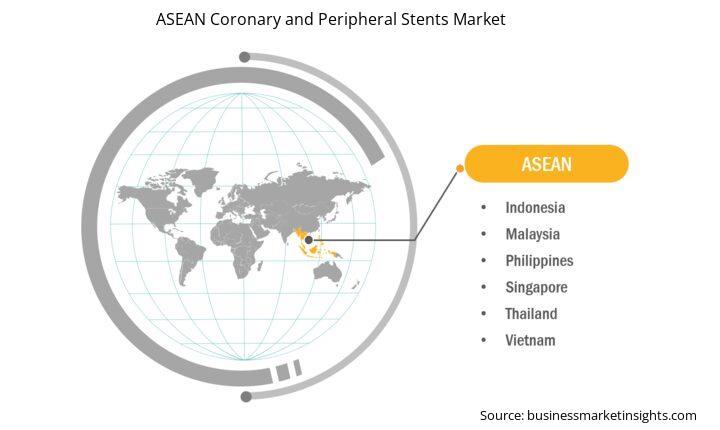
Based on country, the ASEAN coronary and peripheral stents Market is further segmented into Indonesia, Malaysia, the Philippines, Singapore, Thailand, and Vietnam. Indonesia held the largest share in 2024.
Indonesia dominates the ASEAN coronary and peripheral stents market due to its scale, healthcare reforms, and expanding interventional cardiology footprint. The country hosts a growing number of tertiary-care hospitals capable of performing complex coronary procedures, particularly in major urban centers. Drug-eluting coronary stents are increasingly preferred in these facilities due to improved clinical outcomes and reduced repeat intervention risk. Peripheral stent usage is also expanding, driven by rising incidence of diabetes-related vascular complications requiring limb-preserving interventions. Government-led initiatives to strengthen cardiac care capacity, combined with investments in physician training, are improving procedural consistency across regions. Local distributors and strategic partnerships with global manufacturers play a vital role in ensuring product availability and technical support across Indonesia’s diverse geography. Nevertheless, access disparities persist between urban and remote regions, limiting uniform adoption. Despite these challenges, Indonesia’s large patient base, reimbursement support, and expanding clinical expertise firmly establish it as the dominant stents market in ASEAN.
ASEAN Coronary and Peripheral Stents Market Company Profiles
Medtronic, Boston Scientific Corporation, Abbott, B. Braun SE, TERUMO CORPORATION, Teleflex Incorporated, Lepu Medical Technology (Beijing) Co. Ltd., Cook Medical, Meril Life Sciences and Translumina are among the key players operating in the market. These players adopt strategies such as expansion, product innovation, and mergers and acquisitions to stay competitive in the market and offer innovative products to their consumers.
ASEAN Coronary and Peripheral Stents Market Research Methodology:
The following methodology has been followed for the collection and analysis of data presented in this report:
-
Secondary Research
The research process begins with comprehensive secondary research, utilizing both internal and external sources to gather qualitative and quantitative data for each market. Commonly referenced secondary research sources include, but are not limited to:
- Company websites, annual reports, financial statements, broker analyses, and investor presentations
- Industry trade journals and other relevant publications
- Government documents, statistical databases, and market reports
- News articles, press releases, and webcasts specific to companies operating in the market
Note: All financial data included in the Company Profiles section has been standardized to US$. For companies reporting in other currencies, figures have been converted to US$ using the relevant exchange rates for the corresponding year.
-
Primary Research
Business Market Insights conducts a significant number of primary interviews each year with industry stakeholders and experts to validate and analyze the data and gain valuable insights. These research interviews are designed to:
- Refine findings from secondary research
- Enhance the expertise and market understanding of the analysis team
- Gain insights into market size, trends, growth patterns, competitive dynamics, and future prospects
Primary research is conducted via email interactions and telephone interviews with industry experts across various markets, categories, segments, and sub-segments in different regions. Participants typically include:
- Industry stakeholders: Vice Presidents, business development managers, market intelligence managers, and national sales managers
- External experts: Valuation specialists, research analysts, and key opinion leaders with industry-specific expertise
Key Sources Referred:
- The World Bank
- World Health Organization (WHO)
- Center for Disease Control and Prevention (CDC)
- European Society of Cardiology
- American College of Cardiology
- American Heart Association
- Asian Pacific Society of Interventional Cardiology
- Company website
- Company annual reports
- Company investor presentations
ASEAN Coronary and Peripheral Stents Market Strategic Insights
ASEAN Coronary and Peripheral StentsMarket Report Highlights
| Report Attribute | Details |
| Market size in 2024 | US$ 128.3 Million |
| Market Size by 2033 | US$ 218.4 Million |
| CAGR (2025 - 2033) | 6.1% |
| Historical Data | 2022-2023 |
| Forecast period | 2025-2033 |
| Segments Covered |
By Product Type
|
|
Regions and Countries Covered
|
|
| ASEAN | Indonesia, Malaysia, Philippines, Singapore, Thailand, Vietnam |
| Market leaders and key company profiles |
|
ASEAN Coronary and Peripheral Stents Market Country and Regional Insights