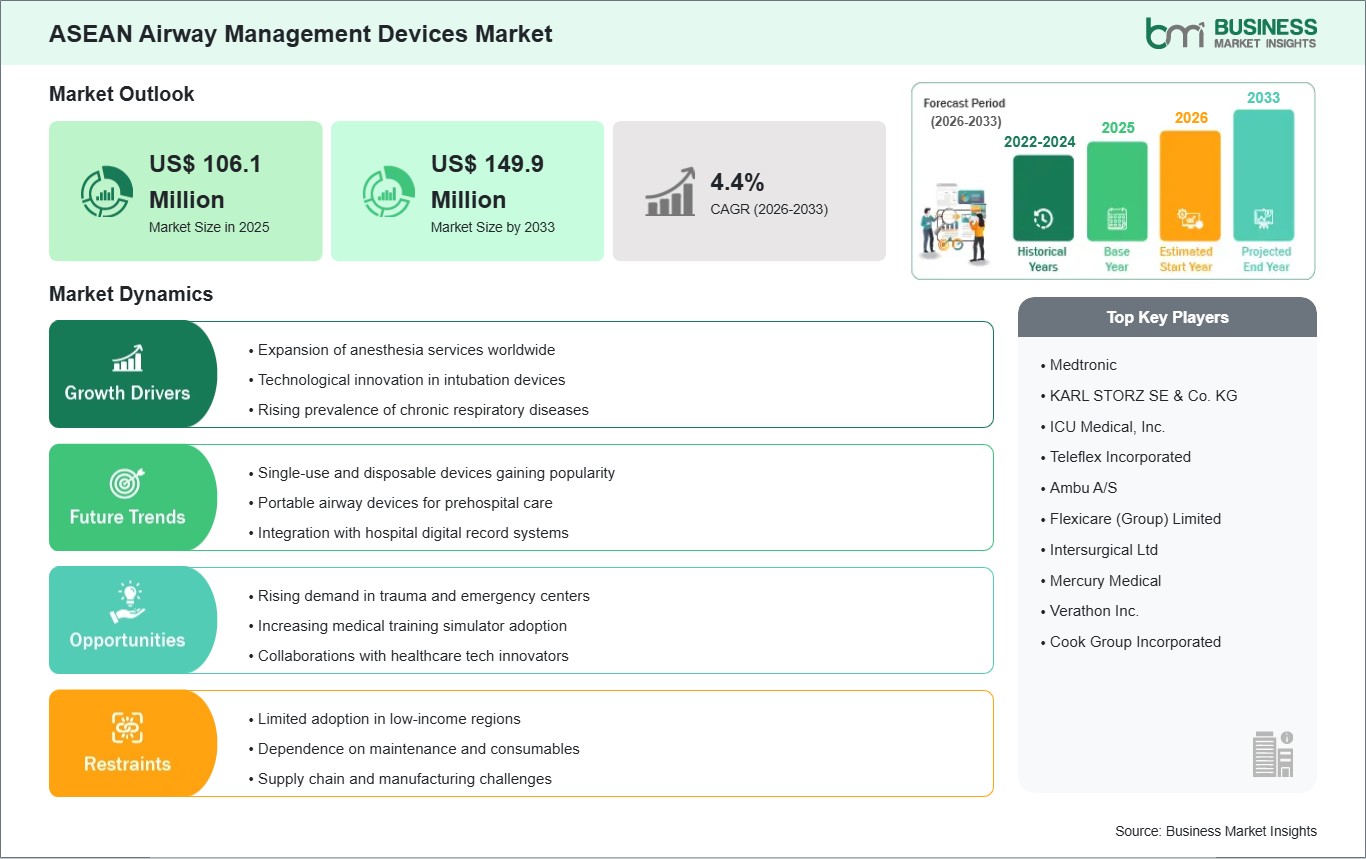
The ASEAN airway management devices market size is expected to reach US$ 149.9 million by 2033 from US$ 106.1 million in 2025. The market is estimated to record a CAGR of 4.4% from 2026 to 2033.
The ASEAN airway management device market is experiencing stable growth due to improved health facilities, increased surgery rates, and enhanced knowledge about managing patients with breathing problems and other related medical issues. Medical establishments in cities within the region are becoming more concerned with investing in important airway management equipment such as endotracheal tubes, laryngeal masks, and supraglottic airway devices. Respiratory disease cases and trauma cases are also on the rise within this geographical location. Technological innovations are a crucial determinant of market performance, as hospitals increasingly adopt video laryngoscopes, flexible fiber-optic endoscopes, and disposable airway devices. Training and education programs for professionals are becoming more common, which contribute significantly to improving the expertise of practitioners and promoting new techniques for airway management. Although technological innovations have played an important role in developing new products and enhancing their quality, the airway management devices market encounters several obstacles. The difference in access to healthcare services in urban and rural areas is a major barrier. Moreover, the cost of innovative technology and the lack of financial incentives in some ASEAN countries pose another challenge. Nevertheless, government policies for healthcare services and the increasing focus on patient safety and emergency planning are expected to fuel the demand for airway management devices in the ASEAN region.

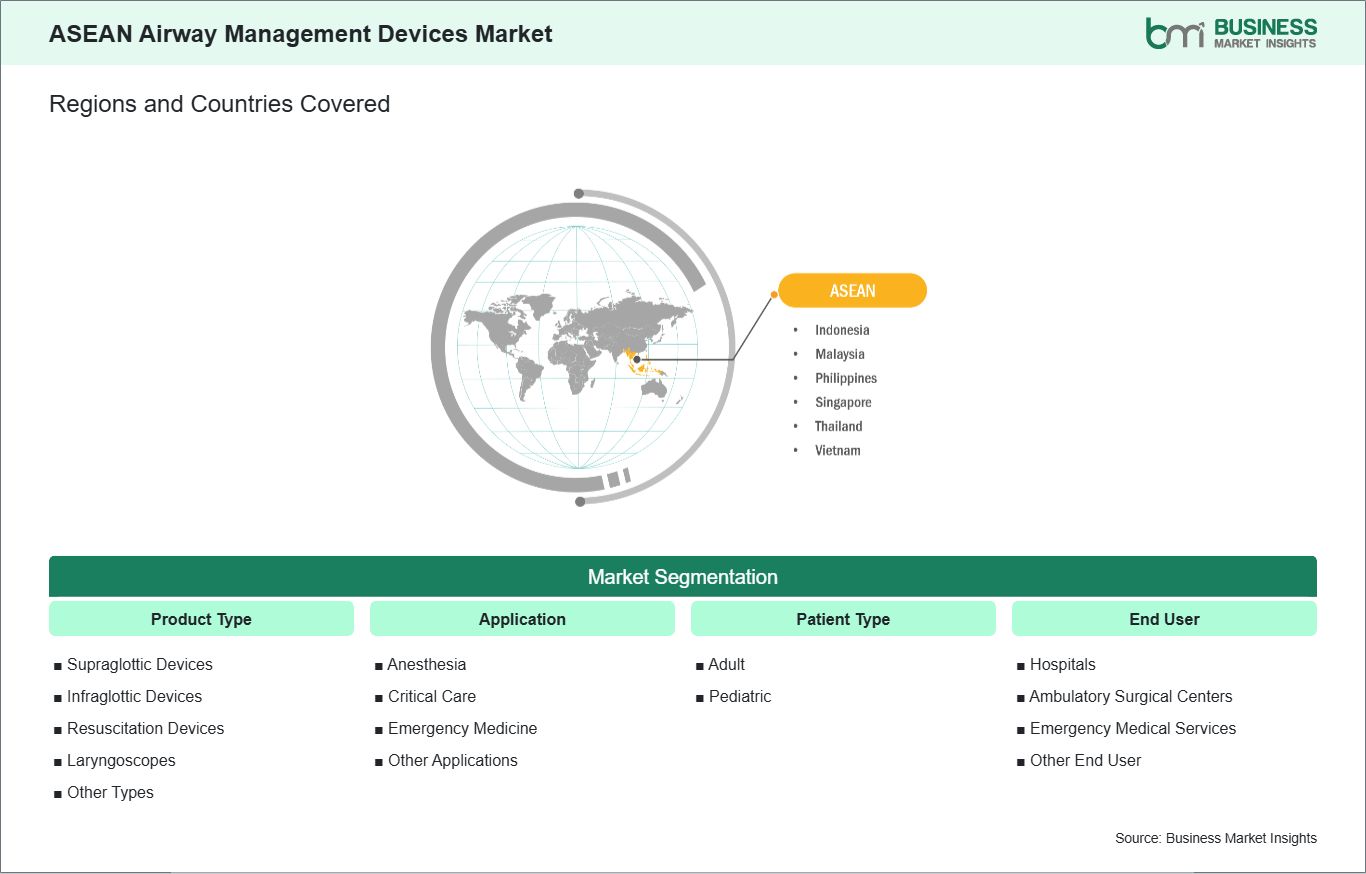
Key segments that contributed to the derivation of the airway management devices market analysis are product type, application, patient type, and end user.
The growth of anesthesia care in the ASEAN countries has been having a profound impact on the need for airway management equipment. Nations like Indonesia, Thailand, Vietnam, and the Philippines are increasing their surgical capabilities in both public and private facilities due to the rising demands in the health sector. In line with the increase in surgeries, anesthesia personnel are increasingly concentrating on enhancing their airway management processes. This has seen increased investments in airway management devices for the induction and maintenance of anesthesia.
Anesthesia education and specialization are progressing in the healthcare systems of ASEAN countries too. Universities and teaching hospitals in Malaysia and Singapore are establishing anesthesia fellowship programs with emphasis on practical skills in airway management, using simulations and rotations to train clinicians in advanced techniques of airway management. It contributes to increased competence among specialists who deal with difficult airway procedures and creates additional need for advanced airway management devices regarded as mandatory tools in perioperative practice. Specialized teams are more likely to suggest upgrading existing medical facilities depending on airway management challenges they face.
Moreover, anesthesiology cooperation between Southeast Asian countries results in dissemination of best practices and latest advances in the field. Anesthesiology societies conduct regular workshops and conferences, focusing on innovation in airway management devices that include ergonomic intubation systems and disposable airway conduits reducing chances of infection transmission. Professional communication and exchange become additional drivers of advancement and contribute to creating a situation when upgrading airway equipment becomes a norm in ASEAN medical facilities.
Trauma and emergency care services in ASEAN countries are experiencing heightened demand, driven by urbanization, increased road traffic, and rising industrial activity. Major cities such as Jakarta, Bangkok, Manila, and Ho Chi Minh City report significant numbers of trauma cases in emergency departments, often involving airway compromise due to accidents or acute medical events. As emergency clinicians recognize the critical role of airway management in stabilizing trauma patients, there is a growing emphasis on equipping emergency centers with a wider range of airway tools from rapid‑deployment resuscitation devices to advanced video laryngoscopes that support first‑attempt success in difficult airways.
Efforts to strengthen pre‑hospital care are also contributing to market growth. Several ASEAN governments are enhancing ambulance services and paramedic training to support effective pre‑hospital airway interventions. In Vietnam’s urban centers, for example, EMS teams are now standardly equipped with portable airway devices that allow secure airway access before hospital arrival. This shift acknowledges that early airway control can dramatically improve patient outcomes and reduce downstream complications, prompting health authorities to invest in portable and durable airway solutions.
Community and hospital‑based emergency units are further aligning protocols to emphasize airway readiness for sudden respiratory distress cases, such as severe asthma exacerbations or allergic reactions. This has led to standardized inventory lists that include both basic and advanced airway equipment. In jurisdictions where emergency care accreditation standards are becoming more rigorous, facilities are benchmarking their airway device inventories against peer institutions. As a result, rising demand from trauma and emergency centers is emerging as a primary driver of airway management device adoption throughout the ASEAN region.

The ASEAN airway management devices market is experiencing steady growth, with market size and share analysis reflecting evolving treatment preferences and competitive dynamics among key players. The report evaluates important subsegments categorized within product type, application, patient type, and end user, highlighting their respective contributions to overall market performance.
By product type, the infraglottic devices subsegment dominated the market in 2025. In anesthesia practice, infraglottic devices provide protection against aspiration and enable precise airway management, driving higher adoption in operating rooms and critical care settings compared to supraglottic devices.
Based on application, the anesthesia subsegment dominated the market in 2025 due to the need for definitive airway control across a wide range of surgical procedures, from routine elective surgeries to complex interventions. Because infraglottic devices are essential for intubation during anesthesia, this segment experiences consistent, high-volume usage, making it the largest segment compared to emergency or general critical care.
In terms of patient type, the adult subsegment dominated the market in 2025. Most procedural training, device designs, and usage guidelines are optimized for adult anatomy and usage scenarios, reinforcing higher market volume.
Based on end user, the hospital subsegment dominated the market in 2025, as hospitals remain the central hub for airway management, handling scheduled surgeries, emergency admissions, ICU care, and trauma cases. Their larger budgets, need for extensive airway inventories, and availability of multidisciplinary professionals make them the largest purchasers compared to outpatient centers or EMS, where volume and purchasing power are comparatively lower.
| Report Attribute | Details |
|---|---|
| Market size in 2025 | US$ 106.1 Million |
| Market Size by 2033 | US$ 149.9 Million |
| CAGR (2026 - 2033) | 4.4% |
| Historical Data | 2022-2024 |
| Forecast period | 2026-2033 |
| Segments Covered | By Product Type
|
|
Regions and Countries Covered
| |
| ASEAN | Indonesia, Malaysia, Philippines, Singapore, Thailand, Vietnam |
| Market leaders and key company profiles |
|
The "ASEAN Airway Management Devices Market Size and Forecast (2022–2033)" report provides a detailed analysis of the market covering below areas:
The geographical scope of the ASEAN airway management devices market report is divided into: Indonesia, Malaysia, the Philippines, Singapore, Thailand, and Vietnam. Indonesia held the largest share in 2025.
Indonesia accounts for the largest share of the airway management devices market in ASEAN nations because of the high population, development of the healthcare sector, and use of medical advancements. Many of the urban hospitals located in cities like Jakarta, Surabaya, and Bandung have started using modern airway management devices, including videolaryngoscopy and single-use supraglottic devices. In addition, private hospitals tend to adopt modern technology in their facilities, whereas public hospitals are more interested in increasing their accessibility to airway management devices by targeting a larger number of patients. There is also increasing training of anesthesiologists and critical care specialists through simulation. However, several issues still persist, especially in the countryside and distant locations, where access to sophisticated equipment and medical personnel may pose a problem. The prohibitive cost of procurement and distribution logistics could impede the availability of such equipment in specific territories. Nevertheless, the Indonesian government’s efforts toward improving healthcare infrastructure, increasing surgery rates, and enhancing intensive care capacities affirm its prominence as the primary contributor to the use of airway management devices in ASEAN.

The ASEAN airway management devices market is evaluated by gathering qualitative and quantitative data post primary and secondary research, which includes important corporate publications, association data, and databases. A few of the key developments in the ASEAN airway management devices market are:
The ASEAN Airway Management Devices Market is valued at US$ 106.1 Million in 2025, it is projected to reach US$ 149.9 Million by 2033.
As per our report ASEAN Airway Management Devices Market, the market size is valued at US$ 106.1 Million in 2025, projecting it to reach US$ 149.9 Million by 2033. This translates to a CAGR of approximately 4.4% during the forecast period.
The ASEAN Airway Management Devices Market report typically cover these key segments-
The historic period, base year, and forecast period can vary slightly depending on the specific market research report. However, for the ASEAN Airway Management Devices Market report:
The ASEAN Airway Management Devices Market is populated by several key players, each contributing to its growth and innovation. Some of the major players include:
The ASEAN Airway Management Devices Market report is valuable for diverse stakeholders, including:
Essentially, anyone involved in or considering involvement in the ASEAN Airway Management Devices Market value chain can benefit from the information contained in a comprehensive market report.
Please tell us your area of interest
(Market Segments/ Regions and Countries/ Companies)