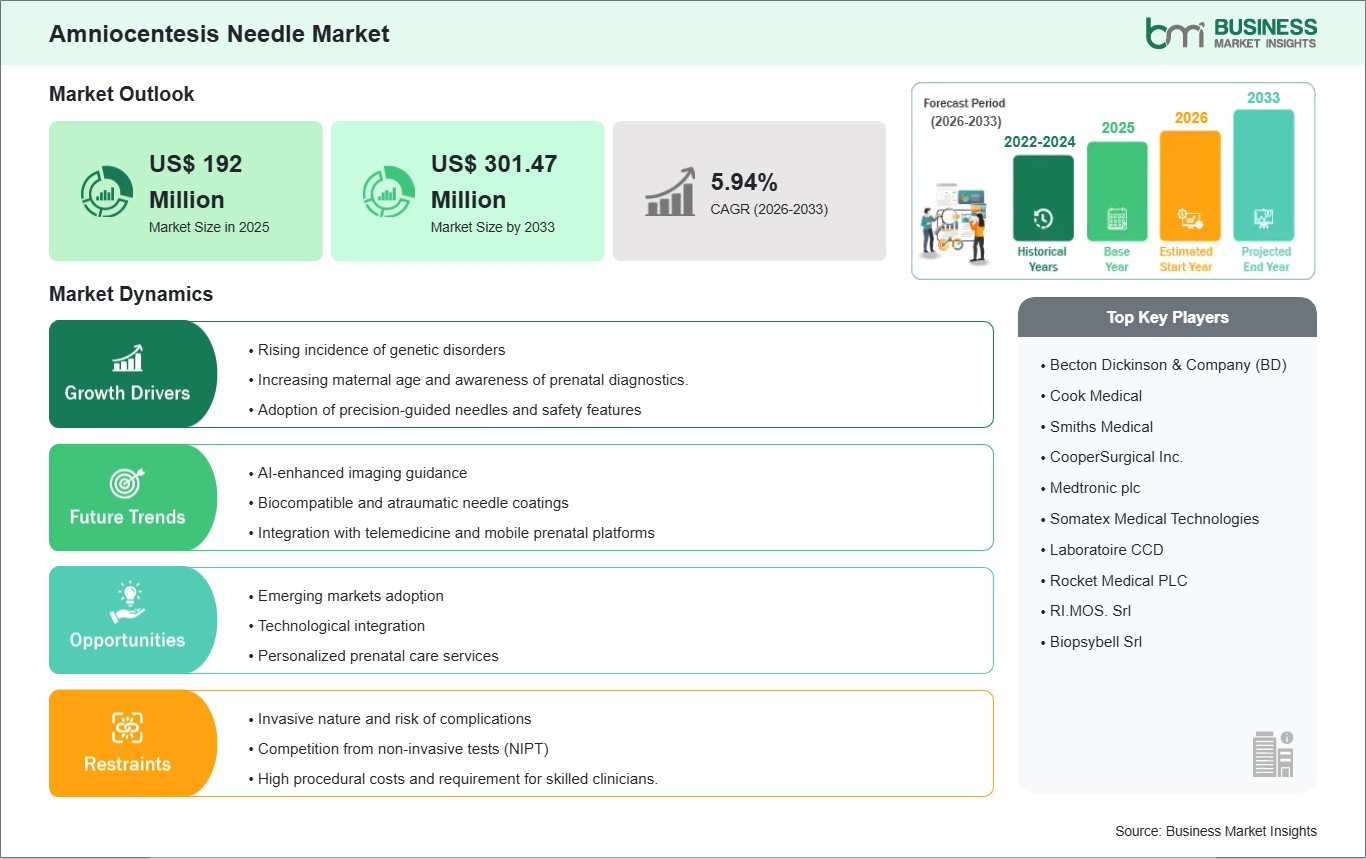
The amniocentesis needle market size is expected to reach US$ 301.47 million by 2033 from US$ 192 million in 2025. The market is estimated to record a CAGR of 5.94% from 2026 to 2033.
Amniocentesis needles serve as vital modern prenatal and maternal healthcare tools because their design enables medical professionals to perform safe, accurate diagnostic and therapeutic procedures by providing access to the amniotic sac. The needles are used in hospitals, maternity centers, and specialized diagnostic clinics for amniotic fluid collection, enabling chromosomal analysis, genetic testing, and fetal health assessment. The system's advanced design features use echogenic tips compatible with ultrasound to reduce procedural risks while enhancing diagnostic performance.
The amniocentesis needle market is experiencing consistent growth, driven by high-risk pregnancies, increasing maternal age, and rising awareness of prenatal genetic screening. Healthcare providers are increasingly adopting invasive diagnostic procedures, such as amniocentesis, to confirm abnormalities detected by screening tests. The market experiences growth through the expansion of prenatal care programs and improvements in diagnostic infrastructure.
The market faces growth challenges because amniocentesis procedures require invasive testing methods and carry essential procedural dangers, and there exist non-invasive prenatal testing methods that function as competing options. In addition, the need for experienced medical professionals creates a barrier to implementation, alongside variable reimbursement practices across different areas. The expansion of healthcare services in developing nations, combined with increased financing for women's health initiatives and ongoing advances in needle design, will create substantial business opportunities over the projection period.

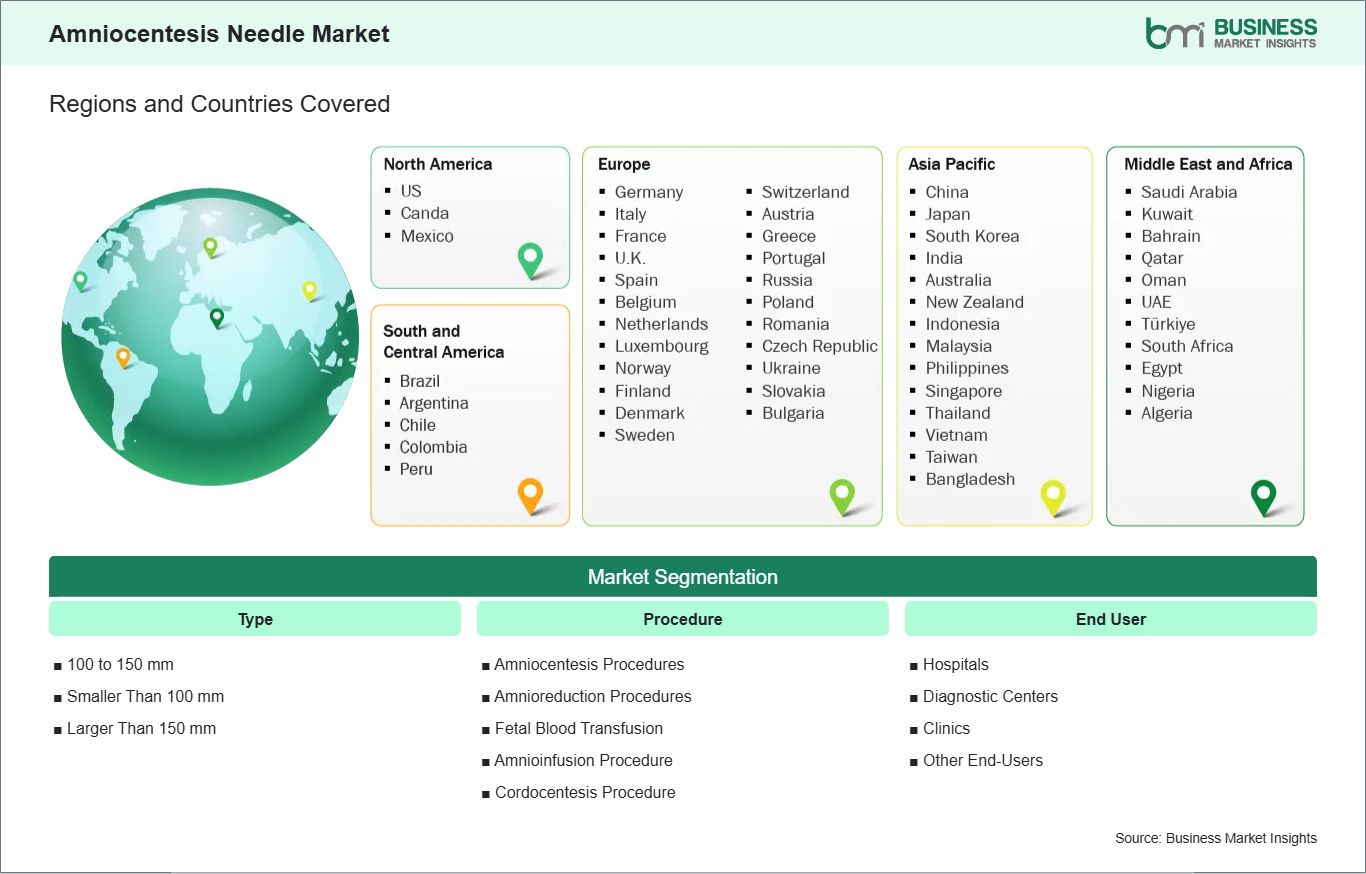
Key segments that contributed to the derivation of the amniocentesis needle market analysis are type, procedure, and end user.
The Amniocentesis Needle market exists because people need precise tests that confirm their unborn child's health conditions. The rising age of mothers has increased their chances of having chromosomal disorders, which include Down syndrome and Edwards syndrome, and neural tube defects, so they need amniocentesis as a confirmation test. Amniocentesis is an essential prenatal diagnostic test because it provides accurate medical results that can help treat patients.
The demand for amniocentesis procedures has grown because more women experience high-risk pregnancies, which result from their lifestyle choices, their existing medical conditions, and their use of assisted reproductive technologies. Parents who expect to have children now show better awareness about genetic and fetal abnormalities, which leads them to accept invasive tests when doctors recommend those tests for medical reasons. The development of ultrasound imaging technologies has enabled better surgical safety protocols, allowing doctors to perform their duties more effectively and deliver better results for their patients.
Healthcare systems worldwide are expanding prenatal screening and diagnostic programs to reduce neonatal complications and improve maternal-fetal outcomes. Hospital and diagnostic center facilities now offer amniocentesis testing as part of their complete prenatal care packages. The global Amniocentesis Needle market is experiencing continuous growth, driven by multiple factors.
The Amniocentesis Needle market shows strong potential for expansion due to technological advances and the emergence of maternal healthcare facilities in developing countries. Manufacturers are developing needles that provide better echogenicity and greater flexibility while maintaining a smaller diameter to reduce both operational pain and safety hazards. New technological developments will enhance operational security by enabling doctors to prefer advanced medical equipment.
The Asia-Pacific, Latin American, and Middle Eastern emerging markets offer substantial business opportunities due to growing healthcare spending, greater access to prenatal care, and government programs that support maternal and child health. The growing hospital networks, together with diagnostic laboratories in these areas, provide better access to advanced prenatal diagnostic tests, including amniocentesis.
The growing number of training programs for obstetricians and fetal medicine specialists will lead to higher adoption rates of medical procedures. The demand for amniocentesis testing will continue, as this method provides essential diagnostic confirmation to support non-invasive prenatal testing, which is becoming increasingly popular. Market opportunities in the upcoming period will increase as manufacturers work with healthcare providers to raise awareness of prenatal genetic conditions.
By type, the amniocentesis needle market is segmented into 100 to 150 mm, Smaller Than 100 mm, Larger Than 150 mm. The 100 to 150 mm segment dominated the market in 2025. Needles in this length range are widely preferred due to their suitability for standard ultrasound-guided amniocentesis procedures, offering optimal reach, control, and safety across a broad range of patient anatomies.
By procedure, the market is segmented into amniocentesis procedures, amnioreduction procedures, fetal blood transfusion, amnioinfusion procedure, cordocentesis procedure. The amniocentesis procedures segment held the largest market share in 2025. This dominance is attributed to the widespread use of amniocentesis as a definitive diagnostic test for detecting chromosomal abnormalities, genetic disorders, and fetal infections during pregnancy.
By end user, the amniocentesis needle market is segmented into hospitals, diagnostic centers, clinics, and others. The hospitals segment dominated the market in 2025. Hospitals are the primary settings for invasive prenatal diagnostic procedures due to the availability of specialized obstetricians, advanced ultrasound equipment, and comprehensive maternal-fetal care services, ensuring safe and accurate procedure execution.
| Report Attribute | Details |
|---|---|
| Market size in 2025 | US$ 192 Million |
| Market Size by 2033 | US$ 301.47 Million |
| Global CAGR (2026 - 2033) | 5.94% |
| Historical Data | 2022-2024 |
| Forecast period | 2026-2033 |
| Segments Covered | By Type
|
|
Regions and Countries Covered
| |
| North America | US, Canada, Mexico |
| Europe | Belgium, Austria, Finland, Denmark, Greece, Poland, Romania, Russia, Ukraine, Czech Republic, Slovakia, Bulgaria, Italy, Luxembourg, Germany, Switzerland, France, Netherlands, Norway, Portugal, Spain, Sweden, United Kingdom |
| Asia-Pacific | Australia, China, India, Japan, South Korea, Indonesia, Malaysia, Philippines, Singapore, Thailand, Vietnam, Bangladesh, New Zealand, Taiwan |
| South and Central America | Brazil, Argentina, Peru, Chile, Colombia |
| Middle East and Africa | Bahrain, Kuwait, Oman, Qatar, Saudi Arabia, United Arab Emirates, Turkiye, South Africa, Egypt, Algeria, Nigeria |
| Market leaders and key company profiles |
|
The "Amniocentesis Needle Market Size and Forecast (2022-2033)" report provides a detailed analysis of the market covering below areas:
The geographical scope of the amniocentesis needle market report is divided into five regions: North America, Asia Pacific, Europe, Middle East & Africa, and South & Central America. The amniocentesis needle market in Asia Pacific is expected to grow significantly during the forecast period.
The Asia-Pacific amniocentesis needle market is segmented into China, Japan, South Korea, India, Australia, New Zealand, Indonesia, Malaysia, the Philippines, Singapore, Thailand, Vietnam, Taiwan, Bangladesh, and the Rest of Asia. The Asia-Pacific Amniocentesis Needle market is growing steadily because more people understand prenatal diagnostic tests, more women give birth after age 35, and more women experience dangerous pregnancy conditions throughout the region. Market growth is driven by rapid healthcare infrastructure development, enabling better access to advanced prenatal diagnostic methods offered by medical facilities in China, Japan, India, South Korea, and Australia.
China, Japan, and India present strong market potential because their large birth cohorts, expanding hospital networks, and growing need for genetic and chromosomal disorder testing drive demand for these services. The adoption of amniocentesis procedures across the region is supported by government programs that aim to enhance maternal and fetal healthcare systems, extend insurance coverage, and encourage early prenatal screening practices.
The development of prenatal diagnostic technologies has reached a new level through the creation of ultrasound-guided medical techniques and newly developed needle equipment which leads to safer procedures and more precise diagnostic results. Market demand is growing as healthcare providers require confirmatory tests after prenatal screenings, while specialized maternity facilities and diagnostic centers are expanding in urban areas. The market will continue to expand because medical professionals are starting to recognize the advantages of detecting health conditions at an early stage which will lead to better outcomes throughout pregnancy. The Asia-Pacific region will maintain its status as one of the fastest-growing amniocentesis needle markets during the entire forecast period.

The amniocentesis needle market is evaluated by gathering qualitative and quantitative data post primary and secondary research, which includes important corporate publications, association data, and databases. A few of the key developments in the Amniocentesis Needle market are:
The Amniocentesis Needle Market is valued at US$ 192 Million in 2025, it is projected to reach US$ 301.47 Million by 2033.
As per our report Amniocentesis Needle Market, the market size is valued at US$ 192 Million in 2025, projecting it to reach US$ 301.47 Million by 2033. This translates to a CAGR of approximately 5.94% during the forecast period.
The Amniocentesis Needle Market report typically cover these key segments-
The historic period, base year, and forecast period can vary slightly depending on the specific market research report. However, for the Amniocentesis Needle Market report:
The Amniocentesis Needle Market is populated by several key players, each contributing to its growth and innovation. Some of the major players include:
The Amniocentesis Needle Market report is valuable for diverse stakeholders, including:
Essentially, anyone involved in or considering involvement in the Amniocentesis Needle Market value chain can benefit from the information contained in a comprehensive market report.
Please tell us your area of interest
(Market Segments/ Regions and Countries/ Companies)