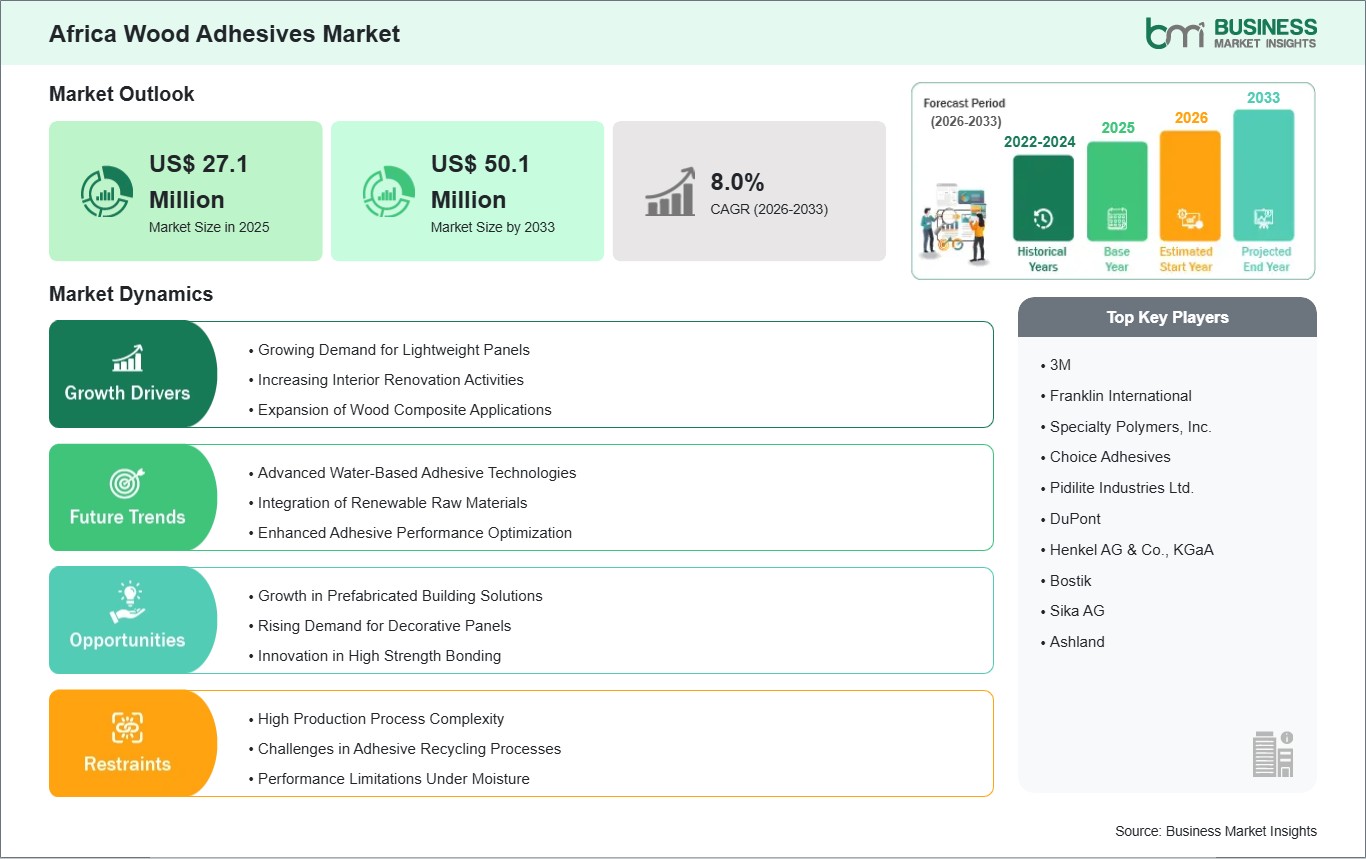
The Africa wood adhesives market size is expected to reach US$ 529.8 million by 2033 from US$ 244.8 million in 2025. The market is estimated to register a CAGR of 10.1% from 2026 to 2033.
Wood adhesives are integral materials used in the manufacturing of furniture, engineered wood products, cabinetry, flooring, and construction components, enabling durable bonding performance across a broad range of applications. The Africa wood adhesives market is witnessing progressive development as industrialization and urban expansion stimulate demand for wood-based products in both residential and commercial sectors. Manufacturers are increasingly focusing on improving adhesive formulations that offer enhanced moisture resistance, bonding strength, and compliance with evolving environmental standards. The market is also benefiting from the gradual modernization of woodworking operations and increased investment in value-added wood processing activities. Rising consumer preference for aesthetically finished furniture and interior products is encouraging producers to adopt advanced adhesive technologies that improve product quality and production efficiency. In addition, the expansion of organized retail channels and local furniture manufacturing is creating new avenues for adhesive suppliers across the continent. Technological advancements related to low-emission and water-based adhesive solutions are reshaping product development strategies as sustainability becomes a stronger purchasing consideration. Competitive activity remains centered on product differentiation, distribution network expansion, and partnerships with woodworking and construction industries. As African economies continue strengthening industrial capabilities and infrastructure development programs, the market is expected to experience broader application diversity, supporting long-term demand for high-performance wood adhesive solutions.

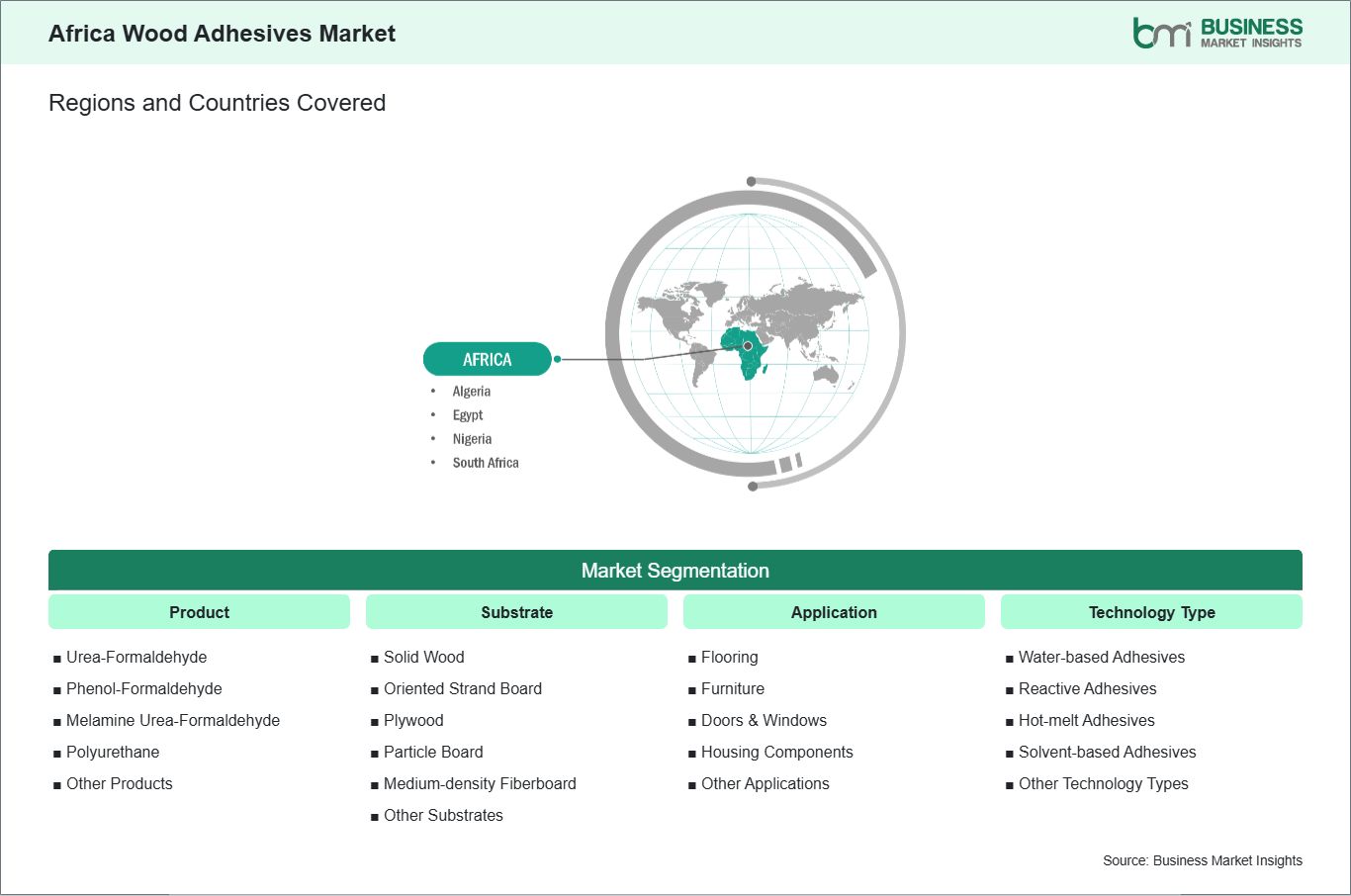
Key segments that contributed to the derivation of the Africa wood adhesives market analysis are product, substrate, application, and technology type.
The Africa wood adhesives market is witnessing growth due to increasing demand for engineered wood products in construction and furniture manufacturing. Urbanization in countries like Nigeria, South Africa, Kenya, and Ghana has led to a trend of utilizing plywood, medium-density fiberboard (MDF), particle board, and laminated wood panels as more affordable alternatives to solid wood. This calls for efficient bonding techniques, thereby maintaining demand for wood adhesives in these regions.
Increased furniture manufacturing activities have been yet another major reason for the increase in adhesive consumption. Higher incomes and increased construction activities have led to an increased demand for furniture that can be assembled by consumers themselves. Furniture manufacturers are increasingly adopting engineered woods, which has helped boost the consumption of urea formaldehyde, PVA, and polyurethane adhesives.
There are sustainability factors as well that are affecting the market. Due to pressures on the natural supply of forest material, companies are now resorting to plantation woods, sawmill residue, and recycled fiber for production purposes. Countries such as South Africa and Egypt have increased production capacity for engineered wood products in recent times, thus necessitating high-quality adhesives for product quality and durability.
Infrastructure development across Africa is creating favorable opportunities for the wood adhesives market. Governments are investing in transportation, education, healthcare, and residential projects to support economic growth and urban expansion. These developments increase demand for wood-based interior materials, including doors, partitions, flooring, and furniture, which rely heavily on adhesives during manufacturing and installation.
Housing construction remains a major growth driver. Several African countries face significant housing deficits, leading to increased investments in affordable housing programs. Nations such as Kenya, Nigeria, and Ethiopia are expanding residential construction activities, encouraging the use of engineered wood panels and prefabricated building components that require reliable adhesive solutions.
Growing industrialization is further supporting market expansion. Investments in furniture manufacturing, wood processing facilities, and industrial parks are strengthening local production capabilities. Countries including Egypt, Ethiopia, and Tanzania are promoting domestic manufacturing industries, which is increasing consumption of wood adhesives used in panel production and furniture applications. Continued infrastructure and industrial development is expected to sustain market growth over the coming years.

The wood adhesives market in Africa is experiencing steady growth, with market size and share analysis reflecting evolving treatment preferences and competitive dynamics among key players. The report evaluates important subsegments categorized within product, substrate, application, and technology, highlighting their respective contributions to market performance.
By product, the urea-formaldehyde (UF) segment dominated the market in 2025, driven by its low cost, fast curing properties, and widespread use in mass-produced engineered wood products across Africa.
Based on substrate, the particle board (PB) segment dominated the market in 2025, driven by strong demand for affordable wood panels in furniture manufacturing and interior construction applications.
On the basis of application, the furniture segment dominated the market in 2025, driven by rising urbanization, population growth, and increasing demand for residential and commercial furnishing products.
In terms of technology, the water-based adhesives segment dominated the market in 2025, driven by growing preference for environmentally compliant, low-VOC, and safer adhesive solutions in wood processing industries.
| Report Attribute | Details |
|---|---|
| Market size in 2025 | US$ 244.8 Million |
| Market Size by 2033 | US$ 529.8 Million |
| CAGR (2026 - 2033) | 10.1% |
| Historical Data | 2022-2024 |
| Forecast period | 2026-2033 |
| Segments Covered | By Product
|
|
Regions and Countries Covered
| |
| Africa | Egypt, South Africa, Nigeria, Algeria |
| Market leaders and key company profiles |
|
The "Africa Wood Adhesives Market Size and Forecast (2022–2033)" report provides a detailed analysis of the market covering below areas:
The geographical scope of the Africa wood adhesives market report is divided into Nigeria, Egypt, South Africa, and Algeria. Egypt held the largest share in 2025.
Egypt represents the dominant market within Africa, supported by its extensive construction activities, expanding furniture manufacturing sector, and well-established industrial base. The country's growing investments in urban development projects and interior fit-out applications continue to generate substantial demand for wood-based products, creating favorable conditions for adhesive consumption. Local manufacturers are increasingly adopting advanced bonding technologies to enhance product quality, production efficiency, and compliance with evolving environmental and performance requirements. South Africa maintains a significant position in the regional market due to its mature woodworking industry and diversified furniture production capabilities. The country benefits from a strong network of manufacturers supplying residential, commercial, and institutional sectors. Demand for wood adhesives is further reinforced by renovation activities, customized furniture production, and increasing emphasis on durable engineered wood products across multiple end-use industries. Nigeria is emerging as a promising market as industrial development initiatives and housing requirements stimulate greater utilization of wood panels, furniture, and construction materials. Growing local manufacturing, activities are encouraging the adoption of efficient adhesive solutions that support product durability and cost optimization. Expanding urban populations and rising consumer spending on home furnishings continue to create opportunities for adhesive suppliers seeking long-term market penetration. Algeria is witnessing steady development in the wood adhesives sector, supported by infrastructure modernization efforts and increasing investment in domestic manufacturing. The country's focus on reducing import dependence and strengthening local production capabilities is contributing to higher demand for wood processing materials. As industrial diversification strategies advance, adhesive manufacturers are finding opportunities to supply products tailored to furniture production, interior applications, and building component assembly.

The Africa Wooden decking market is evaluated by gathering qualitative and quantitative data post primary and secondary research, which includes important corporate publications, association data, and databases. A few of the key developments in the Africa Wooden decking market are:
The Africa Wood Adhesives Market is valued at US$ 244.8 Million in 2025, it is projected to reach US$ 529.8 Million by 2033.
As per our report Africa Wood Adhesives Market, the market size is valued at US$ 244.8 Million in 2025, projecting it to reach US$ 529.8 Million by 2033. This translates to a CAGR of approximately 10.1% during the forecast period.
The Africa Wood Adhesives Market report typically cover these key segments-
The historic period, base year, and forecast period can vary slightly depending on the specific market research report. However, for the Africa Wood Adhesives Market report:
The Africa Wood Adhesives Market is populated by several key players, each contributing to its growth and innovation. Some of the major players include:
The Africa Wood Adhesives Market report is valuable for diverse stakeholders, including:
Essentially, anyone involved in or considering involvement in the Africa Wood Adhesives Market value chain can benefit from the information contained in a comprehensive market report.
Please tell us your area of interest
(Market Segments/ Regions and Countries/ Companies)