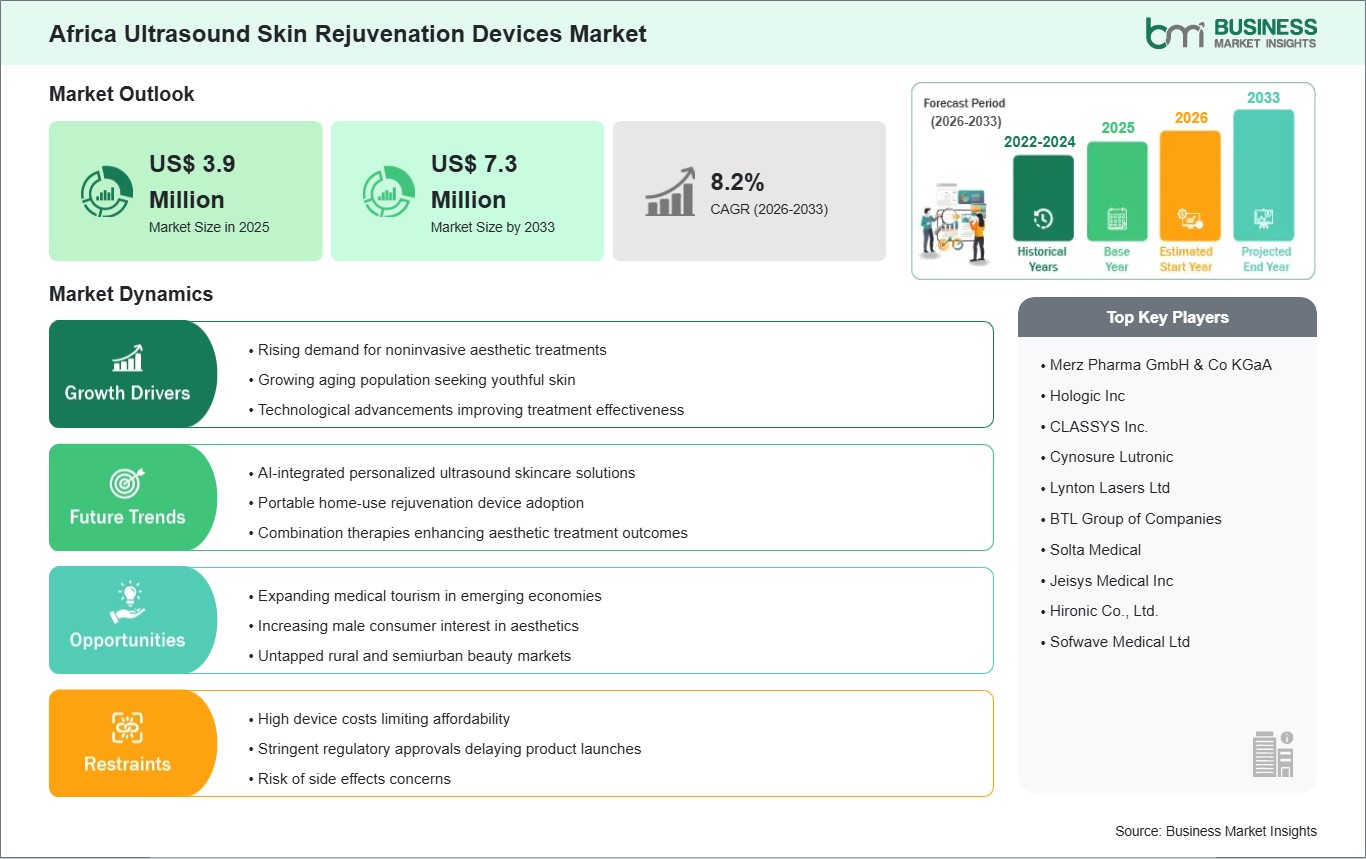
The Africa ultrasound skin rejuvenation devices market size is expected to reach US$ 7.3 million by 2033 from US$ 3.9 million in 2025. The market is estimated to record a CAGR of 8.2% from 2026 to 2033.
Ultrasound devices, specifically high-intensity focused ultrasound (HIFU), are being incorporated within dermatology clinics and medical spas because of their capabilities to remodel collagen tissue and deliver skin-tightening results non-invasively. Factors influencing the market include increased rates of urbanization, the proliferation of privately owned dermatology clinics, and consumer interest in cosmetic treatments by middle and high-income households. Further drivers of growth include trends in social media aesthetics and young consumers' growing preference for preventative treatments against aging signs. As far as the supply-side factors are concerned, there is dominance on the part of foreign manufacturers of aesthetic equipment that operate through regional subsidiaries and aesthetic equipment importers. Dermatology clinics are incorporating multi-platform technology that combines ultrasound devices with radio frequency or laser-based machines.
Barriers to entry into the market include high levels of capital outlays, a lack of reimbursement strategies, and a shortage of skilled aestheticians. Regulatory oversight varies significantly, leading to uneven product approval timelines and fragmented commercialization pathways. Concerns regarding low-cost imitation devices in informal markets pose challenges to brand trust and clinical standardization. Despite these constraints, innovation trends such as compact device formats, AI-assisted treatment planning, and integration with digital skin analysis tools are enhancing clinical efficiency and practitioner adoption. The competitive environment remains moderately consolidated, with global aesthetics technology providers shaping product availability and clinical training ecosystems across urban centers.

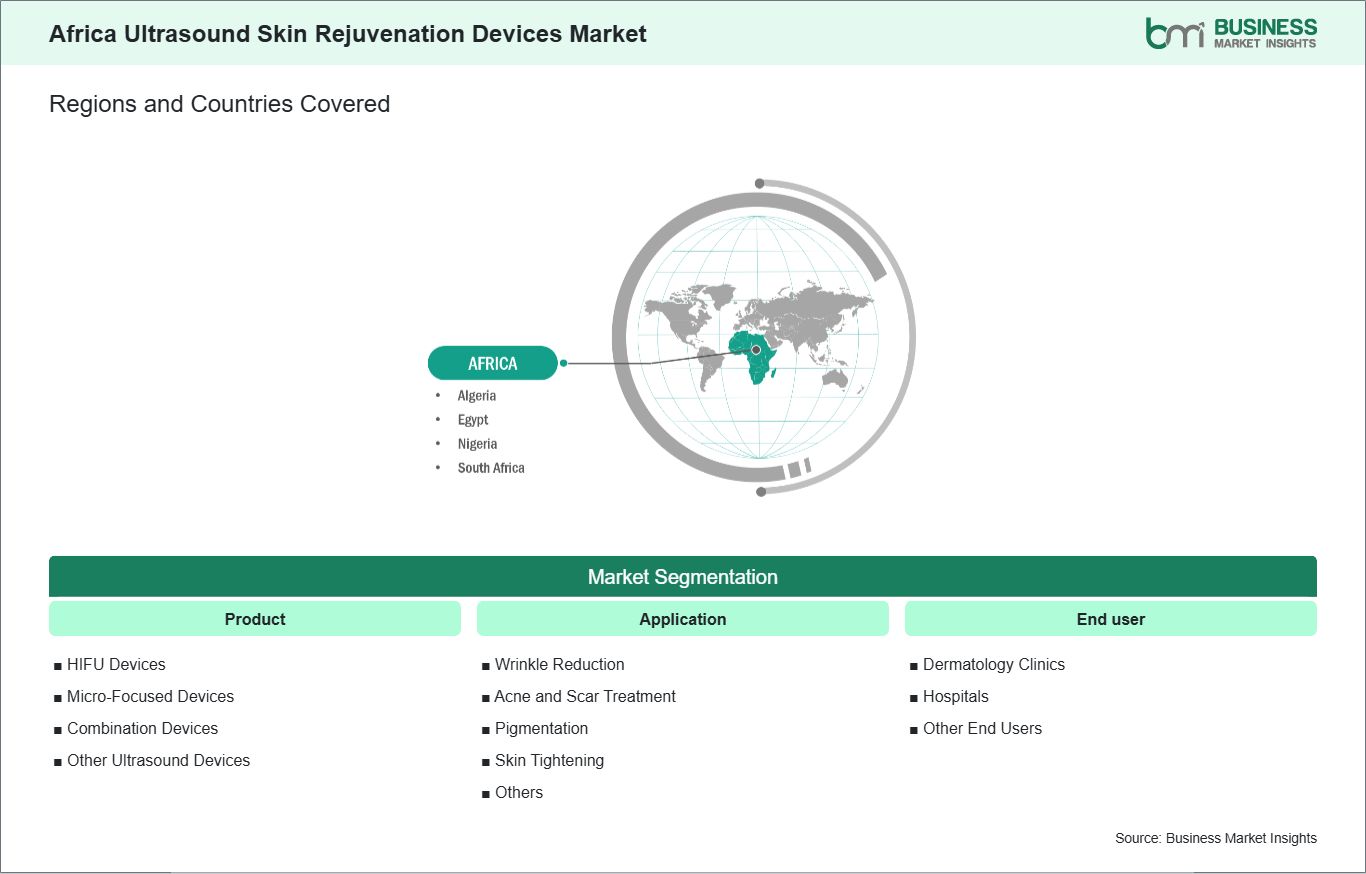
Key segments that contributed to the derivation of the Africa ultrasound skin rejuvenation devices market analysis are product, application, and end user.
There is a structural shift toward noninvasive aesthetic treatments across key urban economies such as South Africa, Egypt, Nigeria, Kenya, and Morocco. Skin tightening procedures using ultrasound technology are gaining popularity in clinics located in Johannesburg and Cape Town as an alternative to facelift surgery, due to the desire among consumers to undergo minimally invasive procedures that do not require any recovery time. Even within South Africa, non-surgical cosmetic procedures are more popular than traditional surgery.
Increasing consciousness about anti-aging treatments among people of moderate and higher income levels in North Africa, especially Egypt and Morocco, is fueling the need for ultrasound facelifts and collagen stimulation. In Cairo, dermatology centers have noted an increasing number of patients being treated for issues such as skin sagging and hyperpigmentation, for which ultrasound devices offer more suitability because of the Fitzpatrick type skin that exists in this region (IV-VI). Medical tourism flows from Europe and the Middle East are encouraging the use of non-invasive treatments.
In Nigeria and Kenya, demand is influenced by increasing disposable incomes coupled with the growth of the urban middle-class population. Lagos and Nairobi are adopting ultrasound skin tightening technology through aesthetic practices in boutiques aimed at younger clients seeking preventive anti-aging treatments. Despite the low penetration in rural areas, mobile and cheaper ultrasound machines are making it easier for dermatology clinics to introduce diversified service offerings.
South Africa emerges as a leader in the region because of the relatively developed infrastructure of dermasurge and cosmetology clinics, which also serve as regional learning centers on advanced energy-based devices. Specialty aesthetic clinics in the country are the fastest-growing ones in the health care sector.
In Egypt and the North African route through the Gulf region, adoption of ultrasound in a clinical environment is on the rise, owing to the presence of well-funded private healthcare facilities along with the impact of dermatologists who have been educated in Europe. Clinics in Cairo and Alexandria are adopting ultrasounds alongside lasers and radiofrequency in a multi-platform approach to provide skin-tightening services.
The growth of boutique aesthetic clinics is fueled by entrepreneurship within the wellness and beauty industry in countries such as Nigeria, Kenya, and Ghana within Sub-Saharan Africa. Clinics operate in high-end neighborhoods within cities such as Lagos' Victoria Island and Nairobi's Westlands, where the demand for high-quality cosmetic treatment is growing. Nevertheless, the growth of clinics is limited by equipment costs as well as training, and many clinics operate on a shared equipment system or rent systems. Nonetheless, adoption of the clinic continues to grow due to increasing consumer awareness of noninvasive treatments.

The Africa ultrasound skin rejuvenation devices market demonstrates steady growth, with size and share analysis highlighting evolving trends and competitive dynamics among key players. The report examines subsegments categorized within product, application, and end user, offering insights into their contribution to overall market performance.
By product, the HIFU devices segment dominated the market in 2025, driven by their superior noninvasive lifting efficacy, deeper tissue penetration, and strong clinical adoption in aesthetic dermatology clinics.
Based on application, the wrinkle reduction segment dominated the market in 2025, driven by high consumer demand for anti-aging treatments and collagen-stimulating, non-surgical facial rejuvenation outcomes.
In terms of end user, the dermatology clinics segment dominated the market in 2025, driven by their specialized infrastructure, high patient footfall for aesthetic procedures, and strong preference for advanced energy-based skin rejuvenation technologies.
| Report Attribute | Details |
|---|---|
| Market size in 2025 | US$ 3.9 Million |
| Market Size by 2033 | US$ 7.3 Million |
| CAGR (2026 - 2033) | 8.2% |
| Historical Data | 2022-2024 |
| Forecast period | 2026-2033 |
| Segments Covered | By Product
|
|
Regions and Countries Covered
| |
| Africa | Egypt, South Africa, Nigeria, Algeria |
| Market leaders and key company profiles |
|
The "Africa Ultrasound Skin Rejuvenation Devices Market Size and Forecast (2022-2033)" report provides a detailed analysis of the market covering below areas:
The geographical scope of the Africa ultrasound skin rejuvenation devices market report is divided into Egypt, South Africa, Nigeria, and Algeria. Nigeria held the largest share in 2025.
Nigeria stands as the dominant market, driven by its large population base, rapidly expanding private healthcare sector, and strong consumer appetite for cosmetic enhancement services in cities such as Lagos and Abuja. The country benefits from a growing number of aesthetic clinics catering to high-income and upper-middle-income groups, alongside increasing investments from private healthcare entrepreneurs in advanced dermatology technologies. South Africa has well-established dermatology and cosmetic surgery networks, particularly in Cape Town, Johannesburg, and Durban, supported by strong practitioner expertise and higher regulatory alignment for medical aesthetic devices. In Egypt, demand is fueled by a dense concentration of dermatology clinics in Cairo and Alexandria, along with strong influence from European-trained medical professionals and consistent adoption of premium noninvasive treatment technologies. In Algeria, demand is primarily centered in urban areas such as Algiers and Oran, where private clinics are introducing aesthetic dermatology services despite regulatory and import-related complexities. Nigeria's dominance is reinforced by its scale, faster clinic expansion rate, and higher frequency of adoption of new aesthetic technologies compared to its regional peers. South Africa and Egypt maintain leadership in clinical sophistication. Algeria remains an emerging but slower-developing contributor to regional device uptake.

The Africa ultrasound skin rejuvenation devices market is evaluated by gathering qualitative and quantitative data post primary and secondary research, which includes important corporate publications, association data, and databases. A few of the key developments in the Africa ultrasound skin rejuvenation devices market are:
The Africa Ultrasound Skin Rejuvenation Devices Market is valued at US$ 3.9 Million in 2025, it is projected to reach US$ 7.3 Million by 2033.
As per our report Africa Ultrasound Skin Rejuvenation Devices Market, the market size is valued at US$ 3.9 Million in 2025, projecting it to reach US$ 7.3 Million by 2033. This translates to a CAGR of approximately 8.2% during the forecast period.
The Africa Ultrasound Skin Rejuvenation Devices Market report typically cover these key segments-
The historic period, base year, and forecast period can vary slightly depending on the specific market research report. However, for the Africa Ultrasound Skin Rejuvenation Devices Market report:
The Africa Ultrasound Skin Rejuvenation Devices Market is populated by several key players, each contributing to its growth and innovation. Some of the major players include:
The Africa Ultrasound Skin Rejuvenation Devices Market report is valuable for diverse stakeholders, including:
Essentially, anyone involved in or considering involvement in the Africa Ultrasound Skin Rejuvenation Devices Market value chain can benefit from the information contained in a comprehensive market report.
Please tell us your area of interest
(Market Segments/ Regions and Countries/ Companies)