Market Summary
Executive Summary and Market Analysis
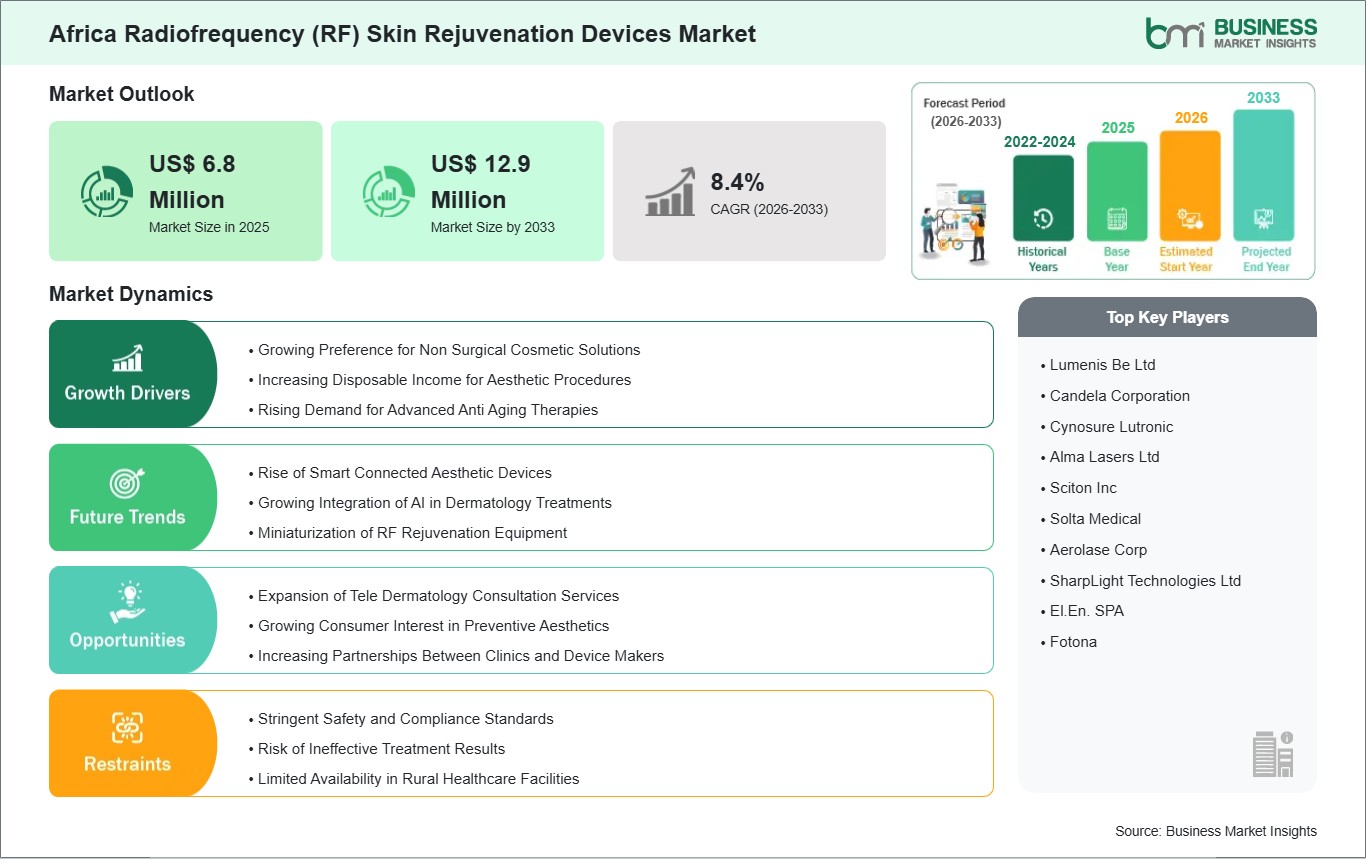
The Africa Radiofrequency (RF) Skin Rejuvenation Devices Market is slowly coming to the forefront as part of the broader aesthetic medicine and more non-invasive cosmetic treatment world across the region. A majority of the demand sits mainly in the more developed healthcare settings like South Africa, Egypt , and a few urban hubs in Nigeria, where dermatology clinics and medspas are starting to adopt energy-based aesthetic tech more often. What’s also pushing this is a growing understanding of non-surgical skin rejuvenation services, especially RF treatments for skin tightening, lessening wrinkles, and scar improvement. These options are getting noticed in middle to upper income groups, mostly because they see them as minimally invasive cosmetic solutions, rather than something more disruptive. One important reason the market could keep growing here is how urbanization is changing everyday life, and along with it, the stronger lifestyle-oriented aesthetic mindset. This is backed by the steadily expanding private healthcare and wellness sector. Also, more dermatology clinics and cosmetic surgery facilities in big cities are helping RF devices move from “rare” into more common use. In addition , medical tourism in some areas of North and Southern Africa is indirectly feeding the desire for modern aesthetic technologies, even when the purchases aren’t always made locally. Still, there are constraints that make adoption slower than it might otherwise be. The biggest thing is the high equipment cost , plus ongoing maintenance expenses, which really hit smaller clinics and independent practitioners. That means advanced RF systems stay out of reach for many providers. On top of that, in certain countries, there’s limited technical know-how and training shortfalls, so clinical use doesn’t spread as fast. Finally, regulatory rules don’t look the same across African nations, and affordability pressure for a large share of the population keeps market growth from moving much beyond urban high-income pockets.
Segment Analysis
Africa Radiofrequency (RF) Skin Rejuvenation Devices Market Segmentation
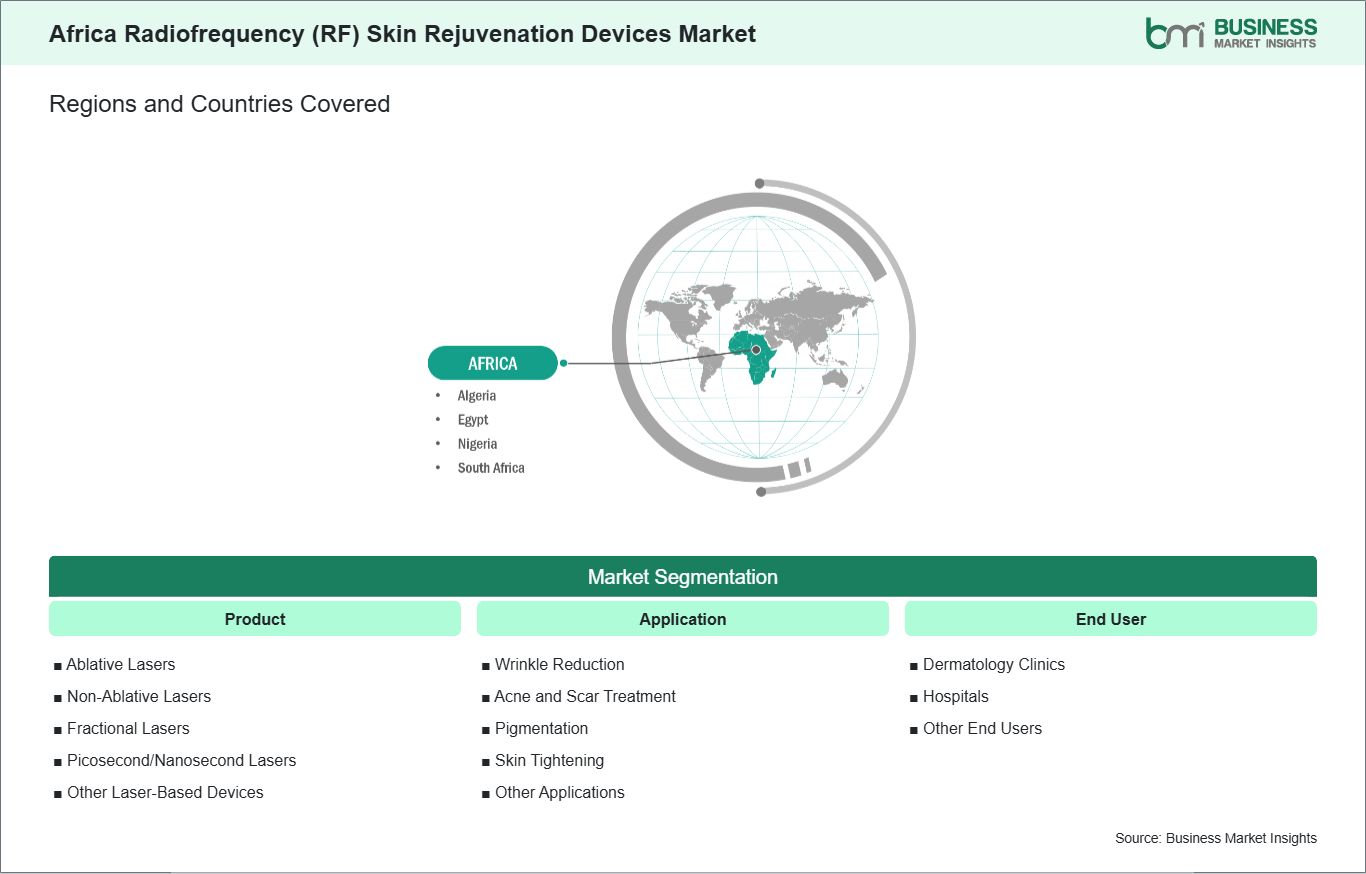
Key segments that contributed to the derivation of the Africa radiofrequency (RF) skin rejuvenation devices market analysis are product, application and end user.
- By product, the radiofrequency (RF) skin rejuvenation devices market is segmented into ablative lasers, non-ablative lasers, fractional lasers, picosecond/nanosecond lasers, and other laser-based devices. The non-ablative lasers segment dominated the market in 2025.
- Based on application, the radiofrequency (RF) skin rejuvenation devices market is categorized into wrinkle reduction, acne and scar treatment, pigmentation, skin tightening, and other applications. The wrinkle reduction segment dominated the market in 2025.
- In terms of end user, the radiofrequency (RF) skin rejuvenation devices market is categorized into dermatology clinics, hospitals, and other end users. The dermatology clinics segment dominated the market in 2025.
Market Forces
Africa Radiofrequency (RF) Skin Rejuvenation Devices Market Drivers and Opportunities
Growing Preference for Non Surgical Cosmetic Solutions
In Africa, the demand for non-invasive cosmetic and aesthetic solutions such as radiofrequency (RF) skin rejuvenation devices is on the rise. More urban consumers from countries like South Africa, Nigeria, and Egypt are now opting for minimally invasive techniques that produce visible changes in their appearance and won’t require either long recovery times or surgical procedures.This is happening as people become more aware of new and advanced technologies and as the standard of beauty has changed through the influence of media from around the world.
Specifically, consumers living in large metropolitan cities (e.g., Lagos, Cairo, Johannesburg) are showing greater interest in using RF products to improve their skin’s firmness, reduce fine lines and wrinkles and create an overall youthful appearance (particularly in the working- age population desiring to have procedures performed quickly).In addition, there has been an increase in adoption of RF devices due to evolving lifestyle habits; increased disposable income; and the growth of private dermatology offices across Africa. More and more patients are also choosing to receive a combination of treatments to maximize their collagen production and achieve natural-looking results with RF instead of resorting to surgical facelift procedures across most urban African markets.
Expansion of Tele Dermatology Consultation Services
Expansion of tele dermatology consultation services is improving access to skin care expertise across Africa, indirectly supporting demand for RF skin rejuvenation devices. Patients in regions with limited dermatology specialists are increasingly using virtual platforms to seek guidance on aesthetic procedures and treatment suitability.In countries such as Kenya, Nigeria, and South Africa, hybrid healthcare models are emerging where online consultations are followed by in-clinic RF treatments.
This approach enhances patient screening, improves procedural planning, and increases trust in non-invasive cosmetic technologies among first-time users. Furthermore, expanding mobile connectivity and digital health adoption are enabling follow-up consultations after RF procedures, ensuring better treatment compliance. This digital integration also increases awareness of energy-based aesthetic devices in semi-urban areas, encouraging more clinics to incorporate RF technologies into their service offerings. Clinics are also integrating RF devices into post-acne and skin tightening protocols which supports broader adoption across both urban and emerging healthcare facilities in Africa.
Size and Share Analysis
Africa Radiofrequency (RF) Skin Rejuvenation Devices Market Size and Share Analysis
The Africa radiofrequency (RF) skin rejuvenation devices market is experiencing steady growth, with market size and share analysis reflecting evolving treatment preferences and competitive dynamics among key players. The report evaluates important subsegments categorized within product, application and end user, highlighting their respective contributions to market performance.
By product, the non-ablative lasers subsegment dominated the market in 2025, driven by increasing consumer preference for minimally invasive skin rejuvenation procedures with reduced downtime and improved safety profiles.
Based on application, the wrinkle reduction subsegment dominated the market in 2025, driven by the rising demand for anti-aging treatments and growing awareness regarding aesthetic skin enhancement procedures.
In terms of end user, the dermatology clinics subsegment dominated the market in 2025, driven by the increasing availability of advanced aesthetic treatment solutions and the growing number of patients seeking specialized skincare services.
Report Coverage
Africa Radiofrequency (RF) Skin Rejuvenation Devices Market Report Coverage and Deliverables
The "Africa Radiofrequency (RF) Skin Rejuvenation Devices Market Size and Forecast (2022–2033)" report provides a detailed analysis of the market covering below areas:
- Market size and forecast at regional and country levels for all market segments covered under the scope
- Market trends, as well as drivers, restraints, and opportunities
- Market analysis covering key trends, regional framework, major players, regulations, and recent developments
- Market concentration, heat map analysis, prominent players, and recent developments for the Market
- Detailed company profiles, including SWOT analysis
Geographic Insights
Africa Radiofrequency (RF) Skin Rejuvenation Devices Market Geographic Insights
The geographical scope of the Africa Radiofrequency (RF) Skin Rejuvenation Devices Market report is divided into Nigeria, Egypt, South Africa, and Algeria. South Africa held the largest share in 2025.
The Africa RF (radiofrequency) skin rejuvenation devices marketplace varies significantly from country to country within the continent. Nigeria, Egypt, South Africa, and Algeria all differ from one another based on differences in healthcare infrastructure, consumer purchasing power, and the level of maturity in aesthetic medicine. South Africa is presently the largest user of RF skin rejuvenation and has a considerably more comprehensive private healthcare system than that of other countries in Africa; thus, this country is positioned at the front of the pack in the usage of RF treatments. There’s a high concentration of dermatology and cosmetic clinics within South African borders. Furthermore, this country has a high degree of consumer acceptance of non-invasive aesthetic treatments (skin-tightening and wrinkle reduction), and there is a strong supply of trained personnel to perform these procedures. Additionally, South Africa was the first region in Africa to adopt energy-based aesthetics, which further establishes its position as an industry leader from a demand and procedure volume standpoint. With the growth of urbanization and increasing aesthetic awareness among the wealthy class (middle- and upper-income) in urban areas, Egypt is gaining momentum and is considered a growing North African RF market. While price sensitivity still acts as a barrier for broad scale adoption, the country has experienced high growth in private dermatology practices. Nigeria is a fragmented emerging market with significant potential. Demand for RF skin rejuvenation is primarily centered in urban centers of affluence. The drivers of growth in Nigeria’s RF market are found in the youth of the population and the increasing interest in cosmetic enhancements; however, Nigeria’s erratic regulatory policies, lack of access to high-end RF devices, and major gaps in infrastructure are hampering the rapid growth of the RF aesthetics industry. Compared to other regions, Algeria has slower growth due to the conservative views associated with undergoing cosmetic operations, along with a lack of specialized aesthetic clinics in the country. Still, private sector medical facilities are modernizing in Algeria, leading to potential early growth opportunities. There is also a great deal of urban-based growth among the other areas on the market as well; South Africa is still regarded as the leader for both maturity of the industry, and the adoption of new technologies.
Industry Activity
Recent Developments
The Africa Radiofrequency (RF) Skin Rejuvenation Devices Market is evaluated by gathering qualitative and quantitative data post primary and secondary research, which includes important corporate publications, association data, and databases. A few of the key developments in the Africa radiofrequency (RF) skin rejuvenation devices market are:
- In October 2023, Reveal Lasers LLC, announced that it launched “Denza,” a next-generation RF skin tightening device featuring a combination of monopolar and bipolar radiofrequency with sequential pulsing technology, designed to improve skin tightening and rejuvenation outcomes for aesthetic clinics globally.
- In August 2024, Candela Corporation, announced FDA clearance expansion for its Matrix RF multi-application skin platform, specifically extending indications of its Matrix Pro RF microneedling applicator for facial wrinkle reduction, strengthening its portfolio of RF-based skin tightening technologies used in aesthetic clinics worldwide.
Trust & Transparency
Research Methodology
The market analysis combines proprietary research with secondary data from government agencies, company disclosures, regulatory filings, industry databases and expert interviews. Market estimates are validated through data triangulation, cross-market benchmarking and analyst
review.
View Full Research Methodology
Key Sources Referred:
Medicines and Healthcare products Regulatory Agency (MHRA – UK)American Society for Laser Medicine and SurgeryEuropean Academy of Dermatology and VenereologyWorld Health Organization (WHO)International Society for Dermatologic SurgeryAmerican Society of Plastic SurgeonsNational Medical Products Administration (NMPA)International Society of Aesthetic Plastic SurgeryCompany WebsitesCompany Annual ReportsCompany Investor Presentations