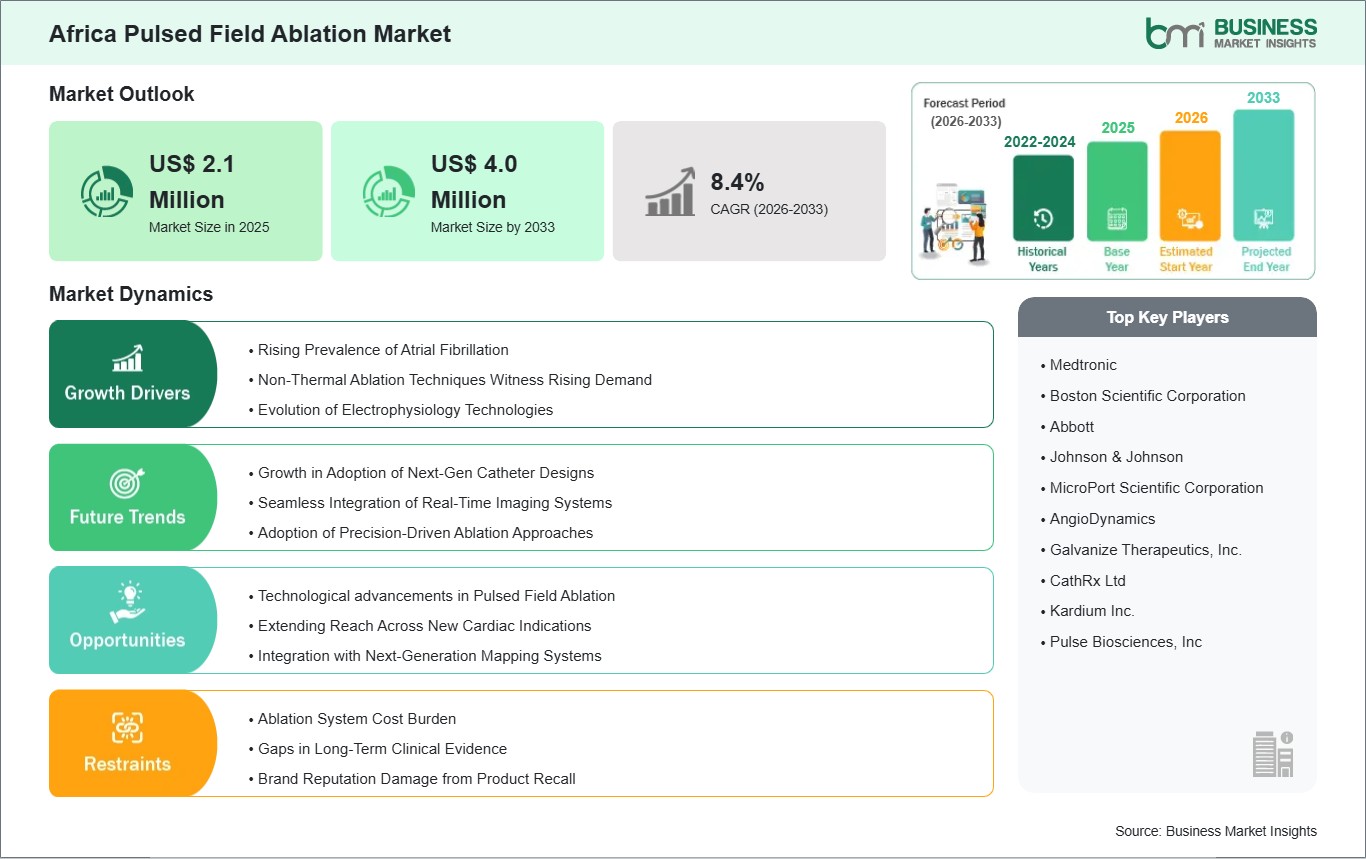
The Africa pulsed field ablation market size is expected to reach US$ 4.0 million by 2033 from US$ 2.1 million in 2025. The market is estimated to register a CAGR of 8.4% from 2026 to 2033.
The Africa pulsed field ablation market is at an early stage of adoption, characterized by selective uptake in more developed healthcare systems while remaining largely untapped across much of the continent. The market is driven by the growing clinical need for safer and more efficient treatment options for cardiac arrhythmias, particularly atrial fibrillation, which is becoming more visible due to improved diagnosis rates in urban centers. Physicians are showing interest in PFA as it offers a nonthermal mechanism of action, reducing the risk of damage to surrounding tissues and making it an attractive alternative to conventional ablation techniques.
Another important growth driver is the gradual modernization of cardiac care infrastructure in key African economies. Investment in the private health sector, setting up of specialized cardiac units, and partnering with foreign manufacturers of medical technology are ensuring early availability of electrophysiology techniques. An increasing pool of cardiologists in urban areas has helped promote the adoption of these techniques. However, the restricted availability of specialized services outside urban centers limits the outreach to potential patients. The high cost of procedures, with the use of foreign medical technology, serves as another deterrent to widespread implementation. Awareness of ablation therapy itself is fairly poor among both patients and physicians. Despite these constraints, the market is expected to progress, led by urban healthcare hubs and private sector initiatives.

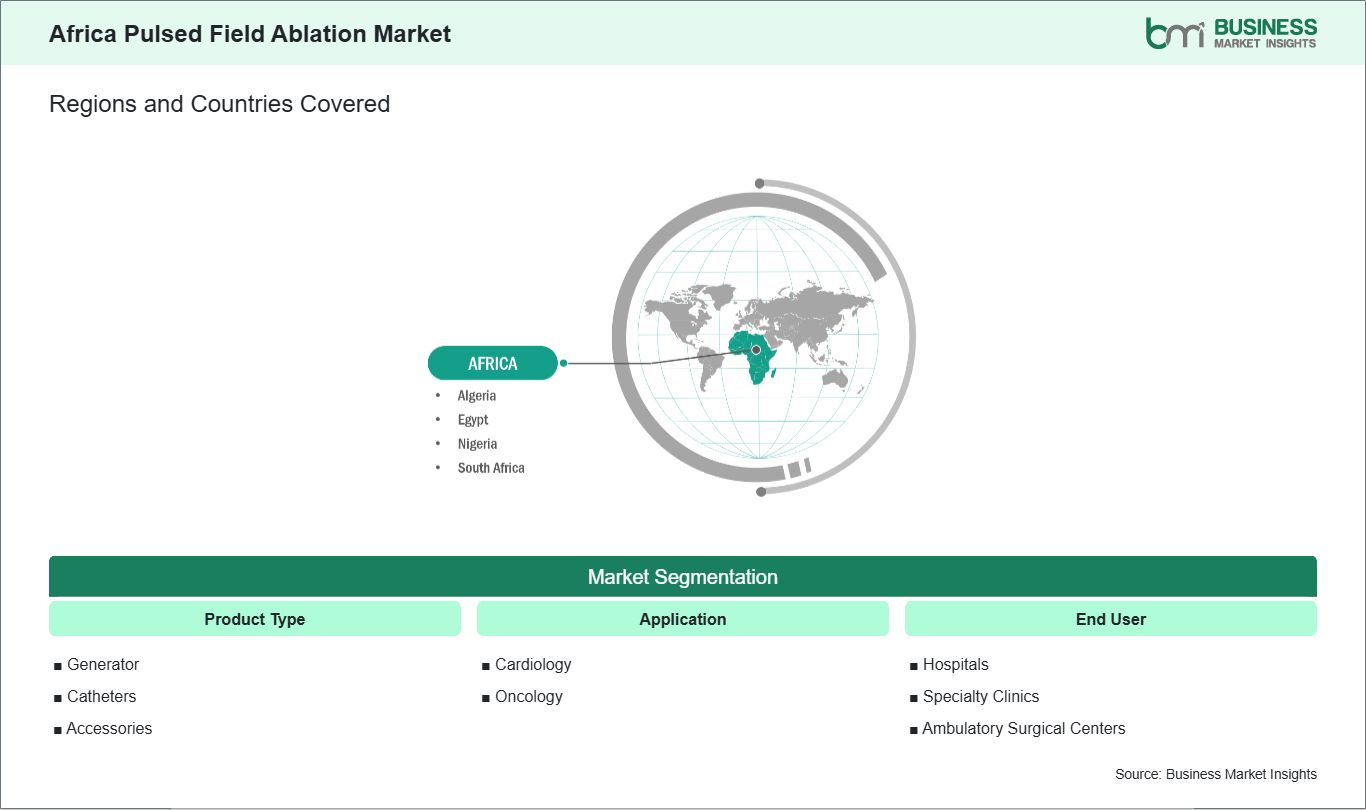
Key segments that contributed to the derivation of the Africa pulsed field ablation market analysis are product type, application, and end user.
Atrial fibrillation (AF) is emerging as a significant focus for cardiovascular care in Africa. Demographic changes, urbanization, and evolving lifestyle patterns are contributing to an increase in conditions linked to AF, such as hypertension, obesity, and metabolic disorders. Healthcare providers are seeing more patients presenting with arrhythmias, driving demand for advanced treatment solutions. This trend is prompting healthcare systems to develop strategies that address the growing clinical burden while improving patient outcomes.
The aging population in the region is influencing AF incidence. As life expectancy rises, more individuals are entering higher-risk age brackets, resulting in a larger pool of patients requiring specialized care. Healthcare organizations are responding by expanding screening programs, implementing early intervention protocols, and investing in therapies that manage arrhythmias effectively. These measures aim to reduce complications and improve long-term cardiovascular health for patients.
For the medical device and electrophysiology market, the rising prevalence of AF represents a substantial growth opportunity. Minimally invasive, targeted therapies such as pulsed field ablation offer healthcare providers efficient and safe options for arrhythmia management. The increasing demand for these solutions is shaping investment priorities, driving expansion in the cardiac technology sector, and supporting the development of advanced treatment capabilities across the region.
Pulsed field ablation (PFA) is gaining recognition as a transformative approach for treating cardiac arrhythmias. Unlike conventional ablation techniques, PFA uses high-voltage electrical pulses to target cardiac tissue while preserving surrounding structures selectively. This method delivers safety advantages, procedural efficiency, and shorter recovery times, aligning with healthcare providers’ goals to improve patient outcomes while optimizing operational performance.
The recent advancements in the field of design and energy delivery make these procedures more accurate and consistent while also making use of the latest mapping and navigation technologies. The innovations described above allow performing complex operations on the highest possible level while minimizing the risks involved and improving the efficacy of the whole process. Modern clinics regard PFA as a tool that will bring clinical performance and business strategies and prove valuable to both patients and their providers.
In Africa, the use of PFA is introduced as both infrastructure and competence continue to evolve. The efforts made towards training and partnerships allow introducing the procedure into the top hospitals of the continent. With time and experience gained from using PFA, the use of the new approach is expected to become central to managing arrhythmias. The growing popularity of PFA allows for identifying several opportunities associated with the development of the cardiac devices market segment.

The African pulsed field ablation market is experiencing steady growth, with market size and share analysis reflecting evolving treatment preferences and competitive dynamics among key players. The report evaluates important subsegments categorized within product type, application, and end user, highlighting their respective contributions to overall market performance.
By product type, the catheters subsegment dominated the market in 2025. Catheter devices offer improved procedural efficiency, reduced risk of complications, and real-time control for electrophysiologists, making them a crucial component for effective PFA therapy and a key revenue driver for manufacturers.
In terms of application, the cardiology subsegment dominated the market in 2025. The leadership of cardiology applications is attributed to the rising prevalence of atrial fibrillation and other cardiac arrhythmias, growing preference for nonthermal and tissue-selective ablation techniques, and increasing awareness among healthcare providers about the clinical benefits of PFA.
Based on end user, the hospitals subsegment dominated the market in 2025. Hospitals maintain a stronghold due to their established cardiology and electrophysiology departments, access to advanced PFA systems, trained physicians and clinical staff, and the capability to perform specialized cardiac procedures with comprehensive patient monitoring and post-procedure care.
| Report Attribute | Details |
|---|---|
| Market size in 2025 | US$ 2.1 Million |
| Market Size by 2033 | US$ 4.0 Million |
| CAGR (2026 - 2033) | 8.4% |
| Historical Data | 2022-2024 |
| Forecast period | 2026-2033 |
| Segments Covered | By Product Type
|
|
Regions and Countries Covered
| |
| Africa | Egypt, South Africa, Nigeria, Algeria |
| Market leaders and key company profiles |
|
The "Africa Pulsed Field Ablation Market Size and Forecast (2022–2033)" report provides a detailed analysis of the market covering below areas:
The geographical scope of the Africa pulsed field ablation market report is divided into Nigeria, Egypt, South Africa, and Algeria. South Africa held the largest share in 2025.
South Africa stands as the leading country in Africa for pulsed field ablation adoption, supported by its relatively mature and well-developed healthcare ecosystem. The country benefits from a strong network of private hospitals and cardiac specialty centers that are equipped to adopt advanced electrophysiology technologies. These institutions are the first to introduce innovative procedures such as PFA, driven by demand for high-quality, minimally invasive cardiac treatments.
A key factor behind South Africa’s dominance is the higher level of clinical expertise available in the field of cardiology and electrophysiology. Specialists in major cities are more exposed to global treatment trends and are often involved in international training programs, which accelerates the acceptance of new technologies such as PFA. The burden of lifestyle-related cardiovascular conditions has increased, creating a consistent need for effective arrhythmia management solutions. The private healthcare sector plays a central role in market development, as it has greater financial flexibility to invest in advanced equipment and training. However, access remains uneven, with public healthcare facilities facing budgetary and infrastructure limitations that slow adoption. South Africa functions as the entry point for pulsed field ablation in Africa, with its healthcare landscape setting the foundation for future expansion into other parts of the continent.

The Africa pulsed field ablation market is evaluated by gathering qualitative and quantitative data post primary and secondary research, which includes important corporate publications, association data, and databases. A few of the key developments in the Africa pulsed field ablation market are:
The Africa Pulsed Field Ablation Market is valued at US$ 2.1 Million in 2025, it is projected to reach US$ 4.0 Million by 2033.
As per our report Africa Pulsed Field Ablation Market, the market size is valued at US$ 2.1 Million in 2025, projecting it to reach US$ 4.0 Million by 2033. This translates to a CAGR of approximately 8.4% during the forecast period.
The Africa Pulsed Field Ablation Market report typically cover these key segments-
The historic period, base year, and forecast period can vary slightly depending on the specific market research report. However, for the Africa Pulsed Field Ablation Market report:
The Africa Pulsed Field Ablation Market is populated by several key players, each contributing to its growth and innovation. Some of the major players include:
The Africa Pulsed Field Ablation Market report is valuable for diverse stakeholders, including:
Essentially, anyone involved in or considering involvement in the Africa Pulsed Field Ablation Market value chain can benefit from the information contained in a comprehensive market report.
Please tell us your area of interest
(Market Segments/ Regions and Countries/ Companies)