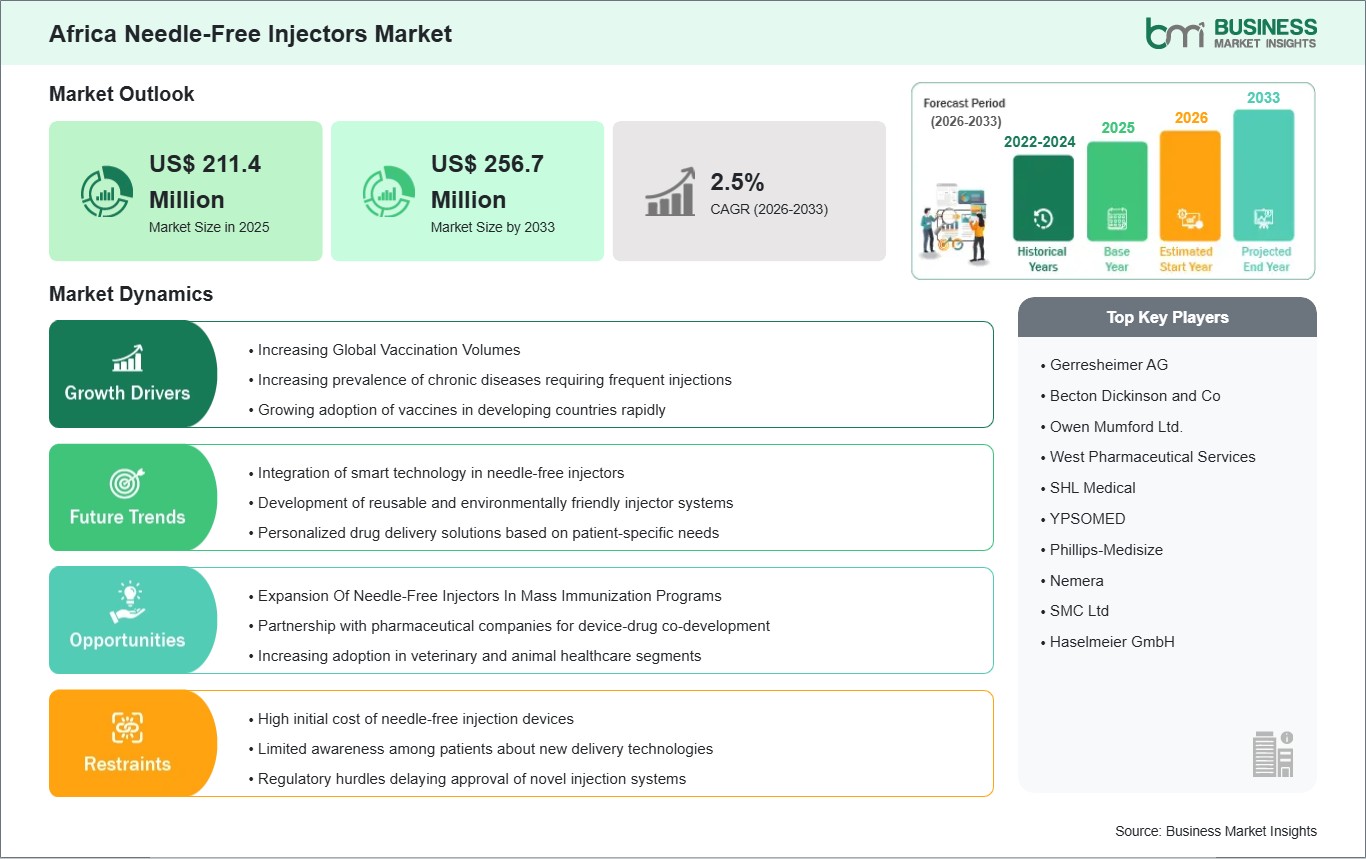
The Africa Needle-free Injectors Market size is expected to reach US$ 256.7 million by 2033 from US$ 211.4 million in 2025. The market is estimated to record a CAGR of 2.5 % from 2026 to 2033.
The market is shaped by a growing emphasis on reducing needle-stick injuries, improving infection control, and increasing patient compliance, particularly in mass immunization and chronic disease management programs. Needle-free injectors are gaining strategic relevance as governments and healthcare providers modernize delivery mechanisms while addressing long-standing challenges related to sharps disposal and healthcare worker safety. Market participants are focusing on device reliability, dose accuracy, and adaptability to different therapeutic applications, which has intensified competition among global manufacturers and emerging regional players. The market demonstrates a mixed adoption pattern influenced by healthcare infrastructure disparities across Africa. Urban and private healthcare facilities show higher penetration of advanced delivery technologies, while rural and public systems remain more cautious due to budgetary constraints and training requirements. Regulatory frameworks are maturing, with countries aligning medical device approvals with international standards, improving market transparency and investor confidence. Distribution partnerships with local medical suppliers have become a critical market entry strategy, enabling manufacturers to navigate complex procurement systems and fragmented healthcare networks. The competitive landscape is characterized by moderate consolidation, with multinational firms leveraging technological expertise and brand recognition, while regional players compete on cost efficiency and localized service support. Innovation is centered on spring-based and gas-powered injector designs that prioritize ease of use and minimal maintenance. Stakeholders are evaluating lifecycle cost benefits rather than upfront device pricing, reflecting a shift toward long-term value-based procurement. The market analysis indicates steady institutional interest, supported by policy-driven healthcare improvements and a transition toward advanced drug delivery solutions.

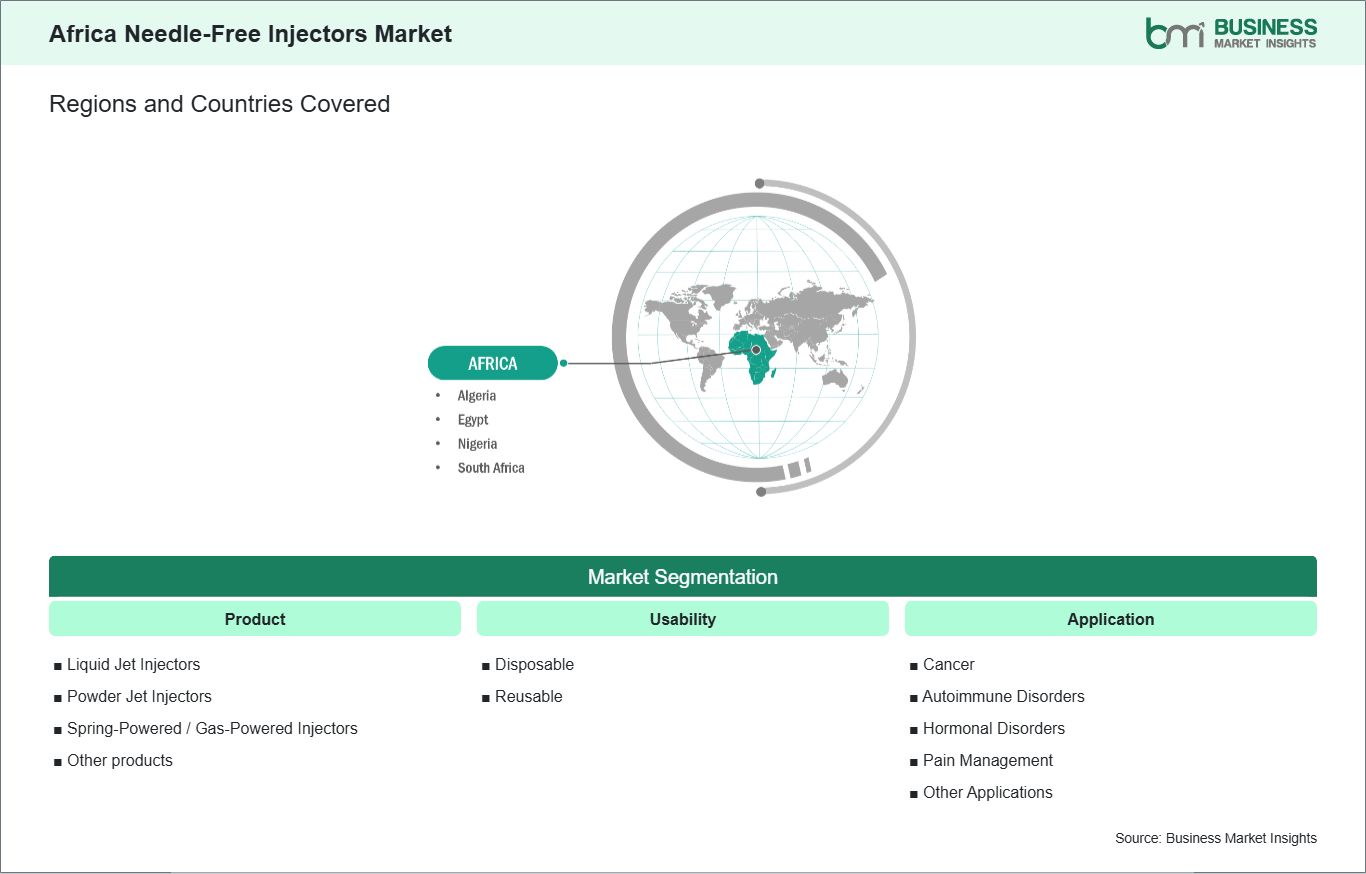
Key segments that contributed to the derivation of the Africa needle-free injectors market analysis are product, usability, and application.
Across developed and developing regions, vaccination efforts have intensified due to routine childhood immunization schedules, disease eradication initiatives, emergency outbreak responses, and periodic booster campaigns. This expansion places greater emphasis on delivery technologies that can support large volumes while maintaining safety and patient comfort. In Africa, rising vaccination volumes are associated with strengthened public health initiatives targeting infectious diseases such as measles, polio, tuberculosis, meningitis, and emerging viral infections. As governments and health organizations work to improve coverage rates, there is attention on methods that allow for rapid and consistent vaccine administration, particularly in mass immunization and outreach programs. Needle-free injectors align with these requirements by enabling quicker delivery and improving acceptance among pediatric and needle-averse populations. Higher vaccination volumes highlight challenges related to needlestick injuries, syringe reuse, and the disposal of sharps waste, especially in high-throughput or resource-limited healthcare settings. Needle-free injector systems address these concerns by eliminating needles, thereby enhancing safety for healthcare workers and reducing the burden of medical waste management during large-scale campaigns. The growth in global vaccination volumes has been accompanied by increased support from international health agencies, non-governmental organizations, and donor-funded initiatives focused on strengthening immunization infrastructure. As vaccination programs broaden in reach and complexity, there is a shift toward delivery technologies that are reliable, easy to use, and adaptable to diverse clinical and community settings. In this context, rising global vaccination volumes play an important role in shaping the adoption of needle-free injectors within Africa.
Mass immunization programs—driven by routine childhood immunizations, outbreak responses, and global eradication goals—require delivery methods that can handle high volumes while maintaining safety and patient acceptance. Needle-free injectors align with these requirements by enabling rapid vaccine administration, reducing the time needed per patient, and simplifying the training process for healthcare workers. In African settings, mass vaccination drives are conducted in remote or underserved regions where healthcare resources are limited. Needle-free injectors support outreach efforts by being easy to use, portable, and suitable for community-based campaigns. In pediatric immunization programs, fear of needles can deter participation. By offering a less intimidating experience, needle-free devices can increase vaccine uptake and improve coverage rates. Mass immunization programs raise concerns related to needlestick injuries, needle reuse, and biomedical waste disposal, especially when large numbers of doses are administered in short time frames. Needle-free injectors eliminate the needle component, reducing the risk of accidental injuries and lowering the volume of hazardous waste generated during campaigns. This trend aligns with public health priorities focused on improving safety and reducing infection risks among healthcare workers and communities. As governments, international health organizations, and NGOs prioritize immunization across Africa, the incorporation of needle-free injectors into mass vaccination strategies continues to support more efficient, safer, and patient-friendly vaccine delivery. This trend is expected to contribute to wider adoption of needle-free systems across the region, especially in high-volume immunization settings.

The Africa Needle-free Injectors Market demonstrates steady growth, with size and share analysis highlighting evolving trends and competitive dynamics among key players. The report examines subsegments categorized within product, usability, and application, offering insights into their contribution to overall market performance.
By product, the liquid jet injectors subsegment dominated the market in 2025, driven by their ability to deliver precise, consistent doses through high-pressure liquid streams without needles, meeting clinical needs in needle-free delivery.
Based on usability, the disposable subsegment dominated the market in 2025, driven by its convenience and reduced risk of cross-contamination with minimal preparation, enhancing safety and ease of use in diverse settings.
In terms of application, the autoimmune disorders subsegment dominated the market in 2025, driven by the rising prevalence and demand for painless, patient-centric delivery of therapeutic biologics and chronic treatments that benefit from needle-free systems.
| Report Attribute | Details |
|---|---|
| Market size in 2025 | US$ 211.4 Million |
| Market Size by 2033 | US$ 256.7 Million |
| CAGR (2026 - 2033) | 2.5% |
| Historical Data | 2022-2024 |
| Forecast period | 2026-2033 |
| Segments Covered | By Product
|
|
Regions and Countries Covered
| |
| Africa | Egypt, South Africa, Nigeria, Algeria |
| Market leaders and key company profiles |
|
The "Africa Needle-free Injectors Market Size and Forecast (2022–2033)" report provides a detailed analysis of the market covering below areas:
The geographical scope of the Africa Needle-free Injectors Market report is divided into Egypt, South Africa, Nigeria, and Algeria. Nigeria held the largest share in 2025.
Nigeria represents a relatively advanced market, supported by a well-established private healthcare sector, higher awareness of advanced medical devices, and structured procurement processes. The country serves as a regional entry point for multinational manufacturers seeking broader Southern African expansion. South Africa is influenced by population scale and expanding immunization coverage, creating demand for delivery systems capable of handling high patient volumes. However, procurement fragmentation and cost sensitivity require suppliers to adopt flexible pricing and partnership-based distribution models. Algeria demonstrates growing openness to innovative drug delivery technologies, supported by strong engagement from international health organizations and pilot programs targeting vaccination and maternal health services. North African countries such as Egypt exhibit demand driven by government-led healthcare modernization efforts and increasing local manufacturing capabilities. These markets emphasize regulatory compliance and product standardization, favoring suppliers with strong quality assurance credentials. Emerging markets in East and Francophone West Africa are characterized by donor-driven procurement, where purchasing decisions are closely tied to global health funding cycles and program-specific requirements. Country insights highlight the importance of tailored market strategies. Success depends on aligning product offerings with national healthcare priorities, reimbursement structures, and operational realities, rather than adopting a uniform continental approach.

The Africa Needle-free Injectors Market is evaluated by gathering qualitative and quantitative data post primary and secondary research, which includes important corporate publications, association data, and databases. A few of the key developments in the Africa needle-free injectors market are:
The Africa Needle-Free Injectors Market is valued at US$ 211.4 Million in 2025, it is projected to reach US$ 256.7 Million by 2033.
As per our report Africa Needle-Free Injectors Market, the market size is valued at US$ 211.4 Million in 2025, projecting it to reach US$ 256.7 Million by 2033. This translates to a CAGR of approximately 2.5% during the forecast period.
The Africa Needle-Free Injectors Market report typically cover these key segments-
The historic period, base year, and forecast period can vary slightly depending on the specific market research report. However, for the Africa Needle-Free Injectors Market report:
The Africa Needle-Free Injectors Market is populated by several key players, each contributing to its growth and innovation. Some of the major players include:
The Africa Needle-Free Injectors Market report is valuable for diverse stakeholders, including:
Essentially, anyone involved in or considering involvement in the Africa Needle-Free Injectors Market value chain can benefit from the information contained in a comprehensive market report.
Please tell us your area of interest
(Market Segments/ Regions and Countries/ Companies)