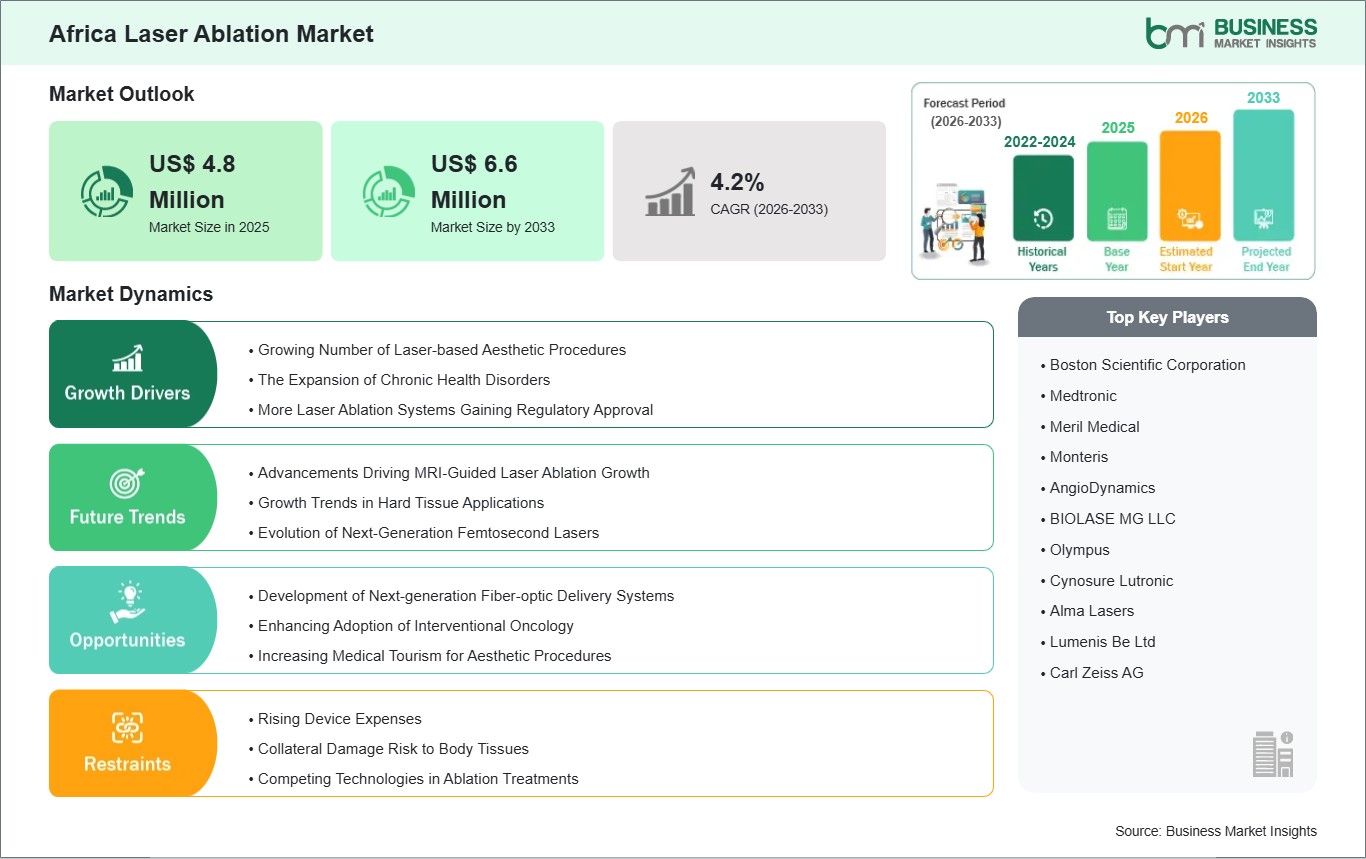
The Africa laser ablation market size is expected to reach US$ 6.6 million by 2033 from US$ 4.8 million in 2025. The market is estimated to record a CAGR of 4.2% from 2026 to 2033.
There is an increasing prevalence of chronic conditions, particularly cancers and dermatological disorders, where targeted tissue removal and reduced procedural risk are critical. Healthcare providers are exploring laser-based solutions due to their ability to enhance treatment accuracy while minimizing patient recovery time, which is becoming an important consideration in urban hospitals and specialized clinics.
There is a growing awareness and acceptance of aesthetic and cosmetic procedures across urban populations. This trend is contributing to the expansion of laser applications beyond traditional medical uses, especially in dermatology and skin care treatments. The expansion of private healthcare networks is supporting access to advanced technologies, particularly in economically stronger regions within Africa.
However, the uneven healthcare infrastructure across countries limits access to advanced procedures in rural and underserved areas. The high cost of laser equipment and maintenance, along with the need for trained professionals, creates barriers to widespread adoption.

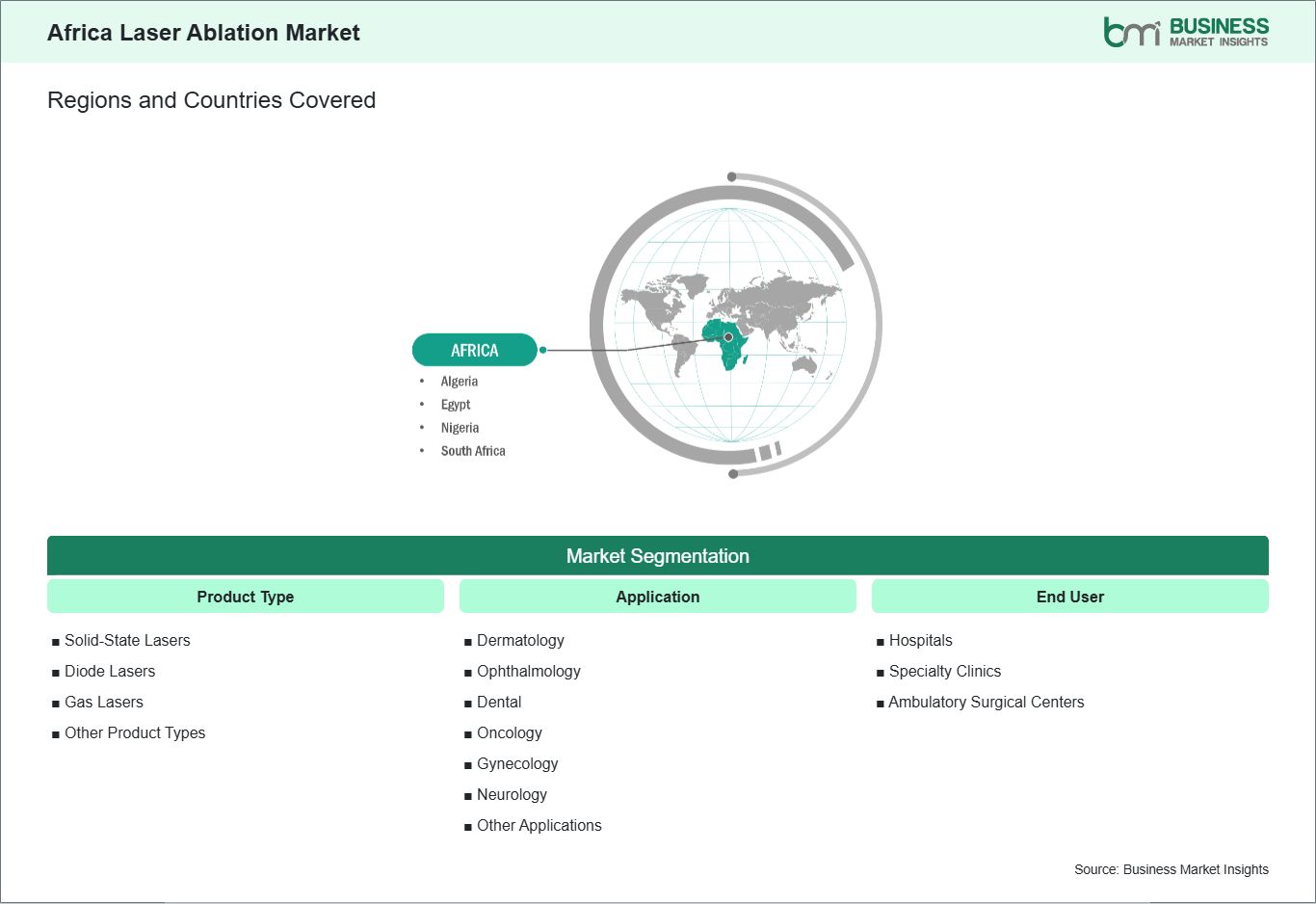
Key segments that contributed to the derivation of the Africa Laser Ablation market analysis are product type, application, and end user.
Africa is witnessing a notable rise in the number of laser-based aesthetic procedures, driven by shifting consumer preferences toward minimally invasive cosmetic treatments. Urban populations across countries such as South Africa, Nigeria, and Kenya are seeking procedures such as laser hair removal, skin resurfacing, and scar revision as awareness around aesthetic dermatology improves. The growing influence of global beauty trends, amplified through social media and digital platforms, is encouraging younger demographics to explore laser-based solutions for both corrective and preventive skincare.
There is an expansion of private dermatology clinics and aesthetic centers in major cities. These facilities are equipped with advanced laser technologies and staffed by trained practitioners, making procedures more accessible than in the past. The normalization of cosmetic procedures in professional and social settings is reducing stigma, encouraging a broader segment of the population, including men, to consider aesthetic treatments. This cultural shift is evident in urban hubs where lifestyle changes and appearance-consciousness are more pronounced.
The diversity of skin tones across the population plays a role in shaping demand for laser ablation procedures. There is a growing need for treatments that address conditions such as hyperpigmentation, keloid scars, and acne-related concerns without causing adverse effects. As a result, clinics are adopting specialized laser systems designed for darker skin types, which is helping build patient confidence and driving procedure volumes across the region.
Advancements in fiber-optic delivery systems are significantly influencing the evolution of the laser ablation market in Africa. These systems enhance the precision and control of laser energy, enabling practitioners to perform targeted treatments with improved safety and efficiency. Their flexible design allows for better maneuverability during procedures, which is valuable in dermatological and surgical applications. As healthcare providers modernize their offerings, the demand for such advanced and adaptable technologies continues to increase.
The development of next-generation fiber-optic systems is enabling the use of compact and portable laser devices, which are well-suited to the varying healthcare infrastructure across the continent. In regions where access to large, centralized medical facilities may be limited, portable systems allow practitioners to deliver high-quality treatments in smaller clinics or mobile healthcare settings. This flexibility is helping bridge gaps in access to advanced care, especially in underserved and semi-urban areas.
Continuous improvements in energy delivery, cooling mechanisms, and real-time feedback integration are enhancing treatment outcomes and reducing the risk of complications. These innovations are important in Africa, where patient safety and treatment customization are critical due to diverse skin characteristics. As training and technical expertise among practitioners continue to grow, the adoption of advanced fiber-optic laser systems is expected to support broader applications of laser ablation beyond aesthetics, including in general surgery and other specialized medical fields.

The African laser ablation market is experiencing steady growth, with market size and share analysis reflecting evolving treatment preferences and competitive dynamics among key players. The report evaluates important subsegments categorized within product type, application, and end user, highlighting their respective contributions to overall market performance.
By product type, the solid-state lasers subsegment dominated the market in 2025, driven by the superior performance and versatility of solid-state lasers in clinical applications. These devices offer high precision, consistent energy delivery, and compatibility with a wide range of tissues, making them the preferred choice for laser ablation procedures.
In terms of application, the dermatology subsegment dominated the market in 2025, propelled by the increasing prevalence of skin disorders such as acne scars, pigmentation issues, and vascular lesions, coupled with a growing demand for minimally invasive cosmetic procedures.
Based on end user, the hospitals subsegment dominated the market in 2025 due to their well-established dermatology and surgical departments, access to advanced laser ablation systems, and availability of trained physicians and clinical staff.
| Report Attribute | Details |
|---|---|
| Market size in 2025 | US$ 4.8 Million |
| Market Size by 2033 | US$ 6.6 Million |
| CAGR (2026 - 2033) | 4.2% |
| Historical Data | 2022-2024 |
| Forecast period | 2026-2033 |
| Segments Covered | By Product Type
|
|
Regions and Countries Covered
| |
| Africa | Egypt, South Africa, Nigeria, Algeria |
| Market leaders and key company profiles |
|
The "Africa Laser Ablation Market Size and Forecast (2022–2033)" report provides a detailed analysis of the market covering below areas:
The geographical scope of the Africa Laser Ablation market report is divided into Nigeria, Egypt, South Africa, and Algeria. South Africa held the largest share in 2025.
South Africa has seen increasing integration of laser technologies into medical disciplines, including oncology, dermatology, ophthalmology, and urology. It is due to the availability of specialized practitioners and healthcare facilities that are equipped to adopt and maintain advanced treatment technologies.
There is a growing preference for minimally invasive procedures among patients and healthcare professionals. Laser-based treatments are being utilized for their ability to reduce complications, which aligns with the shift toward efficient and patient-centric care. In addition, the rise in cosmetic and aesthetic procedures, particularly in urban centers, is contributing to sustained demand for laser technologies.
The presence of a well-developed private healthcare sector plays a significant role, as private institutions are more likely to invest in advanced equipment and offer specialized services. However, disparities between private and public healthcare systems remain a challenge, with access to such technologies being limited in public hospitals. This uneven distribution of resources continues to influence the penetration of laser ablation technologies across the country.

The Africa Laser Ablation market is evaluated by gathering qualitative and quantitative data post primary and secondary research, which includes important corporate publications, association data, and databases. A few of the key developments in the Africa Laser Ablation market are:
The Africa Laser Ablation Market is valued at US$ 4.8 Million in 2025, it is projected to reach US$ 6.6 Million by 2033.
As per our report Africa Laser Ablation Market, the market size is valued at US$ 4.8 Million in 2025, projecting it to reach US$ 6.6 Million by 2033. This translates to a CAGR of approximately 4.2% during the forecast period.
The Africa Laser Ablation Market report typically cover these key segments-
The historic period, base year, and forecast period can vary slightly depending on the specific market research report. However, for the Africa Laser Ablation Market report:
The Africa Laser Ablation Market is populated by several key players, each contributing to its growth and innovation. Some of the major players include:
The Africa Laser Ablation Market report is valuable for diverse stakeholders, including:
Essentially, anyone involved in or considering involvement in the Africa Laser Ablation Market value chain can benefit from the information contained in a comprehensive market report.
Please tell us your area of interest
(Market Segments/ Regions and Countries/ Companies)