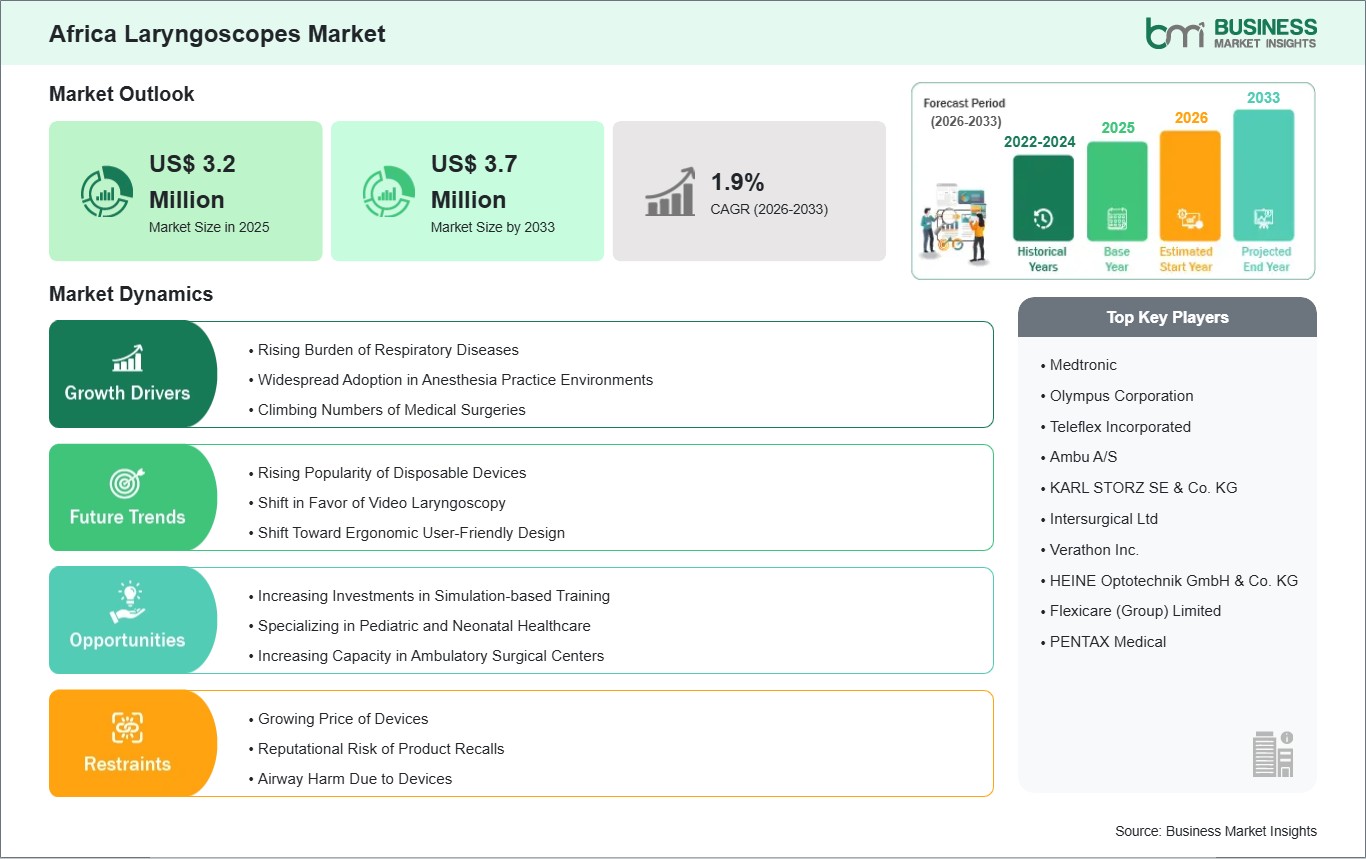
The Africa laryngoscopes market size is expected to reach US$ 3.7 million by 2033 from US$ 3.2 million in 2025. The market is estimated to record a CAGR of 1.9% from 2026 to 2033.
In Africa, the laryngoscope market has been fueled by continuous developments that have been brought about by improvements in the healthcare sector, as well as efforts to enhance the techniques used for airway management during surgical operations and emergencies. Market growth is mainly due to the rising number of surgical operations, critical care services, and compliance with patient safety regulations in hospitals, particularly in urban centers.
The use of airway visualization devices such as the video laryngoscope has played a major role in fueling market expansion. The adoption has been supported by the increasing understanding on the significance of airway visualization and intubation. In addition, the interventions made by the government towards improving the state of healthcare and hospitals have been vital in helping achieve market penetration. However, there are several challenges in this scenario, for instance, financial issues that have limited the purchasing capacity of some healthcare organizations. Furthermore, there has been an unbalanced distribution of anesthesiologists and other personnel offering emergency services, making it hard to employ the machines. Nevertheless, there has been significant growth potential due to the growing involvement of private hospitals, imports of devices, and better clinical training sessions.

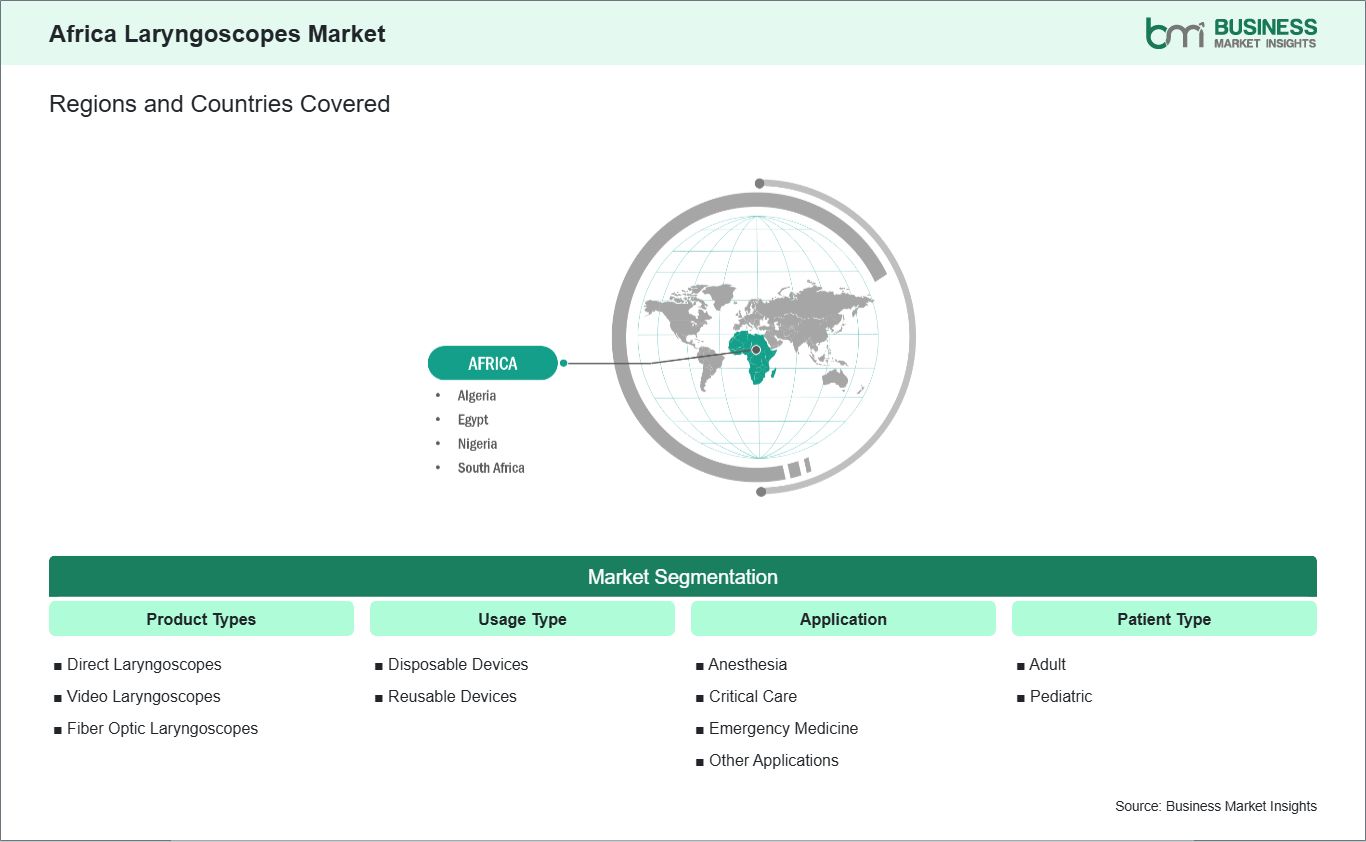
Key segments that contributed to the derivation of the Africa laryngoscopes market analysis are product type, usage type, application, patient type, and end user.
The African market for laryngoscopes is currently being shaped by rising cases of respiratory disorders, which can be attributed to various factors, such as environmental and infectious causes, along with changes in lifestyles. The quickening pace of urbanization has resulted in poor air quality, with increased pollution from vehicles, factories, and even homes. This situation has led to more patients suffering from respiratory ailments.
In addition to the environmental variables, the respiratory infectious diseases have remained a considerable burden for the health care facilities. Diseases like pneumonia, tuberculosis, and other life-threatening infections lead to advanced stages in which the patient needs to be put on ventilators and breathing tubes. Consequently, there is an increased need for laryngoscopes in emergency situations and operations that require quick access to the airways.
Furthermore, there has been a rise in the occurrence of other chronic diseases, such as asthma and chronic obstructive pulmonary disease. The cases have not been well-managed at their early stages, forcing individuals to seek medical attention when their situation is dire. Consequently, there has been a consistent need for laryngoscopes in health facilities within the region.
Simulation training is more popular within the healthcare field as a training technique. Training facilities have begun to understand that it is more beneficial to use simulations as a platform to train health care providers on intubations because it allows them to practice what they need to do in a safe environment prior to performing the task clinically.
The major reason behind such an evolution is the necessity of overcoming the shortage of exposure to challenging airway conditions that trainees have in their initial education period. The ability to repeat complex situations makes it easier for doctors to develop proper decision-making skills and improve their technique without harming patients, which is especially crucial when dealing with difficult airways.
Another reason for this transition lies in increased spending on training facilities. Modern medicine uses more and more simulation models to teach students how to conduct airway management safely. Although low-budget models of training are also utilized in poor countries, they allow more people to become aware of sophisticated laryngoscopy techniques and devices.
The Africa Laryngoscopes market demonstrates steady growth, with size and share analysis highlighting evolving trends and competitive dynamics among key players. The report evaluates important subsegments categorized within product type, usage type, application, patient type, and end user, highlighting their respective contributions to overall market performance.
By product type, the video laryngoscopes subsegment dominated the laryngoscopes market in 2025. This is driven by the increasing demand for enhanced airway visualization, improved first-pass intubation success rates, and reduced complications in difficult airway management, making them a key revenue driver for manufacturers and supporting strong adoption in clinical practice.
In terms of usage type, the disposable devices subsegment led the market in 2025. The dominance of disposable devices is attributed to the growing emphasis on infection control, prevention of cross-contamination, and the operational convenience of eliminating reprocessing and sterilization requirements in high-volume healthcare settings.
Based on application, the anesthesia subsegment held the largest share in 2025. Hospitals and surgical centers widely rely on laryngoscopes during anesthesia procedures for airway management and intubation, supported by the rising number of surgeries and the increasing use of advanced airway management techniques.
In terms of patient type, the adult subsegment dominated the market in 2025. This is driven by the higher prevalence of surgical procedures, critical care admissions, and chronic respiratory conditions among adults, resulting in greater demand for airway management devices in this population group.
By end user, the hospitals subsegment held the largest share in 2025. Hospitals maintain leadership due to their advanced infrastructure, availability of skilled healthcare professionals, high patient inflow, and strong capability to perform complex surgical and emergency procedures requiring laryngoscopy.
| Report Attribute | Details |
|---|---|
| Market size in 2025 | US$ 3.2 Million |
| Market Size by 2033 | US$ 3.7 Million |
| CAGR (2026 - 2033) | 1.9% |
| Historical Data | 2022-2024 |
| Forecast period | 2026-2033 |
| Segments Covered | By Product Types
|
|
Regions and Countries Covered
| |
| Africa | Egypt, South Africa, Nigeria, Algeria |
| Market leaders and key company profiles |
|
The "Africa Laryngoscopes Market Size and Forecast (2022-2033)" report provides a detailed analysis of the market covering below areas:
The geographical scope of the Africa Laryngoscopes market report is divided into Nigeria, Egypt, South Africa, and Algeria. South Africa held the largest share in 2025.
South Africa stands out as the leading and most prominent market in the African laryngoscopes market, owing to its relatively more developed healthcare system and better adoption of medical technologies. It possesses an extensive healthcare network that comprises both public and private sectors. These healthcare centers feature sophisticated operating rooms and intensive care units that necessitate efficient airway management tools. The rising number of surgeries, trauma cases, and ICU admissions in South Africa drives demand for laryngoscopes. Private hospitals in South Africa show a greater preference towards video and fiber optic laryngoscopes compared to their counterparts in the public sector.
However, the need to save on costs within the public healthcare industry remains another important constraint leading to the continued use of traditional laryngoscope techniques. The decision-making processes involved in such purchases are largely dependent on cost savings and not innovations in technology. Furthermore, there is an unequal distribution of healthcare services between urban and rural communities that has caused unequal adoption of laryngoscopes. Despite all these limitations, South Africa remains an essential gateway through which other medical devices are distributed in the region and also leads in technological trends.

The Africa Laryngoscopes market is evaluated by gathering qualitative and quantitative data post primary and secondary research, which includes important corporate publications, association data, and databases. A few of the key developments in the Africa Laryngoscopes market are:
The Africa Laryngoscopes Market is valued at US$ 3.2 Million in 2025, it is projected to reach US$ 3.7 Million by 2033.
As per our report Africa Laryngoscopes Market, the market size is valued at US$ 3.2 Million in 2025, projecting it to reach US$ 3.7 Million by 2033. This translates to a CAGR of approximately 1.9% during the forecast period.
The Africa Laryngoscopes Market report typically cover these key segments-
The historic period, base year, and forecast period can vary slightly depending on the specific market research report. However, for the Africa Laryngoscopes Market report:
The Africa Laryngoscopes Market is populated by several key players, each contributing to its growth and innovation. Some of the major players include:
The Africa Laryngoscopes Market report is valuable for diverse stakeholders, including:
Essentially, anyone involved in or considering involvement in the Africa Laryngoscopes Market value chain can benefit from the information contained in a comprehensive market report.
Please tell us your area of interest
(Market Segments/ Regions and Countries/ Companies)