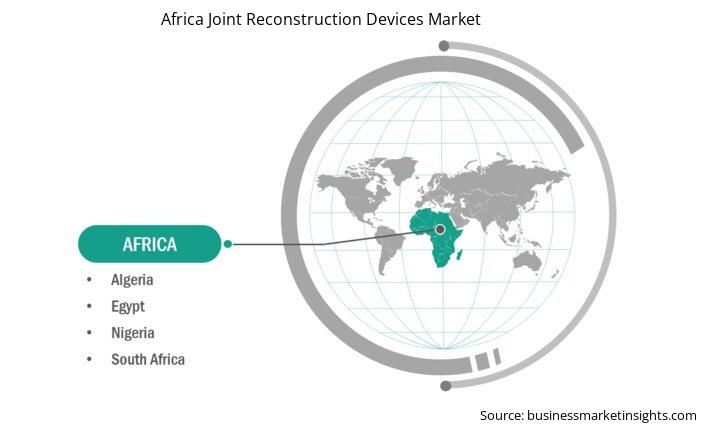
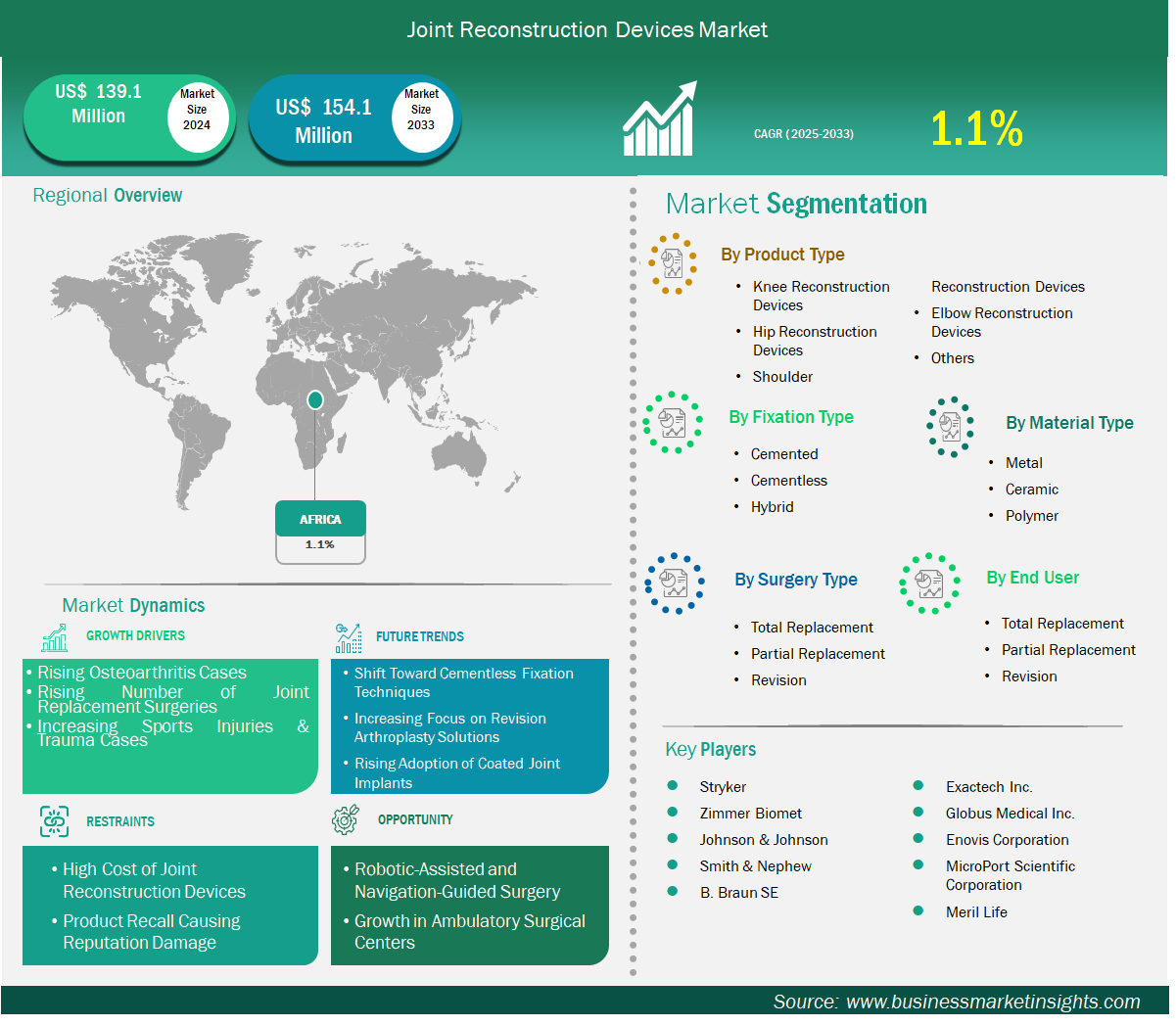
Africa joint reconstruction devices market size is expected to reach US$ 154.1 million by 2031 from US$ 139.1 million in 2024. The market is estimated to record a CAGR of 1.1% from 2025 to 2031.
Executive Summary and Africa Joint Reconstruction Devices Market Analysis:
The joint reconstruction devices market in Africa remains largely undeveloped with minimal market share compared to other regions. For many parts of Africa, access to hip and knee replacement surgeries is limited due to gaps in healthcare infrastructure, lack of trained orthopedic surgeons, and restrictions on public healthcare budgets. Most operations for joint reconstruction are completed in a few urban hospitals and private clinics, where patients can pay for higher cost surgeries and imported implants.
Public healthcare systems of many low- and middle-income countries in Africa focus on basic care or trauma, and this has limited elective procedures such as joint replacement for a wide segment of their population. The recent proliferation of sophisticated surgical technologies remains limited, with only a handful of foreign manufacturers operating localized operations/objectives through distributors or medical missions.
Africa Joint Reconstruction Devices Market Segmentation Analysis:
Key segments that contributed to the derivation of the joint reconstruction devices market analysis are product type, application, and end user.
- By product type, the joint reconstruction devices market is segmented into knee reconstruction devices, hip reconstruction devices, shoulder reconstruction devices, elbow reconstruction devices, others. The knee reconstruction devices segment dominated the market in 2024.
- By fixation type, the joint reconstruction devices market is segmented into cemented, cementless, and hybrid. The cemented segment dominated the market in 2024.
- By material type, the market is segmented into metal, ceramic and polymer. The metal segment held the largest share of the market in 2024.
- By surgery type, the market is segmented into total replacement, partial replacement, and revision. The total replacement segment held the largest share of the market in 2024.
- By end user, the market is segmented into hospitals, ambulatory surgical centers, and orthopedic clinics. The hospitals segment held the largest share of the market in 2024.
Africa Joint Reconstruction Devices Market Outlook
The joint reconstruction devices market in Africa is nascent but is slowly developing out of necessity, as healthcare infrastructure improves, awareness of orthopedic conditions improves, and incidences of trauma and arthritis increase. Urban areas in south Africa, Egypt, Nigeria, and Kenya are showing signs of increased acceptance of joint replacement surgeries, fueled by the growth of private healthcare and specialists. While affordability and access to that level of care is still a concern across the continent, international collaboration and NGO-supported programs are attempting to improve the deficiencies in orthopedic care. Rising medical tourism signals that the joint reconstruction devices market is going to develop more quickly in the immediate future, as countries such as Egypt and Tunisia have positioned themselves as affordable providers of orthopedic surgeries for patients from neighboring African and Middle Eastern countries. The continued adoption of joint reconstruction devices and motion preservation strategies will promote demand for advanced joint reconstruction solutions.
Africa Joint Reconstruction Devices Market Country Insights
Based on country, the Africa joint reconstruction devices Market is further segmented into the Nigeria, Ethiopia, Egypt, DR Congo, South Africa, Tanzania, Kenya, Uganda, Sudan, Algeria, others. The South Africa held the largest share in 2024.
The most prominent country in Africa regarding the joint reconstruction devices market is South Africa. However, when evaluated in the global perspective with others major countries, the overall market is still small in comparison, mostly a market category integrated into larger hospitals of the cities. Most procedures are at urban hospitals, the public hospital's orthopaedic surgeries are limited to basic necessary care, being able to offer more advanced implants and surgical advancements largely limits any private surgery. The extent to which orthopaedic practice can further integrate advanced methods, partially due to limited budgets and regional component access. Some international suppliers do supply their devices through agreed with local partners under selective products and training, however, one could expect a moderate increase in activity in this space from a supply side.
Africa Joint Reconstruction Devices Market Company Profiles
Stryker, Zimmer Biomet, Johnson & Johnson, Smith & Nephew, B. Braun SE, Exactech Inc., Globus Medical Inc., Enovis Corporation, MicroPort Scientific Corporation, and Meril Life are among the key players operating in the market. These players adopt strategies such as expansion, product innovation, and mergers and acquisitions to stay competitive in the market and offer innovative products to their consumers.
Africa Joint Reconstruction Devices Market Research Methodology:
The following methodology has been followed for the collection and analysis of data presented in this report:
- Secondary Research
The research process begins with comprehensive secondary research, utilizing both internal and external sources to gather qualitative and quantitative data for each market. Commonly referenced secondary research sources include, but are not limited to:
- Company websites, annual reports, financial statements, broker analyses, and investor presentations
- Industry trade journals and other relevant publications
- Government documents, statistical databases, and market reports
- News articles, press releases, and webcasts specific to companies operating in the market
Note: All financial data included in the Company Profiles section has been standardized to US$. For companies reporting in other currencies, figures have been converted to US$ using the relevant exchange rates for the corresponding year.
- Primary Research
Business Market Insights conducts a significant number of primary interviews each year with industry stakeholders and experts to validate and analyze the data and gain valuable insights. These research interviews are designed to:
- Refine findings from secondary research
- Enhance the expertise and market understanding of the analysis team
- Gain insights into market size, trends, growth patterns, competitive dynamics, and future prospects
Primary research is conducted via email interactions and telephone interviews with industry experts across various markets, categories, segments, and sub-segments in different regions. Participants typically include:
- Industry stakeholders: Vice Presidents, business development managers, market intelligence managers, and national sales managers
- External experts: Valuation specialists, research analysts, and key opinion leaders with industry-specific expertise
Key Sources Referred:
- The World Bank World Development Indicators
- World Health Organization (WHO)
- Center for Disease Control and Prevention (CDC)
- Medicines and Healthcare Products Regulatory Agency (MHRA)
- American Academy of Orthopaedic Surgeons
- American Orthopaedic Association
- The World Orthopaedic Organisation
- Company website
- Accompany annual reports
- Company investor presentations
Africa Joint Reconstruction Devices Market Strategic Insights
Africa Joint Reconstruction DevicesMarket Report Highlights
| Report Attribute | Details |
| Market size in 2024 | US$ 139.1 Million |
| Market Size by 2033 | US$ 154.1 Million |
| CAGR (2025 - 2033) | 1.1% |
| Historical Data | 2022-2023 |
| Forecast period | 2025-2033 |
| Segments Covered |
By Product Type
|
|
Regions and Countries Covered
|
|
| Africa | Egypt, South Africa, Nigeria, Algeria |
| Market leaders and key company profiles |
|
Africa Joint Reconstruction Devices Market Country and Regional Insights