Market Summary
Executive Summary and Market Analysis
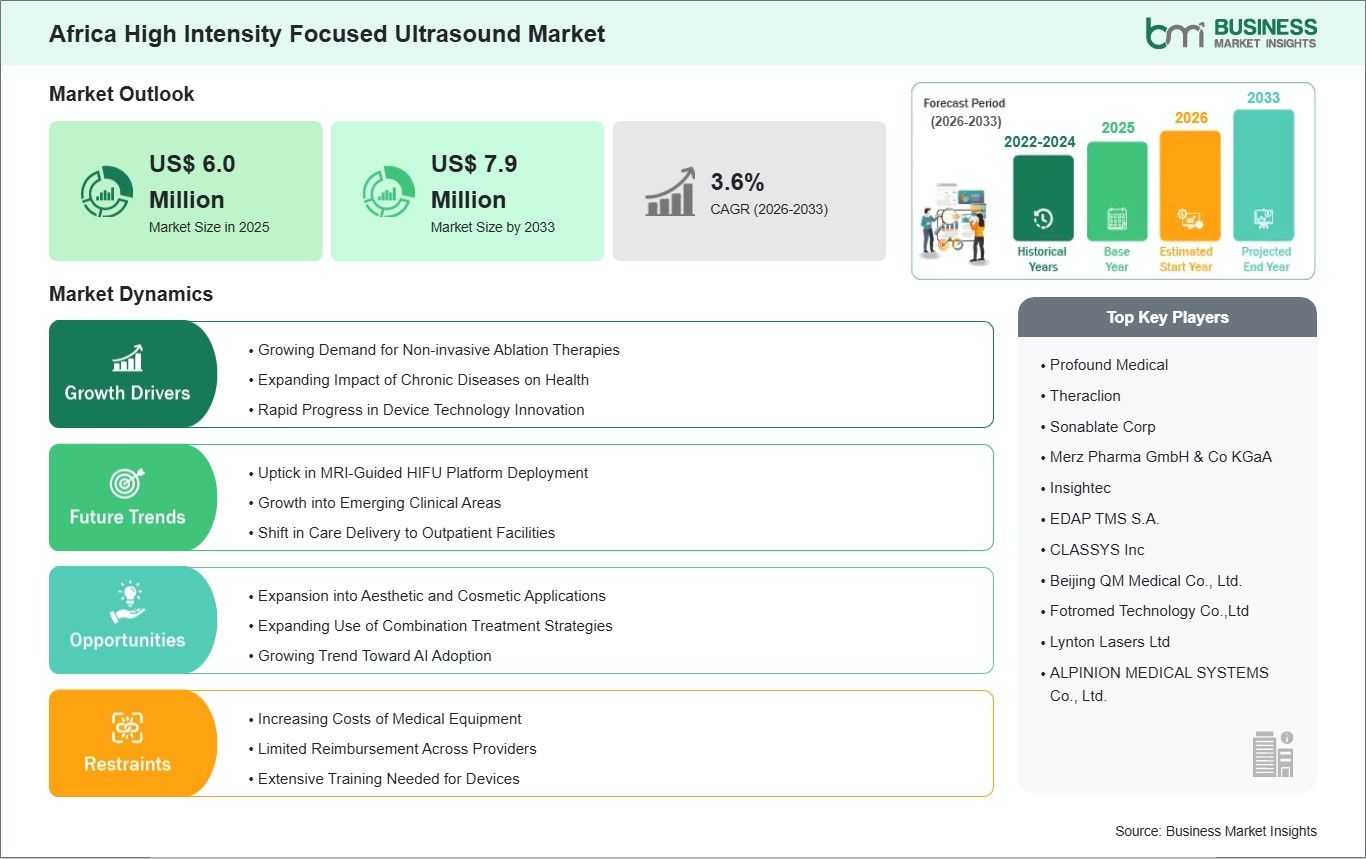
The High Intensity Focused Ultrasound (HIFU) market in Africa is emerging as a strategically important segment within the broader medical devices industry, driven by increasing awareness of noninvasive therapeutic technologies and growing investment in advanced healthcare infrastructure. Across Africa, HIFU adoption is expanding beyond major metropolitan areas into private specialty clinics and tertiary care hospitals, supported by a rising prevalence of chronic conditions such as uterine fibroids, prostate cancer, and certain benign tumors that are well‑suited for HIFU treatment. Healthcare stakeholders are particularly interested in the technology’s potential to reduce hospital stays, minimize post‑operative complications, and lower overall costs associated with traditional surgical procedures. Key drivers include the expanding middle‑class population with greater healthcare spending capacity and active initiatives by governments to modernize cancer care and women’s health services. However, market growth is tempered by challenges, including limited reimbursement frameworks and skill gaps among clinicians for HIFU operation and patient selection. Regulatory complexities across individual African countries also create barriers for seamless technology adoption, slowing down broader regional deployment despite strong clinical interest.
Segment Analysis
Africa High Intensity Focused Ultrasound Market Segmentation
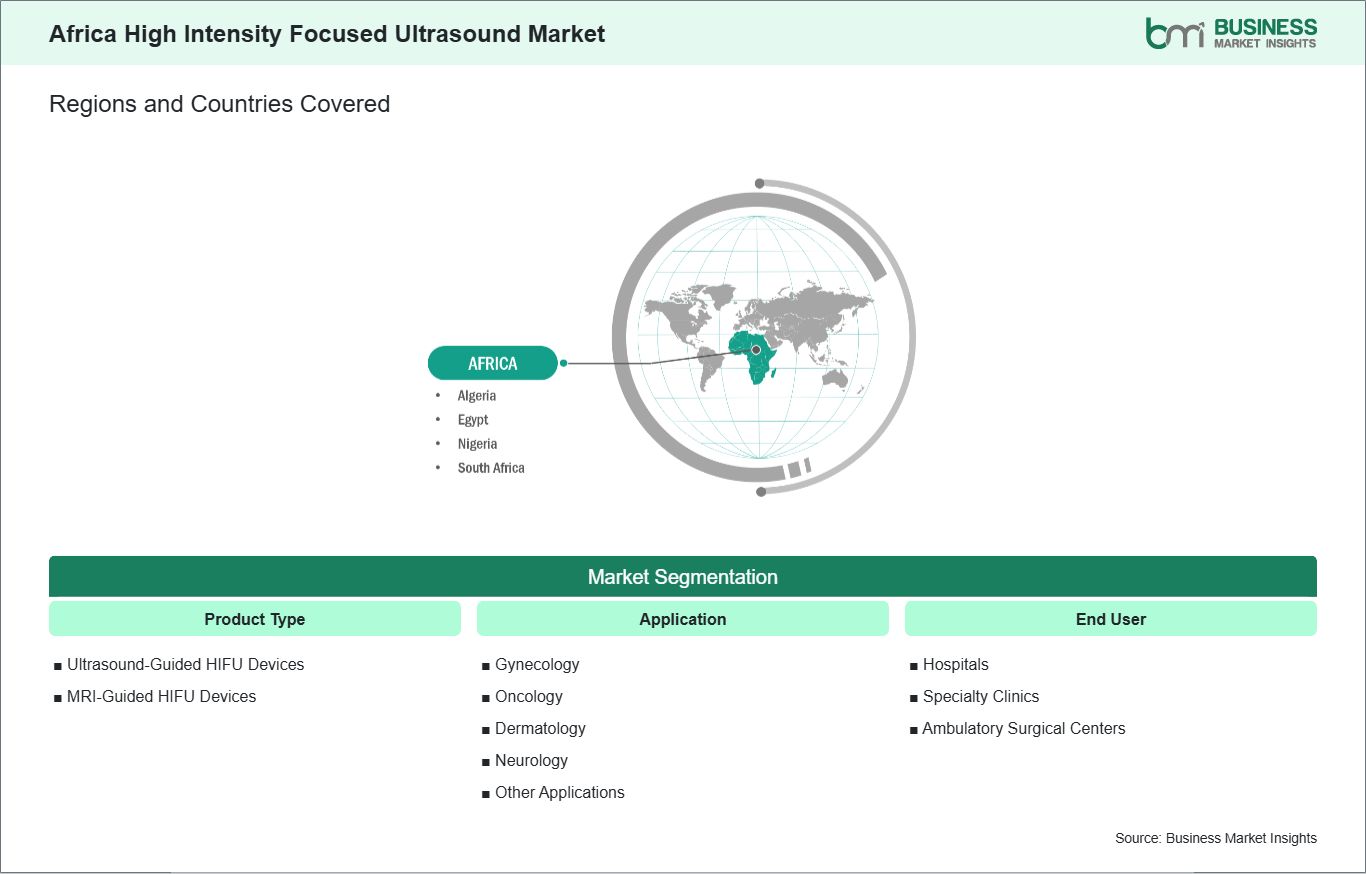
Key segments that contributed to the derivation of the Africa High Intensity Focused Ultrasound market analysis are product type, application, and end user.
- By product type, the high intensity focused ultrasound market is segmented into ultrasound-guided HIFU devices and MRI-guided HIFU devices. The ultrasound-guided HIFU devices segment dominated the market in 2025.
- Based on application, the high intensity focused ultrasound market is classified into gynecology, oncology, dermatology, neurology, and other applications. The gynecology segment dominated the market in 2025.
- In terms of end user, the high intensity focused ultrasound market is categorized into hospitals, specialty clinics, and ambulatory surgical centers. The hospitals segment dominated the market in 2025.
Market Forces
Africa High Intensity Focused Ultrasound Market Drivers and Opportunities
Growing Demand for Noninvasive Ablation Therapies
The African healthcare landscape is embracing noninvasive ablation therapies, particularly for cancer and fibroid treatments. In South Africa and Egypt, hospitals are adopting High Intensity Focused Ultrasound (HIFU) as a less invasive alternative to traditional surgery, offering patients quicker recovery times and reduced procedural risks. Clinics are finding it especially beneficial in cases where surgical intervention may be complicated due to patient comorbidities or resource limitations.
Medical professionals across urban centers are recognizing the clinical benefits of HIFU, such as targeted tissue destruction without harming surrounding organs. This has encouraged larger private hospitals and specialty centers to integrate HIFU platforms into their treatment offerings. Johannesburg and Cairo are observing a growing number of multidisciplinary teams incorporating HIFU into oncology protocols, combining imaging expertise with therapeutic ultrasound applications.
While infrastructure challenges remain in parts of Sub-Saharan Africa, innovative collaborations between local hospitals and international device manufacturers are helping expand access. Pilot programs and demonstration projects in countries such as Nigeria are showing the feasibility of noninvasive ablation therapies even in settings with limited resources, helping clinicians gain experience and confidence in using HIFU technologies.
Expansion into Aesthetic and Cosmetic Applications
Beyond therapeutic uses, HIFU is increasingly being adopted for aesthetic and cosmetic applications in Africa. Clinics in metropolitan areas such as Cape Town, Lagos, and Nairobi are offering non-surgical face lifts, skin tightening, and body contouring treatments, attracting urban clients looking for minimally invasive options. The technology’s ability to achieve visible results without downtime aligns well with consumer preferences in busy urban lifestyles.
The demand for cosmetic HIFU treatments is also supported by a rising awareness of skin health and beauty trends among the middle class. Dermatology and wellness clinics are now investing in portable HIFU systems, making these services more accessible outside large hospital settings. This has allowed smaller practices to diversify their offerings and appeal to a broader clientele.
Despite these advances, HIFU for cosmetic applications is largely concentrated in private clinics and high-income urban markets due to device costs and training requirements. Nevertheless, ongoing professional workshops and international collaborations are helping to build expertise across the continent, setting the stage for wider adoption of HIFU as a standard noninvasive aesthetic.
Size and Share Analysis
Africa High Intensity Focused Ultrasound Market Size and Share Analysis
The African high intensity focused ultrasound market is experiencing steady growth, with market size and share analysis reflecting evolving treatment preferences and competitive dynamics among key players. The report evaluates important subsegments categorized within product type, application, and end user, highlighting their respective contributions to market performance.
By product type, the ultrasound-guided HIFU devices subsegment dominated the market in 2025. This is driven by the recurring need for precise and reliable imaging during HIFU procedures, which ensures accurate targeting and effective ablation of tissues, making these devices a key revenue driver for manufacturers and sustaining consistent demand in clinical settings.
In terms of application, the gynecology subsegment led the market in 2025. The dominance of gynecology applications is attributed to the rising prevalence of uterine fibroids and adenomyosis, growing adoption of noninvasive treatment methods, and increasing awareness among healthcare providers of HIFU’s effectiveness in providing safe, minimally invasive therapeutic options for women’s health conditions.
Based on end user, the hospitals subsegment held the largest share in 2025. Hospitals maintain leadership due to their well-established gynecology and surgical departments, access to advanced HIFU equipment, trained medical staff, and the capability to perform complex procedures while providing comprehensive patient care.
Report Coverage
Africa High Intensity Focused Ultrasound Market Report Coverage and Deliverables
The "Africa High Intensity Focused Ultrasound Market Size and Forecast (2022–2033)" report provides a detailed analysis of the market covering below areas:
- Africa High Intensity Focused Ultrasound market size and forecast at regional and country levels for all market segments covered under the scope
- Africa High Intensity Focused Ultrasound market trends, as well as drivers, restraints, and opportunities
- Africa High Intensity Focused Ultrasound market analysis covering key trends, regional framework, major players, regulations, and recent developments
- Industry landscape and competition analysis covering market concentration, heat map analysis, prominent players, and recent developments for the Africa High Intensity Focused Ultrasound market
- Detailed company profiles, including SWOT analysis
Geographic Insights
Africa High Intensity Focused Ultrasound Market Geographic Insights
The geographical scope of the Africa High Intensity Focused Ultrasound market report is divided into Nigeria, Egypt, South Africa, and Algeria. South Africa held the largest share in 2025.
South Africa stands at the forefront of HIFU market development within Africa, supported by a relatively advanced healthcare system and well‑established private and public hospitals. In South Africa’s leading urban centers, HIFU technology is increasingly being integrated into specialist oncology and women’s health practices, driven by patient demand for noninvasive alternatives to conventional surgery. Local medical communities are actively engaging in awareness campaigns, clinical training programs, and collaborative research to validate HIFU’s effectiveness for conditions such as prostate disorders and uterine fibroids. South African healthcare providers value HIFU for its precision and reduced recovery times, particularly in settings where surgical backlogs and resource constraints make less invasive options attractive. The country’s regulatory environment, while requiring thorough approval processes, is relatively supportive of innovative technologies, allowing faster introduction of new HIFU platforms compared with several other African nations. The penetration varies between urban private facilities and rural public hospitals, reflecting broader disparities in access to advanced medical technologies across the region.
Industry Activity
Recent Developments
The Africa high intensity focused ultrasound market is evaluated by gathering qualitative and quantitative data post primary and secondary research, which includes important corporate publications, association data, and databases. A few of the key developments in the Africa High Intensity Focused Ultrasound market are:
- In September 2025, EDAP TMS S.A. announced that its Focal One High‑Intensity Focused Ultrasound system received the 2025 Industry Award for Innovations in Endourological Instrumentation, reinforcing its leadership and innovative strength in HIFU technology globally, which supports its positioning in Africa, via international sales and clinical engagement.
- In March 2025, EDAP TMS S.A. announced its record 2024 HIFU revenue performance and global Focal One system placements, reflecting increased international deployment momentum that supports broader market expansion, including support for growth in emerging markets such as Africa, where HIFU adoption is gaining traction.
Trust & Transparency
Research Methodology
The market analysis combines proprietary research with secondary data from government agencies, company disclosures, regulatory filings, industry databases and expert interviews. Market estimates are validated through data triangulation, cross-market benchmarking and analyst
review.
View Full Research Methodology
Key Sources Referred:
The World BankWorld Health Organization (WHO)Center for Disease Control and Prevention (CDC)Food and Drug Administration (FDA)European Database on Medical Devices (EUDAMED)European Society of Cardiology (ESC)American College of Cardiology (ACC)American Heart Association (AHA)Company WebsitesCompany Annual ReportsCompany Investor Presentations