Market Summary
Executive Summary and Market Analysis
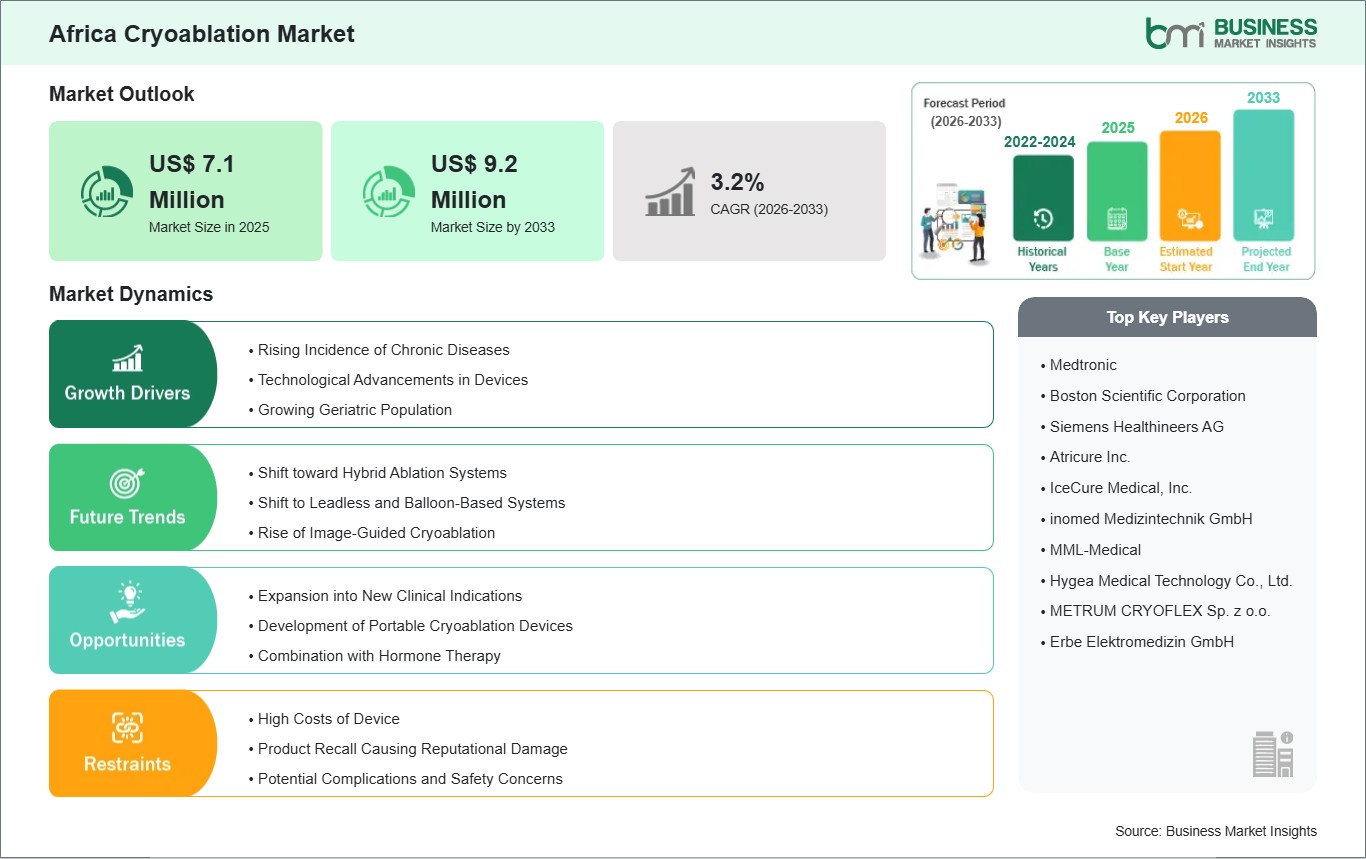
The Africa cryoablation market is gradually gaining prominence as minimally invasive therapeutic procedures become widely accepted in the region’s evolving healthcare landscape. Cryoablation, which encompasses targeted tissue destruction through extreme cold, is viewed as an advanced alternative to conventional surgical procedures, particularly for cardiac arrhythmias, prostate conditions, and certain tumors. A key driver of the market is the growing focus on improving clinical outcomes with reduced hospital stays and faster patient recovery, aligning with healthcare providers’ priorities to enhance service delivery without overburdening limited resources.
Clinical awareness and training are growing among specialists, which is supported by partnerships between device manufacturers and regional medical institutions aimed at building procedural expertise. Despite this progress, the market faces constraints related to disparities in access to advanced medical technologies across urban and rural settings, which can slow technological diffusion. Budgetary limitations in public healthcare systems and competing priorities for infectious disease management also temper rapid growth. Progressive private healthcare providers are actively investing in cryoablation capabilities to meet the rising demand for minimally invasive treatments, illustrating a dual‑tier adoption pattern within the region. The Africa cryoablation market remains nascent compared to more developed regions. A combination of clinical demand, improving infrastructure, and focused professional training is laying the groundwork for sustained expansion in the coming years.
Segment Analysis
Africa Cryoablation Market Segmentation
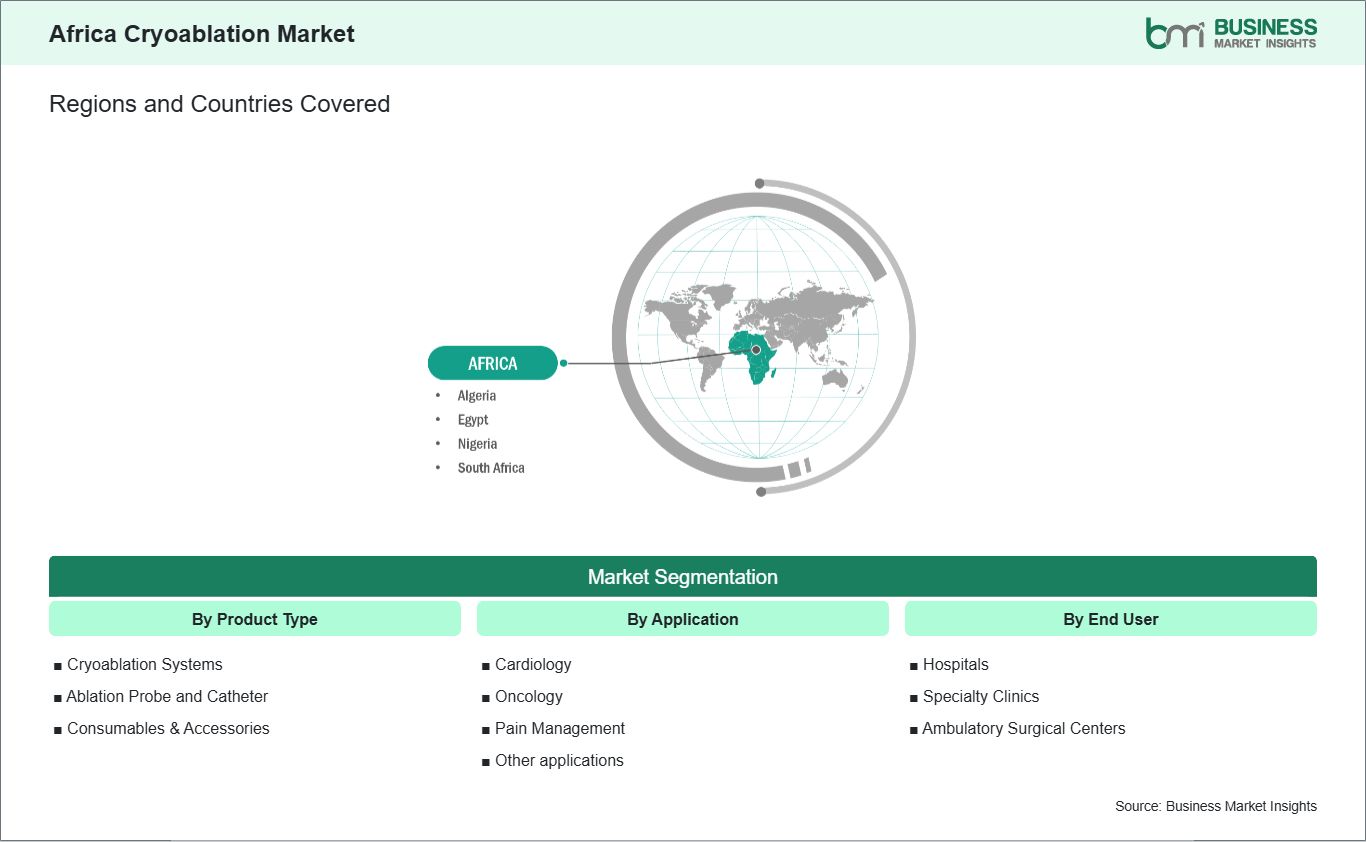
Key segments that contributed to the derivation of the Africa cryoablation market analysis are product type, application, and end user.
- By product type, the cryoablation market is segmented into cryoablation systems, ablation probes and catheters, and consumables & accessories. The ablation probe and catheter segment dominated the market in 2025.
- Based on application, the cryoablation market is classified into cardiology, oncology, pain management, and other applications. The oncology segment dominated the market in 2025.
- In terms of end user, the cryoablation market is categorized into hospitals, specialty clinics, and ambulatory surgical centers. The hospitals segment dominated the market in 2025.
Market Forces
Africa Cryoablation Market Drivers and Opportunities
Rising Incidence of Chronic Diseases
The increasing prevalence of chronic diseases in Africa is creating a strong foundation for the growth of the cryoablation market. Conditions such as cardiac arrhythmias and cancers are becoming more common, prompting healthcare providers to seek advanced, minimally invasive treatment options. Cryoablation offers a targeted approach for managing these diseases, making it an attractive solution for hospitals and specialty clinics across the continent.
Urban healthcare centers in countries with more developed medical infrastructure are beginning to adopt cryoablation as a standard option for treating cardiac and oncological conditions. These facilities are equipped to handle complex procedures, and their growing patient volumes make the investment in cryoablation technology viable.
Despite slower adoption in rural areas, the rising incidence of chronic illnesses is expected to expand demand across the region. As healthcare access improves and awareness of minimally invasive options spreads, more patients are likely to benefit from cryoablation therapies, creating long-term growth opportunities for providers and device manufacturers.
Expansion into New Clinical Indications
The clinical applications of cryoablation in Africa are expanding beyond cardiac care to include oncology and other therapeutic areas. Hospitals that initially adopted the technology for arrhythmia treatment are exploring its potential in managing tumors and soft-tissue lesions, reflecting a broader trend of diversifying the use of minimally invasive procedures.
Oncology represents a promising avenue for growth, as clinicians recognize the benefits of cryoablation for patients who may not be suitable for traditional surgery. Leading hospitals in major cities are integrating cryoablation into their cancer treatment programs, allowing physicians to offer safer, less invasive alternatives to their patients.
In addition to cardiac and oncology applications, there is growing interest in using cryoablation for pain management and palliative care. While adoption is in early stages, collaboration between hospitals and technology providers is helping to demonstrate the procedure’s versatility and safety. As these new indications gain traction, cryoablation is likely to see broader acceptance and use across diverse healthcare settings in Africa.
Size and Share Analysis
Africa Cryoablation Market Size and Share Analysis
The African cryoablation market is experiencing steady growth, with market size and share analysis reflecting evolving treatment preferences and competitive dynamics among key players. The report evaluates important subsegments categorized within product type, application, and end user, highlighting their respective contributions to overall market performance.
By product type, the ablation probe and catheter subsegment dominated the market in 2025. This is driven by the recurring need for precise and reliable probes and catheters during cryoablation procedures, essential for effective freezing and destruction of targeted tissues, making them a key revenue driver for manufacturers and ensuring consistent demand in clinical settings.
In terms of application, the oncology subsegment dominated the market in 2025. The leadership of oncology applications is attributed to the rising incidence of cancer cases, growing preference for minimally invasive tumor ablation techniques, and increasing awareness among healthcare providers about the effectiveness of cryoablation in treating liver, kidney, prostate, and other solid tumors.
Based on end user, the hospitals subsegment dominated the market in 2025. Hospitals maintain a stronghold due to their well-established oncology and surgical departments, access to advanced cryoablation equipment, trained interventional radiologists and staff, and the capability to perform complex procedures with comprehensive patient care.
Report Coverage
Africa Cryoablation Market Report Coverage and Deliverables
The "Africa Cryoablation Market Size and Forecast (2022–2033)" report provides a detailed analysis of the market covering below areas:
- Africa Cryoablation market size and forecast at regional and country levels for all market segments covered under the scope
- Africa Cryoablation market trends, as well as drivers, restraints, and opportunities
- Africa Cryoablation market analysis covering key trends, regional framework, major players, regulations, and recent developments
- Industry landscape and competition analysis covering market concentration, heat map analysis, prominent players, and recent developments for the Africa Cryoablation market
- Detailed company profiles, including SWOT analysis
Geographic Insights
Africa Cryoablation Market Geographic Insights
The geographical scope of the Africa cryoablation market report is divided into Nigeria, Egypt, South Africa, and Algeria. South Africa held the largest share in 2025.
South Africa stands as the dominant market for cryoablation technologies in Africa, driven by an advanced healthcare system and a strong presence of cardiology and oncology centers equipped to offer minimally invasive procedures. In the country’s private and select public hospitals, cryoablation is integrated into treatment pathways for conditions such as atrial fibrillation and localized tumors, reflecting physician familiarity with the technology and patient preference for procedures with reduced recovery time. A major strength in South Africa’s market is the concentration of trained electrophysiologists and interventional specialists who champion evidence‑based practices and adopt newer modalities sooner than in neighboring countries. Partnerships between local clinical experts and global cryoablation device manufacturers have supported procedural training and awareness, elevating the profile of cryoablation within multidisciplinary care protocols. Additionally, the presence of comprehensive diagnostic facilities enables accurate patient selection, critical for successful cryoablation outcomes. Despite its leadership position, South Africa experiences challenges linked to unequal access, with urban centers offering cutting‑edge care while rural regions lag. Funding constraints in the broader public sector can limit widespread availability, often positioning advanced cryoablation services within private healthcare settings. Nevertheless, South Africa remains the focal point of cryoablation activity in Africa, serving as a bellwether for broader regional adoption and clinical acceptance.
Industry Activity
Recent Developments
The Africa cryoablation market is evaluated by gathering qualitative and quantitative data post primary and secondary research, which includes important corporate publications, association data, and databases. A few of the key developments in the Africa cryoablation market are:
- In January 2026, Steve Biko Academic Hospital in Pretoria (South Africa) announced that it successfully performed its first cryoablation procedure in the South African public health sector, which is a clinical milestone demonstrating local adoption of cryoablation technology for minimally invasive tumor treatment.
- In September 2025, IceCure Medical Ltd. announced that its XSense cryoablation system received regulatory approval from the Israel Ministry of Health across broad clinical indications, which is a development that supports broader global availability of its cryoablation platform and can indirectly influence distribution and adoption strategies in the Middle East & Africa region.
Trust & Transparency
Research Methodology
The market analysis combines proprietary research with secondary data from government agencies, company disclosures, regulatory filings, industry databases and expert interviews. Market estimates are validated through data triangulation, cross-market benchmarking and analyst
review.
View Full Research Methodology
Key Sources Referred:
The World Bank World Health Organization (WHO) Center for Disease Control and Prevention (CDC) Food and Drug Administration (FDA) European Database on Medical Devices (EUDAMED) European Society of Cardiology (ESC) American College of Cardiology (ACC) American Heart Association (AHA) Company Websites Company Annual Reports Company Investor Presentations